
Montreal Protocol: Ozone Depletion, Vienna Convention, Kigali Amendment on HFCs and India’s Commitments (UPSC Notes + PYQs)
UPSC has already asked about this. Read the story with these questions in mind.
- Prelims 2015Which one of the following is associated with the issue of control and phasing out of the use of ozone-depleting substances?Solve it below ↓
- Prelims 2017Consider the following statements: Climate and Clean Air Coalition (CCAC) to Reduce Short Lived Climate Pollutants is a unique initiative of G20 group of…Solve it below ↓
The ozone layer and how it was damaged
About 90% of the atmosphere’s ozone sits in the stratosphere, mostly 15-35 km above the surface. It absorbs most of the Sun’s harmful ultraviolet-B radiation, which causes skin cancer, cataracts and damage to crops and plankton. In 1974 Mario Molina and F. Sherwood Rowland showed that chlorofluorocarbons (CFCs), then used in refrigerators, air conditioners, aerosol sprays and foams, drift up to the stratosphere, where UV light breaks them and releases chlorine. One chlorine atom can destroy thousands of ozone molecules. Bromine from halons (fire extinguishers) and methyl bromide (a fumigant) is even more destructive. In 1985 scientists of the British Antarctic Survey (Joseph Farman, Brian Gardiner and Jonathan Shanklin) reported a deep seasonal fall in ozone over Antarctica: the “ozone hole”. Molina, Rowland and Paul Crutzen shared the 1995 Nobel Prize in Chemistry for this work.
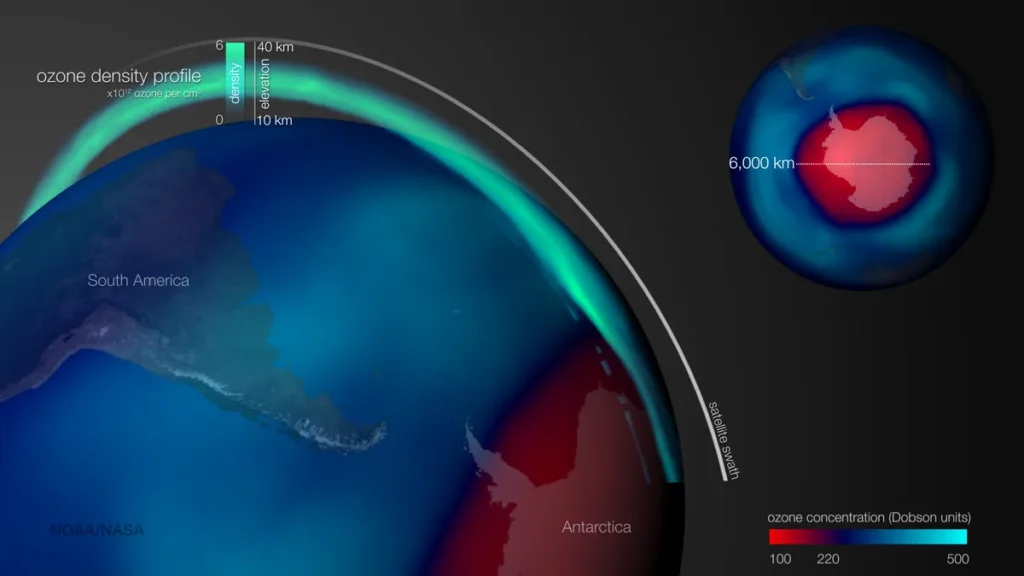
The hole forms over Antarctica in the southern spring (September-October) because winter temperatures there fall below -78°C, forming polar stratospheric clouds. Their ice surfaces turn stable chlorine compounds into active forms, and when sunlight returns, ozone is destroyed rapidly. A strong polar vortex keeps the cold air trapped.
- 1CFCs released at ground level
- 2Drift up to the stratosphere over years
- 3UV light breaks them, freeing chlorine
- 4Chlorine destroys ozone in a chain reaction
- 5More UV-B reaches the surface
From Vienna to Montreal
The Vienna Convention for the Protection of the Ozone Layer (1985) was a framework: countries agreed to cooperate on research and to take measures, but set no targets. Two years later, on 16 September 1987, the Montreal Protocol on Substances that Deplete the Ozone Layer was signed with binding cuts. It came into force on 1 January 1989. The date of signing is now marked as the International Day for the Preservation of the Ozone Layer. The Protocol was tightened by a series of amendments as the science grew clearer: London (1990), Copenhagen (1992), Montreal (1997), Beijing (1999) and Kigali (2016). In 2009 the Vienna Convention and the Montreal Protocol became the first treaties in UN history to be ratified by every member state.
- 1974Molina-Rowland paper on CFCs
- 1985Vienna Convention; ozone hole reported
- 1987Montreal Protocol signed, 16 September
- 1990London Amendment creates Multilateral Fund
- 1992India joins
- 2009Universal ratification
- 2016Kigali Amendment on HFCs
- 2019Kigali in force; India Cooling Action Plan
How the Protocol works
- Controlled substances are listed in annexes: CFCs, halons, carbon tetrachloride, methyl chloroform, methyl bromide, HCFCs and (after Kigali) HFCs.
- Common but differentiated timelines: developing countries (called Article 5 parties) get extra years for each phase-out.
- Multilateral Fund (set up by the London Amendment, 1990) pays the agreed incremental costs of developing countries for switching technology. It is run with UNEP, UNDP, UNIDO and the World Bank as implementing agencies.
- Trade measures: parties may not trade controlled substances with non-parties, which pushed nearly every country to join.
- Licensing of imports and exports, and a non-compliance procedure that helps rather than punishes.
- Regular scientific assessments by expert panels guide the Meeting of the Parties.
The Kigali Amendment and HFCs
CFCs were replaced first by HCFCs, which harm ozone less, and then by hydrofluorocarbons (HFCs), which contain no chlorine and do not harm ozone at all. But HFCs are greenhouse gases thousands of times more potent than carbon dioxide; HFC-134a, a common car AC gas, has a 100-year global warming potential of about 1,430. With air conditioners spreading across hot, growing economies, HFC use was rising fast. At Kigali, Rwanda, in October 2016 the parties agreed to phase down HFCs by 80-85% by the late 2040s. Scientists estimate this can avoid up to about 0.4°C of warming by 2100. The amendment came into force on 1 January 2019.
Countries were put in groups. Developed countries began cutting in 2019. Most developing countries, including China, froze use in 2024. India, with Pakistan, Iran, Iraq and the Gulf states, is in the group with the latest schedule because of hot climates: baseline years 2024-2026, a freeze in 2028, and cuts of 10% (2032), 20% (2037), 30% (2042) and 85% by 2047. The Union Cabinet approved ratification in August 2021.
| Step | Year |
|---|---|
| Baseline years | 2024-2026 |
| Freeze | 2028 |
| 10% cut | 2032 |
| 20% cut | 2037 |
| 30% cut | 2042 |
| 85% cut | 2047 |
India and the Protocol
India joined the Montreal Protocol in 1992. The Ozone Cell in the Ministry of Environment, Forest and Climate Change is the national unit that runs the programme, and the Ozone Depleting Substances (Regulation and Control) Rules, 2000 give legal force to licensing and phase-out dates. India phased out the production and use of CFCs, carbon tetrachloride and halons by 1 January 2010, ahead of its schedule for some substances, and phased out HCFC-141b, used in making foams, by 1 January 2020. The HCFC Phase-out Management Plan is being run in stages with support from the Multilateral Fund, retraining refrigeration technicians and converting factories.
India was also among the first countries to prepare a Cooling Action Plan (March 2019). It looks 20 years ahead and aims to reduce cooling demand across sectors by 20-25% and refrigerant demand by 25-30% by 2037-38, train 1 lakh servicing technicians, and promote research on alternative refrigerants. The plan matters because India’s room AC stock is expected to grow several times over as incomes and temperatures rise.
Is the ozone layer healing?
Yes, slowly. The 2022 Scientific Assessment of Ozone Depletion (WMO and UNEP, released January 2023) found that nearly 99% of banned ozone-depleting substances have been phased out. If current policies hold, ozone is expected to return to 1980 values by around 2066 over Antarctica, around 2045 over the Arctic and around 2040 for the rest of the world. Because CFCs are also greenhouse gases, the Protocol has done more to slow warming than any other treaty so far. Threats remain: unexpected CFC-11 emissions traced to eastern China around 2018 (later reduced after enforcement), nitrous oxide, which is not controlled by the Protocol, and ideas such as stratospheric aerosol injection that could affect ozone.
Why it is called the most successful environmental treaty
- Clear science and an identified villain (a few chemicals made by a few firms).
- Substitutes were available, so industry could switch.
- Money and technology through the Multilateral Fund made developing-country participation fair.
- Trade restrictions made staying out costly.
- The treaty could be adjusted quickly as new evidence came in.
Climate negotiations often look to Montreal for lessons, though carbon dioxide is far harder: it comes from almost all economic activity and has no single cheap substitute.
PYQ trend
Prelims 2015 asked directly which agreement deals with phasing out ozone-depleting substances. Kigali and HFCs, the Climate and Clean Air Coalition (2017) and ozone day appear in current-affairs questions. In Mains, use Montreal as a model of successful global cooperation in GS-III climate answers.
Montreal Protocol: UPSC angle
For UPSC CSE
Prelims: years, Kigali gases, HFC vs HCFC, Multilateral Fund, India’s dates. Mains GS-III: global environmental cooperation, cooling and climate.
Montreal Protocol UPSC PYQs (Prelims)
Questions UPSC has actually asked, from the official papers. Pick an option to check yourself.
Which one of the following is associated with the issue of control and phasing out of the use of ozone-depleting substances?
The Montreal Protocol (1987), under the Vienna Convention, phases out ozone-depleting substances such as CFCs and halons. It is the only UN treaty ratified by every country. Its Kigali Amendment (2016) adds HFCs. Kyoto dealt with greenhouse gases and Nagoya with access and benefit-sharing of genetic resources. Answer as per the official UPSC key · Battle IAS PYQ bankAnswer (b) & why
Consider the following statements :
– 1. Climate and Clean Air Coalition (CCAC) to Reduce Short Lived Climate Pollutants is a unique initiative of G20 group of countries.
– 2. The CCAC focuses on methane, black carbon and hydrofluorocarbons.
Which of the statements given above is/are correct ?
The CCAC was started in 2012 by UNEP and six countries: Bangladesh, Canada, Ghana, Mexico, Sweden and the USA. It is not a G20 body. It targets short-lived climate pollutants: methane, black carbon, HFCs and tropospheric ozone. Cutting these slows warming quickly. Answer as per the official UPSC key · Battle IAS PYQ bankAnswer (b) & why
Mains PYQs on this topic
No UPSC Mains question from 2023-2026 is directly on this topic. Older papers (2013-2022) will be added as the Mains bank grows.
Quick quiz
The Kigali Amendment to the Montreal Protocol deals with
Kigali (2016) phases down HFCs, which are greenhouse gases though they do not harm ozone.Answer (b)
In which year will India freeze its HFC consumption under Kigali?
India’s group has baselines 2024-26 and a freeze in 2028.Answer (c)
The Multilateral Fund of the Montreal Protocol was set up by the
The London Amendment of 1990 created it.Answer (b)
FAQs
Do HFCs harm the ozone layer?
No. They contain no chlorine or bromine. They were added to the Montreal Protocol because they are powerful greenhouse gases.
When will the ozone hole close?
The 2022 assessment projects recovery to 1980 levels around 2066 over Antarctica, 2045 over the Arctic and 2040 elsewhere.
What are Article 5 parties?
Developing countries whose consumption was low; they get extra time for phase-outs and access to the Multilateral Fund.
Why is the ozone hole over Antarctica?
Extreme cold creates polar stratospheric clouds that activate chlorine; spring sunlight then drives rapid ozone loss.
Is the Montreal Protocol related to the Kunming-Montreal framework?
No. The Kunming-Montreal Global Biodiversity Framework (2022) is under the Convention on Biological Diversity.
Spotted an error? Tell us. We correct within 48 hours.
Image: https://commons.wikimedia.org/wiki/File:Ozone_Hole_Over_Antarctica_Reaches_Annual_Maximum_(NESDIS_2015-12-19).png
How to use this in Mains
If asked: Why is the Montreal Protocol considered the most successful environmental treaty? (GS-III)
Quote: “Money and technology through the Multilateral Fund made developing-country participation fair.”
Use it: Use as the 'fair burden-sharing' reason; good lesson for climate talks in the conclusion.
In the news

NBA shares Rs 1.19 crore with 29 State Biodiversity Boards from use of crop genetic resources
On 17 October 2026 the National Biodiversity Authority (NBA) said it had shared ₹1.19 crore with 29 State Biodiversity Boards and one UT Biodiversity Council. The money came from seed companies that used Indian maize, rice, pearl millet and cotton for research and commercial hybrids. As the crops were bought from markets and the original holders could not be traced, the amount was split in proportion to each State’s cultivation area. The release comes two days before the CBD COP 17 opens in Yerevan.
18 Oct 2026
India to accede to the Southern Indian Ocean Fisheries Agreement (SIOFA)
On 14 October 2026 the Centre approved India's accession to the Southern Indian Ocean Fisheries Agreement. India, a Cooperating Non-Contracting Party since 2022, will become a full Contracting Party. Indian vessels can then fish squids, toothfish, alfonsino and other non-migratory stocks in the SIOFA area and join its scientific and compliance bodies.
14 Oct 2026
National Biodiversity Authority shares ₹2.02 crore Access and Benefit-Sharing money from seed companies
The National Biodiversity Authority distributed ₹2.02 crore of Access and Benefit-Sharing money, paid by seed companies using crops such as rice, tomato and okra, among 27 State Biodiversity Boards and 3 UT councils by cultivation area. Its total ABS disbursement has now reached ₹202 crore, ahead of CBD COP 17 in Yerevan from 19 October 2026.
10 Oct 2026
Pre-COP31 in Fiji: India seeks “flexibility, pragmatism and mutual respect” and scaled-up climate finance
At the Pre-COP31 meeting in Nadi, Fiji, India's Environment Minister asked for flexibility, pragmatism and mutual respect so that COP31 gives an ambitious and balanced result. India said higher ambition must come with climate finance, technology and capacity building, and that each country's path must be respected. COP31 is in Antalya, Türkiye, in November.
8 Oct 2026