
National Red List of birds: 1,211 species under assessment, 107 done in first review
Next story · 20 OctIndia–New Zealand FTA enters into force: zero duty on all Indian exports from day one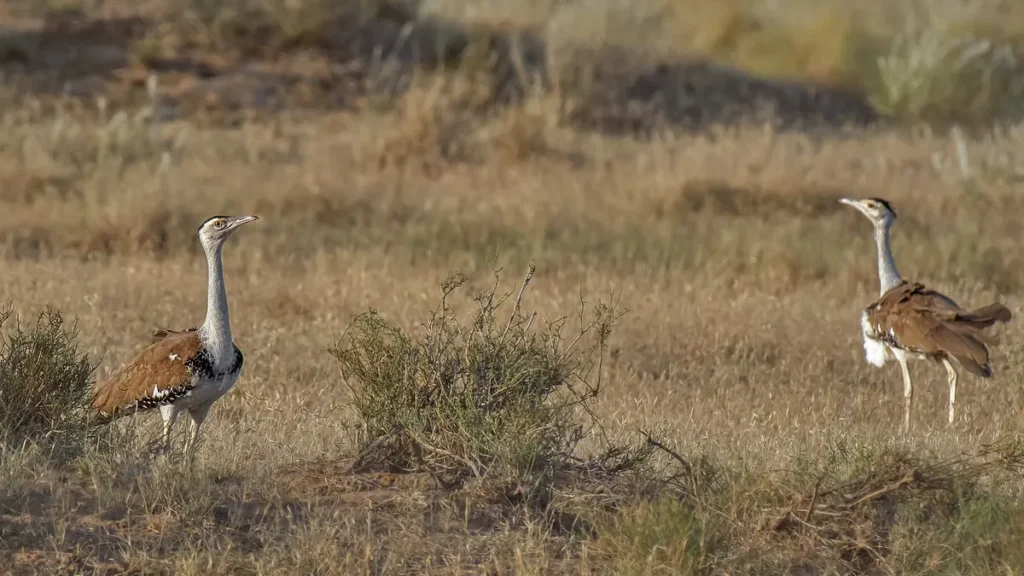
India has begun a national Red List assessment of its 1,211 regularly occurring bird species using the IUCN framework. By 19 October 2026, a preliminary review of 107 species was complete, with the Great Indian Bustard proposed as Critically Endangered and the Indian Roller as Vulnerable. A final assessment is expected towards the end of 2027.
- Species
- 1,211 birds
- Reviewed
- 107 (19 Oct)
- Framework
- IUCN Red List
- Final
- End of 2027
India’s bird Red List: what happened?
Most of us have seen the bright blue flash of an Indian Roller on a roadside wire. The national review now proposes it as Vulnerable. That one line tells you why a national Red List matters: it catches decline in birds we still think of as common.
- As of 19 Oct 2026, a preliminary assessment of 107 bird species was done (HT).
- Proposed: Great Indian Bustard Critically Endangered; Marbled Duck, White-throated Bushchat and Pallas’s Fish-Eagle Endangered.
- Sarus Crane and Indian Roller proposed Vulnerable; Grey Plover Least Concern.
- Birds are assessed by ZSI, IUCN SSC Centre for Species Survival India–WTI and the State of India’s Birds team.
What is a national Red List?
- The IUCN Red List, set up in 1964, is the world’s main inventory of extinction risk.
- A national Red List applies IUCN criteria to a species’ status within one country.
- India launched its National Red List Roadmap and Vision 2025–2030 at the IUCN Congress 2025 in Abu Dhabi.
- Aim: assess over 11,000 species of flora, fauna and fungi by 2030.
How do the IUCN threat categories compare?
| Category | Meaning | Proposed Indian example |
|---|---|---|
| Critically Endangered | Extremely high risk of extinction in the wild | Great Indian Bustard |
| Endangered | Very high risk | Marbled Duck, Pallas’s Fish-Eagle |
| Vulnerable | High risk | Sarus Crane, Indian Roller |
| Least Concern | Widespread and stable | Grey Plover |
Which constitutional and legal provisions apply?
- Article 48A: the State shall protect forests and wildlife.
- Article 51A(g): citizens’ duty to protect wildlife.
- Wildlife (Protection) Act, 1972: the Great Indian Bustard is in Schedule I.
- Biological Diversity Act, 2002 gives effect to India’s duties under the CBD.
How is a bird’s status decided?
From field data to a category
- Gather range, population size and trend
- Citizen science fills data gaps
- Experts debate at the Birds Forum
- IUCN criteria give a category
- Final national list by end-2027
Why does this matter?
| Angle | What to note |
|---|---|
| Conservation priority | Lists decide where money and protection go. |
| Data gaps | Population sizes are unknown for most Indian birds. |
| Citizen science | SoIB uses birdwatchers’ data for trends. |
| Global goals | Feeds Kunming–Montreal biodiversity targets. |
What are the challenges?
- Most Indian birds lack population size estimates.
- Habitat loss in grasslands and wetlands is fast.
- A national category may differ from the global IUCN status.
- Legal schedules do not change automatically with Red List status.
What should be done next?
- Fund long-term bird monitoring, not one-off surveys.
- Link Red List results to habitat plans for grasslands and wetlands.
- Review Wildlife Act schedules where risk has clearly risen.
- Keep citizen science data open and well checked.
What can Prelims ask on the bird Red List?
- 1,211 regularly occurring bird species in India are being assessed.
- Great Indian Bustard: proposed Critically Endangered; Rajasthan’s state bird.
- Sarus Crane, Uttar Pradesh’s state bird: proposed Vulnerable.
- Lead bodies: BSI, ZSI, IUCN India and CSS India–WTI.
- IUCN Red List began in 1964.
How to write about species assessment in Mains
Practice question (10 marks, 150 words): Why does India need a national Red List of species? Discuss with reference to the ongoing assessment of birds. (GS-III)
- Intro: 1,211 birds; 107 reviewed by 19 Oct 2026.
- Purpose: national risk picture, priorities, funding.
- Findings: GIB CR; Sarus, Indian Roller VU.
- Issues: data gaps, habitat loss, law lag.
- Way out: monitoring, habitat plans, schedule review.
Image: A pair of Great Indian Bustards, Desert National Park, Rajasthan. SVKMBFLY, Wikimedia Commons, CC BY-SA 4.0
How to use this in Mains
If asked: Discuss the role of scientific assessment in wildlife conservation in India. (GS-III)
Quote: “Red List assessments are fundamental to identifying extinction risk faced by species and setting conservation priorities.”
Use it: Use it as the opening line; then explain how the national bird assessment will guide priorities.
If asked: Citizen science can strengthen biodiversity governance. Comment. (GS-III)
Quote: “The compilation and analysis of large volumes of citizen science data offer an unprecedented opportunity to understand population trends.”
Use it: Quote it with the State of India’s Birds example; add the need for quality checks.
Exam angle
Prelims: IUCN categories, species and their proposed status, lead institutions. · Mains GS-III: biodiversity conservation and data gaps.
Practice MCQs
Original practice questions (not PYQs).
In India’s ongoing national Red List assessment of birds, which species has been proposed as Critically Endangered?
Answer (c) & explanation
The GIB is proposed as Critically Endangered; Sarus Crane and Indian Roller as Vulnerable (HT).
Consider the following statements:
1. The IUCN Red List was established in 1964.
2. India launched its National Red List Roadmap at the IUCN World Conservation Congress 2025.
3. A national Red List category is always the same as the global IUCN category.
How many of the statements given above are correct?
Answer (b) & explanation
Statements 1 and 2 are correct. National and global categories can differ because they assess different ranges.
The Sarus Crane is the state bird of
Answer (b) & explanation
The Sarus Crane is Uttar Pradesh’s state bird; the GIB is Rajasthan’s.
Questions students ask about this
What is being assessed?
The conservation status of India’s 1,211 regularly occurring bird species.
How far has it reached?
A preliminary review of 107 species was complete by 19 October 2026.
Which birds face the highest risk?
The Great Indian Bustard is proposed as Critically Endangered.
When will the final list come?
Towards the end of next year, that is 2027.
Keep studying
Go deeper
facts from cited sources only; faculty review pending