
Agrivoltaics World Conference in Delhi: PM-KUSUM’s next phase and the small-farmer test
Next story · 22 Oct1% green jet fuel for international flights from 2027: India’s SAF plan and ICAO’s CORSIA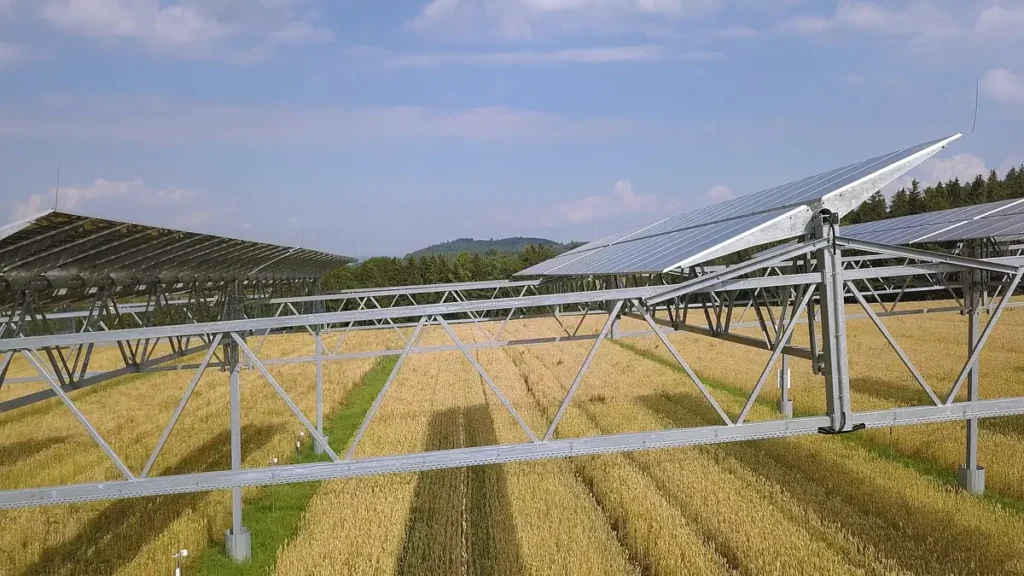
Opening the 7th Agrivoltaics World Conference at Bharat Mandapam on 21 October 2026, the first in the Global South, Renewable Energy Minister Pralhad Joshi said the next phase of PM-KUSUM will carry one of the world’s most ambitious agrivoltaics programmes. Agriculture Minister Shivraj Singh Chouhan said the policy must work for the 85% of farmers who are small and marginal, with an average holding of just 0.96 hectare.
- Conference
- 7th, 21–23 Oct 2026
- Suitable land
- 47.5 million ha (TERI)
- Non-fossil capacity
- 308 GW+
- Extra cost
- 25–30% vs ground solar
Agrivoltaics World Conference: what was said?
Can one field give both grain and electricity? Agrivoltaics says yes, if the panels are raised high enough and spaced well. This week the Centre signalled it wants to scale this idea, and also set a test for it.
- Joshi: the next phase of PM-KUSUM will launch one of the world’s most ambitious agrivoltaics programmes (PIB, 21 Oct 2026).
- Chouhan: farmers can be both ‘annadata’ and ‘urjadata’; panel height, spacing and ploughing must suit small fields.
- He also asked for drainage of rainwater from panels, assured power purchase, timely payments, and a role for FPOs.
- A Global Agrivoltaics Climate-Zone Technical Framework was launched.
How big is the potential?
- TERI: 47.5 million hectares, about 30% of India’s cropland, is technically suitable.
- Using 10% of that land could meet India’s projected 2050 power demand (Joshi).
- Maharashtra, Rajasthan, Andhra Pradesh, Madhya Pradesh, Karnataka and Uttar Pradesh hold about half the potential.
- Field studies show 10–20% higher yields for some crops and about 30% less water use.
How does agrivoltaics compare with ground-mounted solar?
| Point | Ground-mounted solar | Agrivoltaics |
|---|---|---|
| Land use | Farming stops | Farming continues below |
| Cost | Lower | 25–30% higher (raised structures) |
| Power cost | ₹2.5–2.6 per unit | ₹3.20–3.30 per unit (some estimates) |
| Farmer income | Lease rent only | Crop + power income |
Which laws and schemes apply?
- PM-KUSUM (2019): solar pumps and decentralised solar plants for farmers; about 30 lakh pumps solarised so far (Joshi).
- Land is a State subject (State List Entry 18); rules on using farmland for solar differ by State.
- Electricity Act, 2003: discoms buy the power under State commission tariffs.
- Article 48 asks the State to organise agriculture on modern and scientific lines.
What are the challenges?
- Average holding is 0.96 ha; most farmers cannot spare land or capital.
- Higher capital cost needs support to be viable.
- Unclear rules on leasing, sale and restoring land to farming if a farmer exits.
- Delayed discom payments can hurt farmer trust.
What should be done next?
- Design PM-KUSUM’s next phase around small plots, FPOs and cooperatives.
- Bridge the cost gap through capital support and fair tariffs.
- Map suitable crops for each agro-climatic zone.
- Train rural youth and women to run and repair systems.
What can Prelims ask on agrivoltaics?
- PM-KUSUM: Ministry of New and Renewable Energy, launched 2019.
- India’s total capacity: over 560 GW; non-fossil over 308 GW (PIB).
- Decentralised solar added last year: 16.3 GW (7.6 PM-KUSUM, 8.7 rooftop).
- PM Surya Ghar Muft Bijli Yojana: over 63 lakh beneficiaries.
- International Solar Alliance: headquarters in Gurugram.
How to write about agrivoltaics in Mains
Practice question (10 marks, 150 words): Agrivoltaics can help resolve the conflict between land for food and land for energy. Discuss with reference to Indian conditions. (GS-III)
- Intro: 7th Agrivoltaics World Conference; PM-KUSUM next phase.
- Potential: TERI estimate; yields and water.
- Constraints: small holdings, cost, land rules.
- Design: FPOs, tariffs, crop mapping.
- Conclusion: one land, two harvests, if designed for small farmers.
Image: Agrivoltaics pilot plant at Heggelbach Farm, Germany (Fraunhofer ISE). Tobi Kellner, Wikimedia Commons, CC BY-SA 4.0
How to use this in Mains
If asked: Discuss the potential of decentralised solar energy for Indian farmers. (GS-III)
Quote: “AgriVoltaics policy must be designed with the interests of 85 per cent of small and marginal farmers at its core.”
Use it: Use it as your test for any scheme design.
If asked: Examine the challenges in using farmland for renewable energy. (GS-III)
Quote: “Elevated and tilted structures could make agrivoltaic plants 25–30 per cent more expensive than conventional ground-mounted solar installations.”
Use it: Quote it for the cost challenge.
Exam angle
Prelims: PM-KUSUM, TERI estimate, capacity numbers. · Mains GS-III: land-energy-food nexus.
Practice MCQs
Original practice questions (not PYQs).
PM-KUSUM is implemented by the
Answer (b) & explanation
PM-KUSUM is a scheme of the Ministry of New and Renewable Energy, launched in 2019.
Consider the following statements about agrivoltaics:
1. It allows crop cultivation and solar power generation on the same land.
2. Its structures are usually cheaper than ground-mounted solar plants.
Which of the statements given above is/are correct?
Answer (a) & explanation
Raised structures make agrivoltaics 25–30% costlier than ground-mounted solar.
The headquarters of the International Solar Alliance is located in
Answer (b) & explanation
The ISA is headquartered in Gurugram, Haryana.
Questions students ask about this
What is agrivoltaics?
Raising solar panels above farmland so crops grow below while power is generated.
What did the Centre announce?
A large agrivoltaics programme in the next phase of PM-KUSUM.
How much land is suitable?
About 47.5 million hectares, per a TERI study.
What is the main concern?
Making it viable for small and marginal farmers.
Keep studying
Go deeper
Official source: PIB, 21 Oct 2026: Shivraj Singh Chouhan inaugurates the 7th AgriVoltaics World Conference
facts from cited sources only; faculty review pending