
Cauvery panel tells Karnataka to release 3,000 cusecs to Tamil Nadu: Article 262 and the inter-State water dispute
Two States, one river, and a dry year: that is the Cauvery fight in a line. An expert panel has told Karnataka to let 3,000 cusecs of water a day flow to Tamil Nadu for 15 days. Tamil Nadu wanted about five times more. Karnataka says a weak monsoon left its dams 55% short. For you, it is a live case study of Article 262 and water tribunals.
- Release
- 3,000 cusecs/day for 15 days
- Total
- 3.88 tmcft at Biligundlu
- TN demand
- 18.402 tmcft
- Karnataka deficit
- 55.35% in inflows
UPSC has already asked about this. Read the story with these questions in mind.
Cauvery release order: what happened?
Every dry year, the same question returns: how much water must Karnataka send to Tamil Nadu? The panels answered; neither State is happy.
- 24 Oct 2026: the Cauvery Water Regulation Committee (CWRC), at its 145th meeting, told Karnataka to ensure 3,000 cusecs a day at Biligundlu (the border measuring point) for 15 days from 8 a.m. on 24 October.
- The Cauvery Water Management Authority (CWMA) endorsed it at its 60th meeting. Total: 3.88 tmcft.
- Tamil Nadu had asked for 18.402 tmcft in 15 days (14,236 cusecs a day), including a claimed backlog (water owed from earlier) of 13.829 tmcft.
- Karnataka rejected the backlog: it says it released 47.092 tmcft (29 July–22 October) against 45.231 tmcft due, 1.861 tmcft extra.
What is the Cauvery dispute?
- Rises at Talakaveri (Brahmagiri hills, Kodagu, Karnataka); flows through Karnataka and Tamil Nadu into the Bay of Bengal. Its basin also covers Kerala and Puducherry.
- Tributaries (side rivers): Hemavathi, Kabini, Harangi, Bhavani and Amaravati.
- The Cauvery Water Disputes Tribunal gave its final award in 2007; the Supreme Court modified it in February 2018.
- Since 2018, Karnataka must ensure 177.25 tmcft a year at Biligundlu in a normal year. The CWMA (2018) enforces this; the CWRC handles daily releases.
Tamil Nadu vs Karnataka: the two cases
| Point | Tamil Nadu | Karnataka |
|---|---|---|
| Demand / offer | 18.402 tmcft in 15 days | No further release |
| Backlog | Claims 13.829 tmcft | Says it gave 1.861 tmcft extra |
| Storage | Mettur at 20.887 tmcft | Four reservoirs got 122.293 tmcft vs 273.865 average |
| Ground situation | Delta farmers hit | 226 of 240 taluks in drought; 55 of 56 in the basin |
What does the Constitution say?
Rivers cross State borders, so Parliament decides who settles fights over them.
- Article 262(1): Parliament may make a law to settle disputes over inter-State rivers.
- Article 262(2): Parliament may stop the Supreme Court and other courts from hearing such disputes.
- Inter-State River Water Disputes Act, 1956: lets the Centre set up tribunals whose awards bind the States.
- River Boards Act, 1956 and Entry 56 of the Union List: Parliament can regulate inter-State rivers in the public interest.
- Water itself is a State subject (Entry 17, State List), subject to Entry 56 of the Union List.
How big is the gap?
| Measure | Figure |
|---|---|
| Ordered flow | 3,000 cusecs/day = 3.88 tmcft in 15 days |
| Tamil Nadu’s demand | 14,236 cusecs/day = 18.402 tmcft |
| Karnataka’s inflow this year | 122.293 tmcft (30-year average 273.865) |
| Deficit | 55.35% |
| Normal-year annual release (2018) | 177.25 tmcft at Biligundlu |
Cusecs and tmcft in kitchen language
1 cusec = 1 cubic foot of water every second, about 28 litres (one and a half buckets). So 3,000 cusecs ≈ 85,000 litres a second. Over 15 days (12.96 lakh seconds) that adds up to the 3.88 tmcft in the order.
What should you note for the exam?
| Angle | What to note |
|---|---|
| Polity | Article 262, ISWD Act 1956, tribunals, CWMA |
| Geography | Source, tributaries, dams (KRS, Mettur), protected areas in the basin |
| Federalism | Distress sharing, trust deficit, role of expert bodies |
| Environment | Blue-finned mahseer; Nagarhole, Sathyamangalam, Wayanad |
What are the challenges?
- Monsoon dependence: a weak monsoon empties dams, so every dry year reopens the fight.
- Trust deficit: each State doubts the other’s numbers.
- No distress formula (a fixed rule for sharing in a bad year) that both accept.
- Thirsty crops and falling groundwater raise demand.
What should be done?
- Shared, live data on inflows and releases at every dam and at Biligundlu.
- A pre-agreed distress formula, so panels need not decide afresh every fortnight.
- Water-saving crops and drip irrigation in both States.
- Groundwater recharge and city water reuse.
What can Prelims ask on the Cauvery?
- Source: Talakaveri, Brahmagiri hills, Kodagu (Karnataka), in the Western Ghats.
- Tributaries: Hemavathi, Kabini, Harangi, Bhavani, Amaravati.
- Protected areas in the basin: Nagarhole, Sathyamangalam, Wayanad.
- Article 262 and the Inter-State River Water Disputes Act, 1956.
- CWMA (2018) and CWRC (day-to-day releases).
Probability in Prelims: Expect a statement question on the Cauvery: it rises at Talakaveri (Brahmagiri hills, Karnataka); disputes are settled under Article 262 and the Inter-State River Water Disputes Act, 1956, now through the Cauvery Water Management Authority.
How to write about inter-State water disputes in Mains
Practice question (15 marks, 250 words): Constitutional mechanisms to resolve inter-State water disputes have failed to solve the problems. Is the failure structural, procedural or both? (GS-II, 2013)
- Intro: the October 2026 Cauvery order in one line.
- Body 1: the framework: Article 262, ISWD Act, tribunals, CWMA.
- Body 2: structural gaps: no distress formula, slow tribunals, weak enforcement.
- Body 3: process gaps: disputed data, politicisation, monsoon dependence.
- Way forward: live data, basin-level planning, demand management.
Ready lines for your answer
If asked: Constitutional mechanisms to resolve inter-State water disputes have failed. Discuss. (GS-II, 2013)
Quote: “Of its 240 taluks, 226 had been declared drought-affected. In the Cauvery basin, 55 of the 56 taluks were affected.”
Use it: Use it to show why distress years need a pre-agreed sharing formula.
If asked: Discuss the role of expert bodies in managing inter-State rivers. (GS-II)
Quote: “The CWRC directed Karnataka to ensure a flow at the rate of 3,000 cusecs a day, equivalent to 3.88 tmcft over the 15-day period.”
Use it: Quote it as an example of a technical body settling a political dispute fortnight by fortnight.
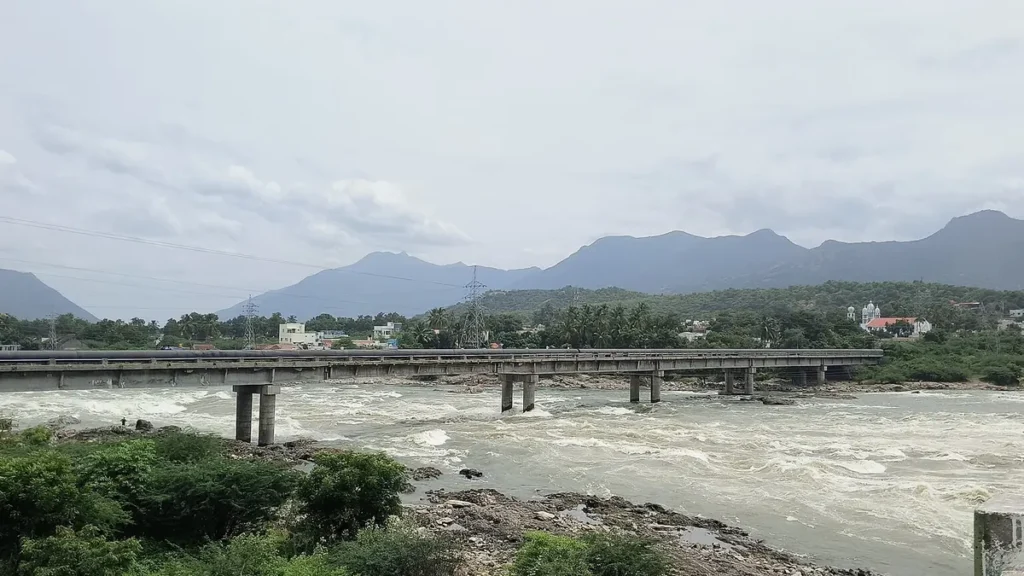
Image: Water flowing from the Mettur Dam on the Cauvery in Tamil Nadu. LakshanaRamasamy, via Wikimedia Commons, CC0
Exam angle
Prelims: Cauvery source and tributaries, Article 262, ISWD Act 1956, CWMA. · Mains GS-II: inter-State water disputes; cooperative federalism.
Practice MCQs
Original practice questions (not PYQs).
Consider the following statements:
1. Article 262 allows Parliament to bar the Supreme Court from hearing inter-State river water disputes.
2. The Cauvery Water Management Authority was set up under the Supreme Court’s 2018 judgment.
3. Biligundlu is the point where Cauvery water enters Karnataka from Tamil Nadu.
Which of the statements given above are correct?
Answer (a) & explanation
At Biligundlu, Cauvery water enters Tamil Nadu from Karnataka, not the other way round.
Which one of the following is NOT a tributary of the Cauvery?
Answer (d) & explanation
Malaprabha is a tributary of the Krishna. Kabini, Hemavathi and Bhavani join the Cauvery.
Which of the following protected areas lie in the Cauvery basin?
1. Nagarhole National Park
2. Sathyamangalam Tiger Reserve
3. Papikonda National Park
Select the correct answer using the code given below.
Answer (a) & explanation
Papikonda is in the Godavari basin in Andhra Pradesh.
Questions students ask about this
Why do Karnataka and Tamil Nadu fight over the Cauvery?
It rises in Karnataka, but Tamil Nadu’s delta farms depend on it. In a dry year there is not enough for both.
How much water must Karnataka release now?
3,000 cusecs a day at Biligundlu for 15 days from 24 October 2026, or 3.88 tmcft in all.
What is the CWMA?
The Cauvery Water Management Authority, set up in 2018 to make States follow the water-sharing award.
Which Article deals with inter-State river disputes, and can courts step in?
Article 262. Under it, the 1956 Act sends disputes to tribunals, but the Supreme Court still heard appeals and modified the Cauvery award in 2018.