
UPSC Mains 2022 GS Paper 1 Q4: model answer
Describe the characteristics and types of primary rocks.
What the question wants
Describe what primary (igneous) rocks are, their characteristics and types.
How to structure it
Describe the characteristics and types: a classification answer.
- Meaning
- Characteristics
- Types
- Importance
How to think it through
Primary rocks are the 'first' rocks, born from cooled magma before any other kind. Slow cooling deep down gives big crystals (granite); fast cooling on the surface gives fine ones (basalt). That single rule, cooling speed controls crystal size, makes you sound like a geographer.
Model answer
The Deccan Traps cover about 5 lakh sq km of India with basalt from lava eruptions some 66 million years ago. Basalt is a primary or igneous rock, formed by the cooling and solidification of magma or lava, and the parent of all other rocks.
Characteristics
- Crystalline, hard and compact; usually without layers or fossils.
- Crystal size depends on cooling speed: slow cooling gives coarse crystals, fast cooling fine ones.
- Rich in minerals such as feldspar, quartz and mica, and associated with metallic ores.
- Weathering produces fertile soils (black regur soils from basalt).
Types
- Intrusive (plutonic): cooled slowly below the surface; coarse-grained (granite, gabbro); seen in batholiths, laccoliths, dykes and sills.
- Extrusive (volcanic): cooled quickly on the surface; fine-grained (basalt, pumice, obsidian).
- By chemistry: acidic (silica-rich, light-coloured, granite) and basic (silica-poor, dark, basalt).
Importance
Granite is used as building stone (from Rajasthan and Karnataka); igneous bodies host ores such as gold at Kolar; and basalt weathers into black soils for cotton farming in Maharashtra.
Draw: Cross-section of a volcano with intrusive bodies (batholith, dyke, sill) and lava flows.
Keywords, cases and data to drop in
Igneous, intrusive, extrusive, batholith, dyke, sill, granite, basalt, regur.
Where most answers lose marks
- Mixing in sedimentary or metamorphic rocks. Stay with primary rocks.
Related Mains PYQs
- Discuss the meaning of colour-coded weather warnings for cyclone prone areas given by India Meteorological Department. UPSC 2022 · GS-I
- What are the forces that influence ocean currents? Describe their role in fishing industry of the world. UPSC 2022 · GS-I
- The troposphere is a very significant atmospheric layer that determines weather processes. How? UPSC 2022 · GS-I
- Differentiate the causes of landslides in the Himalayan region and Western Ghats. UPSC 2021 · GS-I
Fresh examples from current affairs
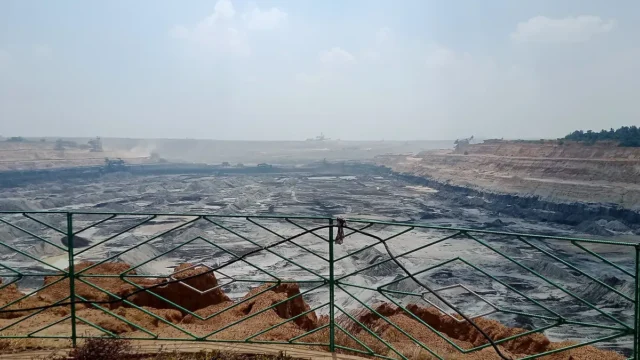
Neyveli, Tiruchirappalli and Atacama: Indian scientists identify Martian analogue sites
Scientists at the University of Kerala, using a laser Raman spectrometer funded under DST-FIST, have identified two minerals that make some places on Earth useful ‘Martian analogue’ sites, DST said on 16 October 2026. Melanterite was found in the lignite of Neyveli, Tamil Nadu. Gypsum was found in the Atacama Desert of Chile and in the Tiruchirappalli Badlands. Both are hydrous sulphates that record how water and rock interacted.
UPSC angle: Prelims: minerals, Raman effect, Atacama. · Mains GS-III: space science and research capacity.
16 Oct 2026
Ancient Gondwana wildfires recorded in Indian coal
BSIP (DST) researchers reported molecular evidence of massive wildfires in Gondwana forests nearly 250 million years ago. Using palynofacies analysis with Raman and FTIR spectroscopy on Godavari Valley Coalfield sediments, they separated high- and low-intensity fire-derived microcharcoal from other opaque particles. The study is in Geological Journal (Wiley).
UPSC angle: Prelims: Gondwana vs Tertiary coal.
25 May 2026
Aravalli Hills: Centre explains move to a uniform definition
The definition decides which hills can be mined. That is why environmental groups are watching closely.
UPSC angle: Prelims: Aravallis. · Mains: Mining vs ecology.
21 Dec 2025Learn the concept
Question text as printed in the official UPSC Civil Services (Main) question paper. The model answer is original Battle IAS work; use it to learn structure, not to memorise.
Want every PYQ in one place? See the Battle IAS PYQ Book.