
Census staff trained for caste and Aadhaar questions
Soon an enumerator will knock on every door in India with a phone or tablet and 40 questions. One of them asks your caste; another asks for Aadhaar, which you may skip. Trainers are now preparing staff for these hard questions. Read it to revise Census 2027, the Census Act and what Aadhaar can and cannot prove.
- Census
- 2027, first digital Census
- Caste count
- First since 1931
- Questions
- 40, of which 13 are new
- Uttar Pradesh start
- 1 December, door to door
Census 2027: what happened?
A Census is the biggest peaceful exercise any government runs. This time it is digital, and for the first time since 1931 it will count caste. That makes training the enumerators very important.
- The second phase of Census 2027 will count every person in the country.
- In Uttar Pradesh and three other poll-bound States, door-to-door counting starts on 1 December.
- This phase has 40 questions, 13 of them new. Each household takes 20 to 25 minutes.
- Question 10 (C) asks the caste of people who are not Scheduled Caste or Scheduled Tribe. It is typed in an open column. People may also choose “Does not want to declare Caste” or “No Caste”. There is no separate column for Other Backward Classes.
- Question 37 asks for Aadhaar, but it is optional. Aadhaar is not proof of citizenship.
How is the Census done, and why does caste matter?
India’s Census is held under the Census Act, 1948. ‘Census’ is in the Union List of the Seventh Schedule, so only the Centre conducts it. The Registrar General and Census Commissioner of India, under the Ministry of Home Affairs, runs it.
The Census is usually held every ten years. The 2021 Census was put off because of the Covid-19 pandemic, so Census 2027 comes after a gap of 16 years.
Every Census since 1951 has counted Scheduled Castes and Scheduled Tribes, but not other castes. The last full caste count was in 1931, under British rule. The Socio Economic and Caste Census of 2011 was a separate survey, and its caste data was not released in full.
Census 2027 is the first digital Census. Enumerators use a mobile app, and people could also fill in details themselves online (self-enumeration).
How is Census 2027 different?
| Point | Earlier Censuses | Census 2027 |
|---|---|---|
| Method | Paper forms | Mobile app; self-enumeration option |
| Caste | Only SC and ST counted | All castes recorded |
| Aadhaar | Not asked | Asked, but optional |
Which laws and Articles apply?
- Census Act, 1948: the legal basis of the Census; it keeps individual answers confidential.
- Seventh Schedule: ‘Census’ is in the Union List.
- Aadhaar Act, 2016: Aadhaar is proof of identity, not of citizenship or domicile.
- Articles 330 and 332: seats for Scheduled Castes and Scheduled Tribes in the Lok Sabha and Assemblies are based on Census population.
Why does Census 2027 matter?
| Angle | What to note |
|---|---|
| Welfare planning | Census data decides where schools, ration shops and hospitals go. |
| Social justice | Caste data can shape reservation and welfare debates. |
| Delimitation | Seats may be redrawn after the first Census after 2026. |
| Digital governance | A test of India’s ability to run a huge digital survey. |
What are the problems with Census 2027?
- People may give wrong or confusing caste names in the open column.
- Some may fear that Aadhaar details will be misused.
- Enumerators in remote areas may face weak internet and tough questions.
- Caste data could be used for narrow political gains.
What should be done next on Census 2027?
- Train enumerators well and give them clear scripts for sensitive questions.
- Tell people clearly that Aadhaar is optional and answers are confidential.
- Use expert groups to sort and group thousands of caste names correctly.
- Release data quickly so that planning can use it.
What can Prelims ask on Census 2027?
Prelims probability: Expect a question on Census 2027: first digital Census, first caste count since 1931; Census is in the Union List; the Census Act is of 1948.
- Census 2027: first digital Census; first caste count since 1931.
- Census is in the Union List; conducted under the Census Act, 1948.
- Registrar General and Census Commissioner works under the Ministry of Home Affairs.
- Aadhaar is not proof of citizenship (Aadhaar Act, 2016).
- There is no separate column for Other Backward Classes in the caste question.
How to write about Census 2027 in Mains
Practice question (15 marks, 250 words): The caste count in Census 2027 can help make welfare fairer, but it also carries risks. Discuss.
- Intro: first caste count since 1931; first digital Census.
- Benefits: data for welfare, reservation debates, targeting.
- Risks: wrong entries, misuse, privacy, political use.
- Safeguards: training, confidentiality, expert grouping of castes.
- Conclusion: good data, used wisely, serves social justice.
Ready lines for your answer
- Census 2027 is the first digital Census and the first caste count since 1931.
- Aadhaar proves identity, not citizenship.
Quotable data point40 questions, 13 new; 20 to 25 minutes per household; door-to-door counting from 1 December in Uttar Pradesh and three other States.
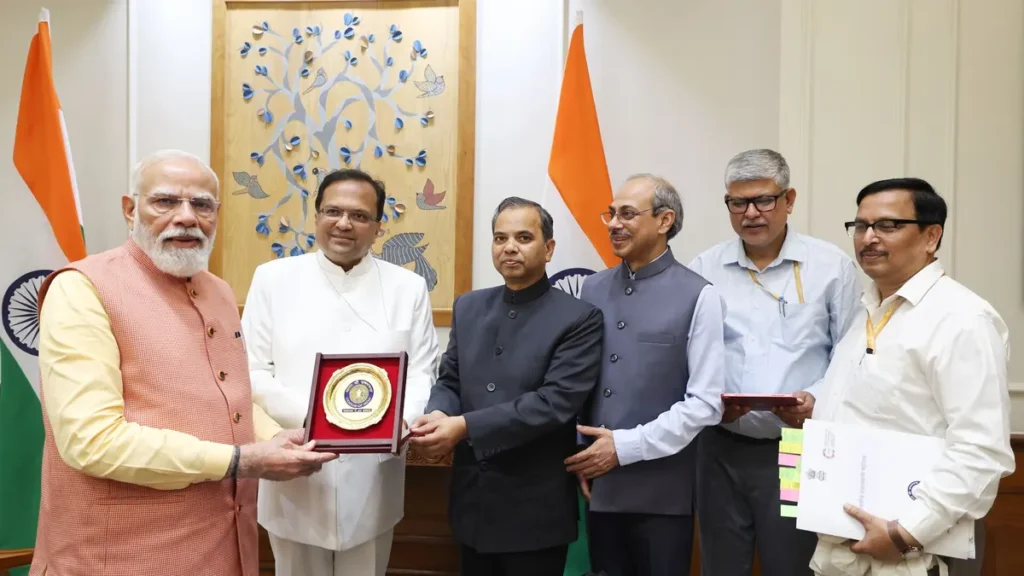
Photo: Prime Minister’s Office, GODL-India, via Wikimedia Commons
Exam angle
Prelims: Census Act 1948, Union List, 1931 caste count, Aadhaar limits. · Mains GS-II and GS-I: caste, social justice, data for welfare.
Practice MCQs
Original practice questions (not PYQs).
Consider the following statements:
1. Census 2027 will be India's first digital Census.
2. The Census is conducted under the Census Act, 1948.
3. The last full caste count in a Census took place in 1931.
How many of the above statements are correct?
Answer (c) & explanation
All three are correct. Census is in the Union List, and the 2011 Socio-Economic and Caste Census was a separate survey whose caste data was never fully released.
Which one of the following statements about Aadhaar is correct?
Answer (d) & explanation
Aadhaar is not proof of citizenship or domicile and can be deactivated by the Unique Identification Authority of India. In Census 2027, Question 37 on Aadhaar is optional.
With reference to the Census in India, consider the following statements:
1. 'Census' is a subject in the Concurrent List.
2. The Registrar General and Census Commissioner of India works under the Ministry of Home Affairs.
Which of the statements given above is/are correct?
Answer (b) & explanation
'Census' is in the Union List, not the Concurrent List. The Registrar General works under the Ministry of Home Affairs.
Questions students ask about this
When was caste last fully counted in India's Census?
In 1931. Since 1951, only Scheduled Castes and Scheduled Tribes were counted until Census 2027.
Is it compulsory to give Aadhaar in Census 2027?
No. Question 37 asks for Aadhaar, but people may skip it.
Under which law is the Census held?
The Census Act, 1948. 'Census' is in the Union List.
Is there a separate column for Other Backward Classes?
No. People who are not SC or ST write their caste in an open column, or choose 'Does not want to declare Caste' or 'No Caste'.