
Court panel seeks tourist limits in Himachal
Himachal Pradesh keeps facing landslides and floods, and its hill towns are packed with tourists, cars and new buildings. A Supreme Court committee now says the State must set limits on how many visitors, vehicles and hotel beds each place can take. Read it to revise the Central Empowered Committee, carrying capacity and the fragile Himalayas.
- Panel
- Central Empowered Committee
- Case
- Suo motu, from 28 July 2025
- Homestays
- Up 669.7% in ten years
- State’s reply
- Due in two weeks
Himachal’s tourism limits: what happened?
A hill can carry only so many roads, buildings and people before its slopes give way. Himachal’s recent disasters have pushed the Supreme Court to ask a hard question: how much is too much?
- The Supreme Court started a case on its own (suo motu) on 28 July 2025 about repeated disasters in Himachal Pradesh. Nine themes are under study.
- It asked its Central Empowered Committee (CEC) to study the causes. The CEC’s first report wants limits on tourists, tighter rules for hill roads and checks on hydropower dams.
- Homestays rose 669.7% in ten years, from 876 to 6,743, and now outnumber hotels.
- No carrying-capacity study was done for Shimla, Manali or Spiti. The panel wants binding limits on visitors, vehicles and hotel beds for each place.
- The Court has given the State two weeks to respond.
What is the Central Empowered Committee, and what is carrying capacity?
The Central Empowered Committee was set up by the Supreme Court in 2002 in the T.N. Godavarman forest case, to check that the Court’s forest orders are followed. In 2023, the Environment Ministry made it a permanent body under the Environment (Protection) Act, 1986.
Carrying capacity is the largest number of people and vehicles a place can handle without damaging its environment, water supply and safety.
The Himalayas are young fold mountains. Their rocks are loose and their slopes steep, so cutting hills for wide roads and buildings makes landslides more likely.
When forest land is used for roads or dams, the Compensatory Afforestation Fund Act, 2016 requires money to be paid for planting new forests elsewhere.
How fast did homestays grow?
| Point | Ten years ago | Now |
|---|---|---|
| Homestays | 876 | 6,743 |
| Growth | — | 669.7% |
| Carrying-capacity study | None | Still none for Shimla, Manali, Spiti |
Which laws and Articles apply?
- Article 21: the right to life includes the right to a clean and safe environment.
- Article 48A: the State shall protect the environment, forests and wildlife (Directive Principle). Article 51A(g): citizens’ duty to protect nature.
- Environment (Protection) Act, 1986: the Central Empowered Committee is now a permanent body under it.
- Compensatory Afforestation Fund Act, 2016: national and State authorities (CAMPA) manage money for new forests.
Why does Himachal’s tourism limits matter?
| Angle | What to note |
|---|---|
| Disaster risk | Unplanned building raises landslide and flood risk. |
| Carrying capacity | A key idea for hill towns and pilgrim sites. |
| Courts and environment | Shows the Supreme Court’s role in green governance. |
| Livelihoods | Tourism feeds families, so limits must be fair. |
What are the problems with Himachal’s tourism limits?
- Tourism is a key income source, so limits may hurt local people.
- Hill roads are widened by cutting slopes without proper study.
- Many dams and tunnels are built in quake- and landslide-prone areas.
- Rules on building and waste are weakly enforced.
What should be done next on Himachal’s tourism limits?
- Do carrying-capacity studies for every major hill town and set limits.
- Use permits, online booking and parking caps for busy places.
- Plan hill roads with geologists and proper drainage.
- Study the combined impact of all dams in a river valley before new ones.
What can Prelims ask on Himachal’s tourism limits?
Prelims probability: Expect a question on the Central Empowered Committee and compensatory afforestation (Compensatory Afforestation Fund Act, 2016).
- Central Empowered Committee: set up by the Supreme Court in 2002 (Godavarman case); permanent body under the Environment (Protection) Act since 2023.
- Compensatory Afforestation Fund Act, 2016: national and State CAMPA.
- Carrying capacity: the limit a place can bear without harm.
- Himalayas: young fold mountains, prone to landslides and earthquakes.
- Article 48A and Article 51A(g): protection of environment.
How to write about Himachal’s tourism limits in Mains
Practice question (15 marks, 250 words): Unregulated tourism and construction are making the Himalayan States more prone to disasters. Discuss in the light of the Central Empowered Committee’s report on Himachal Pradesh.
- Intro: Court’s suo motu case; CEC’s first report.
- Causes: tourism boom, hill-cutting roads, hydropower, weak rules.
- Carrying capacity as a planning tool.
- Way forward: limits, permits, safer roads, valley-wide dam studies.
- Conclusion: tourism must grow within nature’s limits.
Ready lines for your answer
- A hill can carry only so many roads, rooms and cars.
- Tourism must grow within the limits of nature.
Quotable data pointHomestays in Himachal rose 669.7% in ten years, from 876 to 6,743, and now outnumber hotels.
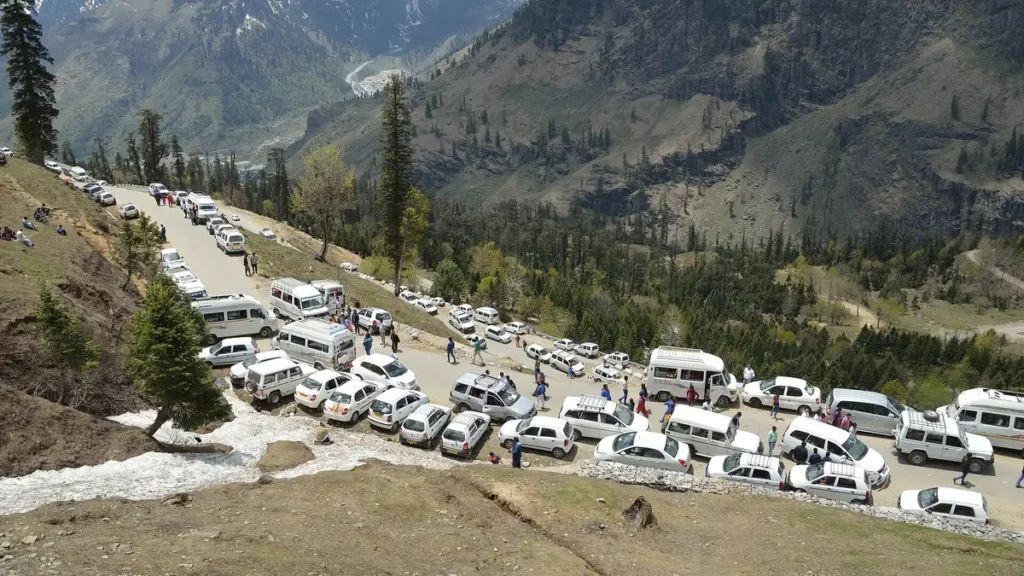
Photo: Biswarup Ganguly, CC BY 3.0, via Wikimedia Commons
Exam angle
Prelims: CEC, CAF Act 2016, carrying capacity, Article 48A. · Mains GS-III: disaster management, Himalayan ecology, sustainable tourism.
Practice MCQs
Original practice questions (not PYQs).
Consider the following statements:
1. The Central Empowered Committee is now a permanent body under the Environment (Protection) Act.
2. Eco-Sensitive Zones ban all activities except farming.
3. The Compensatory Afforestation Fund Act, 2016 set up authorities at both national and State levels.
How many of the above statements are correct?
Answer (b) & explanation
Statements 1 and 3 are correct. Eco-Sensitive Zones regulate activities; they do not ban everything except farming.
The 'carrying capacity' of a tourist place means:
Answer (a) & explanation
Carrying capacity is the limit of use a place can bear without lasting damage. The committee found no such study for Shimla, Manali or Spiti.
The Central Empowered Committee, in the news for its report on Himachal Pradesh, was originally set up by:
Answer (b) & explanation
The Supreme Court set up the CEC in 2002 in the T.N. Godavarman case. It became a permanent body under the Environment (Protection) Act in 2023.
Questions students ask about this
What is the Central Empowered Committee?
A committee set up by the Supreme Court in 2002 to check forest and environment orders; since 2023 it is a permanent body under the Environment (Protection) Act, 1986.
What has it suggested for Himachal Pradesh?
Binding limits on visitors, vehicles and hotel beds for each place, tighter rules for hill roads and checks on hydropower.
What is carrying capacity?
The largest number of people and vehicles a place can handle without harming its environment and safety.
How fast have homestays grown in Himachal?
By 669.7% in ten years, from 876 to 6,743.