
Punjab farm fires cross 3,000; 795 police cases filed
Punjab has recorded 3,144 farm fires this season, with Tarn Taran district on top. Police have filed 795 cases and fines of ₹54.55 lakh have been imposed. Farmers burn leftover paddy straw because they have very little time to sow wheat. Read it to revise crop residue management and air pollution.
- Farm fires
- 3,144 (15 Sept–6 Nov)
- Top district
- Tarn Taran (611)
- Police cases
- 795 under BNS Section 223
- Fines imposed
- ₹54.55 lakh in 1,077 cases
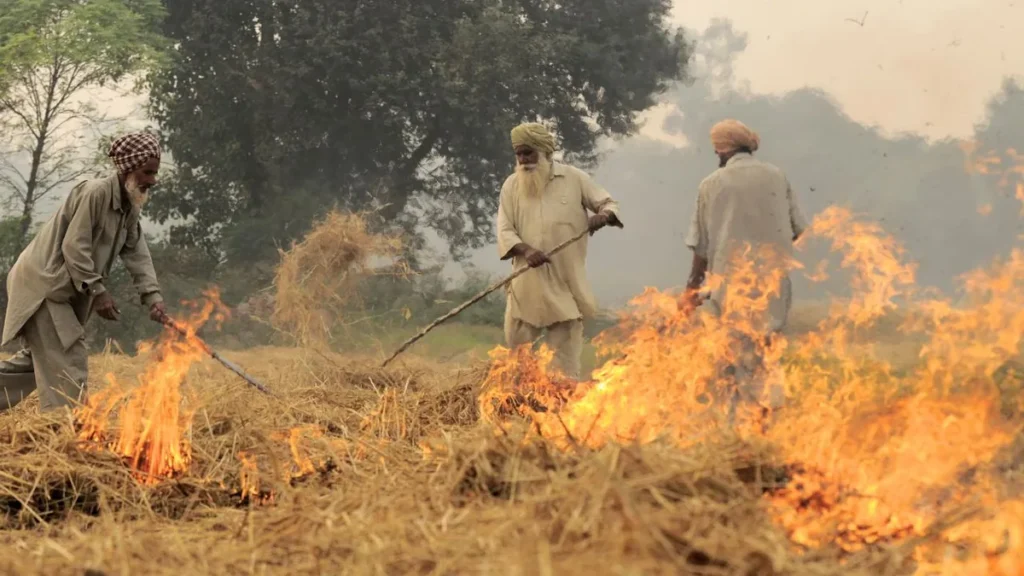
Punjab farm fires: what happened?
Every November, Delhi’s air turns grey. One big reason starts in fields hundreds of kilometres away.
- The Punjab Pollution Control Board recorded 3,144 farm fires between 15 September and 6 November, up from 2,787 a day earlier.
- Tarn Taran had the most (611), then Ferozepur (410), Sangrur (281), Bathinda (262) and Amritsar (231).
- Environmental compensation (a fine for causing pollution) of ₹54.55 lakh was imposed in 1,077 cases; ₹30.05 lakh has been recovered.
- Police filed 795 cases under Section 223 of the Bharatiya Nyaya Sanhita (BNS), which punishes disobeying an order of a public servant.
- 931 ‘red entries’ (a mark that can block loans and benefits) were made in farmers’ land records.
Why do farmers burn stubble?
Stubble is the stalk left in the field after cutting paddy (rice). Machines leave tall stalks behind.
Farmers have only about two to three weeks before they must sow wheat, the rabi (winter) crop. Burning is the quickest and cheapest way to clear the field.
The smoke adds to winter smog in Delhi and the National Capital Region, when cold, still air traps pollution near the ground.
Burning vs better ways
| Method | What it does |
|---|---|
| Happy Seeder / Super Seeder | Sows wheat straight into the stubble |
| Bio-decomposer | A spray that rots straw into manure in weeks |
| Baling for biomass | Straw sold to power and biogas plants |
| Burning | Fast and free, but pollutes and kills soil life |
Which laws and Articles apply?
- Commission for Air Quality Management (CAQM) Act, 2021: a body to control air pollution in the NCR and nearby States.
- Air (Prevention and Control of Pollution) Act, 1981: the base law on air pollution.
- BNS Section 223: punishes disobeying a public servant’s lawful order, like a ban on burning.
- Article 21: the right to life includes the right to clean air, as courts have held.
Why does stubble burning matter?
| Angle | What to note |
|---|---|
| Health | Smoke worsens lung and heart disease. |
| Agriculture | Burning kills soil nutrients and friendly microbes. |
| Governance | Tests Centre–State coordination. |
| Prelims | CAQM, Happy Seeder, bio-decomposer. |
What are the problems with stubble burning?
- Machines are costly, and small farmers cannot afford them.
- The short gap between paddy and wheat leaves little time.
- Paddy-heavy cropping, pushed by assured buying, uses lots of water and leaves lots of straw.
- Fines and police cases anger farmers without solving the cost problem.
What should be done next on stubble burning?
- Give machines through custom-hiring centres at low rent.
- Pay farmers for straw used by biomass and biogas plants.
- Promote crop diversification away from paddy.
- Use the bio-decomposer widely and on time.
What can Prelims ask on stubble burning?
Prelims probability: High. Past-question trend: crop-residue pollutants (2019), zero tillage (2020) and the bio-decomposer (Uttar Pradesh Public Service Commission 2025). Freshness: peak burning season data. Static link: Bharatiya Nyaya Sanhita Section 223, environmental compensation. Testable fact: Tarn Taran tops the farm-fire list.
- CAQM was set up by law in 2021.
- Happy Seeder sows wheat without removing stubble.
- Pusa bio-decomposer was developed by the Indian Agricultural Research Institute.
- Main pollutants from burning: PM2.5, carbon monoxide, nitrogen oxides.
- Top fire district this season: Tarn Taran.
How to write about stubble burning in Mains
Practice question (15 marks, 250 words): Stubble burning is an economic problem with an environmental cost. Discuss and suggest solutions.
- Intro: 3,144 fires, Tarn Taran on top.
- Why farmers burn: time and cost.
- Impact: air, health, soil.
- Solutions: machines, markets for straw, crop change.
- Conclusion: pay for change, not just punish.
Ready lines for your answer
- Farmers burn straw because it is the cheapest choice; make the clean choice cheaper.
- Clean air in Delhi depends on smart farming in Punjab.
Quotable data pointPunjab: 3,144 farm fires (15 Sept–6 Nov 2026); 795 police cases; ₹54.55 lakh fines.
Photo: CIAT, CC BY-SA 2.0, via Wikimedia Commons
Exam angle
Prelims: CAQM, crop residue tools. · Mains GS-III: air pollution and agriculture.
Practice MCQs
Original practice questions (not PYQs).
Consider the following statements:
1. Stubble burning in Punjab is largely linked to clearing paddy residue before sowing wheat.
2. The Happy Seeder sows wheat directly into paddy residue without burning it.
3. The Pusa bio-decomposer was developed by the Indian Agricultural Research Institute.
How many of the above statements are correct?
Answer (c) & explanation
All three are correct.
Questions students ask about this
Why do Punjab farmers burn stubble?
They have only two to three weeks to clear paddy straw and sow wheat, and burning is fastest and cheapest.
Which district had the most farm fires?
Tarn Taran, with 611 fires.
What is a 'red entry'?
A mark in a farmer's land record that can block loans and some government benefits.
Is stubble burning the only cause of Delhi's smog?
No. Vehicles, dust, industry and weather also matter; farm fires add a big share in some weeks.
What can replace burning?
Happy Seeder or Super Seeder machines, the bio-decomposer spray and selling straw to biomass plants.