
Perovskite solar cells need home-grown manufacturing
Perovskite solar cells get more power from the same area than silicon panels. Their active layer is only a few hundred nanometres thick, about a thousand times thinner than silicon wafers. Experts say India must start making them at home. China already treats the technology as a strategic asset. On 16 October, it proposed adding 12 solar technologies to its export control list, including ways to make perovskite and tandem modules. India’s solar industry depends heavily on imports from China, and it does not make polysilicon, the base material for silicon panels. Indian start-ups are testing machines to coat thin perovskite layers. Challenges remain: the cells wear out faster in heat and moisture, and most contain a little lead. Read it to revise photovoltaic cells, tandem cells and why manufacturing at home matters.
- What is new
- Experts call for domestic manufacturing of perovskite solar cells
- Why now
- On 16 October China proposed export controls on 12 solar technologies, including perovskite and tandem modules
- India’s gap
- The solar industry depends on imports from China and does not make polysilicon
- Limits
- Cells wear out faster in heat and moisture; most contain a little lead
Why are perovskite cells in the news, and why make them at home?
A layer a thousand times thinner than a silicon wafer can produce more power from the same roof — but only if the country that wants the power can also make the layer.
- Perovskite solar cells get more power from the same area than silicon panels. Their active layer is only a few hundred nanometres thick, about a thousand times thinner than silicon wafers. Experts say India must start making them at home.
- China already treats the technology as a strategic asset. On 16 October, it proposed adding 12 solar technologies to its export control list, including ways to make perovskite and tandem modules.
- India’s solar industry depends heavily on imports from China, and it does not make polysilicon, the base material for silicon panels.
- Indian start-ups are testing machines to coat thin perovskite layers. Challenges remain: the cells wear out faster in heat and moisture, and most contain a little lead.
What is a perovskite cell, and where does India stand on solar manufacturing?
A photovoltaic cell turns sunlight into electricity. Most panels used in India today are made of crystalline silicon. A perovskite cell uses a different crystal structure as the light-absorbing layer. Because that layer is extremely thin, less material is needed, and — in the laboratory — more power can be drawn from the same area.
A tandem cell stacks a perovskite layer on a silicon cell so that each layer absorbs a different part of the sunlight. That is one reason China has moved to treat both perovskite and tandem know-how as strategic.
India has expanded solar generation quickly, but the manufacturing chain is incomplete. It does not make polysilicon, so even conventional silicon panels depend on imported raw material, much of it from China. If export controls tighten, that dependence becomes a policy risk, not only a price risk.
Domestic work is at an early stage: start-ups are testing coating machines, not yet mass production. Two scientific problems are still open. The cells degrade faster in heat and moisture — a serious issue in much of India — and most recipes still use a little lead, which raises questions of disposal and pollution.
Silicon panels and perovskite cells
| Point | Silicon panels | Perovskite cells |
|---|---|---|
| Active layer | Silicon wafers, relatively thick | A few hundred nanometres; about 1,000 times thinner |
| Power from the same area | The present commercial standard | Can be higher, especially in a tandem stack |
| India’s manufacturing | No domestic polysilicon; heavy import dependence | Start-ups testing coating machines; no mass production yet |
| Main drawbacks | Import dependence on the base material | Shorter life in heat and moisture; most contain a little lead |
Which policies and ideas apply?
- India’s solar manufacturing incentives and domestic-content rules are meant to deepen the chain beyond assembling imported parts.
- Export controls proposed by China on 16 October, covering 12 solar technologies including perovskite and tandem modules, are a trade and technology policy signal.
- Environmental rules will matter if lead-containing cells are made or discarded at scale.
- Indigenisation of critical energy technology is a stated aim of science and industry policy.
Why does perovskite solar cells matter?
| Angle | What to note |
|---|---|
| Science and technology | Perovskite, tandem cells and polysilicon are the kind of terms examiners like to test in a new-energy question. |
| Economy | Import dependence on China for solar hardware is a strategic vulnerability if export controls tighten. |
| Environment | Lead in the cells and a short life in heat and moisture are not side issues in an Indian climate. |
| Prelims | Photovoltaic cells; tandem cells; polysilicon; thin active layer; China’s 16 October list of 12 technologies. |
What are the problems with perovskite solar cells?
- Calling for domestic manufacturing is easier than building plants that can compete on cost and quality.
- If the cells wear out quickly in Indian heat and moisture, a factory at home will not by itself make them a good investment.
- Lead content, even in small amounts, can become a pollution problem if millions of panels are later scrapped.
- Incentives that only assemble imported parts will not close the polysilicon gap, or the perovskite gap.
What should be done next on perovskite solar cells?
- Fund research on lead-free recipes and on cells that last in heat and humidity, not only on first-year efficiency.
- Support pilot lines so that start-ups can move from a coating machine to a small factory.
- Treat polysilicon and other missing links in the silicon chain as part of the same strategy, not a separate subject.
- Watch the Chinese export-control list closely, and plan stocks and partnerships so that a sudden restriction does not stall solar targets.
What can Prelims ask on perovskite solar cells?
Prelims probability: Medium. Solar technology was asked in 2014 and domestic content in 2017. New technology terms are a UPSC favourite. Testable facts: photovoltaic cells, tandem cells, polysilicon, lead content.
- Perovskite solar cells: a very thin active layer, about a thousand times thinner than a silicon wafer, and potentially more power from the same area.
- Tandem cells stack a perovskite layer on silicon.
- India does not make polysilicon, the base material for silicon panels, and depends heavily on imports from China.
- On 16 October China proposed adding 12 solar technologies to its export control list, including perovskite and tandem modules.
- Challenges: shorter life in heat and moisture, and a little lead in most cells.
How to write about perovskite solar cells in Mains
Practice question (15 marks, 250 words): Experts have called for domestic manufacturing of perovskite solar cells as China moves to control exports of the technology. Discuss the promise and the limits of this technology for India.
- Open with the thin active layer, the higher power from the same area, and the 16 October export-control proposal covering 12 solar technologies.
- Explain photovoltaic and tandem cells, and India’s lack of polysilicon capacity.
- Note that start-ups are only testing coating machines, not yet making cells at scale.
- Discuss the two scientific limits: faster wear in heat and moisture, and lead content.
- Close with a manufacturing strategy that includes research, pilot lines, and the missing links in the silicon chain as well.
Ready lines for your answer
- A thinner cell is not a cheaper cell until a factory at home can make it last.
- Export controls turn a laboratory material into a strategic import.
Quotable data pointActive layer a few hundred nanometres thick, about 1,000 times thinner than silicon wafers; China on 16 October proposed export controls on 12 solar technologies including perovskite and tandem modules; India does not make polysilicon; cells wear faster in heat and moisture; most contain a little lead.
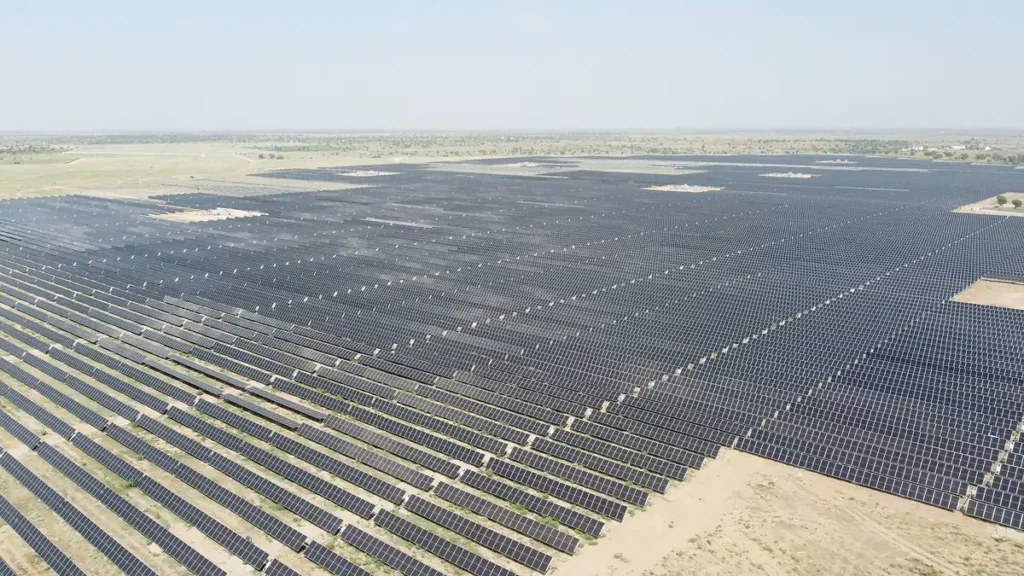
Photo: Sarvajanik Puralekh, CC BY-SA 2.0, via Wikimedia Commons
Exam angle
Prelims: photovoltaic cells, tandem cells, polysilicon, lead content. · Mains GS-III: renewable energy and indigenisation of technology.
Practice MCQs
Original practice questions (not PYQs).
Consider the following statements:
1. The active layer of a perovskite solar cell is only a few hundred nanometres thick, far thinner than a silicon wafer.
2. Most high-performing perovskite formulations contain a small amount of lead.
3. India has large-scale polysilicon manufacturing.
How many of the above statements are correct?
Answer (b) & explanation
Statements 1 and 2 are correct. India has no polysilicon manufacturing and depends heavily on imports from China.
What is a 'tandem' solar cell?
Answer (c) & explanation
A tandem cell stacks a perovskite layer on a silicon cell so that each absorbs different parts of sunlight, raising efficiency.
Questions students ask about this
What is a perovskite solar cell?
A photovoltaic cell whose light-absorbing layer is a perovskite crystal, only a few hundred nanometres thick — about a thousand times thinner than a silicon wafer — and able to get more power from the same area.
What is a tandem cell?
A cell that stacks a perovskite layer on a silicon cell, so that each layer absorbs a different part of the sunlight.
Why is China in this story?
On 16 October it proposed adding 12 solar technologies to its export control list, including ways to make perovskite and tandem modules.
What does India not make?
Polysilicon, the base material for conventional silicon panels. The solar industry also depends heavily on imports from China.
What are the main technical problems?
The cells wear out faster in heat and moisture, and most contain a little lead.