
Air Pollution in India: Pollutants, Sources, AQI, WHO Guidelines, NCAP and GRAP (UPSC Notes + PYQs)
UPSC has already asked about this. Read the story with these questions in mind.
Background: why air pollution is a governance problem
Air pollution is now one of the largest environmental health risks in India. Fine particles called PM2.5 reach deep into the lungs and the bloodstream, causing heart disease, stroke, lung cancer and respiratory infections, and harm children’s growth. Unlike a factory effluent, air pollution has many diffuse sources: vehicles, power plants, industry, construction dust, burning of crop residue and waste, and household cooking with solid fuels. It also crosses boundaries, so a city cannot clean its air alone; the Indo-Gangetic plain behaves like one airshed. The law is old: the Air (Prevention and Control of Pollution) Act, 1981 created a role for the Central and State Pollution Control Boards. But enforcement, coordination among agencies, and the weather of north India in winter make the problem hard.
Pollutants and effects
- PM2.5: enters the lungs and blood; heart and lung disease.
- Ground-level ozone: secondary pollutant formed from NOx and VOCs in sunlight; damages crops.
- SO₂ and NO₂: acid rain, respiratory irritation.
- CO: reduces oxygen in blood.
- 1Stubble, vehicle and dust emissions rise
- 2Cold, calm air near the ground
- 3Temperature inversion traps pollutants
- 4Low mixing height concentrates particles
- 5AQI turns severe
Sources in India
Transport, industry and power plants, road and construction dust, burning of crop residue in Punjab and Haryana in October-November, biomass and coal for cooking, firecrackers. In winter, low wind and temperature inversion trap pollutants over the Indo-Gangetic plain.
AQI and standards
| AQI band | Category |
|---|---|
| 0-50 | Good |
| 51-100 | Satisfactory |
| 101-200 | Moderate |
| 201-300 | Poor |
| 301-400 | Very poor |
| 401-500 | Severe |
The WHO’s 2021 guidelines set the annual PM2.5 level at 5 µg/m³; India’s NAAQS limit is 40 µg/m³.
- Emitted directly
- Example: SO2, NOx, CO, soot
- Controlled at source
- Near the source
- Formed in the air by reactions
- Example: ozone, sulphate and nitrate particles
- Need control of precursors
- Can spread far from sources
Policy response
- Air (Prevention and Control of Pollution) Act, 1981.
- NCAP (2019): city action plans for 130 non-attainment cities; funding tied to results through the 15th Finance Commission.
- GRAP in Delhi-NCR: graded curbs as AQI worsens, run by the Commission for Air Quality Management (2021 Act).
- BS-VI fuel (2020), PM Ujjwala LPG, electric vehicles (FAME, PM E-DRIVE), crop residue machines, bio-decomposers.
Major pollutants at a glance
| Pollutant | Main sources | Health effect |
|---|---|---|
| PM2.5 and PM10 | Combustion, dust, crop and waste burning | Lung and heart disease, low birth weight |
| Nitrogen dioxide | Vehicles, power plants | Airway inflammation, asthma |
| Sulphur dioxide | Coal-fired plants, refineries | Breathing problems; forms secondary particles |
| Ground-level ozone | Formed from NOx and VOCs in sunlight | Lung damage; harms crops |
| Carbon monoxide | Incomplete combustion in vehicles, stoves | Reduces oxygen in blood |
| Lead and ammonia | Batteries, smelters; fertilisers and livestock | Nerve damage; secondary PM |
Why it persists
Airsheds cross State borders, monitoring is thin outside big cities, and enforcement on dust and small industry is weak. Health costs are large: the Lancet and ICMR studies attribute well over a million deaths a year in India to air pollution.
Why Delhi chokes every winter
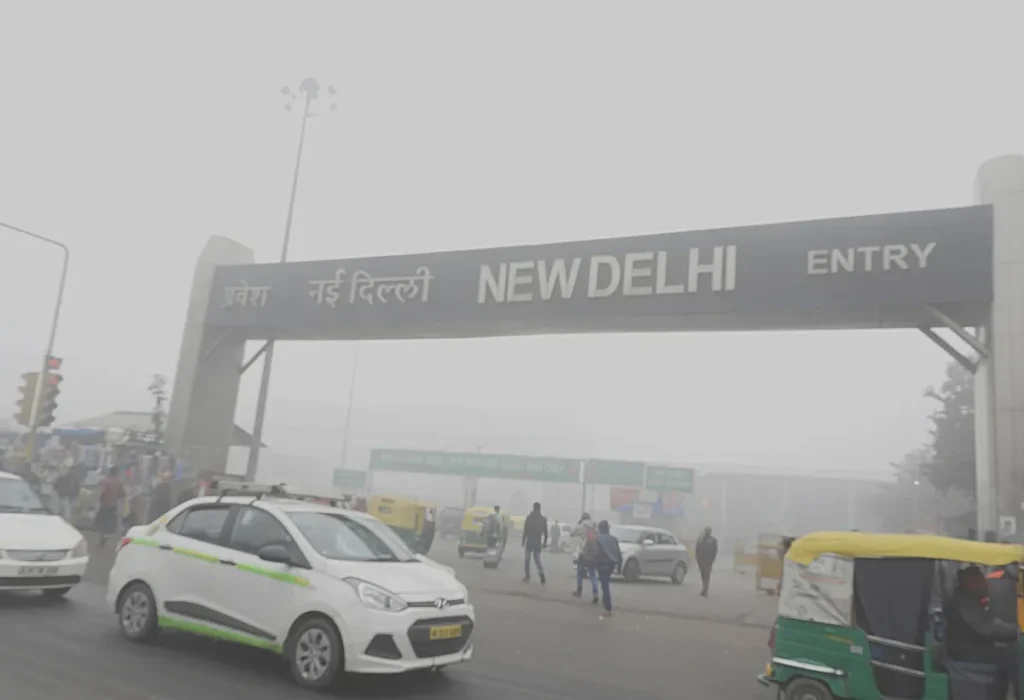
Three things combine in north India between October and January. First, temperature inversion: cold air near the ground is trapped below warmer air, so pollutants cannot rise and disperse. Second, calm winds and a lower mixing height concentrate pollution near the surface. Third, extra emissions arrive at the same time: stubble burning in Punjab and Haryana after the paddy harvest, firecrackers around Diwali, and more biomass burning for heating. Local sources such as vehicles, road dust and industry continue throughout. The geography of the Indo-Gangetic plain, closed by the Himalaya to the north, makes it a bowl that holds pollution. This is why measures limited to Delhi, such as odd-even vehicle rules, can only do so much.
Institutions and laws
| Body or law | Role |
|---|---|
| Air Act, 1981 | Air pollution control areas, consent for industries |
| Environment (Protection) Act, 1986 | Emission standards; umbrella powers for the Centre |
| CPCB and SPCBs | Monitoring, standards, enforcement |
| Commission for Air Quality Management (NCR) | Coordinates action in Delhi-NCR and adjoining areas; statutory since 2021 |
| National Clean Air Programme (2019) | City action plans for non-attainment cities |
| National Green Tribunal | Adjudicates environmental disputes, orders compliance |
Solutions that work
Experience from India and abroad points to a set of measures. Clean cooking fuel through LPG reduces household smoke, the largest exposure for many rural women. Moving vehicles to BS-VI standards, electric mobility and better public transport cuts urban emissions. Flue gas desulphurisation in coal plants reduces sulphur dioxide. For stubble, options include in-situ management with machines like the Happy Seeder, bio-decomposers, use of straw in power and biofuel plants, and crop diversification away from paddy. Construction dust needs covering, wet suppression and penalties. Above all, airshed-level planning across States, real-time monitoring and public data on air quality make action accountable. Beijing’s experience shows that sustained regional action over several years can cut particulate levels substantially.
Answer writing tip
For a Mains answer, organise sources into transport, industry and power, dust, agriculture and households. Mention the health cost and the economic cost in lost productivity. Close with a regional, multi-sector approach rather than city-level quick fixes, and add a simple diagram of temperature inversion to earn presentation marks.
Air pollution in Prelims: common traps
Note that PM2.5 is a subset of PM10, not a separate class. Ozone near the ground is a pollutant, though the stratospheric ozone layer is protective. The AQI is a single index derived from the worst of its sub-indices, not an average. GRAP stages are triggered by AQI levels in Delhi-NCR, while NCAP covers cities across India.
Air Pollution: UPSC angle
For UPSC CSE
Prelims: AQI pollutants, WHO values, secondary pollutants, cloud seeding. Mains GS-III: NCAP effectiveness; stubble burning solutions.
Air Pollution UPSC PYQs (Prelims)
Questions UPSC has actually asked, from the official papers. Pick an option to check yourself.
In the cities of our country, which among the following atmospheric gases are normally considered in calculating the value of Air Quality Index?
– 1. Carbon dioxide
– 2. Carbon monoxide
– 3. Nitrogen dioxide
– 4. Sulfur dioxide
– 5. Methane
Select the correct answer using the code given below.
India’s National AQI (2014) tracks eight pollutants: PM10, PM2.5, NO2, SO2, CO, O3, NH3 and lead. CO2 and methane are greenhouse gases but are not counted in the AQI. Answer as per the official UPSC key · Battle IAS PYQ bankAnswer (b) & why
In the context of WHO Air Quality Guidelines, consider the following statements :
– 1. The 24-hour mean of PM2·5 should not exceed 15 µg/m3 and annual mean of PM2·5 should not exceed 5 µg/m3.
– 2. In a year, the highest levels of ozone pollution occur during the periods of inclement weather.
– 3. PM10 can penetrate the lung barrier and enter the bloodstream.
– 4. Excessive ozone in the air can trigger asthma.
Which of the statements given above are correct ?
The 2021 WHO guidelines set PM2.5 at 15 (24-hour) and 5 µg/m3 (annual). Ground-level ozone forms in sunshine, so it peaks in hot, clear weather, not in bad weather. It does trigger asthma. PM2.5, not PM10, is fine enough to cross into the blood. Answer as per the official UPSC key · Battle IAS PYQ bankAnswer (b) & why
Artificial way of causing rainfall to reduce air pollution makes use of
Cloud seeding sprays particles into suitable clouds so that water droplets form around them. Silver iodide is the standard agent, as its crystal shape is close to ice, and potassium iodide is used with it. Rain then washes dust and smoke out of the air. Answer as per the official UPSC key · Battle IAS PYQ bankAnswer (a) & why
Mains PYQs on this topic
No UPSC Mains question from 2023-2026 is directly on this topic. Older papers (2013-2022) will be added as the Mains bank grows.
Quick quiz
How many pollutants are included in India’s AQI?
PM10, PM2.5, NO₂, SO₂, CO, O₃, NH₃ and Pb.Answer (c)
Ground-level ozone is a
Formed from NOx and VOCs in sunlight.Answer (b)
The Commission for Air Quality Management covers
Created in 2021.Answer (b)
FAQs
What is NCAP?
The National Clean Air Programme, launched in 2019 to cut particulate pollution in non-attainment cities.
What is GRAP?
The Graded Response Action Plan, a set of emergency measures in Delhi-NCR triggered by AQI levels.
What is the WHO guideline for PM2.5?
5 µg/m³ annual mean, from 2021.
Why is winter pollution worse in north India?
Temperature inversion, low wind speed and crop burning trap pollutants.
What is temperature inversion?
A condition where a layer of warm air lies above cooler air near the ground, preventing vertical mixing and trapping pollutants close to the surface.
Which pollutants make up the AQI?
Eight: PM10, PM2.5, NO2, SO2, CO, ozone, ammonia and lead.
What is a non-attainment city?
A city that does not meet the national ambient air quality standards for PM10 or NO2 consistently over a period; these cities prepare action plans under NCAP.
Spotted an error? Tell us. We correct within 48 hours.
Image: Sumita Roy Dutta, Wikimedia Commons, CC BY-SA 4.0
How to use this in Mains
If asked: Air pollution is a public health emergency in India. Discuss. (GS-III)
Quote: “Air pollution is now one of the largest environmental health risks in India.”
Use it: Use as the intro line; follow with NCAP.
In the news
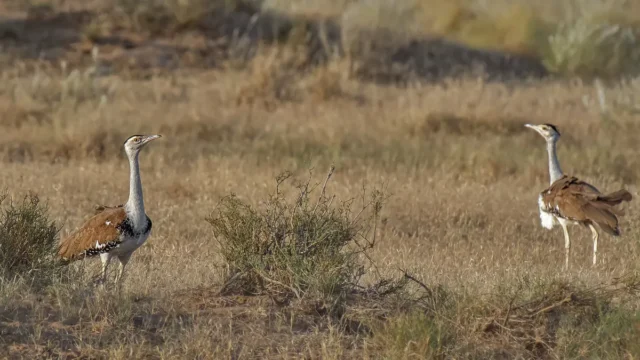
National Red List of birds: 1,211 species under assessment, 107 done in first review
India has begun a national Red List assessment of its 1,211 regularly occurring bird species using the IUCN framework. By 19 October 2026, a preliminary review of 107 species was complete, with the Great Indian Bustard proposed as Critically Endangered and the Indian Roller as Vulnerable. A final assessment is expected towards the end of 2027.
20 Oct 2026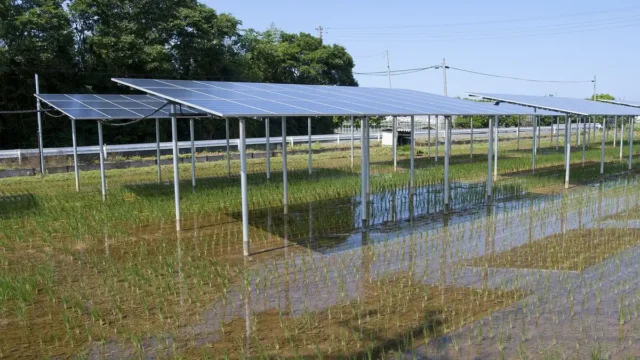
Agrivoltaics: Centre plans a scheme to push solar panels above farms; 5 GW seen in 3–4 years
MNRE Secretary Santosh Kumar Sarangi said on 19 October 2026 that the Centre is planning a central sector scheme to help States adopt agrivoltaics, either standalone or within PM-KUSUM 2.0. He expects capacity to cross 5 GW in three to four years if States notify feed-in tariffs. India hosts the 7th Agrivoltaics World Conference in New Delhi from 21 to 23 October.
20 Oct 2026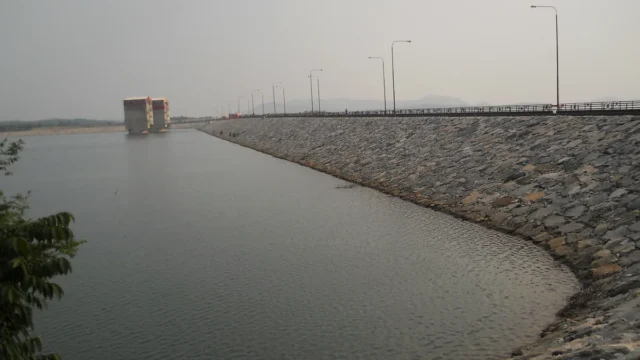
Pumped storage hydropower: India’s roadmap for 100 GW of ‘water batteries’ by 2035-36
A PIB backgrounder of 19 October 2026 explains how pumped storage projects (PSPs) will store solar and wind power for India’s grid. India runs 7.43 GW of pumped storage today, is building 15.87 GW more and has an assessed potential of 345.38 GW. A roadmap aims to add about 100 GW between 2025-26 and 2035-36.
19 Oct 2026
NBA shares Rs 1.19 crore with 29 State Biodiversity Boards from use of crop genetic resources
On 17 October 2026 the National Biodiversity Authority (NBA) said it had shared ₹1.19 crore with 29 State Biodiversity Boards and one UT Biodiversity Council. The money came from seed companies that used Indian maize, rice, pearl millet and cotton for research and commercial hybrids. As the crops were bought from markets and the original holders could not be traced, the amount was split in proportion to each State’s cultivation area. The release comes two days before the CBD COP 17 opens in Yerevan.
18 Oct 2026