
Environmental Impact Assessment (EIA) in India: Process, EIA Notification 2006, Draft 2020 and Key Concerns (UPSC Notes)

UPSC has already asked about this. Read the story with these questions in mind.
- Prelims 2026In a multi-ethnic district where both economic competition and historical grievances frequently led to community tensions, a flashpoint has arisen with a Government decision…Solve with answer →
- Mains 2024 · GS3What role do environmental NGOs and activists play in influencing Environmental Impact Assessment (EIA) outcomes for major projects in India? Cite four examples with…See model answer →
Background: what EIA is for
Environmental Impact Assessment is a process for studying the likely effects of a proposed project on the environment and on people before a decision is taken to approve it. The idea is simple: it is cheaper and fairer to prevent damage at the design stage than to repair it later. EIA asks what the project will do to air, water, land, forests, wildlife and communities; what alternatives exist, including a different site or technology; and how the remaining harm can be reduced or offset. The United States made it a legal requirement through the National Environmental Policy Act of 1969, and the Rio Declaration of 1992 (Principle 17) made it a global norm. In India it is the main tool that brings environmental concerns into decisions on mines, dams, highways, ports, industrial estates and power plants.
Legal history
India began environmental appraisal of river valley projects in the late 1970s. The first EIA Notification came in 1994 after the Stockholm and Rio conferences. The 2006 Notification replaced it and decentralised clearances to State Environment Impact Assessment Authorities (SEIAA).
- 1Screening: Category A or B1/B2
- 2Scoping: Terms of Reference fixed
- 3Public consultation: hearing and written comments
- 4Appraisal by EAC or SEAC
- 5Decision and monitoring of conditions
Stages of EIA under the 2006 Notification
- Screening (for Category B: B1 needs full EIA, B2 does not).
- Scoping: Terms of Reference set by the Expert Appraisal Committee.
- Public consultation: public hearing by the State Pollution Control Board, and written responses.
- Appraisal by the EAC or State EAC, then decision by MoEFCC or SEIAA.
Post-clearance monitoring requires six-monthly compliance reports.
Category A vs B
| Point | Category A | Category B |
|---|---|---|
| Who clears | MoEFCC on EAC advice | SEIAA on SEAC advice |
| Scale | Larger projects, higher impact | Smaller projects |
| Public hearing | Required (with exemptions) | B1 required, B2 exempt |
- Appraised at Union level
- Expert Appraisal Committee
- Clearance by MoEFCC
- Larger, higher-impact projects
- Appraised at State level
- SEAC and SEIAA
- B2 projects need no EIA report
- Smaller projects with local impact
Concerns
- EIA reports prepared by consultants paid by the project proponent; copy-paste reports.
- Public hearings held in English or far from affected villages.
- Weak monitoring of conditions after clearance.
- No cumulative or basin-level assessment.
- Ex post facto clearances: the Supreme Court in Vanashakti (May 2025) struck down notifications that allowed post-facto approval; a larger bench later recalled that judgment for reconsideration.
Key actors in the process
| Actor | Role |
|---|---|
| Project proponent | Applies for clearance; pays for the EIA study |
| Accredited consultant | Prepares the EIA report and the Environment Management Plan |
| Expert Appraisal Committee (EAC) | Appraises Category A projects for the Union Environment Ministry |
| SEIAA and SEAC | State Environment Impact Assessment Authority and its expert committee appraise Category B |
| State Pollution Control Board | Organises the public hearing |
| Affected people and civil society | Give views at hearing and in writing |
| Regional offices of the Ministry | Monitor compliance with clearance conditions |
Draft EIA Notification, 2020
It proposed post-facto clearance, a shorter period for public comments (from 30 to 20 days), more exemptions from public hearing, and annual instead of six-monthly compliance reports. It drew over 17 lakh comments and was not finalised as drafted.
Why public participation matters
The public hearing is meant to give a voice to those who will bear the costs of a project: farmers losing land, fishers losing access to the sea, tribal communities losing forest. Under the 2006 Notification the hearing is held near the site, with notice in local newspapers and the draft EIA summary in the local language. Written comments can also be sent. In practice hearings are often criticised: reports are long and technical, summaries are poorly translated, venues are far from affected villages, and hearings can be tense or stage-managed. Even so, many projects have been modified or rejected after strong local objections, and courts have struck down clearances where the hearing was flawed. This is the part of EIA that turns it from a technical exercise into a democratic one.
Role of NGOs, activists and courts
Environmental groups and local activists influence EIA outcomes in several ways. They read and critique EIA reports, often exposing copied or inaccurate data, as in cases where reports described species or rivers that did not exist at the site. They mobilise communities for public hearings and help them submit evidence. They file appeals before the National Green Tribunal (set up in 2010), which hears challenges to environmental clearances. They also bring issues to the media and to Parliament. Well-known Indian controversies include the Niyamgiri bauxite mining case in Odisha, where the Supreme Court in 2013 asked gram sabhas to decide on religious and community rights, and campaigns around large dams, coastal power plants and mining in the Western Ghats. In Mains, give examples with what was challenged and what changed.
EIA, SEA and cumulative impacts
| Point | Project EIA | Strategic Environmental Assessment |
|---|---|---|
| Level | A single project | Policies, plans and programmes |
| Timing | After project is designed | Before projects are chosen |
| Alternatives | Limited, mostly site or design | Wide, including other sectors |
| Cumulative effects | Often missed | Built into the analysis |
| Legal status in India | Mandatory under the 2006 Notification | Not a general legal requirement |
A single small hydro project may look harmless on its own, but ten on one river can dry up stretches and block fish movement. This is why experts recommend cumulative impact studies and carrying capacity assessments for river basins and ecologically sensitive regions.
Reforms commonly suggested
Several reforms recur in committee reports and expert writing. EIA consultants should be independent of the proponent, for example through a pool funded by fees and allocated by the regulator. Baseline data should be collected over all seasons and made public. Public hearings should be held in accessible places with simple, local-language summaries. Clearance conditions should be monitored with regular reports and site visits, backed by penalties. Strategic and cumulative assessments should precede approvals in fragile regions such as the Himalaya, the Western Ghats and coasts. Finally, exemptions and post-facto approvals should be limited, so that the process remains preventive, which is its whole purpose.
EIA in Prelims: common traps
Remember that EIA in India is not a separate Act passed by Parliament; it is a notification issued under the Environment (Protection) Act, 1986. The first notification came in 1994 and the current one in 2006. B2 projects are exempt from a full EIA report and from public hearing, while B1 projects need both. The State Pollution Control Board conducts the public hearing, but the appraisal is done by the EAC or SEAC. Environmental clearance is different from forest clearance, which is governed by the forest conservation law and needs separate approval when forest land is diverted. Coastal projects may also need clearance under the Coastal Regulation Zone notification.
A simple model answer structure
A strong answer on EIA begins with its purpose: prevention, informed decision-making and public participation. Next, set out the four stages and the A/B categories in a small table. Then examine weaknesses: proponent-paid consultants, poor baseline data, weak hearings, and lax monitoring after clearance. Use two or three real examples to show how activists and courts changed outcomes. End with reforms such as independent consultants, cumulative and strategic assessment, and stronger post-clearance monitoring, tying EIA to sustainable development and the precautionary principle.
Environmental Impact Assessment: UPSC angle
For UPSC CSE
Prelims: parent Act, categories, stages, who conducts public hearing. Mains GS-III: EIA weaknesses; development vs environment.
Environmental Impact Assessment UPSC PYQs (Prelims)
Questions UPSC has actually asked, from the official papers. Pick an option to check yourself.
No Prelims question in the Battle IAS bank is directly on this topic yet.
Mains PYQs on this topic
Questions from the official UPSC Mains papers (2023-2026 in the Battle IAS Mains bank), newest first. Each links to a model answer.
- UPSC Mains 2024 · GS Paper III · Q8 · 10 marks
What role do environmental NGOs and activists play in influencing Environmental Impact Assessment (EIA) outcomes for major projects in India? Cite four examples with all important details.
Quick quiz
The EIA Notification, 2006 was issued under the
EPA 1986.Answer (b)
Who conducts the public hearing in EIA?
The SPCB, with the district administration.Answer (b)
Category B2 projects
But they still need clearance from SEIAA.Answer (c)
FAQs
When was EIA made mandatory in India?
In 1994 through the first EIA Notification.
What is the difference between Category A and B?
Category A projects are cleared by the Centre; Category B by State authorities.
What is ex post facto clearance?
Approval given after a project has already started without clearance; courts have largely frowned on it.
Who prepares the EIA report?
Accredited consultants hired by the project proponent.
What is screening in EIA?
The first stage, where it is decided whether a project needs an EIA and in which category it falls.
What is scoping?
The stage where the expert committee fixes the Terms of Reference: the issues the EIA study must address.
Can an environmental clearance be challenged?
Yes. An appeal lies to the National Green Tribunal under the NGT Act, 2010, and further to the Supreme Court.
Spotted an error? Tell us. We correct within 48 hours.
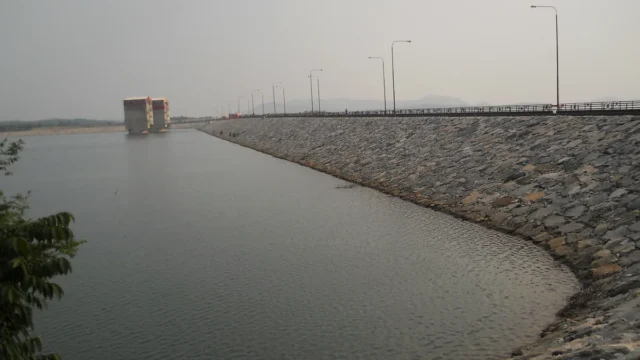
Image: T. R. Shankar Raman, Wikimedia Commons, CC BY-SA 4.0
How to use this in Mains
If asked: UPSC Mains 2024, GS-III: What role do environmental NGOs and activists play in influencing Environmental Impact Assessment (EIA) outcomes for major projects in India? Cite four examples with all important details.
Quote: “EIA reports prepared by consultants paid by the project proponent; copy-paste reports.”
Use it: Use as the conflict-of-interest concern in EIA.
In the news
Pumped storage hydropower: India’s roadmap for 100 GW of ‘water batteries’ by 2035-36
A PIB backgrounder of 19 October 2026 explains how pumped storage projects (PSPs) will store solar and wind power for India’s grid. India runs 7.43 GW of pumped storage today, is building 15.87 GW more and has an assessed potential of 345.38 GW. A roadmap aims to add about 100 GW between 2025-26 and 2035-36.
19 Oct 2026
NBA shares Rs 1.19 crore with 29 State Biodiversity Boards from use of crop genetic resources
On 17 October 2026 the National Biodiversity Authority (NBA) said it had shared ₹1.19 crore with 29 State Biodiversity Boards and one UT Biodiversity Council. The money came from seed companies that used Indian maize, rice, pearl millet and cotton for research and commercial hybrids. As the crops were bought from markets and the original holders could not be traced, the amount was split in proportion to each State’s cultivation area. The release comes two days before the CBD COP 17 opens in Yerevan.
18 Oct 2026
Oil companies bar sugar-based ethanol for 2026-27; maize incentive cut to ₹2.79 a litre
The oil marketing companies have kept sugar out of India’s ethanol programme for the coming year. The tender issued on 16 October 2026 seeks about 11 billion litres of ethanol for the 2026-27 supply year, but asks for none made from sugarcane juice, sugar syrup or B-heavy molasses, because the Government wants sugar diversion for ethanol cut to zero. Grain must now carry the load, and even the maize incentive has been cut. Read this as a live example of the food-versus-fuel trade-off.
18 Oct 2026
India to accede to the Southern Indian Ocean Fisheries Agreement (SIOFA)
On 14 October 2026 the Centre approved India's accession to the Southern Indian Ocean Fisheries Agreement. India, a Cooperating Non-Contracting Party since 2022, will become a full Contracting Party. Indian vessels can then fish squids, toothfish, alfonsino and other non-migratory stocks in the SIOFA area and join its scientific and compliance bodies.
14 Oct 2026