
Disaster Management in India: Disaster Management Act 2005 and 2025 Amendment, NDMA, NDRF, Funds, Sendai Framework and Case Studies (UPSC Notes + PYQs)
UPSC has already asked about this. Read the story with these questions in mind.
- Prelims 2011The 2004 Tsunami made people realize that mangroves can serve as a reliable safety hedge against coastal calamities. How do mangroves function as a…Solve it below ↓
- Mains 2026 · GS3"Community participation is the cornerstone of effective disaster management". Analyse this statement with suitable examples from India. Also discuss the challenges to community participation…See model answer →
Hazard profile
About 58.6% of the land is prone to moderate to very high earthquakes; 12% (over 4 crore hectares) to floods; about 5,700 km of the 7,500 km coastline to cyclones and tsunamis; 68% of cultivable area to drought. Heat waves now kill more people in some years than cyclones.
The legal and institutional set-up
- NDMA (PM chairs) lays down policy and guidelines; NEC under the Union Home Secretary coordinates.
- SDMA (CM chairs) and DDMA (Collector chairs; elected local leader co-chairs).
- NDRF: specialised force of 16 battalions; State forces (SDRF).
- NIDM for training and research.
- Funds: National Disaster Response Fund and State funds for relief; separate mitigation funds since the 15th Finance Commission.
- The 2025 amendment gave the NDMA and SDMAs statutory backing for national and State disaster databases, and created Urban Disaster Management Authorities for State capitals and large cities.
Sendai Framework
Adopted in 2015 with seven targets to 2030 (fewer deaths, fewer people affected, lower economic loss, less damage to critical infrastructure, more national strategies, more international cooperation, better early warning) and four priorities: understanding risk, governance, investing in resilience, and “build back better”. India’s National Disaster Management Plan (2016, updated 2019) is aligned to it. India also leads the Coalition for Disaster Resilient Infrastructure (2019).
What works: Odisha
After the 1999 super cyclone killed about 10,000, Odisha built the OSDMA, cyclone shelters run by village committees, and drills. Phailin (2013) and Fani (2019) saw over a million evacuated with deaths in the dozens. IMD’s forecast accuracy for cyclone tracks has improved sharply, a quiet success.
Gaps
Urban flooding (Chennai 2015, Bengaluru 2022), weak enforcement of building codes, heat action plans in only some cities, landslide and glacial lake risks in the Himalaya, and DDMAs that exist on paper. The way forward: risk-informed planning, local early warning in local languages, insurance, and community capacity.
Disaster Management: UPSC angle
For UPSC CSE
Prelims: NDMA chair, Sendai targets, CDRI, funds. Mains GS-III: disaster management cycle, case studies (Odisha, Kerala floods, Wayanad), urban floods.
Disaster Management UPSC PYQs (Prelims)
Questions UPSC has actually asked, from the official papers. Pick an option to check yourself.
You are an officer in-charge for providing basic medical facilities to the survivors of an earthquake affected area. Despite your best possible effort, people put allegations against you for making money out of the funds given for relief. You would
Mangroves have dense prop and stilt roots anchored in mud. They hold firm against storms and waves and break the force of the water, as seen in Tamil Nadu’s Pichavaram in 2004. Mangroves are mostly low trees, not tall shelters. Answer as per the official UPSC key · Battle IAS PYQ bankAnswer (a) & why
Mains PYQs on this topic
Questions from the official UPSC Mains papers (2023-2026 in the Battle IAS Mains bank), newest first. Each links to a model answer.
- UPSC Mains 2026 · GS Paper III · Q18 · 15 marks
"Community participation is the cornerstone of effective disaster management". Analyse this statement with suitable examples from India. Also discuss the challenges to community participation and measures to strengthen it.
- UPSC Mains 2024 · GS Paper III · Q17 · 15 marks
What is disaster resilience? How is it determined? Describe various elements of a resilience framework. Also mention the global targets of Sendai Framework for Disaster Risk Reduction (2015-2030).
- UPSC Mains 2024 · GS Paper III · Q18 · 15 marks
Flooding in urban areas is an emerging climate-induced disaster. Discuss the causes of this disaster. Mention the features of two such major floods in the last two decades in India. Describe the policies and frameworks in India that aim at tackling such floods.
Quick quiz
The NDMA is chaired by the
Under the DM Act, 2005.Answer (b)
The Sendai Framework covers the period
Successor to Hyogo.Answer (b)
The Coalition for Disaster Resilient Infrastructure was launched by
In 2019.Answer (b)
FAQs
What is the difference between NDRF (force) and NDRF (fund)?
The National Disaster Response Force is a specialised rescue force; the National Disaster Response Fund finances relief.
What did the 2025 amendment add?
Statutory disaster databases and Urban Disaster Management Authorities, among other changes.
What is “build back better”?
Using recovery to reduce future risk rather than recreating old vulnerabilities.
Who heads a DDMA?
The District Collector or Magistrate, with the elected head of the district council as co-chair.
Spotted an error? Tell us. We correct within 48 hours.
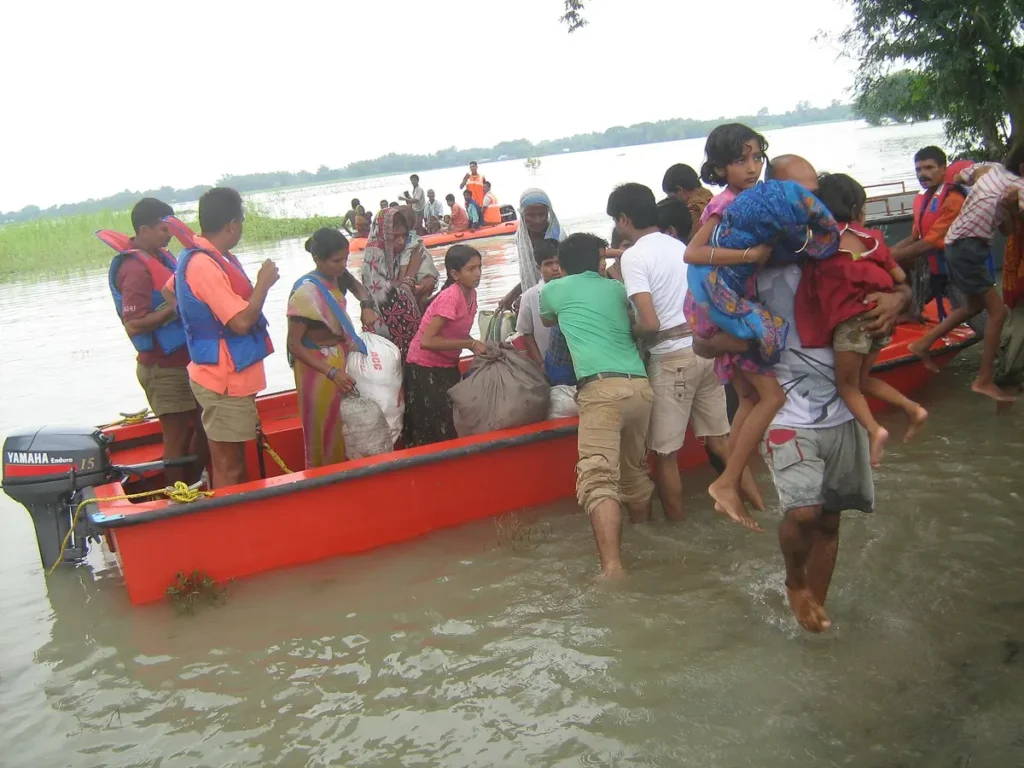
Image: Kumarrakajee, Wikimedia Commons, CC BY-SA 3.0
How to use this in Mains
If asked: UPSC Mains 2026, GS-III: "Community participation is the cornerstone of effective disaster management". Analyse this statement with suitable examples from India. Also discuss the challenges to community participation and measures to strengthen it.
Quote: “Urban flooding (Chennai 2015, Bengaluru 2022), weak enforcement of building codes, heat action plans in only some cities, landslide and glacial lake risks in the Himalaya, and DDMAs that exist on paper.”
Use it: Use it in the challenges part, then turn to community participation.
In the news
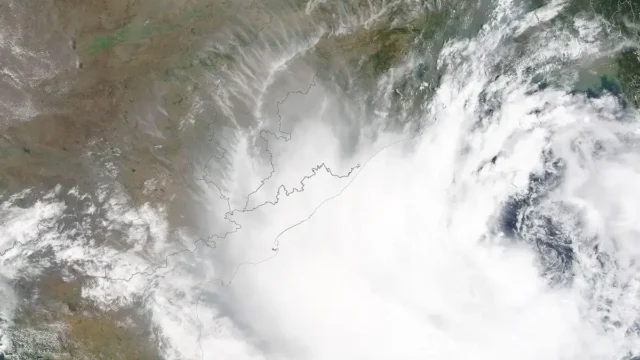
IMD launches a map-based Decision Support System for cyclone and marine warnings
On 12 October 2026 the India Meteorological Department dedicated a Cyclone Warning and Marine Weather Services Decision Support System to the nation. The WebGIS platform shows cyclone track, intensity, winds, rainfall, storm surge and district-wise warnings on one map for disaster managers and the public.
13 Oct 2026
India offers flood relief to Nepal; PM speaks to Nepal PM
On 26 August 2026 Prime Minister Narendra Modi spoke to Nepal's Prime Minister Balendra Shah and conveyed condolences on the loss of lives in floods in Nepal. He said India is ready to provide all possible humanitarian assistance, and that Indian teams are coordinating closely with Nepalese authorities on rescue and relief.
26 Aug 2026
UNCCD COP17: India urges shift from drought response to drought resilience
At a ministerial dialogue on drought resilience at UNCCD COP17 in Ulaanbaatar, Mongolia, on 25 August 2026, India called for a shift from reactive drought relief to proactive, technology-enabled resilience. The Environment Minister said drought must be managed as a predictable, preventable risk, with preparedness over response and prevention over crisis management.
25 Aug 2026
Urban Flood Risk Management Programme: Phase II in 11 cities incl. Lucknow and Kanpur
The Centre has approved the Urban Flood Risk Management Programme in two phases under the National Disaster Mitigation Fund, MHA told Lok Sabha on 11 August 2026. Phase I covers seven metros at ₹3075.65 crore. Phase II covers 11 cities, including Lucknow and Kanpur, at ₹2444.42 crore. States implement the projects.
11 Aug 2026