
Mughal Empire (1526-1857): Rulers, Mansabdari and Jagirdari, Land Revenue, Religious Policy, Art and Decline (UPSC Notes + PYQs)
UPSC has already asked about this. Read the story with these questions in mind.
- Prelims 2019With reference to Mughal India, what is/are the difference / differences between Jagirdar and Zamindar?Solve it below ↓
- Prelims 2014Ibadat Khana at Fatehpur Sikri wasSolve it below ↓
See all 5 PYQs
- Prelims 2019Who among the following Mughal Emperors shifted emphasis from illustrated manuscripts to album and individual portrait?Solve it below ↓
- Prelims 2019With reference to Mian Tansen, which one of the following statements is not correct?Solve it below ↓
- Prelims 2022“Yogavasistha” was translated into Persian by Nizamuddin Panipati during the reign ofSolve it below ↓
Background: from Fergana to Hindustan
Zahiruddin Muhammad Babur, a Timurid prince from Fergana in Central Asia, lost his homeland and turned to India. With field artillery and the tulughma flanking tactic, he defeated Ibrahim Lodi at Panipat in 1526, Rana Sanga at Khanwa in 1527 and the Afghans at Ghaghra in 1529. His son Humayun lost the empire to Sher Shah Suri in 1540 and regained it only in 1555. The real builder of the empire was Akbar (1556-1605), whose administrative, revenue and religious policies gave it a lasting structure. At its height under Aurangzeb, the empire covered almost the entire subcontinent.
Rulers in one line each
- Babur (1526-30): Panipat, Khanwa (1527), memoir Baburnama in Turki.
- Humayun: lost to Sher Shah (Chausa 1539, Kannauj 1540), returned in 1555.
- Sher Shah Suri: rupiya, roads (Grand Trunk Road), measured land revenue.
- Akbar (1556-1605): second Panipat, Rajput alliances, Ibadat Khana, Din-i-Ilahi, Fatehpur Sikri.
- Jahangir: chain of justice, painting at its finest, Sir Thomas Roe’s visit.
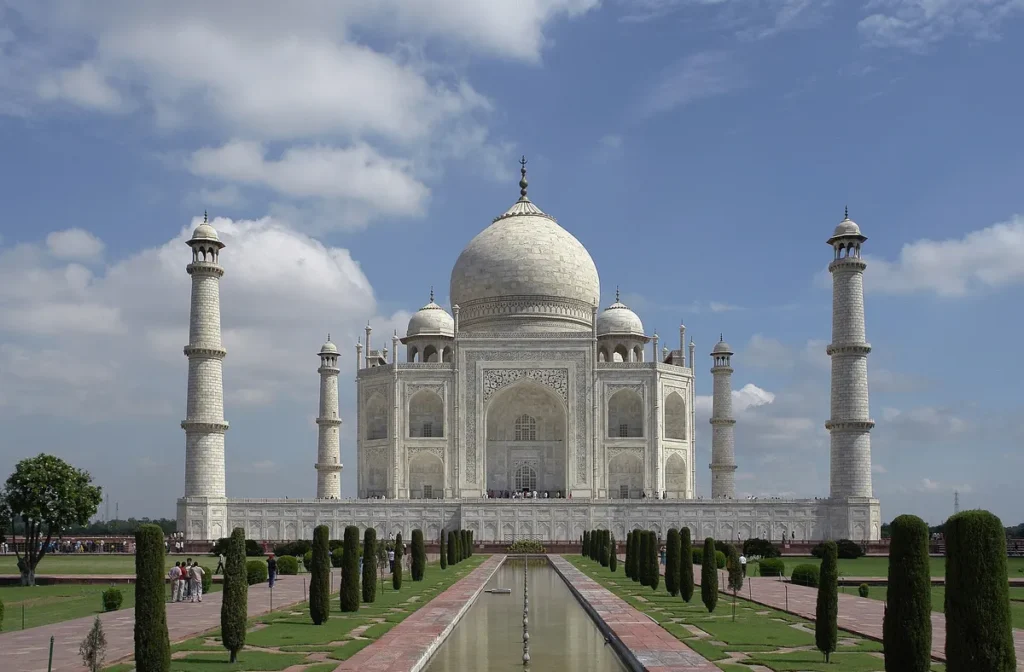
- Shah Jahan: Taj Mahal, Shahjahanabad, Peacock Throne.
- Aurangzeb (1658-1707): largest extent, Deccan wars, jizya reimposed (1679).
- 1526Babur wins at Panipat
- 1540Humayun loses to Sher Shah
- 1556Akbar; second Panipat
- 1605Jahangir
- 1628Shah Jahan
- 1658Aurangzeb
Mansabdari and jagirdari
Every officer held a mansab with two numbers: zat (personal rank and pay) and sawar (cavalry to maintain). Most were paid by jagirs, revenue assignments that were transferable, so no noble could build a local base. A jagirdar collected revenue; a zamindar had hereditary rights in land. The 2019 Prelims tested exactly this difference.
Land revenue
Under Akbar, Raja Todar Mal’s zabt (dahsala) system measured land, classified it by fertility and fixed cash rates on ten-year average produce. Other methods: batai (crop sharing) and kankut (estimation). The Ain-i-Akbari of Abul Fazl records it in detail.
- Land measured
- Average produce over ten years
- Revenue in cash
- Fixed and predictable
- Share of crop at harvest
- Varied each season
- Often paid in kind
- Open to dispute
Religion and culture
- Akbar abolished pilgrim tax (1563) and jizya (1564), debated at the Ibadat Khana (1575), and issued the mahzar (1579).
- Translation bureau: Mahabharata as Razmnama; Dara Shikoh translated the Upanishads (Sirr-i-Akbar).
- Painting: Mir Sayyid Ali and Abdus Samad under Humayun; Jahangir moved from manuscripts to albums and portraits (Mansur’s birds).
- Music: Tansen at Akbar’s court.
Decline
After 1707: wars of succession, the jagirdari crisis (too many mansabdars, too few productive jagirs), Maratha, Sikh and Jat rise, Nadir Shah’s sack of Delhi (1739), and the East India Company after Plassey (1757) and Buxar (1764). Bahadur Shah Zafar, the last emperor, was exiled after 1857.
Akbar’s religious policy
Akbar’s religious outlook changed over time. He abolished the pilgrim tax in 1563 and the jizya in 1564. In 1575 he built the Ibadat Khana at Fatehpur Sikri, where Sunni and Shia scholars, and later Hindus, Jains, Zoroastrians and Jesuit priests, debated faith. The Mahzar of 1579 claimed for him the right to decide among conflicting religious opinions. From these discussions emerged the idea of sulh-i-kul, or universal peace, a principle of tolerance applied in governance. The Din-i-Ilahi of 1582 was a small circle of disciples rather than a new religion. Akbar also had Sanskrit works such as the Mahabharata translated into Persian as the Razmnama.
Mughal architecture and painting
| Ruler | Architecture | Painting |
|---|---|---|
| Akbar | Humayun’s Tomb (by Hamida Banu Begum), Agra Fort, Fatehpur Sikri, Buland Darwaza | Hamzanama; studio under Mir Sayyid Ali and Abd al-Samad |
| Jahangir | Itimad-ud-Daula’s tomb with pietra dura (by Nur Jahan) | Peak: portraits and nature studies by Mansur and Abul Hasan |
| Shah Jahan | Taj Mahal, Red Fort, Jama Masjid | Formal court scenes |
| Aurangzeb | Bibi ka Maqbara, Badshahi Mosque | Patronage declined; artists moved to regional courts |
Mughal Empire: UPSC angle
For UPSC CSE
Prelims: rulers and events, terms (zat, sawar, zabt, jagir), art and music. Mains GS-I: Mughal architecture and painting, administrative continuity into the British period.
Mughal Empire UPSC PYQs (Prelims)
Questions UPSC has actually asked, from the official papers. Pick an option to check yourself.
With reference to Mughal India, what is/are the difference / differences between Jagirdar and Zamindar?
– 1. Jagirdars were holders of land assignments in lieu of judicial and police duties, whereas Zamindars were holders of revenue rights without obligation to perform any duty other than revenue collection.
– 2. Land assignments to Jagirdars were hereditary and revenue rights of Zamindars were not hereditary.
Select the correct answer using the code given below.
A jagir was the right to collect revenue from an area, given to a mansabdar for his salary and military service. Jagirs were transferable and not hereditary. A zamindar held hereditary rights over land revenue and also had to keep order and supply troops when called. Both statements get this wrong. Answer as per the official UPSC key · Battle IAS PYQ bankAnswer (d) & why
Ibadat Khana at Fatehpur Sikri was
Akbar built the Ibadat Khana (“house of worship”) in 1575. At first only Sunni scholars debated there. From 1578 Shias, Hindus, Jains, Zoroastrians and Jesuit priests joined. The debates led to the mahzar (1579) and his idea of sulh-i-kul. Answer as per the official UPSC key · Battle IAS PYQ bankAnswer (c) & why
Raju has ₹ 9000 with him and he wants to buy a mobile handset; but he finds that he has only 75% of the amount required to buy the handset. Therefore, he borrows ₹ 2000 from a friend. Then
Akbar’s studio illustrated long manuscripts like the Hamzanama and Akbarnama. Jahangir preferred albums (muraqqa) of single paintings: portraits, birds and animals, painted by artists such as Mansur and Abul Hasan. Jahangir boasted he could tell which artist had painted each face. Answer as per the official UPSC key · Battle IAS PYQ bankAnswer (a) & why
When a runner was crossing the 12 km mark, she was informed that she had completed only 80% of the race. How many kilometres was the runner supposed to run in this event?
Ramtanu Pandey got the title “Tansen” from Raja Vikramajit of Gwalior. Akbar called him to court in 1562 and gave him the title Mian. He sang dhrupads on gods and on his patrons and is credited with ragas such as Miyan ki Malhar and Darbari Kanada. Answer as per the official UPSC key · Battle IAS PYQ bankAnswer (b) & why
“Yogavasistha” was translated into Persian by Nizamuddin Panipati during the reign of :
Akbar’s translation bureau (Maktab Khana) put many Sanskrit works into Persian: the Mahabharata as Razmnama, the Ramayana, the Atharvaveda and the Lilavati. Nizamuddin Panipati made a Persian version of the Yogavasishtha in 1597, for Prince Salim. Dara Shukoh’s later Sirr-i-Akbar translated the Upanishads. Answer as per the official UPSC key · Battle IAS PYQ bankAnswer (a) & why
Mains PYQs on this topic
Questions from the official UPSC Mains papers (2023-2026 in the Battle IAS Mains bank), newest first. Each links to a model answer.
- UPSC Mains 2025 · GS Paper I · Q2 · 10 marks
Examine the main aspects of Akbar’s religious syncretism.
Quick quiz
In a mansab, “sawar” indicated
Zat was personal rank.Answer (b)
The zabt system of revenue is associated with
Dahsala, 1580.Answer (b)
Jizya was reimposed in 1679 by
Akbar had abolished it in 1564.Answer (c)
FAQs
What was Din-i-Ilahi?
A small spiritual discipline Akbar founded around 1582 for a select group of nobles, not a new religion imposed on subjects.
What is the difference between jagirdar and zamindar?
A jagirdar held a transferable right to collect revenue as salary; a zamindar held hereditary rights over land and its revenue share.
Who built Fatehpur Sikri?
Akbar, from 1571, near the shrine of Shaikh Salim Chishti.
Which Mughal ruler favoured albums and portraits?
Jahangir.
What was sulh-i-kul?
Akbar’s principle of universal peace, under which all religions were tolerated and the state did not discriminate among them.
Who wrote the Akbarnama?
Abul Fazl, whose Ain-i-Akbari forms its third volume.
Who introduced the rupiya coin later used by the Mughals?
Sher Shah Suri, who issued a standard silver rupiya that the Mughals continued.
Spotted an error? Tell us. We correct within 48 hours.
Image: Yann; edited by King of Hearts, Wikimedia Commons, CC BY-SA 4.0
How to use this in Mains
If asked: UPSC Mains 2025, GS-I: Examine the main aspects of Akbar’s religious syncretism.
Quote: “Akbar abolished pilgrim tax (1563) and jizya (1564), debated at the Ibadat Khana (1575), and issued the mahzar (1579).”
Use it: Your key facts for Akbar's syncretism; build sulh-i-kul around them.
In the news
Pollen study links Harappan decline to weak monsoon (5100–4000 BP)
A pollen study by the Birbal Sahni Institute of Palaeosciences links the shrinking of the Harappan Civilization to a weak Indian Summer Monsoon between about 5100 and 4000 years before present, the Science Ministry said on 29 July 2026. Sediments from Deoria Tal in the Garhwal Himalaya show an abrupt dry spell, the "4.2 ka event".
29 Jul 2026
Sarnath inscribed as India’s 45th UNESCO World Heritage Site
On 25 July 2026 the 48th World Heritage Committee in Busan inscribed the "Ancient Buddhist Site of Sarnath" on the UNESCO World Heritage List. It is India's 45th property. The serial site in Varanasi covers Chaukhandi Stupa and the Archaeological Remains of Sarnath, where the Buddha gave his first sermon.
25 Jul 2026
Rakhigarhi skeletal remains handed to Anthropological Survey of India
ASI handed human skeletal remains from Rakhigarhi, Haryana, to the Anthropological Survey of India under a new MoU, the Culture Ministry said on 22 June 2026. The 2025-26 dig at Mound No. 7 found eight burials; three complete skeletons plus fragments went to AnSI's Kolkata repository. Planned work includes aDNA, isotopes and palaeopathology with partner labs.
22 Jun 2026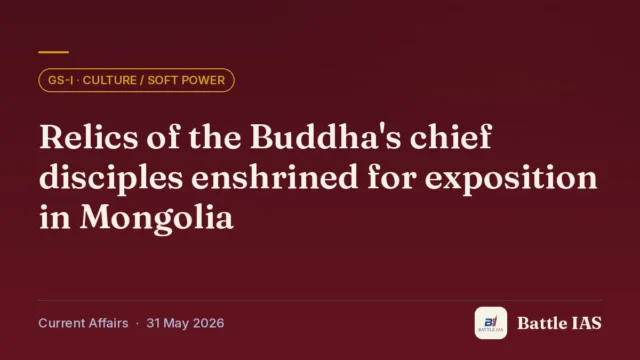
Relics of the Buddha’s chief disciples enshrined for exposition in Mongolia
The holy relics of Arhat Sariputra and Arhat Mahamoggallana, the Buddha's two chief disciples, were ceremonially enshrined at Gandantegchenling Monastery in Ulaanbaatar on Buddha Purnima (Vesak) 2026. Brought from India for a ten-day exposition from 31 May to 10 June 2026, they arrived on a special IAF IL-76 aircraft and had travelled abroad only once before, to Thailand in 2024.
31 May 2026