
Article 32 (Right to Constitutional Remedies): Meaning, Writs, Article 32 vs 226, Suspension and PIL (UPSC Notes + PYQs)
UPSC has already asked about this. Read the story with these questions in mind.
Background
A right is only as good as the remedy behind it. The framers knew from colonial experience that rights written on paper could be ignored by officials. So they did not leave enforcement to ordinary laws: they made the right to approach the Supreme Court itself a Fundamental Right. On 9 December 1948, defending draft Article 25 (now Article 32), B.R. Ambedkar told the Assembly that it was “the very soul of the Constitution and the very heart of it”. The writs borrowed from English law (prerogative writs) were given to the Supreme Court and, through Article 226, to the High Courts.
The four clauses
- 32(1): the right to move the Supreme Court by appropriate proceedings for enforcing Part III rights.
- 32(2): power to issue directions, orders or writs.
- 32(3): Parliament may give other courts these powers within their local limits (not yet done).
- 32(4): the right cannot be suspended except as the Constitution provides, that is, under Article 359 during a national emergency.
Article 32 vs Article 226
| Article 32 | Article 226 |
|---|---|
| Supreme Court | High Courts |
| Only for Fundamental Rights | Fundamental Rights “and for any other purpose” (legal rights too) |
| Itself a Fundamental Right; the Court cannot refuse merely because another remedy exists | Discretionary |
| Can be suspended under Article 359 | Not a Fundamental Right |
| Writ | Literal meaning | Issued against |
|---|---|---|
| Habeas corpus | "You may have the body" | Public authority or private person detaining someone |
| Mandamus | "We command" | Public official or body that fails a public duty |
| Prohibition | "To forbid" | Lower court or tribunal, before decision |
| Certiorari | "To be certified" | Lower court or tribunal, to quash an order |
| Quo warranto | "By what authority" | Person holding a public office illegally |
Key cases
In Romesh Thappar (1950) the Court called itself the protector of Fundamental Rights. During the 1975 Emergency, ADM Jabalpur (1976) held that habeas corpus could be suspended; the 44th Amendment (1978) then barred suspension of Articles 20 and 21 even in an emergency, and Puttaswamy (2017) expressly overruled ADM Jabalpur. L. Chandra Kumar (1997) held judicial review under Articles 32 and 226 to be basic structure. In practice the Court has also asked petitioners to go first to the High Court where that is more efficient.
The five writs at a glance
| Writ | Meaning | Issued against | Not available against |
|---|---|---|---|
| Habeas corpus | “Produce the body”: tests the legality of detention | Public authorities and private persons | Lawful detention, detention by court order, contempt |
| Mandamus | “We command”: orders a public official to do a public duty | Public officials, bodies, lower courts | Private persons, the President, Governors, discretionary duties |
| Prohibition | Stops a lower court or tribunal from exceeding jurisdiction | Judicial and quasi-judicial bodies only | Administrative bodies, legislatures |
| Certiorari | Quashes an order already passed without jurisdiction or with error of law | Judicial, quasi-judicial and (since 1991) administrative bodies affecting rights | Legislative bodies, private persons |
| Quo warranto | “By what authority”: tests the right to hold a public office | Holders of substantive public offices created by law | Ministerial or private offices |
Habeas corpus is the only writ any person, not just the detainee, can seek on another’s behalf, and quo warranto can likewise be sought by any interested person, which is why both are often asked in Prelims.
Why the Court sends petitioners to the High Court
Article 32 is itself a fundamental right, so in theory the Supreme Court cannot refuse a petition. In practice, with a backlog of over 80,000 cases, it often asks petitioners to approach the High Court under Article 226 first, since High Courts are closer to the facts and can hear a wider range of cases. Critics say this dilutes Dr Ambedkar’s “heart and soul” of the Constitution; supporters reply that a remedy that takes years to be heard is no remedy at all, and that Article 226 is broader in any case. The Court has also discouraged petitions filed for publicity and imposed costs for frivolous PILs.
- 1Violation of a group's Fundamental Rights
- 2Any public-spirited person files a petition or letter
- 3Court checks bona fides and public interest
- 4Court appoints amicus or commission to gather facts
- 5Directions issued and monitored (continuing mandamus)
Public interest litigation
From the late 1970s the Court relaxed locus standi so that anyone acting in good faith could approach it for those unable to do so, even by letter (epistolary jurisdiction). Bonded labour, undertrial prisoners and pollution cases came this way. Concerns now include frivolous and publicity PILs, which the Court sometimes dismisses with costs.
Article 32 during emergencies
During a national emergency the President may, under Article 359, suspend the right to move any court for enforcement of specified Fundamental Rights. This was done in 1962, 1971 and 1975. The 1975 order led to ADM Jabalpur (1976), where four of five judges held that no detenu could seek habeas corpus. Justice H.R. Khanna’s lone dissent cost him the chief justiceship. The 44th Amendment (1978) now protects Articles 20 and 21 from suspension, and Article 19 is suspended automatically only for an emergency declared on the ground of war or external aggression, not armed rebellion.
Limits the Court has drawn
- Res judicata applies: a petition dismissed on merits cannot be refiled (Daryao, 1961).
- Article 32 is for Fundamental Rights only; contractual or statutory disputes go elsewhere.
- Writs normally lie against the “State” under Article 12; private bodies performing public functions can be covered under Article 226.
- The Court may refuse when there is gross delay or suppression of facts.
- Compensation can be awarded for violation of Article 21 (Rudul Sah, 1983; Nilabati Behera, 1993).
Way forward
Keep PIL focused on those who cannot reach courts: prisoners, bonded labourers, the very poor. Screen PILs early, impose costs on frivolous ones, and encourage High Courts to take more Article 226 work so the Supreme Court can concentrate on constitutional questions.
PYQ trend
Prelims asks the five writs and the 32-vs-226 difference (2024 on prohibition). Mains linked PIL with judicial power in 2024. Practise one answer on “Article 32 as the heart and soul” with ADM Jabalpur and the 44th Amendment.
Article 32: UPSC angle
For UPSC CSE
Prelims: scope of 32 vs 226, suspension, the five writs. Mains GS-II: PIL, judicial activism, ADM Jabalpur and the 44th Amendment.
Article 32 UPSC PYQs (Prelims)
Questions UPSC has actually asked, from the official papers. Pick an option to check yourself.
A Writ of Prohibition is an order issued by the Supreme Court or High Courts to :
Prohibition is issued by a higher court to a lower court or tribunal, telling it to stop a case it has no power to hear. It is issued only to judicial and quasi-judicial bodies, never to an officer or a legislature. Think of it as “stop before you decide”. Certiorari is “your decision is quashed”. Answer as per the official UPSC key · Battle IAS PYQ bankAnswer (c) & why
Mains PYQs on this topic
Questions from the official UPSC Mains papers (2023-2026 in the Battle IAS Mains bank), newest first. Each links to a model answer.
- UPSC Mains 2024 · GS Paper II · Q14 · 15 marks
Explain the reasons for the growth of public interest litigation in India. As a result of it, has the Indian Supreme Court emerged as the world’s most powerful judiciary?
Quick quiz
Who called Article 32 the “heart and soul” of the Constitution?
In the Constituent Assembly, December 1948.Answer (b)
High Courts can issue writs for
“For any other purpose” in Article 226.Answer (b)
Which case was overruled in Puttaswamy (2017)?
On suspension of habeas corpus.Answer (b)
FAQs
Is Article 32 available to non-citizens?
Yes, for those Fundamental Rights that are available to all persons, such as Article 21.
Can Article 32 be suspended?
Only under Article 359 during a national emergency, and never for Articles 20 and 21.
Why is Article 226 wider?
It covers legal rights besides Fundamental Rights.
What is epistolary jurisdiction?
Treating a letter to the Court as a writ petition, used in early PIL cases.
Can a writ be issued against a private company?
Under Article 32, generally only if it is “State” under Article 12. Under Article 226 a writ can go to any person or authority performing a public duty.
What is continuing mandamus?
A practice where the Court keeps a case open and issues orders over time to monitor compliance.
Spotted an error? Tell us. We correct within 48 hours.
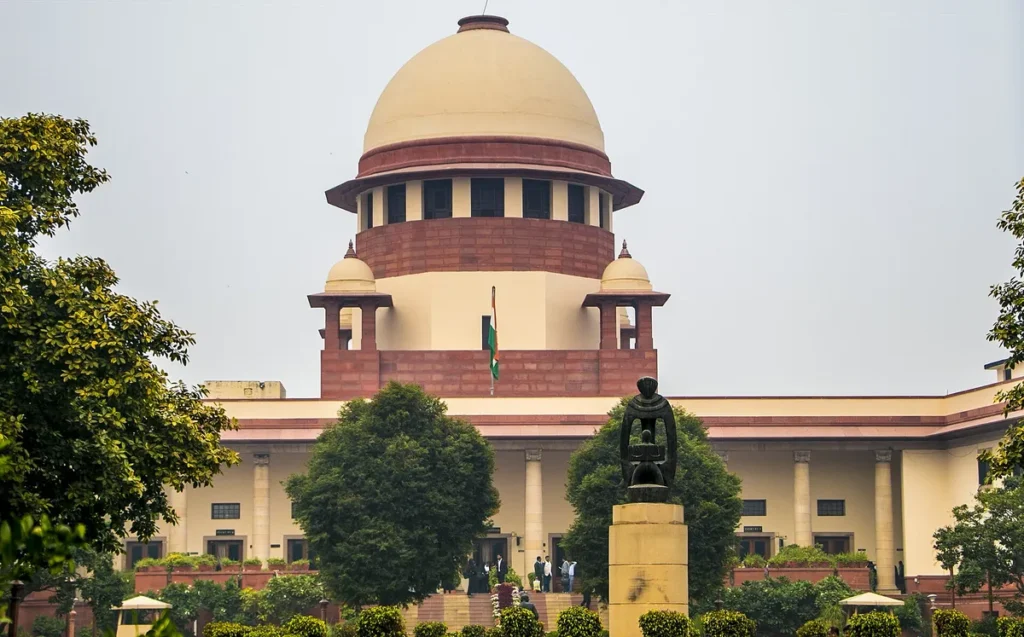
Image: Subhashish Panigrahi, Wikimedia Commons, CC BY-SA 4.0
How to use this in Mains
If asked: UPSC Mains 2024, GS-II: Explain the reasons for the growth of public interest litigation in India. As a result of it, has the Indian Supreme Court emerged as the world’s most powerful judiciary?
Quote: “Keep PIL focused on those who cannot reach courts: prisoners, bonded labourers, the very poor.”
Use it: Use as the balanced way forward on PIL.
In the news

Supreme Court: no prior approval under Section 17A needed to probe a bribe demand
In a judgment of 16 October 2026, a Supreme Court Bench of Justices S.V.N. Bhatti and N.V. Anjaria held that investigating a bribe demand by a public servant does not need prior approval under Section 17A of the Prevention of Corruption Act. Asking for a bribe, the court said, is not part of discharging official duties.
19 Oct 2026
Supreme Court: children have a right to the internet, and platforms must block child abuse material
In a judgment of 15 October 2026, the Supreme Court said that the right to access and use the internet is a fundamental right of every person, children included, under Article 21 read with Article 19(1)(a). So the answer to online danger is not to lock children out but to go after the abusive content and the platforms that fail to remove it. The Court ordered a National Hash and URL List Database, two-hour reporting of unknown abuse material, and loss of revenue for platforms that profit from it through paywalls.
18 Oct 2026
Three High Court Chief Justices appointed as Supreme Court judges
On 5 October 2026 the President appointed three High Court Chief Justices as judges of the Supreme Court: Justice Sunita Agarwal (Gujarat), Justice Devendra Kumar Upadhyaya (Delhi) and Justice Aparesh Kumar Singh (Telangana). The first two have Allahabad as their parent High Court and the third Jharkhand.
5 Oct 2026
₹1,423 crore over three years for implementing PCR and SC/ST Atrocities Acts; 217 exclusive special courts
The Centre released ₹1,423.30 crore to States and UTs over 2022-23 to 2024-25 to implement the Protection of Civil Rights Act, 1955 and the SC/ST (Prevention of Atrocities) Act, 1989. States report 217 Exclusive Special Courts in 15 States and UTs. Yet 65,646 cases were registered in 2024 and 3,92,006 were pending trial at year end.
1 Oct 2026