
Supreme Court moots allowing only BS-VI vehicles into Delhi
The Supreme Court on Monday, 23 November 2026, orally mooted allowing only BS-VI, or Bharat Stage 6, emission-norm-compliant vehicles into Delhi to curb air pollution, The Hindu reported. The Commission for Air Quality Management in the National Capital Region and Adjoining Areas, and the Union government, have identified vehicle emissions as one of the primary causes of the recurring pollution crisis in Delhi. Justice Joymalya Bagchi, part of a three-judge Bench headed by Chief Justice of India Surya Kant, told the Commission and the Centre, both represented by Additional Solicitor General Aishwarya Bhati, that the Court would examine restricting vehicular traffic in Delhi, if not the National Capital Region, to only BS-VI vehicles. BS-VI vehicles are those manufactured, sold and registered in India that comply with the stricter emission standards introduced on 1 April 2020; they align closely with Euro 6 norms. The Court also stressed the need for a long-term plan to keep polluting commercial vehicles out of Delhi without interrupting supplies of essential commodities. The Chief Justice asked whether warehouses could be set up at the borders so that goods could come into the city in battery-operated or other non-polluting vehicles, and said such an arrangement may need up to five years. The Court directed Haryana, Punjab, Uttar Pradesh and other States concerned to file status reports on steps taken to reduce particulate pollution across the National Capital Region.
- What the Court said
- Orally mooted, on 23 November 2026, allowing only BS-VI vehicles into Delhi; this was not reported as a final order
- Bench
- Chief Justice of India Surya Kant, with Justice Joymalya Bagchi, on a three-judge Bench
- BS-VI
- Emission standards introduced on 1 April 2020, aligned closely with Euro 6
- Directions
- Haryana, Punjab, Uttar Pradesh and other concerned States to file status reports on reducing particulate pollution in the National Capital Region
What did the Supreme Court suggest, and what did it actually direct?
Delhi’s winter air is a familiar crisis. The Supreme Court has now said out loud that it is considering a rule that would let only BS-VI vehicles into the city, and it has asked neighbouring States, including Uttar Pradesh, to explain what they are doing about particulate pollution.
- The Supreme Court on 23 November 2026 orally mooted allowing only BS-VI vehicles into Delhi to curb air pollution. The report does not present this as a final, signed order.
- The Commission for Air Quality Management in the National Capital Region and Adjoining Areas, and the Union government, have identified vehicle emissions as one of the primary causes of Delhi’s recurring pollution crisis.
- Justice Joymalya Bagchi, on a three-judge Bench headed by Chief Justice of India Surya Kant, said the Court would examine restricting traffic in Delhi, if not the National Capital Region, to only BS-VI vehicles. Additional Solicitor General Aishwarya Bhati appeared for the Commission and the Centre.
- BS-VI standards were introduced on 1 April 2020 and align closely with Euro 6 norms. They cut harmful exhaust pollutants compared with older BS-IV vehicles.
- The Chief Justice asked whether warehouses at the borders could allow goods to enter the city in battery-operated or other non-polluting vehicles, and said such an arrangement might take up to five years. The Court directed Haryana, Punjab, Uttar Pradesh and other concerned States to file status reports on steps to reduce particulate pollution in the National Capital Region.
Why is this not yet a ban, and why do commercial vehicles complicate it?
An oral observation is a signal of what the Court is considering. It binds no motorist until it is turned into a clear direction or order. The Hindu report is careful to say the Court “orally mooted” the idea and that it would “examine” a restriction. That wording should be kept.
The Chief Justice also pointed to a practical conflict: diesel trucks are a large source of pollution, but Delhi also needs a steady flow of vegetables, fruit and other essential goods. A hard stop on commercial traffic could ease emissions and, at the same time, disrupt daily supply. The warehouse-and-electric-vehicle idea is an attempt to imagine a later arrangement, not a plan already in place for this winter.
The Court also sought accountability from National Capital Region States and asked why they were not more active in the process. The status-report direction to Haryana, Punjab, Uttar Pradesh and other concerned States is the concrete step that came out of this brief hearing.
What was said, and what was directed
| Item | What the report records |
|---|---|
| BS-VI-only idea | Orally mooted for Delhi; the Court said it would examine the question |
| BS-VI start date | 1 April 2020; aligned closely with Euro 6 |
| Commercial vehicles | Need a long-term plan so essential goods still arrive |
| Five-year idea | Border warehouses and battery-operated or non-polluting last-mile vehicles |
| Direction issued | Status reports from Haryana, Punjab, Uttar Pradesh and other concerned States |
Which bodies and standards are in play?
- The matter was heard by a three-judge Bench of the Supreme Court, headed by the Chief Justice of India.
- The Commission for Air Quality Management in the National Capital Region and Adjoining Areas is the statutory body named alongside the Union government.
- Bharat Stage VI emission standards took effect on 1 April 2020 and are described as aligning closely with Euro 6.
- Haryana, Punjab, Uttar Pradesh and other concerned States have been directed to file status reports on particulate pollution in the National Capital Region.
Why does the Supreme Court’s oral idea of a BS-VI-only rule for Delhi matter?
| Angle | What to note |
|---|---|
| Prelims | Orally mooted BS-VI-only entry into Delhi; standards from 1 April 2020; status reports from Haryana, Punjab and Uttar Pradesh. |
| GS-III: environment | Vehicle emissions are named as a primary cause; commercial diesel traffic is both a pollutant and a supply line. |
| GS-II: judiciary | An oral observation is not yet a ban. The concrete direction is the demand for State status reports. |
| State angle | Uttar Pradesh is among the States told to explain what it is doing about particulate pollution in the National Capital Region. |
What are the problems with the Supreme Court’s oral idea of a BS-VI-only rule for Delhi?
- Writing this as if only BS-VI vehicles are already barred from Delhi would be wrong. The Court has mooted the idea and said it will examine it.
- A five-year warehouse plan, as the Chief Justice himself noted, is not available for this winter or necessarily the next.
- The report does not set a date on which a BS-VI-only rule would begin, so no such date should be added.
What should be done next on the Supreme Court’s oral idea of a BS-VI-only rule for Delhi?
- Keep the distinction exact: an oral suggestion, plus a direction to file status reports.
- Remember 1 April 2020, Euro 6, the Commission for Air Quality Management, and the three States named.
- Revise the tension between polluting trucks and essential supplies, and the border-warehouse idea.
- Watch later hearings for an actual order, which this 23 November hearing did not itself report.
What can Prelims ask on the Supreme Court’s oral idea of a BS-VI-only rule for Delhi?
Prelims probability: High. This was an oral suggestion, not a final order. BS-VI norms began on 1 April 2020, the Court has asked Haryana, Punjab, the State and other concerned States for status reports, and it floated a five-year idea of border warehouses and non-polluting last-mile vehicles.
- On 23 November 2026 the Supreme Court orally mooted allowing only BS-VI vehicles into Delhi. This was not reported as a final order.
- BS-VI emission standards were introduced on 1 April 2020 and align closely with Euro 6 norms.
- The Bench was headed by Chief Justice of India Surya Kant, with Justice Joymalya Bagchi also named.
- The Court directed Haryana, Punjab, Uttar Pradesh and other concerned States to file status reports on reducing particulate pollution in the National Capital Region.
- The Chief Justice floated a longer-term idea of warehouses at the borders and goods moving into the city in battery-operated or other non-polluting vehicles, possibly over five years.
How to write about the Supreme Court’s oral idea of a BS-VI-only rule for Delhi in Mains
Practice question (15 marks, 250 words): The Supreme Court has orally mooted a BS-VI-only rule for vehicles entering Delhi. Discuss why this is not yet a ban, and how the Court tried to balance clean air with the supply of essential goods.
- Open with the 23 November 2026 hearing and the fact that the idea was orally mooted, not issued as a final order.
- Define BS-VI: standards from 1 April 2020, aligned closely with Euro 6.
- Explain why vehicle emissions, and diesel commercial traffic in particular, sit at the centre of the problem.
- Set out the warehouse-and-electric last-mile idea, and the Court’s own caution that this may take up to five years.
- Close with the status-report direction to Haryana, Punjab, Uttar Pradesh and other concerned States.
Ready lines for your answer
- An oral observation tells us what a court is considering; it does not, by itself, change the rules on the road.
- Keeping polluting trucks out of Delhi is harder than it sounds, because the same trucks also bring in food and other essentials.
Quotable data pointThe Hindu, 23 November 2026: Supreme Court orally mooted allowing only BS-VI vehicles into Delhi; BS-VI standards from 1 April 2020; status reports sought from Haryana, Punjab, Uttar Pradesh and other concerned States.
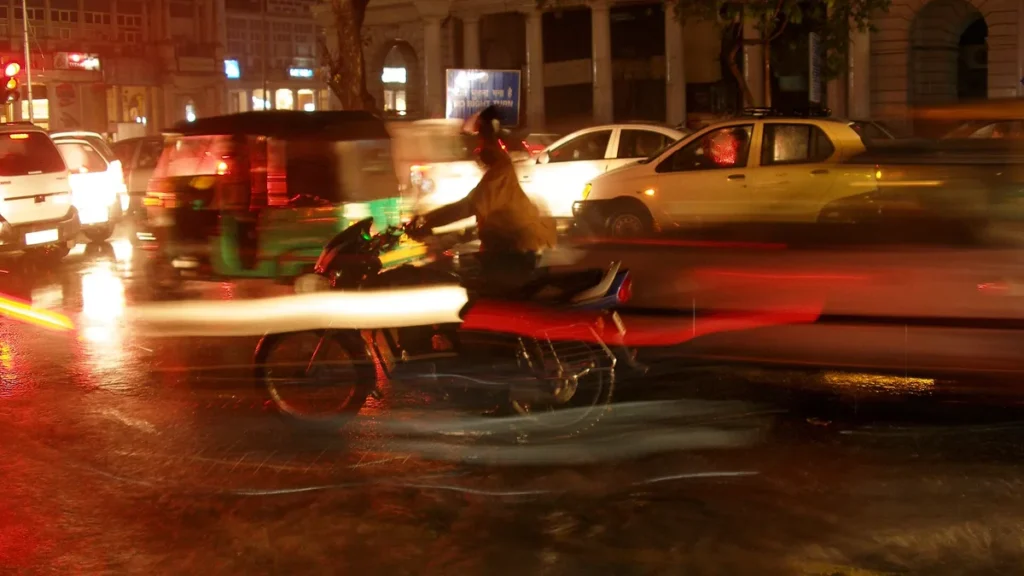
Photo: Vyacheslav Argenberg, CC BY 4.0, via Wikimedia Commons
Exam angle
Prelims: oral suggestion, not a final ban; BS-VI from 1 April 2020; Euro 6; status reports from Haryana, Punjab and Uttar Pradesh; a five-year warehouse idea. · Mains GS-III: how a court balances clean air with the flow of essential goods into a capital city.
Practice MCQs
Original practice questions (not PYQs).
The Supreme Court’s observation on 23 November 2026 about allowing only BS-VI vehicles into Delhi was
Answer (b) & explanation
The Court orally mooted the idea and said it would examine restricting traffic in Delhi, if not the National Capital Region, to only BS-VI vehicles. It was not reported as a final order.
Consider the following statements:
1. BS-VI emission standards were introduced on 1 April 2020 and align closely with Euro 6 norms.
2. The Court directed Haryana, Punjab, Uttar Pradesh and other concerned States to file status reports on steps to reduce particulate pollution in the National Capital Region.
3. The Chief Justice floated a longer-term idea of warehouses at the borders and goods entering the city in battery-operated or other non-polluting vehicles.
How many of the above statements are correct?
Answer (c) & explanation
All three statements are correct, as reported by The Hindu on 23 November 2026.
Questions students ask about this
Has the Supreme Court already banned non-BS-VI vehicles from Delhi?
No. On 23 November 2026 it orally mooted the idea and said it would examine such a restriction.
When did BS-VI standards begin?
On 1 April 2020. They align closely with Euro 6 norms.
Which States were asked to file status reports?
Haryana, Punjab, Uttar Pradesh and other States concerned, on steps to reduce particulate pollution in the National Capital Region.
Who headed the Bench?
Chief Justice of India Surya Kant. Justice Joymalya Bagchi was also named.
What idea was suggested for commercial goods?
Warehouses at the borders, with goods then coming into the city in battery-operated or other non-polluting vehicles, possibly over a five-year horizon.