
Bhutan to place India-linked Buddha relics in 108 stupas
Bhutan is building a new city, Gelephu Mindfulness City, on its border with Assam. Monks and volunteers are building 108 stupas at once along the Mau Chhu river there, and most of the Buddha relics placed inside came from India. Read it to revise stupas, Buddhism in Bhutan and India–Bhutan ties.
- Number
- 108 stupas
- Stretch
- 12 km of the Mau Chhu river
- City
- Gelephu Mindfulness City
- Borders
- Chirang district, Assam
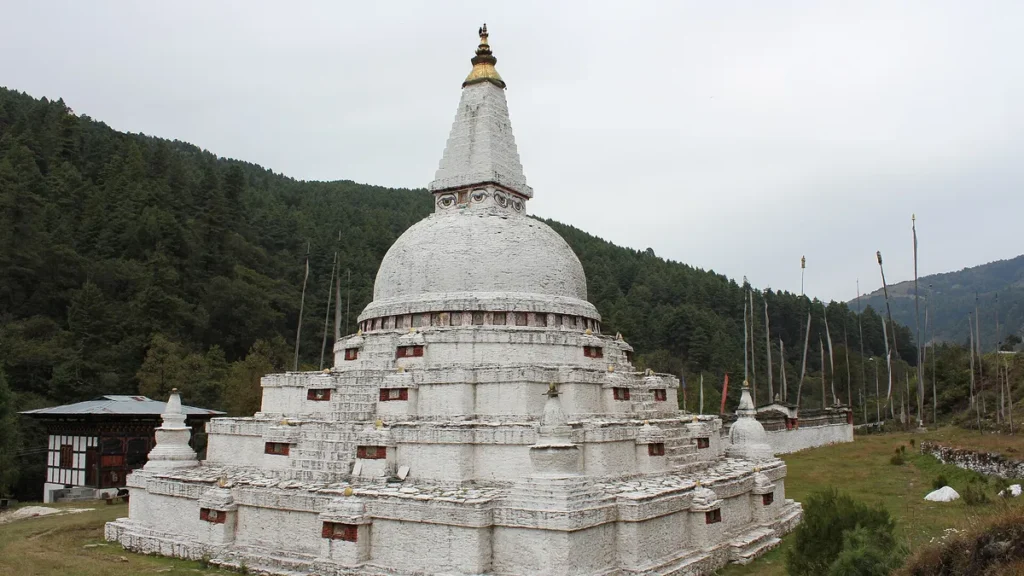
The Gelephu stupas: what happened?
The number 108 is sacred in Buddhism and Hinduism. Building 108 stupas together is meant to give the new city a spiritual base.
- Monks and volunteers are building 108 jangchub chortens (stupas of enlightenment) along a 12 km stretch of the Mau Chhu river in Gelephu.
- The relics were donated by Buddhists in Malaysia, Singapore, Taiwan, Thailand and Bhutan; most were sourced from India.
- Gelephu Mindfulness City is King Jigme Khesar Namgyel Wangchuck’s plan for a spirituality-driven global economic hub.
- It lies about 240 km south-east of Thimphu, bordering Assam’s Chirang district.
What is a stupa?
A stupa is a dome-shaped mound that holds relics. Such burial mounds existed before Buddhism, but Buddhists adopted them to hold relics of the Buddha and great monks.
Emperor Ashoka is said to have spread stupas across India. Famous examples are Sanchi (Madhya Pradesh), Bharhut and Amaravati. A stupa has a dome (anda), a railing (vedika), gateways (torana) and an umbrella on top (chhatra).
Bhutan follows Vajrayana Buddhism, mainly the Drukpa Kagyu school. In Bhutan and Tibet, stupas are called chortens.
Buddhism is a strong cultural link between India and Bhutan, along with hydropower, trade and the 2007 Friendship Treaty.
What are the parts of a stupa?
| Part | Meaning | Note |
|---|---|---|
| Anda | Dome | Holds relics |
| Harmika | Railed box on top | Abode of gods |
| Chhatra | Umbrella | Sign of honour |
| Torana | Gateway | Sanchi’s are famous |
Which laws and Articles apply?
- India–Bhutan Friendship Treaty (2007).
- Antiquities and Art Treasures Act, 1972: rules on export of antiquities from India.
- Sanchi: UNESCO World Heritage Site (1989).
- Gelephu Mindfulness City: announced by Bhutan’s King in December 2023.
Why does the Gelephu stupas matter?
| Angle | What to note |
|---|---|
| Culture | Shows India’s role as the land of the Buddha. |
| Diplomacy | Buddhist heritage strengthens soft power. |
| Economy | Gelephu is planned as a hub linked to Assam. |
| Exam | Stupa architecture is a common Prelims topic. |
What are the problems with the Gelephu stupas?
- Moving relics abroad raises questions about heritage protection.
- A big new city may strain the local environment.
- Benefits for nearby Assam are still unclear.
- Buddhist tourism circuits in India are underused.
What should be done next on the Gelephu stupas?
- Build Buddhist tourism links between Gelephu and Assam.
- Document and protect relics carefully.
- Improve road and rail links to Gelephu.
- Promote India’s Buddhist circuit with neighbours.
What can Prelims ask on the Gelephu stupas?
Prelims probability: Expect a question on stupas: relic mounds older than Buddhism, adopted by Buddhists; famous ones at Sanchi and Bharhut.
- Stupa: relic mound older than Buddhism, adopted by Buddhists.
- Famous stupas: Sanchi, Bharhut, Amaravati.
- Parts: anda, harmika, chhatra, vedika, torana.
- Bhutan follows Vajrayana Buddhism (Drukpa Kagyu).
- Gelephu Mindfulness City borders Assam’s Chirang district.
How to write about the Gelephu stupas in Mains
Practice question (15 marks, 250 words): Buddhist heritage is an important tool of India’s soft power in its neighbourhood. Discuss.
- Intro: 108 stupas at Gelephu with India-linked relics.
- India as the land of the Buddha; sacred sites.
- Use in ties with Bhutan and South-East Asia.
- Challenges: heritage protection, tourism gaps.
- Conclusion: build Buddhist circuits and cultural links.
Ready lines for your answer
- Shared faith is a bridge older than any treaty.
- Heritage diplomacy works best with protected heritage.
Quotable data point108 stupas along a 12 km stretch of the Mau Chhu river.
Photo: Arian Zwegers from Brussels, Belgium, CC BY 2.0, via Wikimedia Commons
Exam angle
Prelims: stupa parts, famous stupas, Vajrayana. · Mains GS-I/II: Buddhist art and cultural diplomacy.
Practice MCQs
Original practice questions (not PYQs).
Which form of Buddhism is mainly followed in Bhutan?
Answer (a) & explanation
Bhutan follows Vajrayana Buddhism of the Drukpa Kagyu school, a tantric form of Mahayana.
Questions students ask about this
How many stupas is Bhutan building at Gelephu?
108 stupas, along a 12 km stretch of the Mau Chhu river.
Where did most of the relics come from?
Most were sourced from India, donated by Buddhists in several countries.
What is Gelephu Mindfulness City?
A new city planned by Bhutan's King as a spirituality-driven global economic hub on the border with Assam.
Which school of Buddhism does Bhutan follow?
Vajrayana Buddhism, mainly the Drukpa Kagyu school.