
National Highways get free-flow tolling design rules
The National Highways Authority of India (NHAI) has issued design rules for Multi-Lane Free Flow (MLFF) tolling — tolls collected without any barrier, while vehicles keep moving. Read it to revise NHAI, FASTag and smart highway tech.
- System
- Multi-Lane Free Flow (MLFF)
- Applies to
- Four-lane and wider National Highways
- Tech
- FASTag + number-plate cameras
- Issued by
- NHAI
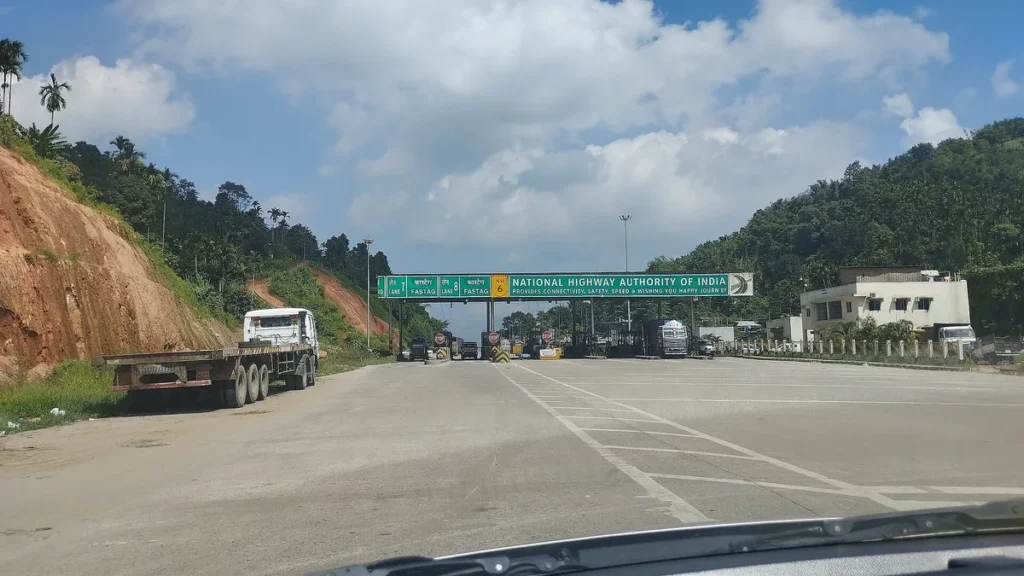
Free-flow tolling: what happened?
Imagine driving past a toll without stopping at all. That is what India’s new rules plan for.
- NHAI issued guidelines for barrier-less MLFF tolling on four-lane and wider National Highways.
- They set a standard layout for gantries, lighting and Variable Message Signs.
- The rules apply to future and under-construction projects.
- MLFF plazas need fewer lanes than old barrier plazas.
- Tolls are collected through FASTag and Automatic Number Plate Recognition (ANPR) cameras.
How do tolls work now?
FASTag is a sticker with an RFID chip linked to a bank account. It was made compulsory on National Highways in 2021.
Even with FASTag, cars slow down at barriers, causing queues and fuel waste.
In free flow, overhead gantries read the tag and the number plate, so the toll is cut while the car moves.
Barrier vs free flow
| Feature | Barrier toll | Free flow |
|---|---|---|
| Stop needed | Yes (slow down) | No |
| Lanes | Many | Fewer |
| Tools | FASTag at booth | FASTag + ANPR on gantry |
Which laws and Articles apply?
- National Highways Authority of India Act, 1988: set up NHAI.
- National Highways Act, 1956: Centre’s power over national highways.
- National Highways Fee Rules, 2008: how tolls are charged.
- Union List: national highways are a Union subject.
Why does barrier-less tolling matter?
| Angle | What to note |
|---|---|
| Time | No queues at toll plazas. |
| Fuel | Less idling saves fuel and cuts smoke. |
| Revenue | Fewer leaks in toll collection. |
| Prelims | FASTag, RFID, NHAI basics. |
What are the problems with barrier-less tolling?
- Wrong number-plate reads can cause wrong fines.
- Vehicles without FASTag need a fair recovery system.
- Privacy concerns over camera data.
- Old plates may not be machine-readable.
What should be done next on barrier-less tolling?
- High-security number plates for all vehicles.
- Easy online appeal for wrong charges.
- Clear data-privacy rules.
- Pilot first, then scale.
What can Prelims ask on barrier-less tolling?
Prelims probability: Medium — free-flow tolling and FASTag are everyday-visible; fewer direct past questions than food or polity themes.
- MLFF = barrier-less tolling.
- FASTag uses RFID.
- ANPR = Automatic Number Plate Recognition.
- NHAI Act, 1988.
- National highways: Union List.
How to write about barrier-less tolling in Mains
Practice question (15 marks, 250 words): Technology-based tolling can make highways faster and fairer. Discuss the opportunities and challenges of free-flow tolling in India.
- Intro: NHAI MLFF rules.
- How it works.
- Benefits: time, fuel, revenue.
- Challenges: errors, privacy.
- Conclusion: smart, fair tolls.
Ready lines for your answer
- A toll that does not stop traffic saves both time and fuel.
- Smart roads need fair rules for mistakes.
Quotable data pointMLFF rules apply to four-lane and wider National Highways.
Photo: Arindambasu2, CC BY-SA 4.0, via Wikimedia Commons
Exam angle
Prelims: FASTag, RFID, NHAI. · Mains GS-III: infrastructure and technology.
Practice MCQs
Original practice questions (not PYQs).
Multi-Lane Free Flow tolling on National Highways means:
Answer (b) & explanation
Multi-Lane Free Flow is barrier-less tolling using gantries, FASTag electronic toll tags and automatic number-plate recognition so vehicles need not stop.
Questions students ask about this
What is MLFF tolling?
Toll collection without barriers, while vehicles keep moving.
What technology does it use?
FASTag (RFID) and number-plate cameras on overhead gantries.
Which roads are covered?
Four-lane and wider National Highways, future and under-construction.
Who issued the rules?
The National Highways Authority of India.