
India bans export of battery black mass
The Directorate General of Foreign Trade has banned the export of lithium-ion battery black mass with immediate effect, changing its export policy from free to prohibited on 10 November. Black mass is the dark powder left after shredding used lithium-ion batteries and factory battery waste; it holds lithium, cobalt, nickel, manganese and graphite, minerals for which India still depends heavily on imports. The Commerce Ministry says the ban will give local recyclers a steady feedstock. Read it to revise critical minerals, extended producer responsibility and battery recycling.
- Decision
- Export of lithium-ion battery black mass prohibited, 10 November 2026
- Earlier policy
- Export was free; it is now prohibited with immediate effect
- What black mass holds
- Lithium, cobalt, nickel, manganese and graphite
- Why now
- Domestic recyclers were short of feedstock, and some even had to import it
Battery black-mass export ban: what happened?
India has stopped a dark powder rich in battery metals from leaving the country, so that recyclers at home can use it first.
- The Directorate General of Foreign Trade has banned the export of lithium-ion battery black mass with immediate effect, changing its export policy from free to prohibited on 10 November.
- Black mass is the dark powder left after shredding used lithium-ion batteries and factory battery waste. It holds lithium, cobalt, nickel, manganese and graphite.
- India depends heavily on imports for these minerals. Its recycling plants have grown, but they run below capacity because black mass made in India was going abroad, and some recyclers even had to import it.
- The Commerce Ministry says the ban will give local recyclers steady raw material, raise their capacity use, and bring more investment and jobs.
What is black mass, and why are these minerals “critical”?
A used lithium-ion battery is first discharged, dismantled and shredded. The dark powder that remains — black mass — still contains the valuable cathode and anode materials. Recovering them is cheaper, and often cleaner, than opening a new mine.
Lithium, cobalt, nickel, manganese and graphite are called critical minerals because they are essential for electric vehicles, grid storage and electronics, and because supply is concentrated in a few countries. India is a member of the Minerals Security Partnership, a grouping that seeks more secure and diversified supply.
Extended producer responsibility, including under the Battery Waste Management Rules, makes companies that put batteries on the market responsible for collecting and recycling them at the end of life.
Trade policy can support that domestic loop. As long as export of black mass was free, a raw material produced in India could leave before local plants had used it.
What changed on 10 November
| Item | Position |
|---|---|
| Product | Lithium-ion battery black mass |
| Earlier export policy | Free |
| New export policy | Prohibited, with immediate effect |
| Authority | Directorate General of Foreign Trade, Commerce Ministry |
Which rules and bodies apply?
- Directorate General of Foreign Trade: export policy for black mass, now prohibited.
- Battery Waste Management Rules and extended producer responsibility for used batteries.
- Minerals Security Partnership, of which India is a member.
- Commerce Ministry policy on recycling capacity and critical-mineral security.
Why does the ban on battery black-mass exports matter?
| Angle | What to note |
|---|---|
| Economy | Keeps battery metals in India instead of shipping out a strategic feedstock. |
| Environment | Recycling cuts the need for new mining and deals with a growing waste stream. |
| Security | Critical minerals sit at the centre of electric mobility and energy storage. |
| Prelims | Black mass composition, DGFT ban, extended producer responsibility, Minerals Security Partnership. |
What are the problems with the ban on battery black-mass exports?
- A ban works only if collection of used batteries is strong; otherwise plants may still run short.
- Recycling capacity and environmental standards have to keep pace with the new feedstock.
- India will still import many of these minerals until recovery and mining both grow.
- Illegal export or mis-classification of black mass will need close watch at the ports.
What should be done next on the ban on battery black-mass exports?
- Enforce extended producer responsibility so that used batteries actually reach recyclers.
- Help plants raise recovery rates for lithium, cobalt, nickel, manganese and graphite.
- Publish clear HS-code guidance so the ban is not evaded by a change of label.
- Pair the trade ban with investment in safer, cleaner recycling technology.
What can Prelims ask on the ban on battery black-mass exports?
Prelims probability: High. Critical minerals are a recent favourite (2025 Minerals Security Partnership, 2025 battery elements; the State exam asked lithium in 2023). Fresh first-ever export ban on black mass. Testable facts: lithium, cobalt, nickel, manganese, graphite; extended producer responsibility.
- Export of lithium-ion battery black mass prohibited from 10 November 2026.
- Black mass holds lithium, cobalt, nickel, manganese and graphite.
- Directorate General of Foreign Trade changed the policy from free to prohibited.
- Extended producer responsibility applies to battery waste.
- India is a member of the Minerals Security Partnership.
How to write about the ban on battery black-mass exports in Mains
Practice question (15 marks, 250 words): India has prohibited the export of lithium-ion battery black mass. Discuss the significance of this step for critical-mineral security and for the circular economy in battery waste.
- Intro: 10 November ban; black mass as a feedstock, not mere waste.
- Why the minerals matter and why India imports them.
- Recycling capacity, extended producer responsibility and the Minerals Security Partnership.
- Risks: collection gaps, standards and leakage.
- Way forward: enforcement, technology and domestic recovery.
Ready lines for your answer
- Black mass is a mine above the ground, if a country chooses to keep it.
- A recycling plant without feedstock is only a building.
Quotable data pointBan from 10 Nov 2026; lithium, cobalt, nickel, manganese, graphite; policy changed from free to prohibited.
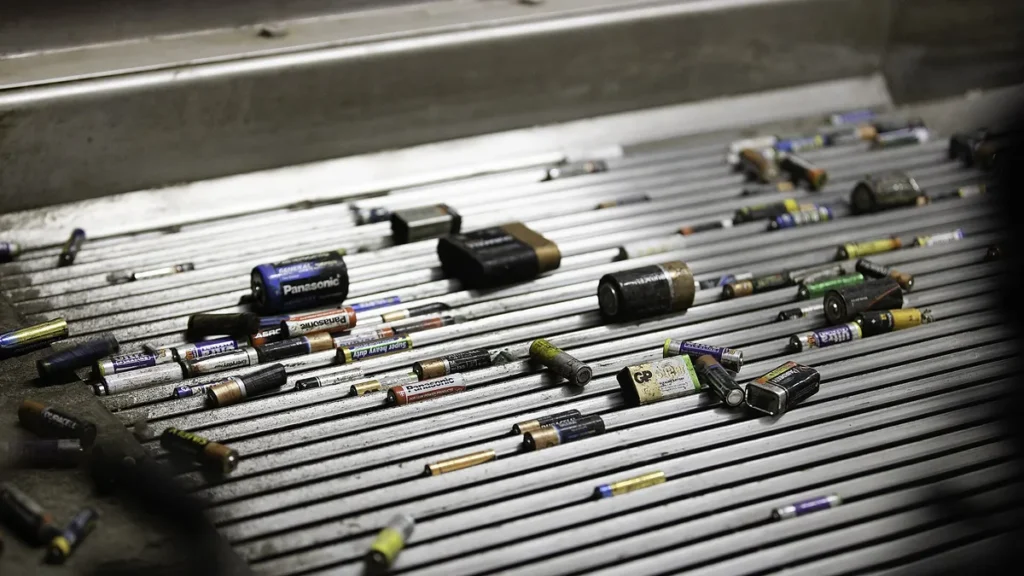
Photo: Bebat organisation, CC BY 4.0, via Wikimedia Commons
Exam angle
Prelims: black mass minerals, DGFT ban, Minerals Security Partnership. · Mains GS-III: critical minerals and recycling.
Practice MCQs
Original practice questions (not PYQs).
Lithium-ion battery 'black mass', whose export India banned in November 2026, contains recoverable quantities of which of the following?
Answer (a) & explanation
Black mass is the powder from shredded lithium-ion batteries and contains lithium, cobalt, nickel, manganese and graphite. The banned item specifically excludes waste containing lead, cadmium or mercury.
Consider the following statements:
1. India is self-sufficient in lithium, cobalt and nickel.
2. Lithium-ion battery black mass is rich in lead, cadmium and mercury.
3. The export ban on black mass was issued by the Bureau of Indian Standards.
How many of the above statements are correct?
Answer (d) & explanation
None is correct. India depends heavily on imports of lithium, cobalt and nickel; black mass contains lithium, cobalt, nickel and manganese; the ban was issued by the Directorate General of Foreign Trade.
Questions students ask about this
What did the government ban?
Export of lithium-ion battery black mass, with immediate effect from 10 November 2026; the export policy changed from free to prohibited.
What is black mass?
The dark powder left after used lithium-ion batteries and factory battery waste are shredded. It contains lithium, cobalt, nickel, manganese and graphite.
Who issued the order?
The Directorate General of Foreign Trade, under the Commerce Ministry.
Why were Indian recyclers struggling?
Black mass made in India was being exported, so plants here ran below capacity and some recyclers even had to import the same material.
How does this link to extended producer responsibility?
EPR, including under the Battery Waste Management Rules, makes producers responsible for collecting and recycling batteries; the export ban helps keep that material inside the country.