
Fixed third stage of India’s workhorse rocket passes test
The Indian Space Research Organisation (ISRO) has successfully tested a modified third stage of the Polar Satellite Launch Vehicle (PSLV) on the ground at Sriharikota. The rocket’s last two flights failed because of trouble in this stage — in May 2025 with an earth observation satellite, and on 12 January 2026 with 16 satellites on board. Engineers re-checked design margins, raw materials and the way the stage is put together. Read it to revise how rockets work in stages and why the PSLV matters.
- What was tested
- Modified PSLV third stage
- Where
- Static Test Facility, Sriharikota
- Failed flights
- May 2025 and 12 January 2026
- Earlier fault
- Pressure drop in the motor chamber
UPSC has already asked about this. Read the story with these questions in mind.
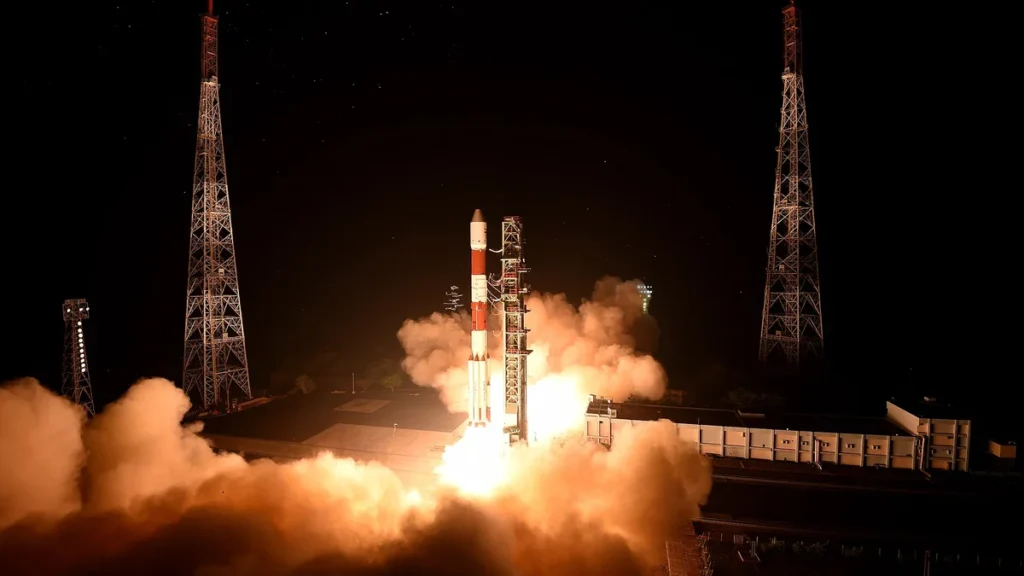
PSLV third stage test: what happened?
A rocket is like a relay race: each stage runs its part, then drops away. If one runner stumbles, the whole race is lost — which is what happened to the PSLV twice.
- ISRO has tested a modified third stage of the Polar Satellite Launch Vehicle on the ground, and the test was a success.
- The test was held at the Static Test Facility of the Satish Dhawan Space Centre, Sriharikota.
- Engineers had re-checked the design margins, raw materials and the way the stage is put together.
- The rocket’s last two flights failed because of trouble in this stage: in May 2025 with an earth observation satellite, and on 12 January 2026 with 16 satellites on board.
- In the May 2025 failure, pressure dropped in the motor’s combustion chamber. This test is a key step to get the PSLV flying again.
How does the PSLV work?
The PSLV has four stages. The first and third burn solid fuel; the second and fourth burn liquid fuel. Strap-on boosters add extra push at lift-off in most versions.
A solid motor is like a giant firecracker: once lit, it burns until the fuel is used up and cannot be throttled. A liquid engine can be controlled and restarted. The third stage gives the rocket its high speed after it leaves the thick lower air.
Called ISRO’s ‘workhorse’, the PSLV launched Chandrayaan-1 (2008), the Mars Orbiter Mission (2013) and Aditya-L1 (2023), and set a record of 104 satellites in one launch in 2017.
The four PSLV stages
| Stage | Fuel |
|---|---|
| First | Solid (with strap-on boosters) |
| Second | Liquid (Vikas engine) |
| Third | Solid |
| Fourth | Liquid |
Which bodies and policies apply?
- Indian Space Research Organisation under the Department of Space.
- Satish Dhawan Space Centre, Sriharikota (Andhra Pradesh): India’s main launch port.
- Indian Space Policy, 2023: opens space activities to private firms.
- IN-SPACe: authorises and promotes private space activity.
Why does the PSLV third stage matter?
| Angle | What to note |
|---|---|
| Science | Explains rocket stages and solid versus liquid fuel. |
| Economy | The PSLV is key to India’s commercial launch business. |
| Strategy | Reliable launches matter for earth observation and security satellites. |
| Prelims | Four stages, solid third stage, Sriharikota, past missions. |
What are the problems with the PSLV third stage?
- Two failures in a row hurt trust among satellite customers.
- Delays push back planned earth observation launches.
- Solid motors cannot be shut down once lit, so faults are hard to recover from.
- Quality checks across many suppliers are hard to keep uniform.
What should be done next on the PSLV third stage?
- Complete more tests before the next flight.
- Tighten quality checks on materials and assembly.
- Share failure findings openly to rebuild confidence.
- Use private industry, through the PSLV production deal, with strict standards.
What can Prelims ask on the PSLV third stage?
Prelims probability: High. Launch vehicles (2018) and private space firms (2026) were asked. Fresh: a fix after two failures. Facts: four stages, solid third stage, Sriharikota.
- PSLV: four stages — solid, liquid, solid, liquid.
- Third stage uses solid fuel.
- Failures: May 2025 (earth observation satellite) and 12 January 2026 (16 satellites).
- Launch site: Satish Dhawan Space Centre, Sriharikota.
- PSLV launched Chandrayaan-1, Mars Orbiter Mission and Aditya-L1.
How to write about the PSLV third stage in Mains
Practice question (15 marks, 250 words): Discuss the importance of the PSLV for India’s space programme and the lessons from its recent failures.
- Intro: modified third stage passes test after two failures.
- PSLV’s role: workhorse rocket, key missions, commercial launches.
- What went wrong: pressure drop in the solid third stage.
- Lessons: testing, quality control, transparency.
- Way forward: safe return to flight, private industry with standards.
Ready lines for your answer
- In space, there are no small mistakes — only expensive lessons.
- A workhorse is valued not for speed but for reliability.
Quotable data pointPSLV third stage passes ground test after failures in May 2025 and on 12 January 2026 (16 satellites).
Photo: Indian Space Research Organisation, GODL-India, via Wikimedia Commons
Exam angle
Prelims: PSLV stages, solid and liquid fuel, Sriharikota. · Mains GS-III: space technology and reliability.
Practice MCQs
Original practice questions (not PYQs).
Which stages of the Polar Satellite Launch Vehicle use solid fuel?
Answer (b) & explanation
The first and third stages use solid fuel; the second and fourth use liquid fuel.
Consider the following statements:
1. The Indian National Space Promotion and Authorisation Centre authorises private space activities.
2. The Satish Dhawan Space Centre is in Kerala.
3. The Polar Satellite Launch Vehicle has never failed since its first flight.
How many of the above statements are correct?
Answer (a) & explanation
Only statement 1 is correct. The Satish Dhawan Space Centre is at Sriharikota in Andhra Pradesh, and the rocket has failed four times, including in May 2025 and January 2026.
Questions students ask about this
What does 'third stage' mean?
A rocket is built in parts called stages. Each stage burns its fuel and drops off. The third stage takes over after the first two and pushes the rocket to high speed.
Why did the PSLV fail twice?
Both failures were linked to trouble in the third stage. In May 2025, pressure dropped in the motor’s combustion chamber.
Is the third stage solid or liquid?
Solid. The PSLV’s first and third stages use solid fuel; the second and fourth use liquid fuel.
Why is the PSLV called a workhorse?
Because it has flown many successful missions, including Chandrayaan-1, the Mars Orbiter Mission and Aditya-L1.
What happens next?
The successful ground test is a key step before the PSLV flies again.