
ISRO and India’s Space Programme: History, Launch Vehicles, Major Missions from Aryabhata to Chandrayaan-3, Space Sector Reforms and the Road to 2040 (UPSC Notes + PYQs)
UPSC has already asked about this. Read the story with these questions in mind.
Beginnings
India’s space story began with Vikram Sarabhai, who persuaded the Government that space technology could serve a poor country’s needs in communication, weather and resource mapping. The Indian National Committee for Space Research (INCOSPAR) was set up in 1962 under the Department of Atomic Energy, and the first sounding rocket rose from Thumba, near Thiruvananthapuram, on 21 November 1963; Thumba was chosen because it lies close to the magnetic equator. INCOSPAR became ISRO in 1969. The Space Commission and the Department of Space followed in 1972, with the Department reporting directly to the Prime Minister.
India’s first satellite, Aryabhata, was launched by a Soviet rocket in 1975. The SITE experiment (1975-76) used a borrowed American satellite to beam educational TV to 2,400 villages. In 1980 India’s own SLV-3, led by A.P.J. Abdul Kalam, put the Rohini satellite in orbit, making India the sixth country with its own launch capability.
- 1962INCOSPAR
- 1963First rocket from Thumba
- 1969ISRO formed, 15 August
- 1975Aryabhata
- 1980SLV-3 puts Rohini in orbit
- 2008Chandrayaan-1
- 2014Mangalyaan reaches Mars
- 2023Chandrayaan-3 lands; Aditya-L1
Launch vehicles
| Rocket | Stages | Main job |
|---|---|---|
| PSLV | Four (solid and liquid alternating) | Earth observation and small satellites to polar and sun-synchronous orbits; also Chandrayaan-1, Mangalyaan and Aditya-L1 |
| GSLV | Three, with an indigenous cryogenic upper stage | 2-tonne class satellites to geosynchronous transfer orbit |
| LVM3 (GSLV Mk III) | Three: two solid strap-ons (S200), liquid core (L110), cryogenic upper stage (C25) | Heavy communication satellites, Chandrayaan-2 and 3, OneWeb, Gaganyaan |
| SSLV | Three solid plus a velocity trimming module | Small satellites on demand, quick turnaround |
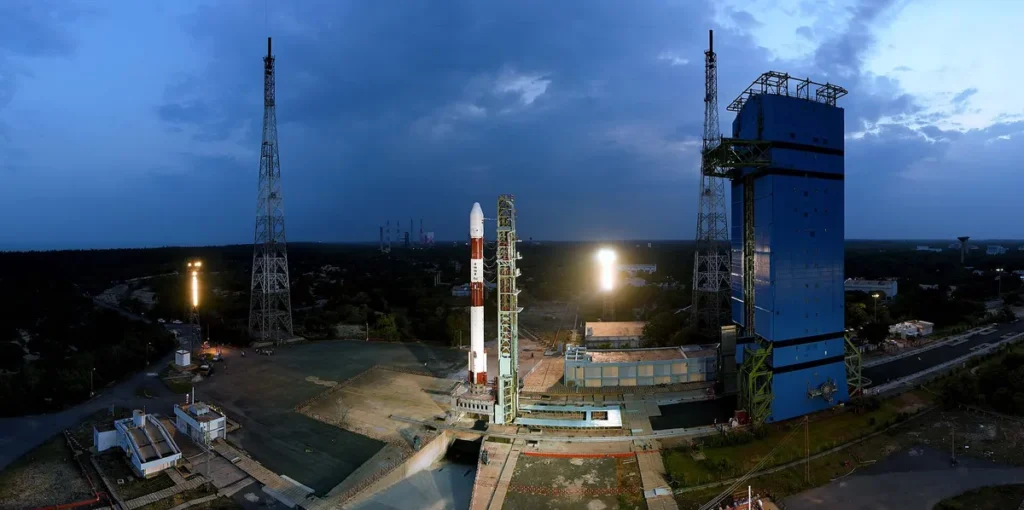
The PSLV, which first succeeded in 1994, has been ISRO’s workhorse, with a record of launching 104 satellites in one flight in February 2017. Cryogenic engines were the hardest step: after the US blocked a Russian technology deal in 1993 under missile control rules, India developed its own, first flown successfully in 2014.
Major missions
| Mission | Year | Highlight |
|---|---|---|
| Chandrayaan-1 | 2008 | Its Moon Impact Probe and NASA’s instrument aboard helped confirm water molecules on the Moon |
| Mars Orbiter Mission (Mangalyaan) | 2013 (orbit 2014) | India became the first to reach Mars orbit on its first try, at a cost of about ₹450 crore |
| Chandrayaan-2 | 2019 | Orbiter still working; lander crashed |
| Chandrayaan-3 | 2023 | Vikram landed near the lunar south pole on 23 August, now National Space Day; India the fourth country to soft-land on the Moon |
| Aditya-L1 | 2023 | India’s first solar observatory, in a halo orbit around Lagrange point L1 from January 2024 |
| SpaDeX | 2024-25 | Docking of two satellites in orbit; India the fourth country to dock |
| NISAR | 2025 | NASA-ISRO radar satellite to map changes in land and ice, launched on a GSLV |
Space in everyday life
- Communication: the INSAT and GSAT series carry TV, telephony, internet and disaster communication.
- Weather: INSAT-3D and 3DR feed IMD forecasts, crucial for cyclone warnings.
- Earth observation: Resourcesat, Cartosat and RISAT map crops, forests, cities and borders.
- Navigation: NavIC (IRNSS), with seven satellites, gives positioning over India and about 1,500 km around it.
- Governance: Bhuvan geoportal, satellite-based crop insurance assessment, and mapping for PM Gati Shakti.
Reforms: opening space to private firms
For decades ISRO did nearly everything itself, with industry only supplying parts. Reforms since 2019 changed that:
- NewSpace India Limited (NSIL, 2019): ISRO’s commercial arm, which owns and operates satellites and sells launches.
- IN-SPACe (2020): an autonomous body under the Department of Space to authorise and promote private space activity.
- Indian Space Policy 2023: defines roles; ISRO to focus on research and advanced missions, private firms to take on manufacturing and operations.
- FDI rules eased in 2024, allowing up to 100% in satellite components and higher limits in launch vehicles and satellite operations.
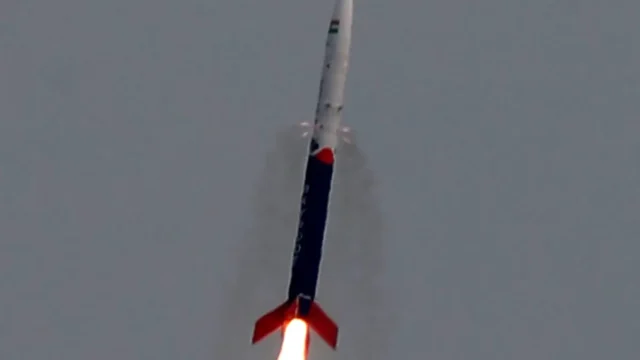
Results followed. Skyroot Aerospace flew Vikram-S, India’s first privately built rocket, in November 2022. Agnikul Cosmos flew a rocket with a single-piece 3D-printed engine in May 2024. Hundreds of space start-ups now work on satellites, ground stations and data services. India’s share of the global space economy is about 2%, and the Government aims for USD 44 billion by 2033.
- ISROResearch, advanced missions
- NSILCommercial arm
- IN-SPACeAuthorises private firms
- Private firmsRockets, satellites, data
The road ahead
The plan is ambitious: the Gaganyaan human spaceflight, the Bharatiya Antariksh Station by 2035, an Indian landing on the Moon by 2040, a Venus Orbiter Mission, Chandrayaan-4 to bring back lunar samples, and the reusable Next Generation Launch Vehicle. Each needs higher budgets, which have stayed around ₹13,000 crore a year, faster launch cadence and a strong private industry base.
Issues
- Launch rate is low compared with SpaceX or China; a few failures (PSLV-C61 in 2025) slowed work.
- Legislation is pending: India has no comprehensive space activities law yet.
- Space debris and the need for space situational awareness (ISRO’s NETRA project).
- Military use: the 2019 anti-satellite test, Mission Shakti, showed capability, and the Defence Space Agency (2019) handles military space.
PYQ trend
Prelims asks launch vehicles, Mangalyaan, private space firms and IN-SPACe. Mains GS-III asks about Chandrayaan-3, space for development, and India’s achievements in space.
ISRO: UPSC angle
For UPSC CSE
Prelims: rockets, missions, orbits, agencies. Mains GS-III: achievements of Indians in science and technology, space for development, private sector role.
ISRO UPSC PYQs (Prelims)
Questions UPSC has actually asked, from the official papers. Pick an option to check yourself.
Consider the following statements :
The Mangalyaan launched by ISRO
– 1. is also called the Mars Orbiter Mission
– 2. made India the second country to have a spacecraft orbit the Mars after USA
– 3. made India the only country to be successful in making its spacecraft orbit the Mars in its very first attempt
Which of the statements given above is/are correct?
Mangalyaan (Mars Orbiter Mission) reached Mars orbit in September 2014, making India the first to succeed on its first attempt. The USSR, the USA and the ESA had reached Mars orbit before, so India was the fourth, and the first Asian nation. Answer as per the official UPSC key · Battle IAS PYQ bankAnswer (c) & why
With reference to India’s satellite launch vehicles, consider the following statements :
– 1. PSLVs launch the satellites useful for Earth resources monitoring whereas GSLVs are designed mainly to launch communication satellites.
– 2. Satellites launched by PSLV appear to remain permanently fixed in the same position in the sky, as viewed from a particular location on Earth.
– 3. GSLV Mk III is a four-staged launch vehicle with the first and third stages using solid rocket motors; and the second and fourth stages using liquid rocket engines.
Which of the statements given above is/are correct ?
The PSLV mainly puts earth-observation satellites in sun-synchronous polar orbits. The GSLV carries heavier communication satellites to geosynchronous transfer orbit. Only geostationary satellites appear fixed in the sky. GSLV Mk III (LVM3) has three stages: two solid strap-ons, a liquid core and a cryogenic upper stage. Answer as per the official UPSC key · Battle IAS PYQ bankAnswer (a) & why
Consider the following statements with regard to involvement of private entities in India’s space programme :
– 1. The Indian National Space Promotion and Authorisation Centre (IN-SPACe) is an autonomous agency formed to facilitate participation of private entities.
– 2. Agnikul Cosmos launched the world’s first flight using 3D-printed rocket engine.
– 3. Skyroot Aerospace has developed liquid fuel for GSLV.
Which of the statements given above is/are correct ?
IN-SPACe (2020) is the single-window body under the Department of Space that authorises private space activity. Agnikul’s Agnibaan SOrTeD (May 2024) flew on a single-piece 3D-printed semi-cryogenic engine. Skyroot builds its own Vikram rockets; it does not make fuel for ISRO’s GSLV. Answer as per the official UPSC key · Battle IAS PYQ bankAnswer (c) & why
Mains PYQs on this topic
Questions from the official UPSC Mains papers (2023-2026 in the Battle IAS Mains bank), newest first. Each links to a model answer.
- UPSC Mains 2023 · GS Paper III · Q16 · 15 marks
What is the main task of India’s third moon mission which could not be achieved in its earlier mission? List the countries that have achieved this task. Introduce the subsystems in the spacecraft launched and explain the role of the ‘Virtual Launch Control Centre’ at the Vikram Sarabhai Space Centre which contributed to the successful launch from Sriharikota.
Quick quiz
Thumba was chosen for India’s first rocket launch mainly because it
Thumba lies near the magnetic equator, good for upper-atmosphere studies.Answer (b)
Which body authorises private space activities in India?
IN-SPACe, set up in 2020.Answer (c)
Aditya-L1 studies
It is India’s first solar observatory, at Lagrange point L1.Answer (c)
FAQs
When was ISRO founded?
On 15 August 1969, growing out of INCOSPAR (1962).
What is the difference between PSLV and GSLV?
PSLV mainly places satellites in polar and sun-synchronous orbits; GSLV, with a cryogenic upper stage, places heavier satellites in geosynchronous transfer orbit.
What did Chandrayaan-3 achieve?
It soft-landed near the Moon’s south pole on 23 August 2023, making India the fourth country to soft-land on the Moon and the first near the south pole.
What is IN-SPACe?
An autonomous single-window agency under the Department of Space that authorises and promotes private space activities.
What is NavIC?
India’s regional satellite navigation system, giving positioning over India and about 1,500 km around it.
Spotted an error? Tell us. We correct within 48 hours.
Image: Indian Space Research Organisation, Wikimedia Commons, GODL-India
How to use this in Mains
If asked: Assess the achievements and constraints of India's space programme. (GS-III)
Quote: “Legislation is pending: India has no comprehensive space activities law yet.”
Use it: Use it in the challenges part and suggest a space law in the way forward.
In the news
India’s space economy to grow from about $9 billion to $40-45 billion in 7-8 years
On 17 October 2026, Union Minister Dr Jitendra Singh said India’s space economy, worth about USD 9 billion today, should reach USD 40-45 billion in the next seven to eight years. He said the task now is to move from showing what India can do in space to building space companies that can compete and earn worldwide. For that, private firms need steady demand, quick approvals and patient capital. This is the story of space turning from a science mission into an industry.
18 Oct 2026
Government says satellite communication licensing is fair; three NGSO-based GMPCS licensees at same stage
On 8 October 2026 the Department of Telecommunications rejected a social media claim that satellite internet licensing is discriminatory. Three licences for Global Mobile Personal Communication by Satellite services using non-geostationary satellites have been issued; all three are going through security assessment, after which each can seek spectrum.
8 Oct 2026
ARIES-led decade-long study of blazar OJ 287, a binary supermassive black hole
A study coordinated by ARIES, Nainital, with 106 scientists from 18 countries, tracked the blazar OJ 287 from 2015 to 2025. OJ 287, about 4 billion light years away, has two supermassive black holes in a 12-year orbit. The study estimated the central black hole at no less than 3.89 billion solar masses.
6 Oct 2026
India–France space cooperation: human spaceflight, TRISHNA and start-ups
On 28 September 2026 a French delegation led by Minister Philippe Baptiste met India's Minister of State for Science and Technology in New Delhi. They discussed the joint TRISHNA satellite, French support for Gaganyaan, and links with India's more than 400 space start-ups, under the India-France Year of Innovation 2026.
28 Sep 2026