
Centre to pay freight when vegetable prices crash
Union Agriculture Minister Shivraj Singh Chouhan met farmers at Samrala in Ludhiana, Punjab, on Tuesday, as part of the Khet Bachao Abhiyan, a soil-health campaign running till 30 November. He announced relief for growers of potato, onion and tomato. If their prices crash in Punjab but stay higher in Delhi, Mumbai, Kolkata or Chennai, the Centre will pay the full cost of moving the produce there. The produce will be sold through State government agencies, so farmers can reach better-paying city markets without paying for transport. He also explained the Market Intervention Scheme: when farmers must sell at very low prices, the Centre and the State share the loss equally, and the price gap goes straight into farmers’ bank accounts. Farmer identity numbers are being issued to stop subsidised urea and di-ammonium phosphate going to factories; Punjab already has six lakh. A strict new pesticide law and a new seed law are also being prepared. Read it to revise agricultural marketing, Operation Greens, the National Agriculture Market and the Market Intervention Scheme.
- The relief
- The Centre will pay the full transport cost of potato, onion and tomato when prices crash in Punjab but stay higher in four big cities
- How it will be sold
- Through State government agencies, so farmers need not pay the freight themselves
- Market Intervention Scheme
- The Centre and the State share the loss equally; the price gap is paid into farmers’ bank accounts
- Farmer identity numbers
- Being issued to stop subsidised urea and di-ammonium phosphate going to factories; Punjab already has six lakh
What relief has the Centre announced for potato, onion and tomato growers?
A crash in kitchen prices is a crisis for the farmer long before it is a relief for the city buyer. The Centre has now said it will pick up the freight bill so that a cheap mandi in Punjab can reach a dearer market in a big city.
- Union Agriculture Minister Shivraj Singh Chouhan met farmers at Samrala in Ludhiana, Punjab, on Tuesday. The visit was part of the Khet Bachao Abhiyan, a soil-health campaign running till 30 November.
- He announced relief for growers of potato, onion and tomato. If their prices crash in Punjab but stay higher in Delhi, Mumbai, Kolkata or Chennai, the Centre will pay the full cost of moving the produce there.
- The produce will be sold through State government agencies. So farmers can reach better-paying city markets without paying for transport.
- He also explained the Market Intervention Scheme. When farmers must sell at very low prices, the Centre and the State share the loss equally. The price gap goes straight into farmers’ bank accounts. To stop subsidised urea and di-ammonium phosphate going to factories, farmer identity numbers are being issued; Punjab already has six lakh. A strict new pesticide law and a new seed law are also being prepared.
How do farm-price crashes, freight and the Market Intervention Scheme usually work?
Potato, onion and tomato are perishable. When a harvest is good in one State, the local mandi can crash even as prices stay firm in a distant city. The gap is often the cost of moving a truckload quickly, plus the weakness of the farmer’s bargaining power. A promise that the Centre will pay the full freight is an attempt to close that gap without waiting for the crop to rot.
The Market Intervention Scheme is the older tool for perishable and horticultural crops that do not always sit inside the minimum support price system. When the market price falls well below a fixed intervention price, the government steps in. The minister’s explanation is specific: the Centre and the State share the loss equally, and the difference is paid into the farmer’s bank account, rather than only through a slow purchase and storage operation.
The National Agriculture Market, or e-NAM, was built so that a lot in one mandi could, in principle, find a buyer in another. Agricultural Produce Market Committees still run most of the physical trade. Operation Greens, launched for tomato, onion and potato, was meant to smooth exactly this kind of price crash. The new freight promise sits in that family of ideas, but it is a fresh, direct offer: the Centre pays the transport, and State agencies sell the produce in the four named cities.
Farmer identity numbers, already issued to six lakh farmers in Punjab, are a different problem. Subsidised urea and di-ammonium phosphate are meant for fields, not factories. A unique identity is meant to stop leakage. The minister also said a stricter pesticide law and a new seed law are being prepared. Those are still only promises, but they belong to the same visit: price support on one side, and a cleaner input market on the other.
Freight relief and the Market Intervention Scheme
| Item | What to note |
|---|---|
| Crops covered in the announcement | Potato, onion and tomato |
| When freight is paid | If prices crash in Punjab but stay higher in Delhi, Mumbai, Kolkata or Chennai |
| Who pays the transport | The Centre, in full; sale through State government agencies |
| Market Intervention Scheme | Centre and State share the loss equally; the gap is paid into bank accounts |
| Farmer identity numbers | Punjab already has six lakh; meant to stop subsidised urea and di-ammonium phosphate leaking to factories |
Which laws and schemes apply?
- Agriculture is a State subject under the Seventh Schedule, but the Centre can support marketing, transport and price intervention through national schemes.
- The Market Intervention Scheme is the Centre–State tool used when perishable farm prices fall sharply; the minister said the loss will be shared equally and paid into bank accounts.
- The National Agriculture Market (e-NAM) and the Agricultural Produce Market Committee system are the usual marketing framework through which produce still moves.
- Operation Greens, a Central scheme for tomato, onion and potato, was designed to reduce exactly this kind of price crash and wastage.
Why does the new freight relief for perishable vegetables matter?
| Angle | What to note |
|---|---|
| Agricultural marketing | A full-freight offer on potato, onion and tomato is a live example of how the Centre tries to link a crashing mandi to a dearer city market. |
| Prelims | Equal Centre–State loss sharing under the Market Intervention Scheme, the four named cities, and six lakh farmer identity numbers in Punjab. |
| Food prices | The same three crops sit in the kitchen basket, so a farm-price crash and a city-price spike can happen in the same season. |
| Inputs | Farmer identity numbers, and the promised pesticide and seed laws, are about leakage and quality, not only about freight. |
What are the problems with the new freight relief for perishable vegetables?
- A freight subsidy helps only if State agencies actually lift the crop quickly and sell it in the named cities before it spoils.
- Equal loss-sharing still needs a clear intervention price, a fast bank transfer, and a State that is willing to pay its half.
- Naming four metro markets may leave out other cities where prices are also higher, or may overload those four if many States claim the same relief.
- Farmer identity numbers will work only if the subsidy records are clean; a number on paper does not, by itself, stop a diverted bag of urea.
What should be done next on the new freight relief for perishable vegetables?
- The Centre should publish simple rules: which price crash triggers the freight, which State agencies will lift the crop, and how quickly the trucks will move.
- The Market Intervention Scheme payout should be audited so that the equal Centre–State share, and the bank transfer, can be checked by the farmer.
- e-NAM and local mandi reforms should travel with the freight offer, or the same crash will return at the next harvest.
- The promised pesticide and seed laws, and the wider issue of farmer identity numbers, should be taken to a clear draft rather than left as a speech.
What can Prelims ask on the new freight relief for perishable vegetables?
Prelims probability: High. Farm marketing is asked often: the National Agriculture Market in 2017 and market laws in 2015. The relief is fresh and touches kitchen prices. Testable facts: equal Centre–State loss sharing, full transport cost, six lakh farmer identity numbers in Punjab.
- The Centre will pay the full cost of moving potato, onion and tomato if prices crash in Punjab but stay higher in Delhi, Mumbai, Kolkata or Chennai.
- The produce will be sold through State government agencies.
- Under the Market Intervention Scheme, the Centre and the State share the loss equally, and the price gap is paid into farmers’ bank accounts.
- Punjab already has six lakh farmer identity numbers, meant to stop subsidised urea and di-ammonium phosphate going to factories.
- The announcement was made at Samrala in Ludhiana during the Khet Bachao Abhiyan, which runs till 30 November.
How to write about the new freight relief for perishable vegetables in Mains
Practice question (15 marks, 250 words): The Centre has announced that it will bear the cost of moving potato, onion and tomato to better-paying markets when prices crash in producing States. Discuss the constraints in marketing perishable farm produce and the role of freight support and the Market Intervention Scheme.
- Open with the announcement: full freight on potato, onion and tomato when Punjab prices crash but metro prices stay higher, with sale through State agencies.
- Explain why perishable crops crash locally even when city prices are firm: transport cost, weak bargaining power, and limited storage.
- Set out the Market Intervention Scheme: equal Centre–State loss sharing, and a direct payment into the farmer’s bank account.
- Link the offer to the wider marketing framework: Agricultural Produce Market Committees, the National Agriculture Market, and Operation Greens.
- Close with the limits: speed of lifting, the State’s half-share, and the separate problem of leaking fertiliser subsidies.
Ready lines for your answer
- A cheap mandi and a dear city can exist in the same week; the missing piece is often a truck.
- Equal loss-sharing is only as good as a fast bank credit and a State that pays its half.
Quotable data pointAnnouncement at Samrala, Ludhiana, during the Khet Bachao Abhiyan (till 30 November): Centre to pay full freight on potato, onion and tomato to Delhi, Mumbai, Kolkata or Chennai; Market Intervention Scheme losses shared equally and paid into bank accounts; six lakh farmer identity numbers already issued in Punjab.
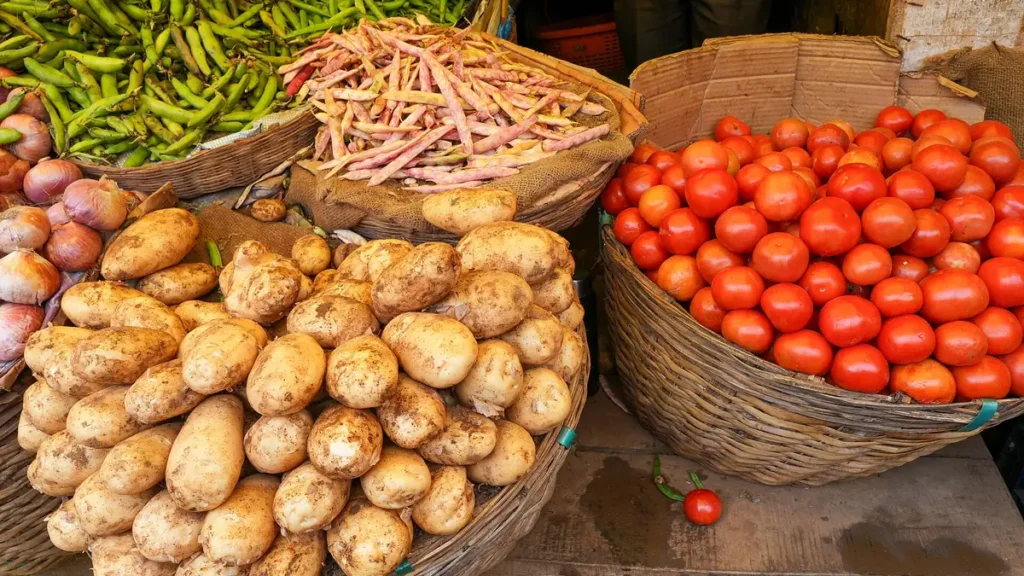
Photo: Timothy A. Gonsalves, CC BY-SA 4.0, via Wikimedia Commons
Exam angle
Prelims: full freight on potato, onion and tomato, equal Centre–State loss sharing, and six lakh farmer identity numbers in Punjab. · Mains GS-III: agricultural marketing, Operation Greens, the National Agriculture Market and price support for perishable crops.
Practice MCQs
Original practice questions (not PYQs).
Under the relief announced by the Union Agriculture Minister on 17 November 2026, when potato, onion or tomato prices crash in a producing State, the Centre will
Answer (a) & explanation
The Centre will bear the entire transportation cost of moving the produce to better-paying markets in other States, with sales through State government agencies.
Consider the following statements:
1. Under the Market Intervention Scheme, the Centre and the State share the loss equally.
2. The National Agriculture Market is a pan-India electronic trading portal for farm produce.
3. Agricultural markets in India are regulated mainly under the Essential Commodities Act, 1955.
How many of the above statements are correct?
Answer (b) & explanation
Statements 1 and 2 are correct. Agricultural markets are regulated under the Agricultural Produce Market Committee Acts enacted by States, not the Essential Commodities Act.
Which State is the leading producer of potato in India?
Answer (c) & explanation
Uttar Pradesh is the largest potato producer in India; West Bengal comes second.
Questions students ask about this
What exactly will the Centre pay for?
The full cost of moving potato, onion and tomato from Punjab to Delhi, Mumbai, Kolkata or Chennai, when prices crash in Punjab but stay higher in those cities.
Who will sell the produce in the cities?
State government agencies, so that farmers do not have to pay the transport themselves.
How does the Market Intervention Scheme share the loss?
The Centre and the State share the loss equally, and the price gap is paid into farmers’ bank accounts.
Why are farmer identity numbers being issued?
To stop subsidised urea and di-ammonium phosphate being diverted to factories. Punjab already has six lakh such numbers.
When and where was the announcement made?
On Tuesday, by Union Agriculture Minister Shivraj Singh Chouhan, at Samrala in Ludhiana, during the Khet Bachao Abhiyan, which runs till 30 November.