
Malaria cases and deaths down nearly 80% in ten years
President Droupadi Murmu opened the golden jubilee of the National Institute of Malaria Research in New Delhi on Tuesday. The institute is part of the Indian Council of Medical Research. She said malaria cases and deaths fell by nearly 80% between 2015 and 2025. High-burden districts fell from 155 to 33. From 2022 to 2025, 160 districts reported no local malaria case at all. In 2024, India moved out of the World Health Organization’s “High Burden to High Impact” group. She warned that climate change, unplanned cities and mosquitoes resisting insecticides could slow the fight. Dengue is also a growing challenge. She praised the institute’s work on an indigenous malaria vaccine being developed in Bhubaneswar. Read it to revise vector-borne diseases, the World Health Organization grouping, and India’s malaria elimination effort.
- The fall
- Malaria cases and deaths down nearly 80% between 2015 and 2025
- High-burden districts
- Fell from 155 to 33; 160 districts reported no local case from 2022 to 2025
- Global listing
- In 2024 India moved out of the World Health Organization’s “High Burden to High Impact” group
- The occasion
- Golden jubilee of the National Institute of Malaria Research, part of the Indian Council of Medical Research; an indigenous vaccine is being developed in Bhubaneswar
What did the President say about India’s fight against malaria?
A disease that once filled hospital wards is in retreat, but it has not gone. The President used a 50-year laboratory anniversary to put a hard number on the retreat, and a warning on what could slow it.
- President Droupadi Murmu opened the golden jubilee of the National Institute of Malaria Research in New Delhi on Tuesday. The institute is part of the Indian Council of Medical Research.
- She said malaria cases and deaths fell by nearly 80% between 2015 and 2025. High-burden districts fell from 155 to 33. From 2022 to 2025, 160 districts reported no local malaria case at all.
- In 2024, India moved out of the World Health Organization’s “High Burden to High Impact” group.
- She warned that climate change, unplanned cities and mosquitoes resisting insecticides could slow the fight. Dengue is also a growing challenge. She praised the institute’s work on an indigenous malaria vaccine being developed in Bhubaneswar.
What is the National Institute of Malaria Research, and what does the World Health Organization grouping mean?
The National Institute of Malaria Research is the country’s specialist laboratory on the malaria parasite, the mosquito, insecticide resistance and field surveillance. It sits inside the Indian Council of Medical Research, the apex biomedical research body under the Union health ministry. Its golden jubilee is a 50-year mark, not a claim that the disease is over.
The fall of nearly 80% in cases and deaths between 2015 and 2025, and the drop in high-burden districts from 155 to 33, are the headline gains. The 160 districts with no local case from 2022 to 2025 are a stricter test: they suggest transmission has been interrupted in a large number of places, not only reduced.
The World Health Organization’s “High Burden to High Impact” group was a list of countries that still carried a very large share of the world’s malaria. India’s exit from that group in 2024 was a public recognition of the same downward curve. It is not a certificate of elimination. India still has a national elimination goal, commonly set at 2030, and a few dozen high-burden districts remain.
The President’s warnings are the other half of the story. Climate change and unplanned cities create new breeding sites. Insecticide resistance makes old sprays less reliable. Dengue, spread by a different Aedes mosquito that breeds in clean stored water, is rising in many of the same cities. An indigenous malaria vaccine under work in Bhubaneswar is a research bet, not a rolled-out jab. World Malaria Day, on 25 April, is the yearly hook on which these numbers will be asked again.
India’s malaria numbers, as stated by the President
| Item | What to note |
|---|---|
| Cases and deaths, 2015 to 2025 | Down nearly 80% |
| High-burden districts | Down from 155 to 33 |
| Districts with no local case, 2022–2025 | 160 |
| World Health Organization group | India left the “High Burden to High Impact” group in 2024 |
| New risks named | Climate change, unplanned cities, insecticide resistance, and a rising dengue challenge |
Which institutions and programmes apply?
- The National Institute of Malaria Research, under the Indian Council of Medical Research, is the national laboratory on malaria parasites, vectors and control tools.
- The National Center for Vector Borne Diseases Control, under the Union health ministry, runs the operational programme against malaria, dengue and other vector-borne diseases.
- The World Health Organization’s “High Burden to High Impact” approach grouped countries with the heaviest malaria load; India left that group in 2024.
- India’s malaria elimination effort is a national programme with a widely cited 2030 target; an indigenous vaccine being developed in Bhubaneswar is still at the research stage.
Why does India’s ten-year fall in malaria matter?
| Angle | What to note |
|---|---|
| Public health | A nearly 80% fall in ten years is a rare, measurable public-health success, with 33 high-burden districts still on the map. |
| Prelims | The 155-to-33 drop, 160 districts with no local case, the 2024 exit from the World Health Organization group, and the Bhubaneswar vaccine work. |
| Climate and cities | The President herself linked leftover risk to climate change, unplanned urban growth and insecticide resistance. |
| Other diseases | Dengue is rising on a different mosquito, so a malaria success does not automatically mean safer cities. |
What are the problems with India’s ten-year fall in malaria?
- Leaving the World Health Organization’s high-burden group can breed complacency in districts that are not yet free of the parasite.
- Insecticide resistance and climate-driven breeding sites can reverse local gains faster than a national average will show.
- An indigenous vaccine in development is not yet a public programme; it should not be described as if doses are already in the field.
- Dengue control needs a different set of habits — clean stored water, not only rural bed-nets — and is still a growing challenge.
What should be done next on India’s ten-year fall in malaria?
- The remaining 33 high-burden districts need a targeted last-mile plan, and the 160 zero-local-case districts need surveillance so that a stray case does not restart a chain.
- City planning and water management have to sit beside medicines and sprays, as the President warned.
- The Bhubaneswar vaccine work should be reported honestly at each trial stage, without over-claiming.
- Readers should keep malaria and dengue apart: different mosquitoes, different breeding sites, and a shared need for public cooperation.
What can Prelims ask on India’s ten-year fall in malaria?
Prelims probability: High. Mosquito-borne diseases were asked in 2023 and 2017, and a malaria vaccine in the State 2024. The 80% fall and the 2024 exit from the World Health Organization group are crisp facts. Upcoming hook: World Malaria Day on 25 April.
- Malaria cases and deaths fell by nearly 80% between 2015 and 2025.
- High-burden districts fell from 155 to 33; 160 districts reported no local case from 2022 to 2025.
- In 2024 India moved out of the World Health Organization’s “High Burden to High Impact” group.
- The National Institute of Malaria Research, part of the Indian Council of Medical Research, marked its golden jubilee in New Delhi.
- An indigenous malaria vaccine is being developed in Bhubaneswar; climate change, unplanned cities and insecticide resistance remain risks, and dengue is a growing challenge.
How to write about India’s ten-year fall in malaria in Mains
Practice question (15 marks, 250 words): India has recorded a steep fall in malaria cases and deaths over the past decade, even as new environmental and urban risks remain. Discuss the reasons for the progress and the challenges that still stand in the way of elimination.
- Open with the President’s figures: nearly 80% fall from 2015 to 2025, high-burden districts from 155 to 33, and 160 districts with no local case from 2022 to 2025.
- Note the 2024 exit from the World Health Organization’s “High Burden to High Impact” group, and the role of the National Institute of Malaria Research.
- Explain the leftover risks: climate change, unplanned cities, insecticide resistance, and a rising dengue challenge.
- Treat the Bhubaneswar vaccine as research in progress, not as a finished tool.
- Close with what elimination will still need: last-mile work in the remaining high-burden districts, and honest surveillance in the districts that now report no local case.
Ready lines for your answer
- A national average can fall 80% and still leave 33 high-burden districts on the map.
- Leaving a World Health Organization list is a milestone, not a certificate that the mosquito has gone.
Quotable data pointPresident at the golden jubilee of the National Institute of Malaria Research, 17 November 2026: cases and deaths down nearly 80% from 2015 to 2025; high-burden districts 155 to 33; 160 districts with no local case from 2022 to 2025; India left the WHO “High Burden to High Impact” group in 2024.
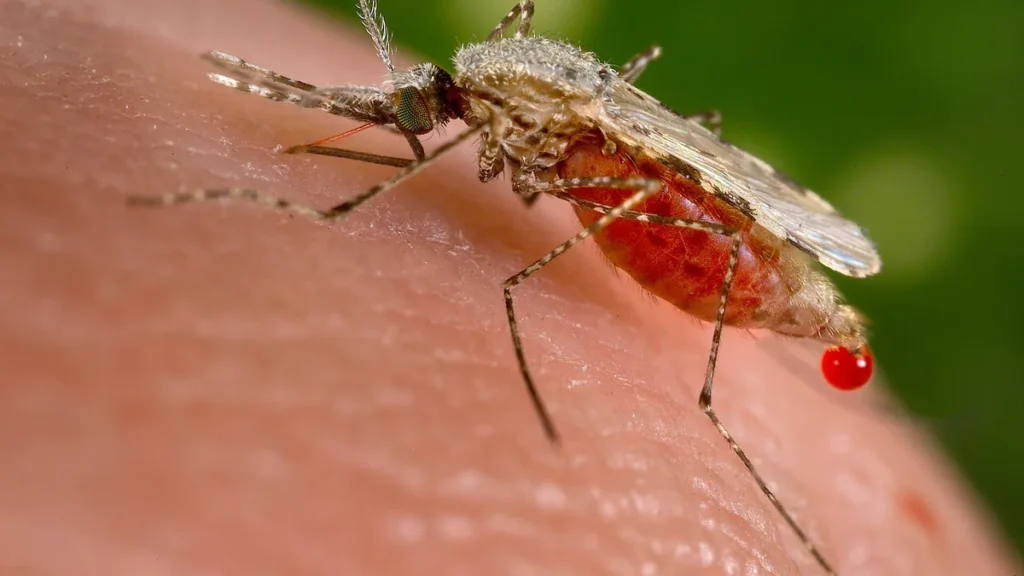
Photo: Jim Gathany, Public domain, via Wikimedia Commons
Exam angle
Prelims: nearly 80% fall from 2015 to 2025, 155 to 33 high-burden districts, 160 zero-local-case districts, and the 2024 exit from the World Health Organization group. · Mains GS-II: vector-borne disease control, public-health institutions and the 2030 elimination goal.
Practice MCQs
Original practice questions (not PYQs).
According to the President, between 2015 and 2025 malaria cases and deaths in India fell by nearly
Answer (a) & explanation
President Droupadi Murmu said malaria cases and deaths declined by nearly 80% between 2015 and 2025.
Consider the following statements:
1. Malaria is caused by a virus spread by the Aedes mosquito.
2. India moved out of the World Health Organization's High Burden to High Impact group in 2024.
3. The number of high-burden malaria districts fell from 155 to 33.
How many of the above statements are correct?
Answer (b) & explanation
Statements 2 and 3 are correct. Malaria is caused by the Plasmodium parasite and spread by female Anopheles mosquitoes, not a virus spread by Aedes.
Questions students ask about this
By how much did malaria cases and deaths fall?
By nearly 80% between 2015 and 2025, according to the President.
What happened to high-burden districts?
They fell from 155 to 33. From 2022 to 2025, 160 districts reported no local malaria case at all.
What is the “High Burden to High Impact” group?
It is a World Health Organization grouping of countries with a very heavy malaria load. India moved out of it in 2024.
Which institute marked its golden jubilee?
The National Institute of Malaria Research in New Delhi, which is part of the Indian Council of Medical Research.
What new risks did the President flag?
Climate change, unplanned cities, mosquitoes resisting insecticides, and a growing dengue challenge. She also noted work on an indigenous malaria vaccine in Bhubaneswar.