
District ombudspersons to hear rural job complaints
The new rural jobs law is the Viksit Bharat – Guarantee for Rozgar and Ajeevika Mission (Gramin) Act, 2025. It replaced the Mahatma Gandhi National Rural Employment Guarantee Act. On Wednesday, the Union Ministry of Rural Development issued guidelines for ombudspersons and appellate authorities under the new law. Each district will have an ombudsperson to hear workers’ complaints. These cover job cards, work, wage payments, compensation for delays, worksite facilities and muster rolls, the attendance registers. The ombudsperson will also hear cases of discrimination and harassment, including those of women and vulnerable groups. More people can now apply for the post. They may come from rural development, public administration, law, teaching, social work or management. Tenure and pay have also been revised. A new digital platform will register and track complaints online. It will record hearings, upload decisions and follow up on action taken. Photographs from field visits will carry location and time stamps. Each ombudsperson must attend at least three social audit hearings or Gram Sabha meetings every month. Read it to revise the rural jobs guarantee, social audit, the Gram Sabha and grievance redressal.
- The law
- The Viksit Bharat – Guarantee for Rozgar and Ajeevika Mission (Gramin) Act, 2025, which replaced the Mahatma Gandhi National Rural Employment Guarantee Act
- The new post
- Each district will have an ombudsperson to hear workers’ complaints, with an appellate authority above
- The platform
- A digital system will register and track complaints, record hearings, upload decisions and follow up on action
- The monthly duty
- Each ombudsperson must attend at least three social audit hearings or Gram Sabha meetings every month
What have the new guidelines changed for rural job complaints?
A jobs law is only as strong as the place where a worker can complain. The Centre has now set out who will hear those complaints in every district, and how the hearing will be tracked.
- The new rural jobs law is the Viksit Bharat – Guarantee for Rozgar and Ajeevika Mission (Gramin) Act, 2025. It replaced the Mahatma Gandhi National Rural Employment Guarantee Act.
- On Wednesday, the Union Ministry of Rural Development issued guidelines for ombudspersons and appellate authorities under the new law. Each district will have an ombudsperson to hear workers’ complaints.
- The complaints cover job cards, work, wage payments, compensation for delays, worksite facilities and muster rolls, the attendance registers. The ombudsperson will also hear cases of discrimination and harassment, including those of women and vulnerable groups.
- More people can now apply for the post, from rural development, public administration, law, teaching, social work or management. Tenure and pay have also been revised. A new digital platform will register and track complaints, record hearings, upload decisions and follow up on action taken. Photographs from field visits will carry location and time stamps. Each ombudsperson must attend at least three social audit hearings or Gram Sabha meetings every month.
What did the old rural jobs law do, and why do ombudspersons and social audits matter?
For nearly two decades, the Mahatma Gandhi National Rural Employment Guarantee Act gave rural households a legal right to work and to be paid for it. The 2025 Act has replaced that law. Examiners will still expect the old scheme’s basic ideas — a demand-driven right to work, unemployment allowance, social audit and the Gram Sabha — and will now also expect the new law’s name and its new complaint machinery.
An ombudsperson is an independent complaint-hearer. Under the new guidelines, that person sits at the district and an appellate authority sits above. The list of subjects is wide: job cards, work, wages, delay compensation, worksite facilities, muster rolls, and discrimination or harassment, including of women and vulnerable groups.
A social audit is a public check of the rolls and the works, usually before the Gram Sabha, the village assembly. The new rule that each ombudsperson must attend at least three such hearings or Gram Sabha meetings a month is meant to keep the post close to the worksite, not only to a computer.
The digital platform is meant to leave a trail: a complaint registered, a hearing recorded, a decision uploaded, and action followed up. Time-stamped, location-stamped photographs from field visits are part of that trail. The widening of who may apply is meant to enlarge the pool; it will matter only if appointments are actually made and hearings actually held.
What the new guidelines set out
| Item | The rule |
|---|---|
| The law | Viksit Bharat – Guarantee for Rozgar and Ajeevika Mission (Gramin) Act, 2025 |
| Who hears first | A district ombudsperson |
| What can be complained about | Job cards, work, wages, delay compensation, worksite facilities, muster rolls, discrimination and harassment |
| The digital trail | Register, track, record hearings, upload decisions, follow up on action |
| Monthly field duty | At least three social audit hearings or Gram Sabha meetings |
Which law, offices and village bodies apply?
- The Viksit Bharat – Guarantee for Rozgar and Ajeevika Mission (Gramin) Act, 2025, is the new rural jobs law; it replaced the Mahatma Gandhi National Rural Employment Guarantee Act.
- The Union Ministry of Rural Development has issued the guidelines for ombudspersons and appellate authorities.
- The Gram Sabha is the village assembly, and social audit is the public check of works and muster rolls before that assembly.
- Field-visit photographs are to carry location and time stamps, and complaints are to be registered and tracked on a digital platform.
Why does the new district ombudspersons under the rural jobs law matter?
| Angle | What to note |
|---|---|
| Prelims | The 2025 Act, a district ombudsperson, an appellate authority, and at least three social audit or Gram Sabha hearings a month. |
| Governance | A digital trail for complaints, hearings, decisions and action taken, with time-stamped field photographs. |
| Social justice | Complaints may include discrimination and harassment, including of women and vulnerable groups. |
| Village democracy | Social audit and the Gram Sabha remain the public check; the ombudsperson is now required to attend. |
What are the problems with the new district ombudspersons under the rural jobs law?
- Guidelines do not appoint people; vacant or weak ombudsperson posts would leave the new platform with nobody to hear the case.
- A digital trail helps only if workers can file a complaint and if decisions are actually carried out on wages and job cards.
- Three hearings a month is a minimum; a large district may need more if social audits are to be more than a formality.
- Widening the applicant pool is useful, but independence will depend on who is chosen and how secure the tenure is.
What should be done next on the new district ombudspersons under the rural jobs law?
- States should appoint district ombudspersons and appellate authorities quickly, under the new guidelines.
- The digital platform should be easy for a worker to use, not only for an officer to view.
- Readers should keep the testable facts straight: the 2025 Act, one ombudsperson per district, and at least three social audit or Gram Sabha hearings a month.
- The old law’s ideas — a right to work, social audit, the Gram Sabha — still need to be revised beside the new name.
What can Prelims ask on the new district ombudspersons under the rural jobs law?
Prelims probability: High. Rural jobs and Gram Sabha powers are old favourites: the Gram Sabha under the Scheduled Areas law was asked in 2012. The new law is less than a year old and its rules are fresh. Testable facts: 125 days, district ombudsperson, three social audit hearings a month.
- The Viksit Bharat – Guarantee for Rozgar and Ajeevika Mission (Gramin) Act, 2025, replaced the Mahatma Gandhi National Rural Employment Guarantee Act.
- On Wednesday the Union Ministry of Rural Development issued guidelines for ombudspersons and appellate authorities.
- Each district will have an ombudsperson to hear complaints on job cards, work, wages, delay compensation, worksite facilities and muster rolls, and on discrimination and harassment.
- A digital platform will register and track complaints, record hearings, upload decisions and follow up on action; field photographs will carry location and time stamps.
- Each ombudsperson must attend at least three social audit hearings or Gram Sabha meetings every month.
How to write about the new district ombudspersons under the rural jobs law in Mains
Practice question (15 marks, 250 words): The Centre has issued guidelines for district ombudspersons and appellate authorities under the 2025 rural jobs law. Examine how grievance redressal and social audit can make a rural employment guarantee real for workers.
- Open with the new law’s name, the fact that it replaced the Mahatma Gandhi National Rural Employment Guarantee Act, and Wednesday’s guidelines.
- Describe the district ombudsperson, the appellate authority, and the list of complaints, including discrimination and harassment.
- Explain the digital platform and the rule of at least three social audit hearings or Gram Sabha meetings a month.
- Link social audit and the Gram Sabha to public checking of job cards, muster rolls and wage payments.
- Close with the gap between a guideline and an appointment, and why a complaint that is not acted on is not redressal.
Ready lines for your answer
- A jobs law without a hearer in the district is only a promise on paper.
- Social audit works when the rolls are read in the Gram Sabha, not only when a portal is opened.
Quotable data pointPIB PRID 2337720 and The Hindu, 19 November 2026: guidelines for ombudspersons and appellate authorities under the Viksit Bharat – Guarantee for Rozgar and Ajeevika Mission (Gramin) Act, 2025; digital complaint platform; at least three social audit hearings or Gram Sabha meetings a month.
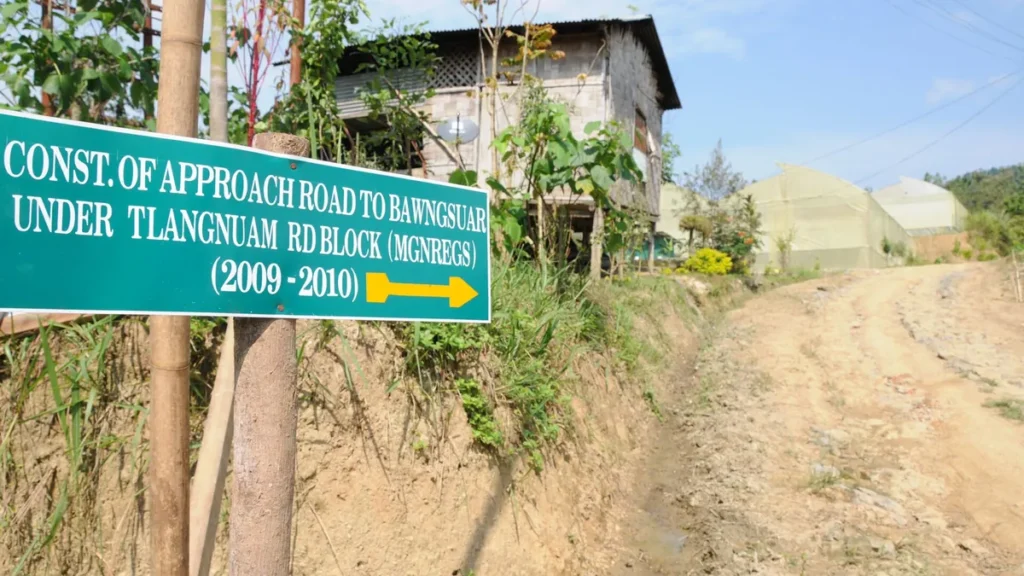
Photo: Ministry of Information and Broadcasting, GODL-India, via Wikimedia Commons
Exam angle
Prelims: the 2025 Act’s name, the district ombudsperson, the digital platform, and three social audit hearings or Gram Sabha meetings a month. · Mains GS-II: grievance redressal, social audit and the shift from the Mahatma Gandhi National Rural Employment Guarantee Act.
Practice MCQs
Original practice questions (not PYQs).
Under the new guidelines for the rural jobs law, each ombudsperson must attend at least how many social audit public hearings or Gram Sabha meetings every month?
Answer (a) & explanation
The guidelines say ombudspersons will attend at least three social audit public hearings or Gram Sabhas every month.
Consider the following statements:
1. The Viksit Bharat – Guarantee for Rozgar and Ajeevika Mission (Gramin) Act, 2025 raises the work guarantee to 125 days a year.
2. The Mahatma Gandhi National Rural Employment Guarantee Act was passed in 2005.
3. The new guidelines provide a digital platform for online registration and tracking of complaints.
How many of the above statements are correct?
Answer (c) & explanation
All three are correct. The new law raises the guarantee from 100 to 125 days; the earlier law was passed in 2005; the guidelines create a dedicated digital platform for ombudspersons.
Questions students ask about this
Which law do the new guidelines belong to?
The Viksit Bharat – Guarantee for Rozgar and Ajeevika Mission (Gramin) Act, 2025, which replaced the Mahatma Gandhi National Rural Employment Guarantee Act.
Who will hear a worker’s complaint first?
A district ombudsperson. There is also an appellate authority.
What kind of complaints can be heard?
Job cards, work, wage payments, compensation for delays, worksite facilities, muster rolls, and cases of discrimination and harassment, including those of women and vulnerable groups.
What is new about the process?
A digital platform will register and track complaints, record hearings, upload decisions and follow up on action. Field-visit photographs will carry location and time stamps.
What monthly duty does an ombudsperson have?
Each must attend at least three social audit hearings or Gram Sabha meetings every month.