
Uttar Pradesh ranks second in rural water testing with field kits
Uttar Pradesh ranked second in the country in water-quality testing with Field Testing Kits in 2026–27, The Times of India reported on 23 November 2026, citing official figures. As of 27 October 2026, the State had completed 33.95% of its annual testing target, well above the national average of 12.83%. Karnataka led with 69.32%, and Tamil Nadu was third at 28.43%. According to Uttar Pradesh Jal Nigam (Rural), the State has 97,071 villages and an annual target of 11,64,852 water-quality tests for 2026–27. About 4.85 lakh women are engaged in the testing work. Under the programme, five women in each revenue village are responsible for testing water with field kits. Departmental information from November 2026, as reported, said the State had given tap connections to more than 2.25 crore rural families, bringing total coverage to roughly 2.672 crore rural homes, under the Jal Jeevan Mission. The report is careful to say that field kits are a screening tool, not a substitute for laboratory analysis, and that a positive or doubtful field result still needs confirmatory tests and remedial action.
- Standing as of 27 October 2026
- Uttar Pradesh had completed 33.95% of its annual target, above the national average of 12.83%, and ranked second; Karnataka led at 69.32%
- Target and villages
- Annual target of 11,64,852 tests in 2026–27; 97,071 villages
- Women testers
- About 4.85 lakh women; five women in each revenue village are responsible for field-kit testing
- Tap connections
- More than 2.25 crore rural families given connections; total coverage about 2.672 crore rural homes, as reported from November 2026 departmental information
What do the official testing figures show?
A household tap does not, by itself, guarantee that the water is safe. Uttar Pradesh is now using trained rural women and field kits to test water in the village, and on the 27 October figures it stood second in the country on that work, still well short of its full annual target.
- As of 27 October 2026, Uttar Pradesh had completed 33.95% of its annual target for water-quality testing with Field Testing Kits, above the national average of 12.83%, and ranked second nationally, The Times of India reported on 23 November 2026.
- Karnataka led with 69.32%. Tamil Nadu was third at 28.43%, Andhra Pradesh at 24.39% and Assam at 7.30%.
- Uttar Pradesh Jal Nigam (Rural) puts the number of villages at 97,071 and the annual target for 2026–27 at 11,64,852 tests. About 4.85 lakh women are engaged in the testing. Five women in each revenue village are responsible for using the kits.
- Departmental information from November 2026, as reported, said the State had given tap connections to more than 2.25 crore rural families under the Jal Jeevan Mission, bringing total coverage to about 2.672 crore rural homes.
- The report stresses that a field kit is a screening tool. It is not a substitute for laboratory analysis. If a field test suggests contamination, confirmatory laboratory tests and remedial action are still required.
Why are field kits and women testers being used together?
The official argument in the report is that access to a tap and safety of the water are two different things. Sources can be contaminated by naturally occurring substances, agricultural runoff, poor sanitation and other environmental factors. Carrying every sample to a distant laboratory makes routine monitoring slow, especially in a large rural State. Field kits allow a first check near the source. Laboratory work remains necessary when a field test raises a doubt.
The social design is specific: five women in each revenue village are given the testing responsibility. The report presents this both as a way to bring surveillance closer to households and as a livelihood and participation opportunity for women. The 4.85 lakh figure is the scale of that engagement, as reported.
The Jal Jeevan Mission is the Union framework for household tap connections. The coverage figures of more than 2.25 crore families, and about 2.672 crore rural homes in all, are departmental information as of November 2026, as cited in the 23 November report. They should not be updated or rounded in a way that invents a later official total.
Field-kit testing progress as of 27 October 2026
| State or average | Share of annual target completed |
|---|---|
| Karnataka | 69.32% (first) |
| Uttar Pradesh | 33.95% (second) |
| Tamil Nadu | 28.43% (third) |
| National average | 12.83% |
| Uttar Pradesh annual target | 11,64,852 tests, in 97,071 villages |
Which programme and agency are named?
- Rural tap connections are being expanded under the Jal Jeevan Mission.
- Uttar Pradesh Jal Nigam (Rural) is the agency cited for the village count and the annual testing target.
- Field Testing Kits are used for local screening. Laboratory tests remain necessary for confirmation.
- The testing design assigns five women in each revenue village to this work.
Why does Uttar Pradesh’s field-kit testing of rural drinking water matter?
| Angle | What to note |
|---|---|
| Prelims | 33.95% as of 27 October 2026; national average 12.83%; target 11,64,852; 97,071 villages; about 4.85 lakh women testers. |
| GS-II: water | A tap connection is not the same as safe water. Field kits are a screening layer, not a laboratory replacement. |
| GS-II: women | Five women in each revenue village are given the testing responsibility, at a reported scale of about 4.85 lakh women. |
| State angle | The figures are from Uttar Pradesh Jal Nigam (Rural) and departmental information, as reported on 23 November 2026. |
What are the problems with Uttar Pradesh’s field-kit testing of rural drinking water?
- Second place at 33.95% still means most of the annual target had not been completed by 27 October. The department, the report says, is still working towards the full target.
- Field-kit results are a screen, not a final water-quality certificate.
- The coverage figures for taps are departmental information as reported, not a new census of every rural home.
What should be done next on Uttar Pradesh’s field-kit testing of rural drinking water?
- Keep the 27 October cut-off, the 33.95% and 12.83% figures, and Karnataka’s 69.32% exact.
- Remember 11,64,852 tests, 97,071 villages, five women per revenue village, and about 4.85 lakh women.
- Use the Jal Jeevan Mission coverage figures only as reported from November 2026 departmental information.
- Do not treat a field test as a substitute for a laboratory result.
What can Prelims ask on Uttar Pradesh’s field-kit testing of rural drinking water?
Prelims probability: High. The 27 October 2026 cut-off, 33.95% against a national average of 12.83%, Karnataka first at 69.32%, an annual target of 11,64,852 tests, 97,071 villages, five women in each revenue village, and about 4.85 lakh women testers are all factual questions.
- As of 27 October 2026, Uttar Pradesh had completed 33.95% of its annual field-kit water-testing target, above the national average of 12.83%, and ranked second. Karnataka led at 69.32%.
- The State’s annual target for 2026–27 is 11,64,852 tests, across 97,071 villages.
- About 4.85 lakh women are engaged in the testing. Five women in each revenue village are responsible for using Field Testing Kits.
- Field kits are a screening tool and not a substitute for laboratory analysis.
- Departmental information from November 2026, as reported, said more than 2.25 crore rural families had been given tap connections, with total coverage of about 2.672 crore rural homes.
How to write about Uttar Pradesh’s field-kit testing of rural drinking water in Mains
Practice question (15 marks, 250 words): Uttar Pradesh has been ranked second in rural water-quality testing with field kits. Discuss the figures reported as of 27 October 2026, the role of women testers, and why a field kit cannot replace a laboratory test.
- Open with the 23 November report and the 27 October cut-off, including 33.95%, the national average of 12.83%, and Karnataka’s lead.
- Give the State’s annual target of 11,64,852 tests and the 97,071 villages.
- Explain the design: five women in each revenue village, and about 4.85 lakh women engaged.
- Separate tap coverage under the Jal Jeevan Mission from water-quality testing.
- Close with the limit: field kits screen; confirmatory laboratory tests and remedial action are still required.
Ready lines for your answer
- A household tap is a measure of access, not, by itself, a measure of safe water.
- A field kit can bring testing closer to the village; it cannot replace a laboratory when contamination is suspected.
Quotable data pointThe Times of India, 23 November 2026, citing official figures: as of 27 October 2026 Uttar Pradesh had completed 33.95% of an annual target of 11,64,852 tests and ranked second nationally; about 4.85 lakh women testers.
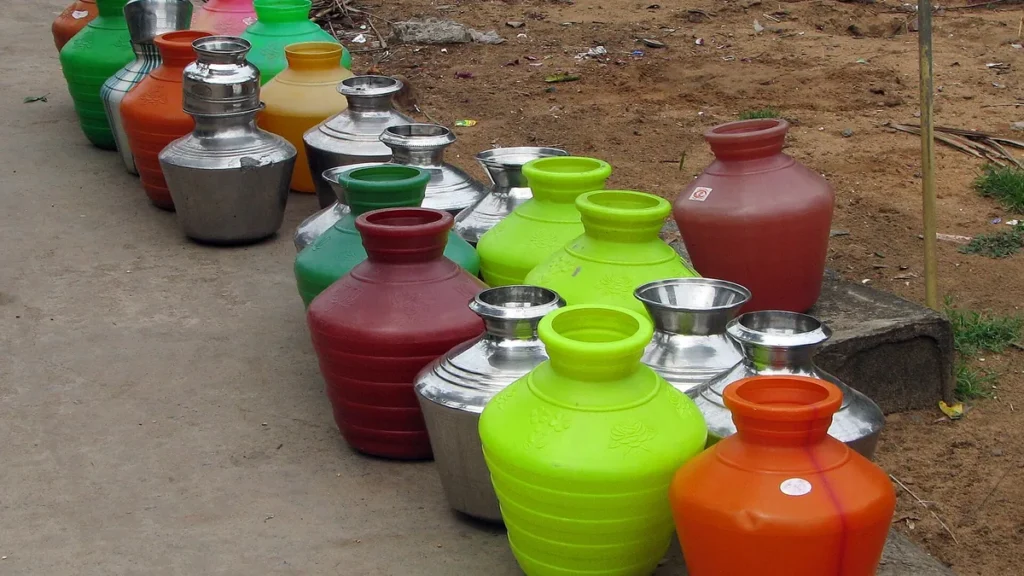
Photo: McKay Savage from London, UK, CC BY 2.0, via Wikimedia Commons
Exam angle
Prelims: 33.95% as of 27 October 2026, national average 12.83%, Karnataka 69.32%, 11,64,852 tests, 97,071 villages, five women per revenue village. · Mains GS-II: why tap connections are not enough, and how community screening sits beside laboratory tests.
Practice MCQs
Original practice questions (not PYQs).
As of 27 October 2026, Uttar Pradesh had completed what share of its annual field-kit water-quality testing target?
Answer (c) & explanation
The State had completed 33.95% of its annual target, above the national average of 12.83%, and ranked second. Karnataka led at 69.32%.
Under Uttar Pradesh’s rural field-kit testing programme, how many women in each revenue village are responsible for testing water?
Answer (c) & explanation
Five women in each revenue village are responsible for testing water with Field Testing Kits. About 4.85 lakh women are engaged in the work overall.
Questions students ask about this
What was Uttar Pradesh’s testing performance as of 27 October 2026?
It had completed 33.95% of its annual target, above the national average of 12.83%, and ranked second. Karnataka led at 69.32%.
What is the annual target?
11,64,852 tests in 2026–27, across 97,071 villages, according to Uttar Pradesh Jal Nigam (Rural).
How are women involved?
About 4.85 lakh women are engaged. Five women in each revenue village are responsible for field-kit testing.
Are field kits a substitute for laboratory tests?
No. They are a screening tool. A result that suggests contamination still needs laboratory confirmation and remedial action.
What tap-connection figures were reported?
More than 2.25 crore rural families had been given connections, with total coverage of about 2.672 crore rural homes, from November 2026 departmental information as cited in the report.