
Directive Principles of State Policy (Articles 36-51): Classification, Amendments and the FR-DPSP Conflict (UPSC Notes + PYQs)
UPSC has already asked about this. Read the story with these questions in mind.
- Prelims 2012Consider the following provisions under the Directive Principles of State Policy as enshrined in the Constitution of IndiaSolve it below ↓
- Prelims 2013According to the Constitution of India, which of the following are fundamental for the governance of the country?Solve it below ↓
See all 5 PYQs
- Prelims 2015Consider the following statements regarding the Directive Principles of State PolicySolve it below ↓
- Prelims 2014In the Constitution of India, promotion of international peace and security is included in theSolve it below ↓
- Prelims 2017The mind of the makers of the Constitution of India is reflected in which of the following?Solve it below ↓
Background: a promise for the future
The framers of the Constitution faced a nation of deep poverty, illiteracy and inequality. They could not promise every citizen a job, a school or a hospital as an enforceable right in 1950, because the State simply lacked the resources. Yet they did not want to leave these goals out. Borrowing the idea from the Irish Constitution of 1937, they placed them in Part IV as Directive Principles of State Policy, Articles 36 to 51. Article 37 says they are not enforceable by any court but are fundamental in the governance of the country, and it is the duty of the State to apply them in making laws. Dr Ambedkar described them as an instrument of instructions to future governments, and said that a government which ignored them would have to answer to the voters. Together with Fundamental Rights they form what Granville Austin called the conscience of the Constitution.
What they are, and why they are not enforceable
The framers borrowed the idea from the Irish Constitution of 1937. A newly free country with little money could not promise every citizen a job or a pension as a legal right, so these were written as directions to the State. Ambedkar called them an “instrument of instructions”, and argued that a government ignoring them would answer to voters, not judges.
- 1951Champakam Dorairajan: FRs prevail
- 1967Golaknath: Parliament cannot amend FRs
- 197125th Amendment adds Article 31C
- 1973Kesavananda: basic structure
- 197642nd Amendment widens 31C
- 1980Minerva Mills: balance is basic structure
Three broad groups
| Group | Examples |
|---|---|
| Socialist | Art. 38 (social order, reducing inequality), 39 (adequate livelihood, equal pay, no concentration of wealth), 41, 42 (maternity relief), 43 (living wage) |
| Gandhian | Art. 40 (village panchayats), 43 (cottage industries), 46 (SCs, STs, weaker sections), 47 (prohibition), 48 (cow slaughter) |
| Liberal-intellectual | Art. 44 (uniform civil code), 45 (early childhood care), 48A (environment), 49 (monuments), 50 (separating judiciary from executive), 51 (international peace) |
The classification is a teaching aid. The Constitution itself does not group them.
Later additions
- 42nd Amendment (1976): Art. 39(f) child development, 39A free legal aid, 43A workers in management, 48A environment.
- 44th Amendment (1978): Art. 38(2), reducing inequalities of income and status.
- 86th Amendment (2002): rewrote Art. 45 to early childhood care, after education for 6-14 year olds became a Fundamental Right under Art. 21A.
- 97th Amendment (2011): Art. 43B, promotion of co-operative societies.
- SocialistArts 38, 39, 41, 42, 43, 47
- GandhianArts 40, 43, 46, 47, 48
- Liberal-intellectualArts 44, 45, 48, 48A, 49, 50, 51
- Added laterArts 38(2), 39(f), 39A, 43A, 43B, 48A
The FR-DPSP conflict in court
The story runs through five cases, and examiners like the sequence.
- Champakam Dorairajan (1951): Fundamental Rights prevail; DPSPs must “run as subsidiary”.
- Golaknath (1967): Parliament cannot amend Fundamental Rights to implement DPSPs.
- 25th Amendment (1971): Art. 31C protected laws giving effect to Art. 39(b) and (c).
- Kesavananda Bharati (1973): upheld the first part of 31C, struck down the clause barring judicial review.
- Minerva Mills (1980): the Constitution rests on a balance between Parts III and IV; giving absolute primacy to one destroys the basic structure.
In 2024 a nine-judge bench in Property Owners Association held that not every private resource is a “material resource of the community” under Art. 39(b).
Fundamental Rights vs Directive Principles
| Point | Fundamental Rights (Part III) | Directive Principles (Part IV) |
|---|---|---|
| Nature | Negative: limits on the State | Positive: duties of the State |
| Enforceability | Justiciable (Article 32, 226) | Not justiciable (Article 37) |
| Aim | Political democracy | Social and economic democracy |
| Need for law | Operate on their own | Need legislation to take effect |
| Source | US Bill of Rights | Irish Constitution |
| Laws violating them | Can be struck down | Cannot be struck down for violating them |
How far have they been implemented?
More than critics admit. Land reforms (39b, c), MGNREGA (41), the Equal Remuneration Act (39d), free legal aid through NALSA (39A), panchayats via the 73rd Amendment (40), the Mid-Day Meal and NFSA (47), and the Wildlife and Environment Protection Acts (48A) all trace back to Part IV. The uniform civil code (44) remains the most debated; Uttarakhand passed its own UCC in 2024.
DPSPs that became law or rights
| Directive | How it was given effect |
|---|---|
| Article 40: village panchayats | 73rd Amendment (1992) |
| Article 45: early childhood care and education (originally free education to 14) | Article 21A and the RTE Act, 2009 |
| Article 39A: free legal aid | Legal Services Authorities Act, 1987 |
| Article 43: living wage, cottage industries | Minimum Wages Act, Khadi and Village Industries Commission; now Code on Wages |
| Article 47: nutrition and public health | National Food Security Act, 2013; mid-day meals |
| Article 48A: environment | Environment (Protection) Act, 1986; wildlife and forest laws |
| Article 50: separation of judiciary from executive | Code of Criminal Procedure, 1973 |
| Article 39(d): equal pay for equal work | Equal Remuneration Act, 1976 |
How courts use DPSPs today
Although courts cannot enforce Directive Principles directly, they use them in three ways. First, to interpret Fundamental Rights broadly: the right to life under Article 21 has been read with Articles 39, 41, 47 and 48A to include livelihood, health, education, food and a clean environment. Second, to uphold laws as reasonable restrictions: a law that advances a Directive Principle is more likely to be held reasonable under Article 14 or 19. Third, as part of the basic structure: in Minerva Mills (1980) the Supreme Court held that the harmony and balance between Parts III and IV is a basic feature. In this way, a non-justiciable part of the Constitution has shaped some of the most important rights Indians enjoy.
Directive Principles Of State Policy: UPSC angle
For UPSC CSE
Prelims: which article says what (a favourite: 39A, 40, 43A, 44, 48A, 50), which amendment added it. Mains GS-II: FR vs DPSP, UCC, welfare state, judicial use of DPSPs to read rights into Art. 21.
Directive Principles Of State Policy UPSC PYQs (Prelims)
Questions UPSC has actually asked, from the official papers. Pick an option to check yourself.
Consider the following provisions under the Directive Principles of State Policy as enshrined in the Constitution of India :
– 1. Securing for citizens of India a uniform civil code
– 2. Organizing village Panchayats
– 3. Promoting cottage industries in rural areas
– 4. Securing for all the workers reasonable leisure and cultural opportunities
Which of the above are the Gandhian Principles that are reflected in the Directive Principles of State Policy?
Gandhian DPSPs include village panchayats (Art. 40), cottage industries (Art. 43), prohibition, cow protection and the welfare of weaker sections. The uniform civil code (Art. 44) is a liberal-intellectual principle; leisure and cultural opportunities for workers (Art. 43, living wage) is counted as a socialist principle. Answer as per the official UPSC key · Battle IAS PYQ bankAnswer (b) & why
According to the Constitution of India, which of the following are fundamental for the governance of the country?
Article 37 says the Directive Principles are not enforceable by any court but are “nevertheless fundamental in the governance of the country”, and the State must apply them in making laws. Answer as per the official UPSC key · Battle IAS PYQ bankAnswer (c) & why
Consider the following statements regarding the Directive Principles of State Policy :
– 1. The Principles spell out the socio-economic democracy in the country.
– 2. The provisions contained in these Principles are not enforceable by any court.
Which of the statements given above is/are correct?
Fundamental Rights give us political democracy. The DPSPs aim at social and economic democracy: livelihood, fair wages, health, education. Article 37 makes them non-justiciable. Answer as per the official UPSC key · Battle IAS PYQ bankAnswer (c) & why
In the Constitution of India, promotion of international peace and security is included in the
Article 51 directs the State to promote international peace and security, keep just and honourable relations between nations, respect international law and settle disputes by arbitration. It is the last of the Directive Principles. Answer as per the official UPSC key · Battle IAS PYQ bankAnswer (b) & why
The mind of the makers of the Constitution of India is reflected in which of the following?
The Preamble grew out of the Objectives Resolution that Nehru moved in December 1946. The Supreme Court has called it a key to the minds of the makers, first in Berubari (1960). Answer as per the official UPSC key · Battle IAS PYQ bankAnswer (a) & why
Mains PYQs on this topic
No UPSC Mains question from 2023-2026 is directly on this topic. Older papers (2013-2022) will be added as the Mains bank grows.
Quick quiz
Free legal aid was added to the Directive Principles by the
Art. 39A, 1976.Answer (a)
Organisation of village panchayats is found in
A Gandhian principle.Answer (b)
The case that described the Constitution as founded on a balance between Parts III and IV is
1980.Answer (c)
FAQs
Can a citizen go to court to enforce a DPSP?
No. Article 37 says they are not enforceable by any court, though courts use them to interpret laws and to widen Article 21.
Which DPSP was added by the 97th Amendment?
Article 43B, promotion of co-operative societies.
Is the Uniform Civil Code a DPSP?
Yes, Article 44.
Where did the idea of DPSPs come from?
The Irish Constitution of 1937, which itself drew on the Spanish Constitution.
Which Article deals with the Uniform Civil Code?
Article 44, which asks the State to endeavour to secure a uniform civil code for citizens throughout India.
Which DPSP deals with international peace?
Article 51, which asks the State to promote international peace and security and respect for international law.
What did the 86th Amendment do to Article 45?
It made free education for children aged 6-14 a Fundamental Right under Article 21A and changed Article 45 to early childhood care and education below six.
Spotted an error? Tell us. We correct within 48 hours.
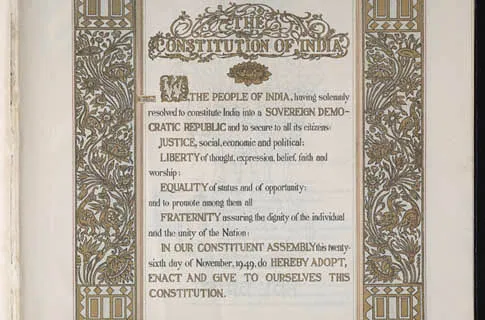
Image: https://commons.wikimedia.org/wiki/File:India_constitution_2006_1_4.jpg
How to use this in Mains
If asked: Trace the evolving relationship between Fundamental Rights and DPSPs. (GS-II)
Quote: “Champakam Dorairajan (1951): Fundamental Rights prevail; DPSPs must “run as subsidiary”.”
Use it: Start the case sequence here.
In the news
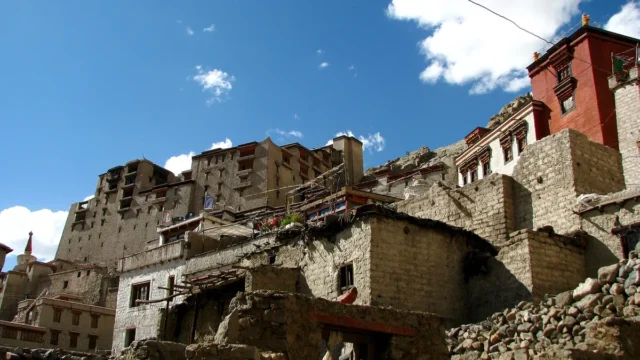
Ladakh draft framework: L-G to have final say on laws of proposed UT-level elected body
The Centre’s draft ‘Constitutional and Statutory Framework’ for Ladakh proposes a Union Territory-level elected body whose every regulation will take effect only after the Lieutenant Governor’s assent, The Hindu reported on 21 October 2026. A new constitutional provision would also give constitutional status to the hill councils. Leh and Kargil groups, who want Sixth Schedule safeguards, meet the Home Ministry this week.
21 Oct 2026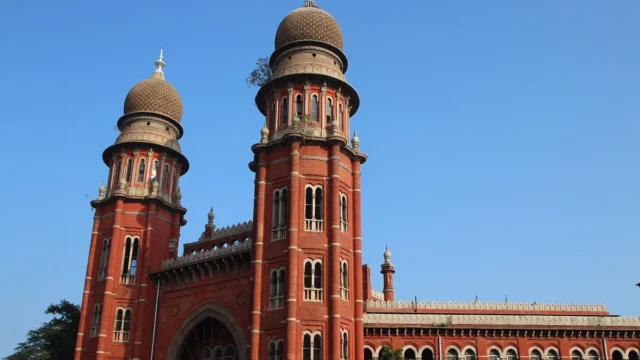
Conversion does not carry over a quota: Supreme Court on Tamil Nadu’s BC Muslim certificates
On 15 October 2026, in The Secretary to Government v. Sameer Ahamed N., the Supreme Court upheld the Madras High Court’s quashing of a 2024 Tamil Nadu order. That order let converts to Islam from Backward, Most Backward, Denotified and Scheduled Caste communities get Backward Class Muslim certificates and use the 3.5% BC Muslim quota. The Court said conversion to Islam does not by itself make a person a member of any of the seven notified BC Muslim communities.
21 Oct 2026
India to host 61st CIML meeting on legal metrology in New Delhi, 26–28 October
India will host the 61st meeting of the International Committee of Legal Metrology (CIML) for the first time, in New Delhi from 26 to 28 October 2026. The Department of Consumer Affairs is organising it with the International Organization of Legal Metrology (OIML), and more than 100 delegates are expected, PIB said on 19 October.
19 Oct 2026
NMC withdraws MSMER-2023: medical colleges lose the fixed penalty rulebook, annual disclosure stays
The National Medical Commission (NMC) has de-notified the Maintenance of Standards of Medical Education Regulations, 2023 (MSMER-2023) by a notification dated 14 October 2026, published in the Gazette on 16 October. Its fixed penalties, including seat cuts and fines of up to ₹5 lakh for false records, go with it. The Annual Disclosure Report stays.
19 Oct 2026