
Insurance Sector in India: IRDAI, the Sabka Bima Sabki Raksha (Amendment of Insurance Laws) Act 2025, 100% FDI, Penetration, Government Schemes and Insurance for All by 2047 (UPSC Notes + PYQs)
UPSC has already asked about this. Read the story with these questions in mind.
Why insurance matters
A farmer in Vidarbha loses his cotton crop to unseasonal rain. A street vendor in Patna needs surgery. A family in Kochi loses its earning member in an accident. In each case, without insurance, one shock can push a household into debt for years. Studies of health spending show that out-of-pocket medical costs push millions of Indians below the poverty line every year. Insurance spreads such risks across many people, so that no one carries the whole burden alone.
Insurance is also a source of long-term savings for the economy. Life insurers and pension funds invest in government bonds, roads, power and housing, because their liabilities stretch over decades. A deeper insurance market therefore helps both social protection and infrastructure finance.
A short history
| Year | Event |
|---|---|
| 1818 | Oriental Life Insurance Company, Calcutta, first life insurer in India |
| 1938 | Insurance Act, still the basic law |
| 1956 | Life insurance nationalised; LIC formed |
| 1972 | General insurance nationalised; GIC and four subsidiaries |
| 1994 | Malhotra Committee recommends opening to private players and an independent regulator |
| 1999 | IRDA Act; private and foreign entry with 26% FDI |
| 2015 | FDI cap raised to 49% |
| 2021 | FDI cap raised to 74% |
| 2025 | FDI cap raised to 100% by the Sabka Bima Sabki Raksha Act |
- 11999: 26%
- 22015: 49%
- 32021: 74%
- 42025: 100%
The 2025 amendment
The Sabka Bima Sabki Raksha (Amendment of Insurance Laws) Act, 2025 was passed by Parliament on 17 December 2025, received assent on 20 December 2025, and most of its provisions came into force on 5 February 2026. It amends three laws at once: the Insurance Act, 1938, the LIC Act, 1956 and the IRDA Act, 1999. Its main features:
- 100% FDI in Indian insurance companies, up from 74%. Rules notified by the Finance Ministry require that at least one of the chairperson, managing director or CEO be a resident Indian citizen.
- Foreign reinsurers: the net owned fund requirement for branches of foreign reinsurers is cut from ₹5,000 crore to ₹1,000 crore, to deepen reinsurance capacity in India.
- Share transfers: the threshold above which insurers need prior regulatory approval for transfer of shares is raised from 1% to 5%.
- Intermediaries: one-time licensing for intermediaries, and suspension of a licence as an option instead of straight away cancelling it.
- LIC: autonomy to open zonal offices and to align its foreign offices with local laws.
How deep is Indian insurance?
| Indicator | India | World average |
|---|---|---|
| Penetration (premium as % of GDP), 2023-24 | About 3.7% (life 2.8%, non-life 1.0%) | About 7% |
| Density (premium per person) | About US$95 | About US$890 |
India is one of the fastest growing insurance markets, and LIC remains the largest life insurer with a majority share of new premium in group business. But the protection gap, the difference between the cover people need and what they have, is huge, especially for health and natural disasters. Most health cover comes from government schemes, while the “missing middle”, people too rich for government schemes but too poor to buy private policies, remains largely unprotected.
- Bima SugamOnline marketplace
- Bima VistaarSimple rural bundle
- Bima VahakWomen field force
- Govt schemesPMJJBY, PMSBY, PMFBY, PM-JAY
Government schemes and IRDAI reforms
- PM Jeevan Jyoti Bima Yojana: life cover of ₹2 lakh for a yearly premium of ₹436.
- PM Suraksha Bima Yojana: accident cover of ₹2 lakh for ₹20 a year.
- PM Fasal Bima Yojana (2016): crop insurance with low farmer premiums of 2% for kharif, 1.5% for rabi and 5% for commercial and horticultural crops.
- Ayushman Bharat PM-JAY: ₹5 lakh a year per family for hospital care, extended to all citizens above 70 in 2024.
- Bima Trinity of IRDAI: Bima Sugam, an online marketplace for buying policies and settling claims; Bima Vistaar, a simple bundled policy for rural people; and Bima Vahak, women-led field force at the gram panchayat level.
- IRDAI’s goal is “Insurance for All by 2047”.
Why 100% FDI?
- Capital: insurance needs large, patient capital; Indian promoters often cannot supply enough to grow fast.
- Competition and products: global firms bring underwriting skills, technology and new products such as cyber and climate insurance.
- Penetration: more players can reach smaller towns and new segments.
- Long-term funds: more insurance assets mean more money for infrastructure.
Concerns
- Profits abroad: critics worry that fully foreign-owned firms will focus on rich urban clients and send profits home.
- Mis-selling: complex products sold by agents for high commissions harm trust; claim rejection and delays are common complaints.
- Health claims: rising hospital costs and disputes between insurers and hospitals hurt policyholders.
- Crop insurance: delayed payouts, disputes over yield data and some States leaving PMFBY show design gaps.
- Public sector insurers: some state-owned general insurers have weak finances.
- Climate risk: floods, cyclones and heatwaves are raising losses faster than premiums.
- Low incomes and savings
- Mis-selling and claim disputes
- Low financial literacy
- Few simple products for rural India
Way forward
Use the new FDI room to raise capital while keeping strong IRDAI oversight on fair pricing and claims. Push simple, standard products and digital sales through Bima Sugam. Build parametric insurance, which pays automatically when rainfall or temperature crosses a trigger, for farmers and informal workers. Create a national disaster risk pool with States. Fix health claim disputes through standard hospital rates and fast grievance redress. Improve financial literacy, so that people know what they buy. A deeper insurance market is a quiet but powerful tool of social security.
PYQ trend
Prelims has asked about crop insurance, cyber insurance, aviation insurance and who can trade in bonds. Mains GS-III asks about financial inclusion and social security.
Insurance Sector in India: UPSC angle
For UPSC CSE
Prelims: IRDAI, FDI limits, schemes, penetration vs density. Mains GS-III: financial sector reforms, inclusion, social security, agriculture risk.
Insurance Sector in India UPSC PYQs (Prelims)
Questions UPSC has actually asked, from the official papers. Pick an option to check yourself.
With reference to 'Pradhan Mantri Fasal Bima Yojana', consider the following statements
– 1. Under this scheme, farmers will have to pay a uniform premium of two percent for any crop they cultivate in any season of the year.
– 2. This scheme covers post-harvest losses arising out of cyclones and unseasonal rains.
Which of the statements given above is/are correct?
Under PMFBY (2016), the farmer’s premium is 2% for kharif, 1.5% for rabi food and oilseed crops, and 5% for commercial and horticultural crops, so it is not uniform. The scheme covers post-harvest losses for up to 14 days from cyclones, cyclonic rain and unseasonal rain. Answer as per the official UPSC key · Battle IAS PYQ bankAnswer (b) & why
In India, which of the following can trade in Corporate Bonds and Government Securities ?
– 1. Insurance Companies
– 2. Pension Funds
– 3. Retail Investors
Select the correct answer using the code given below :
Insurers and pension funds are the biggest long-term buyers of bonds; the law even requires them to hold a share of their funds in G-Secs. Retail investors can buy corporate bonds on stock exchanges and G-Secs directly through the RBI Retail Direct portal (2021). So all three. Answer as per the official UPSC key · Battle IAS PYQ bankAnswer (d) & why
Which of the following statements about insurance in aviation sector is/are correct ?
– 1. 'Aviation Hull Insurance' covers the physical aircraft, including the body, engine, and on-board equipment.
– 2. Under the Montreal Convention, adopted in 1999 by over 130 countries, including India, airlines are strictly liable to pay compensation to the family/nominee of every deceased passenger without requiring the family to prove fault.
Select the answer using the code given below :
Hull insurance covers the aircraft itself: body, engines and equipment on board. Passenger claims fall under liability cover. The Montreal Convention, 1999 (India joined in 2009) makes the airline strictly liable up to a fixed limit for death or injury of a passenger; the family need not prove fault for that first tier. Both are correct. Answer as per the official UPSC key · Battle IAS PYQ bankAnswer (c) & why
Mains PYQs on this topic
Questions from the official UPSC Mains papers (2023-2026 in the Battle IAS Mains bank), newest first. Each links to a model answer.
- UPSC Mains 2026 · GS Paper III · Q2 · 10 marks
Examine the view that financial inclusion is an integral part of social and economic inclusion in a country like India. Also throw light on the usefulness of the R.B.I.'s Financial Inclusion Index.
Quick quiz
The FDI limit in Indian insurance companies after the 2025 amendment is
Raised from 74% to 100%.Answer (c)
Insurance penetration measures
Density is premium per person.Answer (b)
Which committee recommended opening insurance to private players?
R.N. Malhotra Committee, 1994.Answer (b)
FAQs
What is the Sabka Bima Sabki Raksha Act?
The 2025 law amending the Insurance Act, 1938, the LIC Act, 1956 and the IRDA Act, 1999, which allows 100% FDI in insurance and strengthens the regulator.
What does IRDAI do?
It licenses and regulates insurers and intermediaries, protects policyholders and promotes orderly growth of the insurance industry.
What is the difference between insurance penetration and density?
Penetration is total premium as a share of GDP; density is premium per person.
What is the Bima Trinity?
IRDAI’s plan of Bima Sugam (online platform), Bima Vistaar (simple bundled rural cover) and Bima Vahak (women field agents).
What is parametric insurance?
Insurance that pays automatically when a measurable event, such as rainfall below a level, occurs, without assessing individual losses.
Spotted an error? Tell us. We correct within 48 hours.
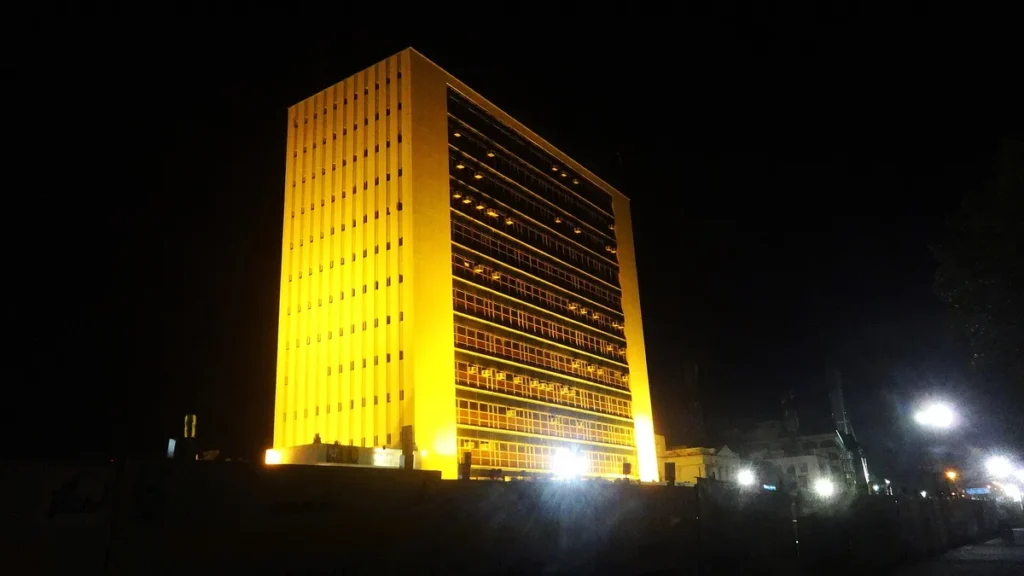
Image: Arjuncm3, Wikimedia Commons, CC BY-SA 4.0
How to use this in Mains
If asked: UPSC Mains 2026, GS-III: Examine the view that financial inclusion is an integral part of social and economic inclusion in a country like India. Also throw light on the usefulness of the R.B.I.'s Financial Inclusion Index.
Quote: “Mis-selling: complex products sold by agents for high commissions harm trust; claim rejection and delays are common complaints.”
Use it: Use it to show why insurance has not reached people despite growth; good for the 'issues' part.
In the news
Cabinet raises EPFO wage ceiling from ₹15,000 to ₹25,000 a month
On 16 September 2026 the Union Cabinet raised the wage ceiling for mandatory EPFO coverage from ₹15,000 to ₹25,000 a month. More than 51 lakh more employees will now come under provident fund, pension (EPS) and insurance (EDLI) cover. The ceiling was last raised in September 2014. The Government's yearly outgo is estimated at about ₹11,339 crore.
16 Sep 2026
Bharat Maritime Insurance Pool launches sovereign-backed P&I cover
The Department of Financial Services launched India's first sovereign-backed Protection and Indemnity (P&I) insurance product under the Bharat Maritime Insurance Pool on 30 July 2026. Designed by New India Assurance, it covers third-party liabilities up to USD 1.5 billion. Since May, BMIP has issued 1608 war risk policies and cut premiums by about 35 to 40 per cent.
30 Jul 2026
Bharat Maritime Insurance Pool of USD 1.5 billion launched with sovereign guarantee
The Department of Financial Services launched the Bharat Maritime Insurance Pool (BMIP) of USD 1.5 billion on 12 May 2026, backed by a sovereign guarantee of USD 1.4 billion (₹12,980 crore). It covers hull and machinery, cargo, P&I and war risk for Indian-linked vessels. GIC Re is administrator. The guarantee applies only to claims above USD 100 million.
12 May 2026
PMJJBY, PMSBY and APY complete 11 years
The three Jan Suraksha schemes, launched on 9 May 2015, completed 11 years in 2026. PMJJBY has over 27.43 crore enrolments and paid ₹21,512.50 crore on 10,75,625 claims. PMSBY has over 58.09 crore enrolments and paid ₹3,667.52 crore on 1,84,662 claims. Atal Pension Yojana has over 9.04 crore subscribers.
9 May 2026