
Lok Adalats and Legal Aid in India: Article 39A, the Legal Services Authorities Act 1987, NALSA, National and Permanent Lok Adalats, Free Legal Aid and Reform (UPSC Notes + PYQs)
UPSC has already asked about this. Read the story with these questions in mind.
Justice that is cheap and quick
India’s courts carry more than five crore pending cases. A simple dispute over a motor accident claim, an unpaid electricity bill or a small bank loan can take years. For a poor litigant, the cost of a lawyer and repeated trips to court can exceed the amount at stake. The Constitution recognises this problem. Article 39A, added by the 42nd Amendment in 1976, directs the State to ensure that the legal system promotes justice on equal opportunity and to provide free legal aid, so that no citizen is denied justice because of economic or other disabilities. Article 14 (equality before law) and Article 22(1) (right to consult a lawyer) support the same idea, and the Supreme Court in Hussainara Khatoon (1979) and M.H. Hoskot (1978) held that free legal aid is part of the right to life and personal liberty under Article 21.
The first Lok Adalat was held in 1982 at Junagadh, Gujarat, as a voluntary, informal forum where disputes were settled by mutual agreement with the help of retired judges and social workers. Its success led Parliament to give Lok Adalats statutory backing.
The Legal Services Authorities Act, 1987
The Act came into force on 9 November 1995, the date now observed as National Legal Services Day. It creates a nationwide network of legal services institutions:
| Level | Body | Head |
|---|---|---|
| National | National Legal Services Authority (NALSA) | Patron-in-Chief: Chief Justice of India; Executive Chairman: senior-most Supreme Court judge after the CJI |
| Supreme Court | Supreme Court Legal Services Committee | A sitting Supreme Court judge |
| State | State Legal Services Authority (SLSA) | Patron-in-Chief: Chief Justice of the High Court; Executive Chairman: a senior High Court judge |
| High Court | High Court Legal Services Committee | A sitting High Court judge |
| District | District Legal Services Authority (DLSA) | District Judge |
| Taluk | Taluk Legal Services Committee | Senior civil judge |
- 1NALSA (CJI as Patron-in-Chief)
- 2State Legal Services Authority
- 3District Legal Services Authority
- 4Taluk Legal Services Committee
- 5Lok Adalats and legal aid clinics
Who gets free legal aid
Section 12 of the Act lists those entitled to free legal services, whatever the strength of their case:
- members of Scheduled Castes and Scheduled Tribes;
- victims of trafficking or begar (forced labour);
- women and children;
- persons with disabilities, including mental illness;
- victims of mass disasters, ethnic violence, caste atrocity, flood, drought, earthquake or industrial disaster;
- industrial workmen;
- persons in custody, including in protective homes and psychiatric hospitals;
- persons whose annual income is below a limit set by the Centre or the State.
Since about 80% of Indians fall in one or more of these categories, legal aid is in theory available to a vast majority. Services include a lawyer, court fees, drafting, and advice, and NALSA’s Legal Aid Defence Counsel System, rolled out from 2022, provides full-time public defenders in criminal cases.
How a Lok Adalat works
- Composition: a serving or retired judicial officer, with a lawyer and a social worker as members.
- Cases: pending cases referred by a court, or pre-litigation disputes not yet filed. Common subjects: motor accident claims, bank recovery, cheque bounce, electricity and water bills, matrimonial and family matters, labour disputes and land acquisition compensation.
- Limits: no jurisdiction over non-compoundable criminal offences, those that cannot be settled by the parties under law.
- No court fee: if a pending case is settled, the court fee paid earlier is refunded.
- Award: deemed to be a decree of a civil court; final and binding; no appeal lies against it, though a party can challenge it in a writ petition on limited grounds such as fraud.
- Failure: if no settlement is reached, the case goes back to the regular court.
- FinalNo appeal
- FreeCourt fee refunded
- ConsentBased on compromise
- ScopeCivil and compoundable cases
Types of Lok Adalats
| Type | Features |
|---|---|
| National Lok Adalat | Held on a single day across the country, usually four times a year, covering lakhs of cases |
| State and district Lok Adalats | Organised locally as needed |
| Permanent Lok Adalat | Added by a 2002 amendment (Section 22B) for public utility services such as transport, post, telecom, power, water, hospitals and insurance; can decide a dispute on merits if conciliation fails; limit of ₹1 crore |
| e-Lok Adalat | Online sessions started during the Covid-19 pandemic in 2020 |
| Mobile Lok Adalat | Vans that travel to villages to settle disputes locally |
The National Lok Adalat held on 13 December 2025 again settled lakhs of pre-litigation and pending cases in a day, a reminder of the scale the system can reach.
Lok Adalat vs arbitration
UPSC asked candidates to distinguish the two. A Lok Adalat works only by consent: if both sides do not agree, there is no award (except in a Permanent Lok Adalat). An arbitral tribunal, under the Arbitration and Conciliation Act, 1996, decides the dispute on merits after hearing both sides, and its award can be challenged in court on limited grounds. Lok Adalats are free; arbitration can be expensive. Lok Adalats can take up civil cases and compoundable criminal cases; arbitration covers civil and commercial disputes only.
Strengths and weaknesses
Strengths: speed, no cost, informal procedure, finality of awards, preservation of relationships, and relief to court dockets. Bank recovery and motor accident cases, in particular, are disposed of in large numbers.
Weaknesses:
- Pressure to settle: poor litigants may accept lower compensation just to end the case.
- Numbers over quality: targets for disposal can encourage hurried settlements.
- Limited scope: complex and serious cases stay in regular courts.
- Legal aid quality: panel lawyers are often poorly paid and stretched, and awareness of free legal aid remains low, particularly among undertrial prisoners, who form about three-fourths of India’s prison population.
- Funding: legal aid spending per person is very low.
- Low awareness
- Poorly paid panel lawyers
- Low funding per person
- Large undertrial population
Way forward
Raise funding for legal aid and pay panel lawyers fairly. Expand the public defender system so that every undertrial has a lawyer. Use technology, with online dispute resolution and e-Lok Adalats, while protecting those with poor digital access. Train Lok Adalat members in mediation skills, so that settlements are fair, not forced. Link Lok Adalats with the Mediation Act, 2023 and the Gram Nyayalayas for a full ladder of alternatives to litigation. Spread legal literacy through schools, panchayats and paralegal volunteers.
PYQ trend
Mains GS-II has asked directly about Lok Adalats versus arbitration tribunals and about NALSA’s role in free legal aid. Prelims has asked about NALSA’s objectives.
Lok Adalat: UPSC angle
For UPSC CSE
Prelims: Article 39A, NALSA, features of Lok Adalats. Mains GS-II: judiciary, access to justice, ADR, pendency of cases.
Lok Adalat UPSC PYQs (Prelims)
Questions UPSC has actually asked, from the official papers. Pick an option to check yourself.
With reference to National Legal Services Authority, consider the following statements :
– 1. Its objective is to provide free and competent legal services to the weaker sections of the society on the basis of equal opportunity.
– 2. It issues guidelines for the State Legal Services Authorities to implement the legal programmes and schemes throughout the country.
Which of the statements given above is/are correct?
NALSA was set up under the Legal Services Authorities Act, 1987. It provides free and competent legal services to weaker sections, and lays down policies and guidelines that the State Legal Services Authorities carry out. Answer as per the official UPSC key · Battle IAS PYQ bankAnswer (c) & why
Mains PYQs on this topic
Questions from the official UPSC Mains papers (2023-2026 in the Battle IAS Mains bank), newest first. Each links to a model answer.
- UPSC Mains 2024 · GS Paper II · Q2 · 10 marks
Explain and distinguish between Lok Adalats and Arbitration Tribunals. Whether they entertain civil as well as criminal cases?
- UPSC Mains 2023 · GS Paper II · Q2 · 10 marks
Who are entitled to receive free legal aid ? Assess the role of the National Legal Services Authority (NALSA) in rendering free legal aid in India.
Quick quiz
Which Article provides for free legal aid?
Article 39A, added in 1976.Answer (b)
An award of a Lok Adalat
No appeal lies against it.Answer (b)
Permanent Lok Adalats deal with
Section 22B, added in 2002.Answer (b)
FAQs
What is a Lok Adalat?
A forum under the Legal Services Authorities Act, 1987 where pending or pre-litigation disputes are settled amicably; its award is final and binding.
Can a Lok Adalat hear criminal cases?
Only compoundable offences, which the law allows parties to settle. Non-compoundable offences are excluded.
Who heads NALSA?
The Chief Justice of India is the Patron-in-Chief and the senior-most Supreme Court judge after the CJI is the Executive Chairman.
What is a Permanent Lok Adalat?
A standing body for disputes about public utility services that can decide on merits if conciliation fails.
Who is eligible for free legal aid?
SCs and STs, women, children, persons with disabilities, trafficking and disaster victims, industrial workers, people in custody and those below an income limit.
When is National Legal Services Day?
9 November, the day the Act came into force in 1995.
Spotted an error? Tell us. We correct within 48 hours.
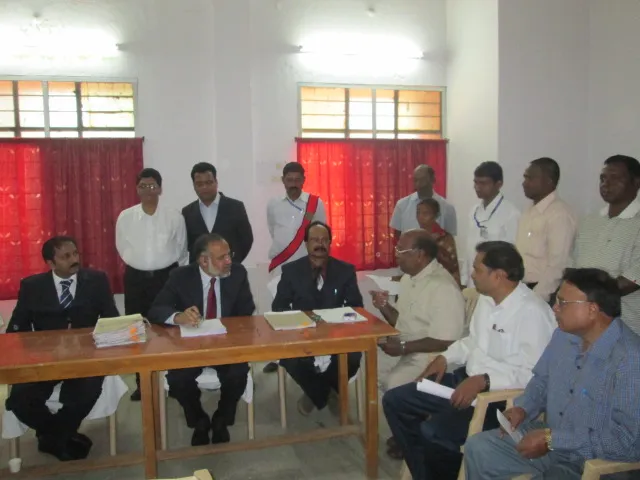
Image: Hpsatapathy, Wikimedia Commons, CC BY-SA 3.0
How to use this in Mains
If asked: UPSC Mains 2024, GS-II: Explain and distinguish between Lok Adalats and Arbitration Tribunals. Whether they entertain civil as well as criminal cases?
Quote: “Pressure to settle: poor litigants may accept lower compensation just to end the case.”
Use it: Use as the balancing point when you list the strengths of Lok Adalats.
In the news
National Legal Services Day: Lok Adalats settled 23.58 crore cases in three years
Lok Adalats clear huge numbers, but many are traffic challans and small bank recoveries. Quality of settlement matters as much as quantity.
8 Nov 2025