
UPSC Mains 2019 GS Paper 1 Q17: model answer
How do ocean currents and water masses differ in their impacts on marine life and coastal environment? Give suitable examples.
What the question wants
Compare how ocean currents and water masses affect marine life and coastal environments, with examples.
How to structure it
How do ... differ ... Give suitable examples: a comparison.
- Definitions
- Currents: effects
- Water masses: effects
- Key differences
- Conclusion
How to think it through
A current is a river in the ocean; a water mass is a lake in the ocean, a big body with its own temperature and salinity. Rivers carry and deliver; lakes layer and store. Once you see that, the comparison writes itself. Use Peru, the Grand Banks and the Bay of Bengal.
Model answer
Off Peru the cold Humboldt current supports one of the world's largest single-species fisheries, the anchoveta; in the Bay of Bengal a layer of fresh, light water on top of saltier water starves the surface of nutrients. One example is about a current, the other about water masses, and the effects differ.
Definitions
- Ocean currents: directed horizontal or vertical flows of water driven by winds, Coriolis force and density.
- Water masses: large bodies of water with distinct temperature and salinity, formed at the surface in a source region and then sinking to their density level (e.g. North Atlantic Deep Water, Antarctic Bottom Water).
Effects of currents
- Marine life: transport larvae, plankton and nutrients; meeting of warm and cold currents creates fishing grounds (Grand Banks, Kuroshio–Oyashio).
- Upwelling along cold-current coasts (Peru, Namibia, California) brings nutrients up, fuelling plankton blooms.
- Coasts: warm currents give mild, moist climates (north-west Europe); cold currents create fog and coastal deserts (Atacama, Namib).
- They spread pollutants and plastics (Great Pacific Garbage Patch) and invasive species.
Effects of water masses
- Layering (stratification) controls oxygen and nutrient mixing; stable layers can create dead zones.
- Deep water masses store carbon and heat, shaping long-term climate through thermohaline circulation.
- Different species live in different masses; deep-sea ecosystems depend on oxygen carried by sinking polar water.
- Coasts: a warm water mass raises sea surface temperature, fuelling cyclones, coral bleaching (Great Barrier Reef) and marine heat waves.
Key differences
- Currents act quickly and horizontally, mainly on surface life and coastal weather.
- Water masses act slowly and vertically, controlling deep ecosystems, carbon storage and climate over decades.
Both are parts of one ocean system. Climate change is weakening the mixing between water masses and shifting currents, which threatens fisheries and coasts alike.
Draw: Ocean cross-section: surface current arrows on top, layered water masses below with sinking polar water.
Keywords, cases and data to drop in
Upwelling, Humboldt, anchoveta, NADW, AABW, stratification, thermohaline circulation, marine heat wave.
Where most answers lose marks
- Treating currents and water masses as the same thing.
Related Mains PYQs
- Describe the characteristics and types of primary rocks. UPSC 2022 · GS-I
- Discuss the meaning of colour-coded weather warnings for cyclone prone areas given by India Meteorological Department. UPSC 2022 · GS-I
- What are the forces that influence ocean currents? Describe their role in fishing industry of the world. UPSC 2022 · GS-I
- The troposphere is a very significant atmospheric layer that determines weather processes. How? UPSC 2022 · GS-I
Fresh examples from current affairs
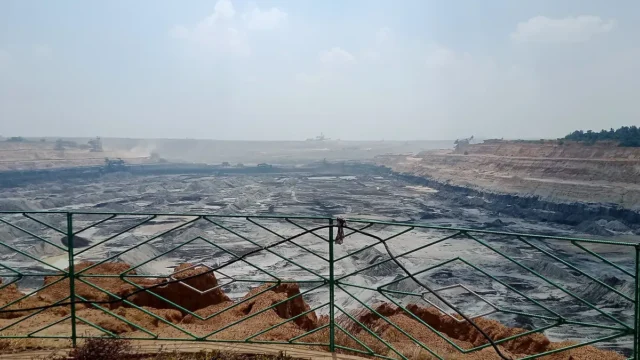
Neyveli, Tiruchirappalli and Atacama: Indian scientists identify Martian analogue sites
Scientists at the University of Kerala, using a laser Raman spectrometer funded under DST-FIST, have identified two minerals that make some places on Earth useful ‘Martian analogue’ sites, DST said on 16 October 2026. Melanterite was found in the lignite of Neyveli, Tamil Nadu. Gypsum was found in the Atacama Desert of Chile and in the Tiruchirappalli Badlands. Both are hydrous sulphates that record how water and rock interacted.
UPSC angle: Prelims: minerals, Raman effect, Atacama. · Mains GS-III: space science and research capacity.
16 Oct 2026
Ancient Gondwana wildfires recorded in Indian coal
BSIP (DST) researchers reported molecular evidence of massive wildfires in Gondwana forests nearly 250 million years ago. Using palynofacies analysis with Raman and FTIR spectroscopy on Godavari Valley Coalfield sediments, they separated high- and low-intensity fire-derived microcharcoal from other opaque particles. The study is in Geological Journal (Wiley).
UPSC angle: Prelims: Gondwana vs Tertiary coal.
25 May 2026
Aravalli Hills: Centre explains move to a uniform definition
The definition decides which hills can be mined. That is why environmental groups are watching closely.
UPSC angle: Prelims: Aravallis. · Mains: Mining vs ecology.
21 Dec 2025Learn the concept
Question text as printed in the official UPSC Civil Services (Main) question paper. The model answer is original Battle IAS work; use it to learn structure, not to memorise.
Want every PYQ in one place? See the Battle IAS PYQ Book.