
UPSC Mains 2019 GS Paper 2 Q13: model answer
“The reservation of seats for women in the institutions of local self-government has had a limited impact on the patriarchal character of the Indian Political Process.” Comment.
What the question wants
Comment on whether women's quotas in local bodies have done little to change patriarchal politics.
How to structure it
Comment: agree partly, show both evidence sets, end with what would make the quota bite.
- The scale
- Limited impact
- Real gains
- Why both are true
- Way forward
How to think it through
The famous 'pradhan-pati' or sarpanch-pati is real. But so is the West Bengal study that showed women heads spent more on drinking water. A good comment holds both and asks: what changes with time in office?
Model answer
In 2025 news reports from a Chhattisgarh village showed husbands taking the oath in place of newly elected women panchayat members. Yet at about the same time India had about 14.5 lakh elected women representatives, roughly 46% of all panchayat members. Both pictures are true.
The design
Article 243D and 243T reserve at least one-third of seats and chair posts for women; about 21 States have raised this to 50%.
Why the impact looks limited
- Proxy rule: husbands or male relatives run the office; a Ministry of Panchayati Raj advisory committee (report 2025) called for penalties for proxy leadership.
- Rotation: seats rotate every term, so women rarely build a second innings or a base.
- Party structures: few women move from panchayat to Assembly; women were under 10% of most State Assemblies until the 106th Amendment.
- Caste and class: dominant families field their women to keep power.
- Gram sabha attendance by women is low; meetings are timed and placed for men.
Real gains
- Chattopadhyay and Duflo (2004): women-led panchayats in West Bengal invested
more in drinking water and roads women used.
- Women's presence raised reporting of crimes against women, a sign of confidence.
- A generation of women leaders: Chhavi Rajawat of Soda (Rajasthan), many heads in Kerala and Odisha.
- Self-help groups (Kudumbashree, Jeevika) now feed women into politics.
Why both are true
Patriarchy bends slowly; the first term is often proxy, the second is often real. Research from Rajasthan shows that voters' bias falls after one term of a woman head.
Way forward
Longer rotation (two terms), training through RGSA, women-only gram sabhas before the main one, action against proxy leaders, and SHG–panchayat links.
The quota opened the door; patriarchy still stands in the corridor.
Draw: A staircase: seat (quota) → voice (gram sabha) → power (decisions) → career (higher office), with the drop-off at each step.
Keywords, cases and data to drop in
Article 243D, 243T, 50% in 21 States, 14.5 lakh EWRs, sarpanch-pati, Chattopadhyay–Duflo 2004, rotation, 106th Amendment 2023, Kudumbashree, RGSA.
Where most answers lose marks
- Fully agreeing with the statement. 'Comment' expects your own judgment; the evidence supports 'limited, but real and rising'.
Related Mains PYQs
- Discuss the position of the Governor in the federal polity of India. What is the nature of his power while giving assent… UPSC 2026 · GS-II
- How far has the Indian federal framework been successful in accommodating regional and cultural diversities? Highlight the role of asymmetric federalism and… UPSC 2026 · GS-II
- Examine how the separation of powers is practised in India compared to the rigid presidential model of the United States of America.… UPSC 2026 · GS-II
- Examine the evolving pattern of Centre-State financial relations in the context of planned development in India. How far have the recent reforms… UPSC 2025 · GS-II
Fresh examples from current affairs

Cauvery panel tells Karnataka to release 3,000 cusecs to Tamil Nadu: Article 262 and the inter-State water dispute
The Cauvery Water Regulation Committee has told Karnataka to ensure 3,000 cusecs of water a day at Biligundlu for 15 days, and the Cauvery Water Management Authority has endorsed it. Tamil Nadu wanted almost five times more, including a claimed backlog. Karnataka says a weak monsoon has left its four Cauvery reservoirs 55% short and most of its taluks in drought. For you, this is a live case study of Article 262, water tribunals and how a dry year turns sharing into a crisis.
UPSC angle: Prelims: Cauvery source and tributaries, Article 262, ISWD Act 1956, CWMA. · Mains GS-II: inter-State water disputes; cooperative federalism.
25 Oct 2026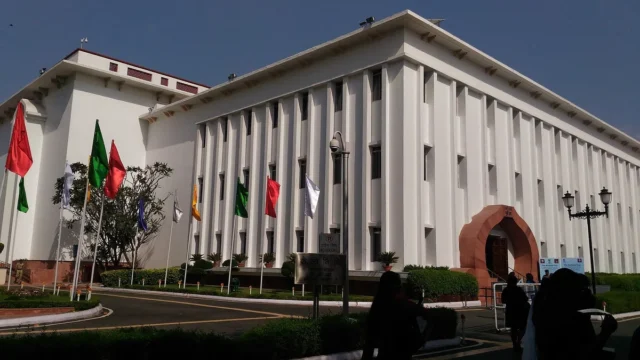
Cooperative federalism and law reform: Law Commission proposes a ‘citizen friction test’
On 22 October 2026, the 23rd Law Commission of India held a national conference on ‘Co-operative Federalism and Law Reforms’ at Vigyan Bhawan, inaugurated by Vice-President C. P. Radhakrishnan. He urged State Law Commissions to find and repeal outdated laws. Law Commission Chairperson Justice (retd.) Dinesh Maheshwari proposed a ‘citizen friction test’ to check whether a law reduces the time, cost and paperwork it imposes on citizens.
UPSC angle: Prelims: Law Commission, Articles 1, 252, 254, 263. · Mains GS-II: cooperative federalism; law reform.
22 Oct 2026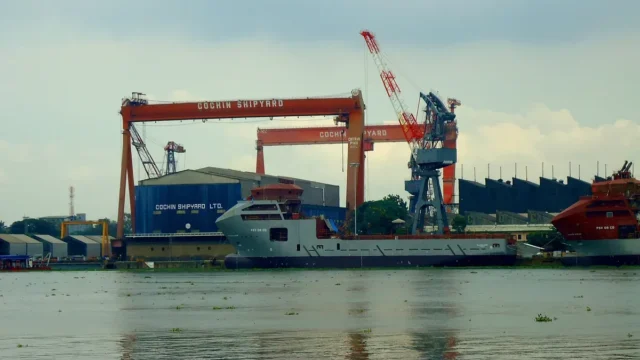
21st Maritime State Development Council: first MSDC under the Indian Ports Act, 2025
The 21st Maritime State Development Council met in Mumbai on 13 October 2026. It was the first MSDC after the Indian Ports Act, 2025 (notified 15 May 2026) made the Council a statutory body. Members adopted Vision 2030 and 2047 targets and set March 2027 deadlines for One Nation One Port Process and Maritime Single Window integration.
UPSC angle: Prelims: Ports Act 2025 date, MSDC, ONOP, Sagar Setu, SbPCP/BCSPS. · Mains GS-III: ports and shipbuilding; GS-II: cooperative federalism.
13 Oct 2026
57th GST Council: arrest provisions to go, prosecution threshold raised to ₹5 crore
The 57th GST Council meeting on 8 October 2026 focused on process reform rather than rates. It recommended removing arrest powers under GST, raising the prosecution threshold from ₹1 crore to ₹5 crore, cutting the general penalty from ₹25,000 to ₹10,000, no notices below ₹10,000 tax, wider input tax credit and refunds, and limits on interception of goods in transit.
UPSC angle: Prelims: GST Council structure, Article 279A. · Mains GS-III: indirect tax reform; GS-II: fiscal federalism.
8 Oct 2026Learn the concept
Question text as printed in the official UPSC Civil Services (Main) question paper. The model answer is original Battle IAS work; use it to learn structure, not to memorise.
Want every PYQ in one place? See the Battle IAS PYQ Book.