
UPSC Mains 2019 GS Paper 2 Q4: model answer
From the resolution of contentious issues regarding distribution of legislative powers by the courts, ‘Principle of Federal Supremacy’ and ‘Harmonious Construction’ have emerged. Explain.
What the question wants
Explain the principles of federal supremacy and harmonious construction that courts use to settle legislative conflicts.
How to structure it
Explain: define, give the Article and a case each, then show how they fit together.
- Where conflicts arise
- Federal supremacy
- Harmonious construction
- Helper doctrines
How to think it through
Federal supremacy is the tie-breaker; harmonious construction is the attempt to avoid a tie. Courts try the second first, like a good parent with two quarrelling children.
Model answer
Schedule Seven has 97 Union, 66 State and 47 Concurrent entries as originally framed. With so many lists, overlaps were certain.
Federal supremacy
- Article 246 opens with 'notwithstanding': if an entry in the Union List and one in the
State List truly collide, the Union entry wins.
- Article 254: in Concurrent matters, a Union law prevails over a repugnant State law, unless the State law got Presidential assent.
- Courts use it only as a last resort, as in State of West Bengal v Kesoram Industries (2004).
Harmonious construction
- Courts read entries so that each keeps meaning and neither is made useless.
- In ITC v Agricultural Produce Market Committee (2002), the Court reconciled a State market fee with a Union tobacco law.
Helper doctrines
- Pith and substance: look at the true nature of a law (Prafulla Kumar Mukherjee, 1947).
- Colourable legislation: what cannot be done directly cannot be done indirectly.
Together they keep federalism workable: harmony first, supremacy only when harmony fails. This keeps the Union from swallowing State powers through broad readings of its entries.
Draw: A flow chart: conflict → try harmonious reading → if impossible, Union entry prevails.
Keywords, cases and data to drop in
Article 246, 254, 'notwithstanding', repugnancy, Kesoram 2004, ITC v APMC 2002, pith and substance, colourable legislation.
Where most answers lose marks
- Treating them as rivals. They work in sequence, not in competition.
Related Mains PYQs
- Discuss the position of the Governor in the federal polity of India. What is the nature of his power while giving assent… UPSC 2026 · GS-II
- How far has the Indian federal framework been successful in accommodating regional and cultural diversities? Highlight the role of asymmetric federalism and… UPSC 2026 · GS-II
- Examine how the separation of powers is practised in India compared to the rigid presidential model of the United States of America.… UPSC 2026 · GS-II
- Examine the evolving pattern of Centre-State financial relations in the context of planned development in India. How far have the recent reforms… UPSC 2025 · GS-II
Fresh examples from current affairs

Cauvery panel tells Karnataka to release 3,000 cusecs to Tamil Nadu: Article 262 and the inter-State water dispute
The Cauvery Water Regulation Committee has told Karnataka to ensure 3,000 cusecs of water a day at Biligundlu for 15 days, and the Cauvery Water Management Authority has endorsed it. Tamil Nadu wanted almost five times more, including a claimed backlog. Karnataka says a weak monsoon has left its four Cauvery reservoirs 55% short and most of its taluks in drought. For you, this is a live case study of Article 262, water tribunals and how a dry year turns sharing into a crisis.
UPSC angle: Prelims: Cauvery source and tributaries, Article 262, ISWD Act 1956, CWMA. · Mains GS-II: inter-State water disputes; cooperative federalism.
25 Oct 2026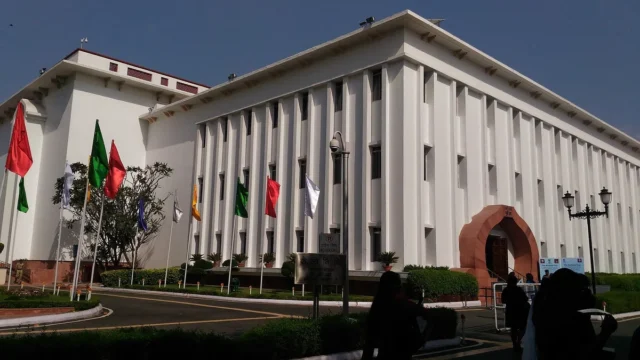
Cooperative federalism and law reform: Law Commission proposes a ‘citizen friction test’
On 22 October 2026, the 23rd Law Commission of India held a national conference on ‘Co-operative Federalism and Law Reforms’ at Vigyan Bhawan, inaugurated by Vice-President C. P. Radhakrishnan. He urged State Law Commissions to find and repeal outdated laws. Law Commission Chairperson Justice (retd.) Dinesh Maheshwari proposed a ‘citizen friction test’ to check whether a law reduces the time, cost and paperwork it imposes on citizens.
UPSC angle: Prelims: Law Commission, Articles 1, 252, 254, 263. · Mains GS-II: cooperative federalism; law reform.
22 Oct 2026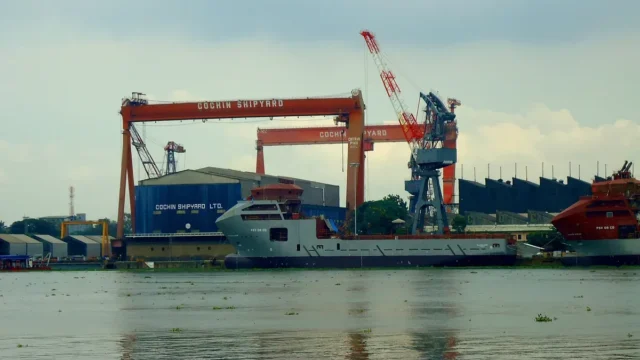
21st Maritime State Development Council: first MSDC under the Indian Ports Act, 2025
The 21st Maritime State Development Council met in Mumbai on 13 October 2026. It was the first MSDC after the Indian Ports Act, 2025 (notified 15 May 2026) made the Council a statutory body. Members adopted Vision 2030 and 2047 targets and set March 2027 deadlines for One Nation One Port Process and Maritime Single Window integration.
UPSC angle: Prelims: Ports Act 2025 date, MSDC, ONOP, Sagar Setu, SbPCP/BCSPS. · Mains GS-III: ports and shipbuilding; GS-II: cooperative federalism.
13 Oct 2026
57th GST Council: arrest provisions to go, prosecution threshold raised to ₹5 crore
The 57th GST Council meeting on 8 October 2026 focused on process reform rather than rates. It recommended removing arrest powers under GST, raising the prosecution threshold from ₹1 crore to ₹5 crore, cutting the general penalty from ₹25,000 to ₹10,000, no notices below ₹10,000 tax, wider input tax credit and refunds, and limits on interception of goods in transit.
UPSC angle: Prelims: GST Council structure, Article 279A. · Mains GS-III: indirect tax reform; GS-II: fiscal federalism.
8 Oct 2026Learn the concept
Question text as printed in the official UPSC Civil Services (Main) question paper. The model answer is original Battle IAS work; use it to learn structure, not to memorise.
Want every PYQ in one place? See the Battle IAS PYQ Book.