
Chapter 16 · Topic 16.2 · Prelims + Mains2 of 3
Ancient Indian Art & Architecture: Temples and sculpture
Key points
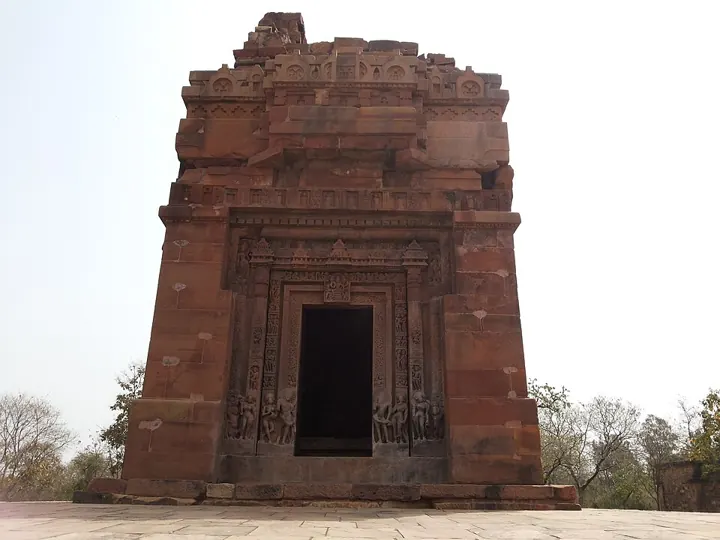
- The free-standing temple began in the Gupta age: Sanchi Temple 17, Deogarh, Bhitargaon.
- Parts: garbhagriha, mandapa, shikhara or vimana, panchayatana plan.
- Styles: Nagara (north), Dravida (south), Vesara (Deccan) (Prelims 2012).
- Schools: Gandhara (schist), Mathura (red sandstone), Amaravati (white limestone), Sarnath (Gupta).
Prelims box: facts and traps
- Prelims 2014: Mahaparinirvana at Ajanta; Arjuna's Penance at Mamallapuram; Varaha at Udayagiri (MP).
- Gandhara: Kushan patronage, wavy hair, heavy robes.
- Mathura: Buddhist, Jain and Hindu images.
The temple and its three styles
The free-standing Hindu temple took shape in the Gupta age. It began as a small flat-roofed square shrine (Sanchi Temple 17) and grew a tower over the sanctum (the inner room holding the god). The Dashavatara temple at Deogarh (6th century) and the brick temple at Bhitargaon are the best early examples.
| Part | Meaning |
|---|---|
| Garbhagriha | Small dark sanctum with the main image |
| Mandapa | Hall for worshippers |
| Shikhara or vimana | Tower over the sanctum (north: shikhara; south: vimana) |
| Panchayatana | Main shrine with four smaller shrines at the corners |
Prelims 2012 asked simply: The Nagara, the Dravida and the Vesara are the three main styles of Indian temple architecture. Nagara is the northern style with a curved shikhara (Khajuraho, Odisha temples); Dravida is the southern style with a pyramid-like vimana and tall gopurams (gateway towers); Vesara mixes the two in the Deccan (later Chalukyas, Hoysalas).
The Nagara, the Dravida and the Vesara are the
- three main racial groups of the Indian subcontinent
- three main linguistic divisions into which the languages of India can be classified
- three main styles of Indian temple architecture
- three main musical Gharanas prevalent in India
Show answer
Answer: (c) · UPSC official key
What UPSC asks
Prelims: garbhagriha, shikhara, vimana; three styles. Mains: evolution of the temple. Next likely: temple heritage.
Schools of sculpture
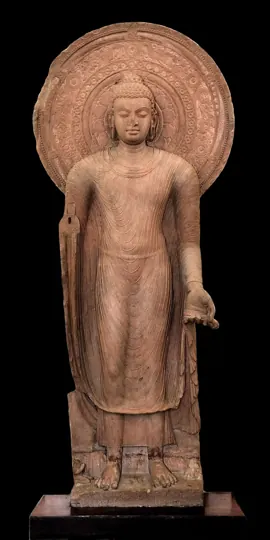
Around the 1st century CE the Buddha began to be shown in human form. Three schools grew up, and UPSC loves to compare them.
| School | Material | Features |
|---|---|---|
| Gandhara (north-west, Taxila, Peshawar) | Grey-blue schist, stucco | Greco-Roman style: wavy hair, heavy folded robes, muscular body; mainly Buddhist; Kushan patronage |
| Mathura (Uttar Pradesh) | Spotted red sandstone | Indian style: fleshy, smiling, light robe; Buddhist, Jain and Hindu images |
| Amaravati (Andhra Pradesh) | White limestone | Narrative reliefs full of movement; Satavahana patronage |
| Sarnath (Gupta) | Buff sandstone | Calm faces, see-through robes; the classic Gupta Buddha |
Mains 2019: ‘Highlight the Central Asian and Greco-Bactrian elements in the Gandhara art.’ Mention Greek and Roman drapery (cloth folds) and Apollo-like faces, Kushan dress and boots, Bactrian gold-work, and stucco (lime plaster) from Central Asia.
Highlight the Central Asian and Greco-Bactrian elements in the Gandhara art.
Prelims 2014 matched sculptures to sites. The Mahaparinirvana is at Ajanta, and Arjuna’s Penance, ‘sculpted on the surface of huge boulders ‘, is at Mamallapuram. The great Varaha is at Udayagiri (Madhya Pradesh), not Mount Abu.
With reference to the Indian history of art and culture, consider the following pairs :
Famous work of sculpture – Site
1. A grand image of Buddha’s Mahaparinirvana with numerous celestial musicians above and the sorrowful figures of his followers below – Ajanta
2. A huge image of Varaha Avatar (boar incarnation) of Vishnu, as he rescues Goddess Earth from the deep and chaotic waters, sculpted on rock – Mount Abu
3. “Arjuna’s Penance”/ “Descent of Ganga” sculpted on the surface of huge boulders – Mamallapuram
Which of the pairs given above is/are correctly matched?
- 1 and 2 only
- 3 only
- 1 and 3 only
- 1, 2 and 3
Show answer
Answer: (c) · UPSC official key
What UPSC asks
Prelims: Gandhara, Mathura, Amaravati, Sarnath. Mains: Gandhara elements (2019). Next likely: return of antiquities.
Mains box: analysis and answer points
- Gandhara elements (Mains 2019): Greco-Roman drapery, Kushan dress, Bactrian gold-work, stucco.
- Evolution of the temple: flat roof to tower.
- Likely next angle: return of antiquities.
Practice
Practice MCQs (8)
Which one of the following is NOT a characteristic of the Gandhara school of sculpture?
Answer (c) & explanation
Gandhara sculptors in the north-west used grey-blue schist and later stucco, and their work shows Hellenistic and Roman modelling absorbed through Bactria and Parthia. Their princely Bodhisattvas wear turbans, heavy jewellery and often moustaches. Spotted red sandstone from the Sikri area is the stone of Mathura, not of Gandhara.
The Bhutesar railing pillars, carved with yakshis and women standing on crouching dwarfs and now displayed in the Indian Museum, Kolkata, are among the best-known works of the
Answer (a) & explanation
The Bhutesar pillars come from the Bhutesar mound at Mathura and belong to the Kushana period (about second century CE). Carved in Mathura's spotted red sandstone, they show full-bodied female figures, with a bird cage, a wine jar or a bathing scene, each standing on a dwarf. Their fleshy volume continues the indigenous yaksha-yakshi tradition seen earlier at Bharhut and Sanchi.
With reference to the Mathura school of the early centuries CE, consider the following statements according to NCERT:
1. Besides the numerous Buddhist images, images of the Jaina, Vaishnava and Shaiva faiths are also found at Mathura.
2. The Buddha image at Mathura is modelled on the lines of earlier yaksha images, whereas in Gandhara it has Hellenistic features.
3. At Mathura, images of Vishnu and Shiva are identified mainly by their vahanas (mounts).
Which of the statements given above are correct?
Answer (b) & explanation
NCERT says images of the Vaishnava (mainly Vishnu and his forms) and Shaiva (mainly lingas and mukhalingas) faiths are found at Mathura along with Jaina images, though Buddhist images are the most numerous. It also says the Mathura Buddha is modelled on earlier yaksha images, while the Gandhara Buddha has Hellenistic features. But NCERT notes that images of Vishnu and Shiva are represented by their ayudhas (weapons), not by their mounts.
Consider the following pairs: Art centre or monument : Principal stone used
1. Gandhara sculpture : Grey-blue schist
2. Mathura sculpture : Black basalt
3. Bharhut railing : Red sandstone
4. Sarnath lion capital : Chunar sandstone
Which of the pairs given above are correctly matched?
Answer (d) & explanation
Gandhara sculptors of the north-west worked mainly in grey-blue schist (and later in stucco). Mathura is known for its spotted red sandstone, not black basalt. The Bharhut railing and gateway, now in the Indian Museum, Kolkata, are carved in red sandstone of the Vindhyan region. NCERT notes that Mauryan pillars such as the Sarnath capital were carved in polished Chunar sandstone. So pairs 1, 3 and 4 are correct.
With reference to the seated Buddha from the Katra mound, Mathura (second century CE), consider the following statements:
1. The Buddha's right hand is in abhaya mudra, raised a little above shoulder level.
2. The attendant figures are identified as the Bodhisattvas Padmapani and Vajrapani.
3. The sanghati (robe) covers both shoulders in heavy folds.
Which of the statements given above are correct?
Answer (a) & explanation
NCERT's box on the Katra mound Buddha says he sits in padmasana on a lion throne, with the right hand in abhayamudra raised a little above the shoulder and the left on the thigh. The two crowned attendants are Padmapani (holding a lotus) and Vajrapani (holding a thunderbolt). NCERT stresses that the sanghati covers only one shoulder and clings to the torso, with a very large halo decorated with simple geometric motifs.
With reference to the nineteenth-century history of the stupa at Amaravati, consider the following statements:
1. Its ruins were stumbled upon by a local raja who wanted to use the stone to build a temple.
2. Walter Elliot, the commissioner of Guntur, collected several sculpture panels there and took them away to Madras.
3. Its gateways and railing survived in place because the French and the English were satisfied with plaster-cast copies.
Which of the statements given above is/are correct?
Answer (c) & explanation
NCERT narrates that in 1796 a local raja who wanted to build a temple stumbled upon the ruins at Amaravati and decided to use the stone. Later Walter Elliot, commissioner of Guntur, collected sculpture panels and took them to Madras; these came to be called the Elliot marbles. By the 1850s slabs had gone to Calcutta, Madras and London. Statement 3 describes Sanchi, not Amaravati: it was Sanchi's eastern gateway that the French and English agreed to copy in plaster, and Amaravati's torana has disappeared.
The 'Shrine of the Double-headed Eagle', a stupa base whose facade combines Greek-style pediments, Indian torana arches and chaitya-arched niches, was excavated at
Answer (b) & explanation
John Marshall excavated the shrine in Block F of Sirkap, the Indo-Greek and Saka-Parthian city at Taxila. The base of its stupa has pilasters of the Corinthian type separating three kinds of niche: Greek pediments, bell-shaped chaitya arches and Indian toranas, with a double-headed eagle perched on one of them. It is a textbook example of the mixed architectural vocabulary of the north-west in the first century BCE and first century CE.
Consider the following major find-sites of Gandhara art:
1. Taxila
2. Takht-i-Bahi
3. Butkara
4. Hadda
How many of the above are located in present-day Pakistan?
Answer (c) & explanation
Taxila (Punjab) and the monastery of Takht-i-Bahi near Mardan (Khyber Pakhtunkhwa), both World Heritage sites, are in Pakistan, as is Butkara in the Swat valley, excavated by an Italian mission. Hadda, the source of thousands of stucco and schist sculptures, lies near Jalalabad in eastern Afghanistan. So three of the four are in Pakistan.
0 / 0 correct
Write an answer
In 150 words, explain the significance of Ancient Indian Art & Architecture with one recent example.
Flashcards (6)
Early Gupta stone temple?
Dashavatara, Deogarh.
Three temple styles?
Nagara, Dravida, Vesara.
Main shrine plus four corner shrines?
Panchayatana.
Gandhara material?
Grey-blue schist.
Mathura material?
Spotted red sandstone.
Amaravati material?
White limestone.
Read more: related explainers
In the news
- 20 Oct 2026Sirpur in Chhattisgarh enters UNESCO’s Tentative List of World Heritage sites
- 15 Oct 2026PM inaugurates five Ladakh projects: Nimmu–Padum–Darcha road, Leh terminal, Hanu hydro
- 14 Oct 2026HAL, NCF and ASI sign MoA for Hampi, Taj Mahal and Bekal Fort
- 11 Oct 2026Birth anniversaries: Jayaprakash Narayan and Nanaji Deshmukh
 Next topic · 16.3 →Ancient Indian Art & Architecture: The whole chapter
Syllabus: Prelims GS-I · History of India and Indian National Movement.