
Chapter 13 · Topic 13.1 · Prelims + Mains1 of 3
South Indian Kingdoms: Pallavas, Chalukyas and Rashtrakutas
Key points
- Pallava stages: Mahendravarman I (caves), Narasimhavarman I (rathas), Rajasimha (Shore Temple, Kailasanatha).
- Narasimhavarman I took Vatapi in 642 and killed Pulakeshin II (title Vatapikonda).
- Chalukyas of Badami (about 543–753 CE): Pulakeshin II's Aihole inscription (634 CE) by Ravikirti.
- Rashtrakutas: Dantidurga, Krishna I (Kailasa, Ellora), Amoghavarsha I (Manyakheta); fell in 973.
Prelims box: facts and traps
- Ajanta and Mahabalipuram (Prelims 2016): both have rock-cut monuments.
- Mattavilasa Prahasana: farce by Mahendravarman I.
- Virupaksha, Pattadakal: built by Lokamahadevi.
- Kavirajamarga: Kannada poetics under Amoghavarsha.
- Takkolam (949): Krishna III beat the Cholas.
The Pallavas of Kanchi
From the 6th to the 9th century, three powers fought over the south: the Pallavas of Kanchipuram, the Chalukyas of Badami and the Pandyas of Madurai. Learn the Pallava kings in order, because each one stands for a stage in temple building.
| King | Remember him for |
|---|---|
| Simhavishnu (late 6th century) | Made the Pallavas a major power between the Krishna and the Kaveri |
| Mahendravarman I (about 600–630) | Rock-cut cave temples; wrote the Sanskrit farce Mattavilasa Prahasana; turned from Jainism to Shaivism under the saint Appar |
| Narasimhavarman I ‘Mamalla’ (630–668) | Defeated and killed Pulakeshin II and took Vatapi in 642 (title Vatapikonda); Mamallapuram’s rathas; Hiuen Tsang visited Kanchi |
| Narasimhavarman II ‘Rajasimha’ (about 700–728) | Structural temples: the Shore Temple and the Kailasanatha temple at Kanchi |
| Nandivarman II (8th century) | Vaikuntha Perumal temple, Kanchi |
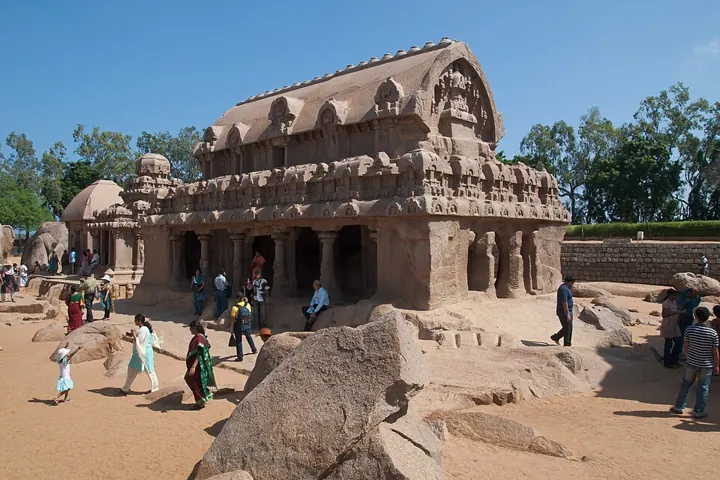
Kanchi was a great seat of learning, with a ghatika (college) and Buddhist, Jain and Hindu scholars. By tradition, the poets Bharavi (Kiratarjuniya) and Dandin (Kavyadarsha) were linked with the Pallava court. The Tamil bhakti (loving devotion) saints, the Shaiva Nayanars and Vaishnava Alvars, sang in this age. The Pallava script, called Grantha, spread to Southeast Asia.
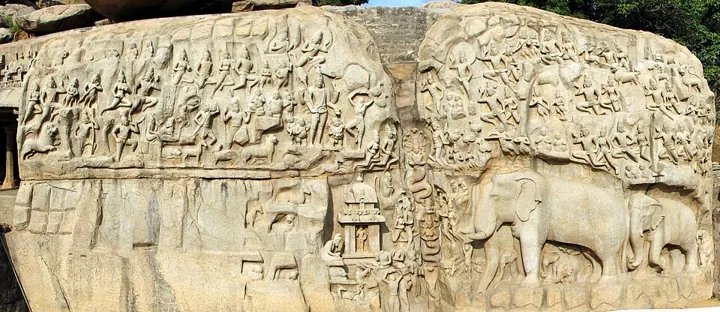
Mains 2024 asked: Estimate the contribution of Pallavas of Kanchi for the development of Art and literature of South India. A good answer covers the move from cave to monolith (a temple cut from one rock) to structural temple, the sculpture at Mamallapuram, Sanskrit literature at court and the bhakti hymns in Tamil.
Estimate the contribution of Pallavas of Kanchi for the development of Art and literature of South India.
Prelims 2016 asked: What is/are common to the two historical places known as Ajanta and Mahabalipuram? Prelims 2016 Only one thing: both have rock-cut monuments (b). Ajanta is mostly Buddhist and earlier; Mahabalipuram is Hindu and Pallava.
What is/are common to the two historical places known as Ajanta and Mahabalipuram? 1. Both were built in the same period. 2. Both belong to the same religious denomination. 3. Both have rock-cut monuments. Select the correct answer using the code given below.
- 1 and 2 only
- 3 only
- 1 and 3 only
- None of the statements given above is correct
Show answer
Answer: (b) · UPSC official key
What UPSC asks
Prelims: Pallava kings; Ajanta and Mahabalipuram (2016). Mains: Pallava art and literature (2024). Next likely: Mamallapuram heritage site.
Chalukyas of Badami and the Rashtrakutas
The Chalukyas of Badami (Vatapi) ruled the western Deccan from about 543 to 753 CE. Pulakeshin I founded the kingdom and performed the horse sacrifice. Pulakeshin II (610–642) was the greatest: he stopped Harsha on the Narmada and defeated the Pallavas, as the Aihole inscription (634 CE), written by the Jain poet Ravikirti, records. He was killed when Narasimhavarman I took Vatapi in 642.
Later, Vikramaditya II took Kanchi, and his queen Lokamahadevi built the Virupaksha temple at Pattadakal to mark the win. Chalukya temples at Aihole, Badami and Pattadakal show early trials of temple form, so Aihole is often called a cradle of Indian temple architecture.
| Rashtrakuta king | Remember him for |
|---|---|
| Dantidurga (8th century) | Overthrew the Chalukyas of Badami about 753 CE |
| Krishna I (756–774) | The monolithic Kailasa temple at Ellora |
| Dhruva and Govinda III | Campaigns in the north, in the fight for Kanauj |
| Amoghavarsha I (814–878) | Capital Manyakheta; Kavirajamarga, early work on Kannada poetics; patron of Jains and of the mathematician Mahaviracharya |
| Krishna III (939–967) | Defeated the Cholas at Takkolam (949) |
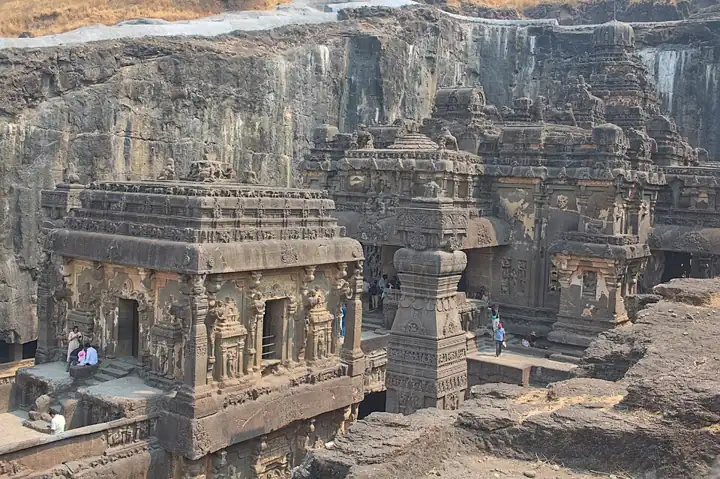
The Rashtrakutas were one of the three powers in the tripartite struggle for Kanauj, with the Palas and Pratiharas. The Arab traveller Sulaiman (851 CE) counted the Rashtrakuta king among the four great kings of the world. In 973 the Chalukyas of Kalyani overthrew them.
What UPSC asks
Prelims: Aihole inscription; Ellora; Amoghavarsha. Mains: the tripartite struggle. Next likely: Pattadakal and Ellora World Heritage Sites.
Mains box: analysis and answer points
- Pallava art and literature (Mains 2024): cave to monolith to structural temple; Mamallapuram; Sanskrit court; Tamil bhakti.
- Tripartite struggle: Rashtrakuta role.
- Likely next angle: Pattadakal and Ellora heritage.
Practice
Practice MCQs (8)
The Pallava king who captured the Chalukya capital Vatapi in 642 CE, avenging his father's defeat, and took the title 'Vatapikonda' (conqueror of Vatapi) was
Answer (c) & explanation
Mahendravarman I had been defeated by Pulakeshin II. His son Narasimhavarman I (also called Mamalla) turned the tables: he defeated the Chalukyas, captured Vatapi in 642 CE, where Pulakeshin II lost his life, and assumed the title Vatapikonda.
The capital of the Pallava kings, who dominated the northern Tamil country from the sixth to the ninth century, was
Answer (b) & explanation
The Pallavas ruled from Kanchipuram (Kanchi), which grew into a great centre of Sanskrit learning and temple building. Madurai was the Pandya capital, Uraiyur the early Chola centre and Vatapi (Badami) the seat of their Chalukya rivals in the Deccan.
With reference to the Chalukyas of Badami, consider the following statements:
1. Pulakeshin I made Vatapi his capital and performed the ashvamedha sacrifice.
2. Vikramaditya II defeated the Pallavas and entered Kanchi.
3. Vishnuvardhana, the founder of the Eastern Chalukya line of Vengi, was a son of Pulakeshin II.
Which of the statements given above is/are correct?
Answer (b) & explanation
Pulakeshin I's Badami cliff inscription (543 CE) records the fortification of Vatapi and his performance of the ashvamedha. In the eighth century Vikramaditya II defeated the Pallava Nandivarman II and entered Kanchi, where he made gifts to the Kailasanatha temple instead of sacking the city. Statement 3 is wrong: Vishnuvardhana was Pulakeshin II's younger brother, placed in charge of Vengi.
Consider the following pairs: Dynasty : Capital
1. Hoysalas : Dorasamudra
2. Western Gangas : Talakad
3. Eastern Chalukyas : Vengi
4. Chalukyas of Badami : Manyakheta
How many of the pairs given above are correctly matched?
Answer (c) & explanation
Three pairs are correct. The Hoysalas ruled from Dorasamudra (Halebidu), the Western Gangas from Talakad on the Kaveri, and the Eastern Chalukyas from Vengi in the Krishna-Godavari delta. Pair 4 is wrong: the Chalukyas of Badami ruled from Vatapi; Manyakheta was the capital of the Rashtrakutas, who displaced them, and later briefly of the Chalukyas of Kalyani.
With reference to Vikramaditya VI of the Chalukyas of Kalyani, consider the following statements:
1. The poet Bilhana's biography of him is titled the Rajatarangini.
2. Vijnaneshvara wrote the Mitakshara, a commentary on the Yajnavalkya Smriti, at his court.
3. He started a new era, the Chalukya-Vikrama era, from 1076 CE.
Which of the statements given above is/are correct?
Answer (c) & explanation
Vikramaditya VI (1076-1126) of Kalyani replaced the Shaka era in his records with the Chalukya-Vikrama era from his accession. Vijnaneshvara composed the Mitakshara at his court, the basis of the most widespread school of Hindu law. Statement 1 is wrong: Bilhana's biography of the king is the Vikramankadevacharita; the Rajatarangini is Kalhana's chronicle of Kashmir.
With reference to the account of Marco Polo, who visited south India towards the end of the thirteenth century, consider the following statements:
1. He visited the Pandya kingdom on the Coromandel coast.
2. He described the kingdom of Mutfili (Motupalli) as ruled by a queen.
3. He visited the court of the Chola king Rajaraja I.
Which of the statements given above is/are correct?
Answer (a) & explanation
The Venetian Marco Polo came to south India around 1292-93 on his return journey from China. He described the Pandya country (Maabar) and its trade, and the kingdom of Mutfili, the Kakatiya port of Motupalli, which he said was ruled by a wise queen (usually identified with Rudramadevi). Statement 3 is wrong: Rajaraja I reigned three centuries earlier (985-1014).
Consider the following dynasties:
1. Rashtrakutas
2. Kakatiyas
3. Hoysalas
4. Yadavas of Devagiri
How many of the above dynasties began as feudatories of one or the other Chalukya house (of Badami or of Kalyani)?
Answer (d) & explanation
All four did. The Rashtrakutas under Dantidurga were feudatories of the Chalukyas of Badami before overthrowing them. The Kakatiyas, Hoysalas and Yadavas (Seunas) served the Chalukyas of Kalyani and declared independence in the twelfth century as Kalyani power collapsed; they then divided the Deccan among themselves until the Delhi Sultanate's campaigns.
Consider the following events:
1. Battle of Takkolam
2. Death of Harshavardhana
3. Northern campaign of Rajendra I up to the Ganga
4. Overthrow of the Chalukyas of Badami by Dantidurga What is the correct chronological order of the above events, starting from the earliest?
Answer (a) & explanation
Harsha died in about 647 CE. Dantidurga ended Chalukya rule at Badami around 752-53. Krishna III's victory at Takkolam came in 949, and Rajendra I's army reached the Ganga around 1022, after which he took the title Gangaikondachola. The order is 2-4-1-3.
0 / 0 correct
Write an answer
In 150 words, explain the significance of South Indian Kingdoms with one recent example.
Flashcards (10)
Capital of the Pallavas?
Kanchipuram.
Who wrote the Mattavilasa Prahasana?
Mahendravarman I.
Who took Vatapi in 642?
Narasimhavarman I (Mamalla).
Who built the Shore Temple?
Narasimhavarman II (Rajasimha).
What is common to Ajanta and
Mahabalipuram (2016)? Rock-cut monuments.
Who wrote the Aihole inscription?
Ravikirti.
Who built the Virupaksha temple at
Pattadakal? Queen Lokamahadevi.
Who built the Kailasa temple, Ellora?
Krishna I (Rashtrakuta).
Rashtrakuta capital under Amoghavarsha?
Manyakheta.
Battle of Takkolam (949)?
Krishna III defeated the Cholas.
Read more: related explainers
In the news
- 20 Oct 2026Sirpur in Chhattisgarh enters UNESCO’s Tentative List of World Heritage sites
- 15 Oct 2026PM inaugurates five Ladakh projects: Nimmu–Padum–Darcha road, Leh terminal, Hanu hydro
- 14 Oct 2026HAL, NCF and ASI sign MoA for Hampi, Taj Mahal and Bekal Fort
- 11 Oct 2026Birth anniversaries: Jayaprakash Narayan and Nanaji Deshmukh
 Next topic · 13.2 →South Indian Kingdoms: Cholas and their administration
Syllabus: Prelims GS-I · History of India and Indian National Movement.