
Chapter 13 · Topic 13.2 · Prelims + Mains2 of 3
South Indian Kingdoms: Cholas and their administration
Key points
- Vijayalaya took Thanjavur about 850 CE; Parantaka I's Uttaramerur inscriptions (919, 921 CE).
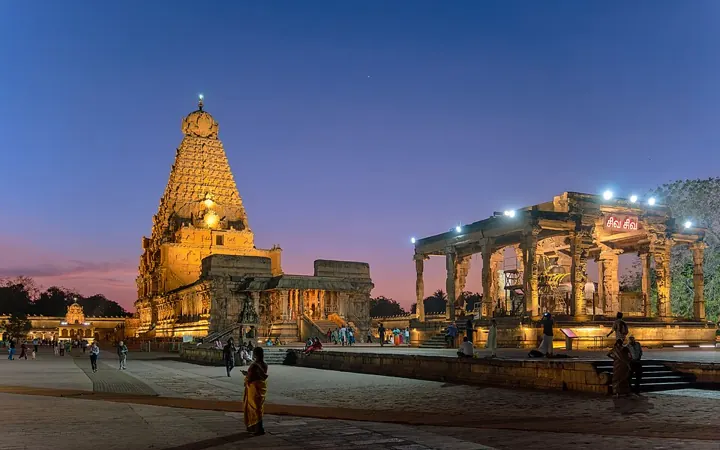
- Rajaraja I: land survey, Brihadishvara (1010); Rajendra I: Ganga march, Gangaikondacholapuram, Srivijaya raid.
- Units: mandalam, valanadu, nadu, village; assemblies ur, sabha, nagaram.
- Sabha members were chosen by kudavolai (lots from a pot) and worked through variyams (committees).
Prelims box: facts and traps
- Srivijaya raid (Prelims 2025): Rajendra I, about 1025 CE.
- Chronology (Prelims 2020): Mahendravarman I, Gopala, Bhoja, Parantaka I.
- Kulottunga I: embassy to China (1077); abolished tolls.
- Sabha eligibility: quarter veli of land, own house, age 35–70, Vedic learning.
The imperial Cholas
Vijayalaya took Thanjavur around 850 CE and founded the imperial Chola line. His son Aditya I defeated the last Pallavas. Parantaka I (907–955) took Madurai but lost to the Rashtrakutas at Takkolam; his Uttaramerur inscriptions describe village assemblies.
Prelims 2020 asked for the chronological order of four events: Rise of Pratiharas under King Bhoja; Establishment of Pallava power under Mahendravarman I; Establishment of Chola power by Parantaka I; Pala dynasty founded by Gopala. Mahendravarman (about 600), Gopala (about 750), Bhoja (9th century), Parantaka (907), so 2-4-1-3 (c).
Consider the following events in the history of India: 1. Rise of Pratiharas under King Bhoja 2. Establishment of Pallava power under Mahendravarman — I 3. Establishment of Chola power by Parantaka — I 4. Pala dynasty founded by Gopala What is the correct chronological order of the above events, starting from the earliest time ?
- 2-1-4-3
- 3-1-4-2
- 2-4-1-3
- 3-4-1-2
Show answer
Answer: (c) · UPSC official key
| King | Remember him for |
|---|---|
| Rajaraja I (985–1014) | Defeated the Cheras and Pandyas; took northern Sri Lanka and the Maldives; land survey; built the Brihadishvara temple, Thanjavur (1010) |
| Rajendra I (1014–1044) | Took all Sri Lanka; marched to the Ganga and defeated the Pala king Mahipala (title Gangaikondachola); new capital Gangaikondacholapuram; naval raid on Srivijaya |
| Kulottunga I (1070–1120) | Joined the Chola and Eastern Chalukya lines; sent an embassy to China (1077); abolished tolls |
Prelims 2025 asked: Who among the following led a successful military campaign against the kingdom of Srivijaya, the powerful maritime State, which ruled the Malay Peninsula, Sumatra, Java and the neighbouring islands? The answer is Rajendra I (Chola) (c), around 1025 CE, with raids on Kadaram (Kedah) and other ports.
Who among the following led a successful military campaign against the kingdom of Srivijaya, the powerful maritime State, which ruled the Malay Peninsula, Sumatra, Java and the neighbouring islands?
- Amoghavarsha (Rashtrakuta)
- Prataparudra (Kakatiya)
- Rajendra I (Chola)
- Vishnuvardhana (Hoysala)
Show answer
Answer: (c) · UPSC official key
After Kulottunga the Cholas weakened, fighting the Chalukyas of Kalyani, the Hoysalas and the Pandyas. The Pandyas overpowered them in the 13th century; the last Chola, Rajendra III, is last heard of in 1279.
What UPSC asks
Prelims: Rajendra I and Srivijaya (2025); chronology (2020). Mains: Chola naval power. Next likely: India–Southeast Asia ties.
Chola administration and village assemblies
The Chola king was at the top, helped by officials. The kingdom was split into mandalams (provinces), often under princes; mandalams into valanadus; valanadus into nadus; and nadus into villages, a bit like state, district, block and village today. Land revenue was the main income, and Rajaraja I had land surveyed to fix it. The Cholas kept a large army and a strong navy.
| Assembly | Who sat in it |
|---|---|
| Ur | Landholders of an ordinary village |
| Sabha (mahasabha) | Brahmana landholders of a brahmadeya village granted to Brahmanas |
| Nagaram | Merchants of a trading town |
| Nadu | Assembly of a group of villages |
The Uttaramerur inscriptions of Parantaka I (919 and 921 CE) give the rules of a sabha (village assembly). A member had to own a quarter veli of tax-paying land and a house on his own site, be between 35 and 70, and know Vedic texts. Anyone who had served in the last three years, failed to hand in accounts, or was a close relative of such a person was barred.
| Feature | Detail |
|---|---|
| Kudavolai | Names written on palm leaves were put in a pot, and a young boy drew lots |
| Variyams | Committees, each with a job: annual work, gardens, tanks, justice, gold |
| Term | One year |
This is the classic example of local self-government (people running their own village) in early India, often quoted in essays on Panchayati Raj. Note its limits too: membership depended on land, property and learning, so local elites ruled.
What UPSC asks
Prelims: ur, sabha, nagaram; Uttaramerur; kudavolai. Mains: local self-government in early India. Next likely: Panchayati Raj roots.
Mains box: analysis and answer points
- Local self-government: Uttaramerur as an early model, but rule by landed elites.
- Chola naval power: Sri Lanka, Maldives, Srivijaya.
- Likely next angle: Panchayati Raj roots.
Practice
Practice MCQs (8)
Our Pasts II notes that Chola inscriptions mention more than 400 terms for different kinds of taxes. The most frequently mentioned tax, 'vetti', was taken in the form of
Answer (b) & explanation
NCERT states that the Chola inscriptions refer to more than 400 terms for taxes; the most frequently mentioned is vetti, taken not in cash but in the form of forced labour, and kadamai, or land revenue. Other levies fell on thatching houses, using a ladder to climb palm trees, succession to family property and so on.
With reference to the muvendar described in NCERT's account of early south India, consider the following statements:
1. 'Muvendar' is a Tamil term meaning three chiefs, used for the heads of the Chola, Chera and Pandya families.
2. Each of the three had two centres of power, one inland and one on the coast.
3. Poets who composed in praise of chiefs were often rewarded with precious stones, gold, horses, elephants, chariots and fine cloth.
Which of the statements given above is/are correct?
Answer (d) & explanation
NCERT (Class VI) explains that muvendar means 'three chiefs' and refers to the heads of the Chola, Chera and Pandya families, who became powerful in south India about 2,300 years ago. Each had two centres, an inland one and a coastal one; of these six, Puhar (Chola) and Madurai (Pandya) were the most important. The chiefs received gifts and tribute rather than regular taxes and shared their wealth with kin, soldiers and poets, who were rewarded with gems, gold, horses, elephants, chariots and cloth.
With reference to local bodies in the Chola kingdom described in Our Pasts II, consider the following statements:
1. The ur was the assembly of Brahmana landholders in villages granted to Brahmanas (brahmadeyas).
2. The nagaram was an organisation of traders.
3. Groups of villages formed larger units called nadu.
Which of the statements given above is/are correct?
Answer (b) & explanation
Our Pasts II explains that settlements of peasants (ur) became prosperous and groups of them formed larger units called nadu. In brahmadeyas, the land was looked after by an assembly of prominent Brahmana landholders, the sabha, while associations of traders, the nagaram, also did administrative work in towns. Statement 1 gives the sabha's role to the ur.
According to Our Pasts II, Vijayalaya, the founder of the imperial Chola line, captured the Kaveri delta in the middle of the ninth century from
Answer (a) & explanation
Our Pasts II says that a minor chiefly family, the Muttaraiyar, held power in the Kaveri delta as subordinates of the Pallava kings of Kanchipuram. Vijayalaya, of the ancient Chola family from Uraiyur, captured the delta from them, built the town of Thanjavur and a temple for the goddess Nishumbhasudini there.
With reference to the Chola king Rajaraja I (985-1014 CE), consider the following statements:
1. He conquered the northern part of Sri Lanka.
2. His navy is credited with the conquest of the Maldive islands.
3. He built Gangaikondacholapuram as his new capital.
Which of the statements given above is/are correct?
Answer (b) & explanation
Rajaraja I, whom NCERT calls the most powerful Chola ruler, conquered the northern part of Sri Lanka and, according to his inscriptions, the 'old islands of the sea numbering 12,000', identified with the Maldives. Statement 3 is wrong: Gangaikondacholapuram was founded by his son Rajendra I to commemorate the northern campaign that reached the Ganga.
Kulottunga I, who ascended the Chola throne in 1070 CE and united the Chola and Vengi crowns, belonged by paternal descent to the
Answer (a) & explanation
Kulottunga I (Rajendra Chalukya) was the son of the Eastern Chalukya king Rajaraja Narendra of Vengi and of a Chola princess, a daughter of Rajendra I. When the main Chola line failed in 1070 he took the throne at Gangaikondacholapuram, beginning the Chalukya-Chola line; he is also remembered by the title 'he who abolished tolls'.
In the administrative hierarchy of the Chola empire, the term 'valanadu' denoted
Answer (d) & explanation
Nilakanta Sastri describes the Chola empire as divided into provinces called mandalams, each split into valanadus, which in turn grouped several nadus of villages; Rajaraja I is credited with reorganising the valanadus. The valanadu was thus an intermediate territorial unit, not an institution or an endowment.
With reference to Chola relations with Southeast Asia and China, consider the following statements:
1. Rajendra I's naval expedition against Srivijaya is generally explained as an attempt to secure the sea route of Chola merchants to China.
2. In Rajaraja I's reign, a Shailendra king of Srivijaya built a Buddhist vihara at Nagapattinam, which received a Chola grant of a village.
3. The Cholas sent embassies to the Song court of China.
Which of the statements given above is/are correct?
Answer (d) & explanation
All three are correct. The Larger Leiden plates record the Chudamani vihara at Nagapattinam built by the Shailendra king Maravijayottungavarman and a village granted to it in Rajaraja I's time, showing that relations were at first friendly. Rajendra I's raid on Srivijaya and Kadaram (c. 1025) is usually explained as a move to remove obstacles to Indian trade with China, and Chola missions reached the Song court in the eleventh century.
0 / 0 correct
Write an answer
In 150 words, explain the significance of South Indian Kingdoms with one recent example.
Flashcards (8)
Founder of the imperial Cholas?
Vijayalaya.
Who built the Brihadishvara temple?
Rajaraja I.
Who raided Srivijaya (2025)?
Rajendra I.
Rajendra I's new capital?
Gangaikondacholapuram.
Whose inscriptions are at Uttaramerur?
Parantaka I's.
What was a sabha?
Assembly of a Brahmana village.
What was kudavolai?
Selection by lot with palm leaves.
Largest Chola unit of administration?
Mandalam.
Read more: related explainers
In the news
- 20 Oct 2026Sirpur in Chhattisgarh enters UNESCO’s Tentative List of World Heritage sites
- 15 Oct 2026PM inaugurates five Ladakh projects: Nimmu–Padum–Darcha road, Leh terminal, Hanu hydro
- 14 Oct 2026HAL, NCF and ASI sign MoA for Hampi, Taj Mahal and Bekal Fort
- 11 Oct 2026Birth anniversaries: Jayaprakash Narayan and Nanaji Deshmukh
 Next topic · 13.3 →South Indian Kingdoms: The whole chapter
Syllabus: Prelims GS-I · History of India and Indian National Movement.