
Chapter 11 · Topic 11.1 · Prelims + Mains1 of 3
The Gupta Empire: The Gupta kings
Key points
- Chandragupta I began the Gupta era in 319–320 CE and married the Lichchhavi princess Kumaradevi.
- Samudragupta (about 335–375 CE) is known from Harishena's Prayag Prashasti; V. A. Smith called him the 'Napoleon of India'.
- Chandragupta II defeated the Western Kshatrapas; Fa-hien visited about 399–414 CE (Prelims 2025).
- Skandagupta repelled the Hunas; Toramana and Mihirakula followed; the empire faded by about 550 CE.
1 PYQ 2010–2019
Prelims box: facts and traps
- Prayag Prashasti: by Harishena, on the Ashokan pillar at Allahabad.
- Fa-hien: came under Chandragupta II (Prelims 2025).
- Eran inscription (510 CE): earliest inscriptional record of sati.
- Junagadh inscription: Skandagupta repaired the Sudarshana lake.
- Mehrauli Iron Pillar: inscription of king Chandra.
Rise of the Guptas: Chandragupta I to Chandragupta II
The Guptas rose in the Ganga valley, around Magadha and Prayag, in the early 4th century CE. Chandragupta I took the title maharajadhiraja (‘great king of kings’) and started the Gupta era, a new year-count, in 319–320 CE. He married Kumaradevi, a Lichchhavi princess; their joint gold coins show how much this marriage alliance mattered.
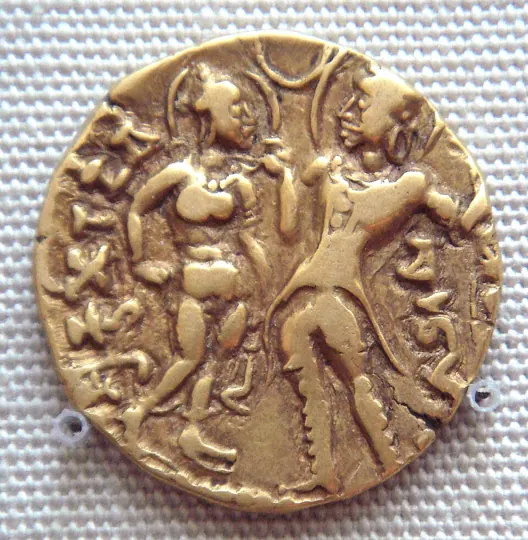
Samudragupta (about 335–375 CE) is known from the Prayag Prashasti, a eulogy (a poem of praise) by his court poet Harishena, carved on the Ashokan pillar at Allahabad. It lists a different policy for each region. He also performed the ashvamedha (horse sacrifice, a claim to supreme power), and his coins show him playing the veena. Historian V. A. Smith called him the ‘Napoleon of India’.
| Region | Policy in the Prayag Prashasti |
|---|---|
| Aryavarta (north) | Nine kings uprooted and their lands annexed |
| Dakshinapatha (south) | Twelve kings captured, then freed and restored as tributaries |
| Forest kingdoms (atavika) | Made into servants |
| Frontier kingdoms and republics | Paid tribute and obeyed orders |
| Distant rulers | Kushanas, Shakas and the king of Sri Lanka sent gifts and sought favour |
Chandragupta II (about 375–415 CE), also called Vikramaditya, married his daughter Prabhavati to the Vakataka king Rudrasena II, which made the Deccan side safe. He then defeated the Shaka Western Kshatrapas of Gujarat and Malwa, winning the western ports, and issued silver coins for that region and ‘lion-slayer’ gold coins. Ujjayini became a second capital. The Iron Pillar at Mehrauli carries an inscription of a king Chandra, usually identified with him.
Prelims 2025 asked: Fa-hien (Faxian), the Chinese pilgrim, travelled to India during the reign of Prelims 2025 which king? The answer is Chandragupta II (b); Fa-hien was in India from about 399 to 414 CE and found the land peaceful and the people prosperous.
Fa-hien (Faxian), the Chinese pilgrim, travelled to India during the reign of
- Samudragupta
- Chandragupta II
- Kumaragupta I
- Skandagupta
Show answer
Answer: (b) · UPSC official key
What UPSC asks
Prelims: Prayag Prashasti; Fa-hien under Chandragupta II (2025); marriage alliances. Mains: was the Gupta age a ‘golden age’? Next likely: Gupta coin hoards in the news.
Later Guptas and the decline
Kumaragupta I (about 415–455 CE) kept the empire whole; tradition credits him with founding the monastery at Nalanda. Late in his reign the Pushyamitras attacked. Skandagupta (about 455–467 CE) beat back the first attack of the Hunas (Hephthalites), mounted archers from Central Asia; his Junagadh inscription records another repair of the Sudarshana lake.
After Skandagupta the empire weakened. In the late 5th and early 6th centuries the Huna chiefs Toramana and Mihirakula overran the north-west and Malwa, until Yashodharman of Mandsaur and the Gupta king Narasimhagupta Baladitya defeated Mihirakula. By about 550 CE the imperial Guptas had faded.
| Cause of decline | Detail |
|---|---|
| Huna invasions | Drained the treasury and broke Gupta control of the north-west |
| Rise of feudatories | Maitrakas of Valabhi, Maukharis of Kanauj, later Guptas of Magadha, Yashodharman of Malwa |
| Land grants | Kings gave away land with revenue and administrative rights, weakening central power |
| Economic strain | Loss of western trade; later gold coins carry less gold |
| Weak successors | Disputes over succession after Kumaragupta |
The Eran inscription of Bhanugupta (510 CE), set up for a general who died in battle, records that his wife joined him on the funeral fire. It is the earliest inscription to record sati.
What UPSC asks
Prelims: Hunas, Skandagupta, Eran sati inscription. Mains: causes of Gupta decline. Next likely: Nalanda’s revival.
Mains box: analysis and answer points
- Causes of decline: Huna invasions, rise of feudatories, land grants, loss of trade, weak successors.
- Golden age debate: peace and culture for the elite, but growing caste rigidity.
- Likely next angle: Gupta coin hoards in the news.
Practice
Practice MCQs (8)
According to a Chinese account, Meghavarna, the king of Sri Lanka, sent an embassy to Samudragupta seeking permission to build a monastery for pilgrims from his island. This monastery was to be built at
Answer (d) & explanation
R.S. Sharma and R.C. Majumdar cite a Chinese source which says that Meghavarna, ruler of Sri Lanka, sent presents and an embassy to Samudragupta and asked leave to build a monastery for Sinhalese monks at Bodh Gaya, the place of the Buddha's enlightenment. Permission was granted. The episode shows the Gupta court's standing with distant Buddhist rulers.
Which historian called Samudragupta the 'Napoleon of India' because of the extent of his military campaigns?
Answer (a) & explanation
The phrase comes from Vincent A. Smith, whose Early History of India (1904) compared Samudragupta with Napoleon for his long series of victorious campaigns. Later historians use the phrase with caution, since many southern conquests were raids followed by reinstatement rather than lasting annexation.
With reference to the treatment of different groups of rulers described in Samudragupta's Prayaga prashasti, consider the following statements:
1. Several rulers of Aryavarta were uprooted and their kingdoms were made part of his empire.
2. Twelve rulers of Dakshinapatha were captured and then released and allowed to rule again.
3. The rulers of the forest kingdoms were uprooted and their lands were given away as grants to Brahmanas.
Which of the statements given above is/are correct?
Answer (b) & explanation
NCERT (Our Pasts I) reads the prashasti as describing graded treatment. The kings of Aryavarta were uprooted and their lands annexed. The twelve rulers of Dakshinapatha surrendered and were allowed to rule again, the policy the text calls capture, release and favour (grahana-moksha-anugraha). The kings of the forest regions (atavika rajyas) were made his servants (paricharaka); they were not dispossessed in favour of Brahmanas. Statements 1 and 2 are correct.
With reference to the gana-sanghas (republican peoples) in Samudragupta's Prayaga prashasti, consider the following statements:
1. Peoples such as the Malavas, Arjunayanas and Yaudheyas are listed among those who paid all taxes, obeyed his orders and came to pay homage.
2. The prashasti states that these republics were violently uprooted and annexed, in the same way as the kings of Aryavarta.
Which of the statements given above is/are correct?
Answer (a) & explanation
The prashasti groups the Malavas, Arjunayanas, Yaudheyas, Madrakas, Abhiras and others with the frontier kingdoms: they 'gratified his imperious commands' by paying all taxes (sarva-kara-dana), obeying orders (ajna-karana) and coming to make obeisance (pranamagamana). They kept their own institutions as tributaries. The harsher policy of uprooting (prasabhoddharana) is reserved for the kings of Aryavarta.
Consider the following:
1. Samatata
2. Kamarupa
3. Simhala
4. Vengi
How many of the above are named in Samudragupta's Prayaga prashasti among the frontier (pratyanta) kingdoms whose rulers paid all kinds of taxes, obeyed his orders and came to pay homage?
Answer (b) & explanation
The prashasti names five frontier kingdoms: Samatata (south-east Bengal), Davaka, Kamarupa (Assam), Nepala and Kartripura. Their rulers paid tribute, obeyed orders and attended court. Simhala (Sri Lanka) is placed in a different group, the distant powers who offered services and gifts. Vengi is one of the twelve kingdoms of Dakshinapatha whose rulers were captured and released. So only Samatata and Kamarupa fit.
Arrange the following Gupta rulers in the chronological order of their reigns, from the earliest to the latest:
1. Budhagupta
2. Chandragupta II
3. Skandagupta
4. Samudragupta
Select the correct answer using the code given below.
Answer (c) & explanation
The main line runs Samudragupta (c. 335-375 CE), Chandragupta II (c. 375-415), Kumaragupta I (c. 415-455) and Skandagupta (c. 455-467). After a confused succession, Budhagupta (c. 476-495) is the last Gupta ruler whose records come from a wide area, from Bengal to Eran in Madhya Pradesh. So the order is 4, 2, 3, 1.
With reference to the distant rulers mentioned in Samudragupta's Prayaga prashasti, consider the following statements:
1. The 'Daivaputra-Shahi-Shahanushahi' named among them is generally taken to refer to the later Kushana rulers of the north-west.
2. The services they are said to have offered include personal attendance, gifts of maidens in marriage and requests for charters bearing the Garuda seal.
3. The prashasti records that Simhala was annexed and placed under a Gupta governor.
Which of the statements given above is/are correct?
Answer (c) & explanation
The prashasti claims that the Daivaputra-Shahi-Shahanushahi (read by most historians as the later Kushanas), the Shaka-Murundas, the people of Simhala and the island- dwellers pleased Samudragupta by atma-nivedana (personal attendance), kanyopayana (gifts of maidens) and requests for charters marked with the Garuda seal (garutmadanka) to rule their own lands. These are claims of prestige, not of conquest. Nothing in the text annexes Sri Lanka or posts a governor there.
A verse found in the Vayu and Brahmanda Puranas says that kings born of the Gupta line would enjoy the territories along the Ganga up to Prayaga, together with Saketa and Magadha. Historians generally take this verse to describe
Answer (a) & explanation
The verse (anu-Ganga Prayagam cha Saketam Magadhams tatha) gives the Guptas only the middle Ganga valley: Prayaga, Saketa (Ayodhya region) and Magadha. Since it says nothing of the vast conquests recorded in the prashasti, R.C. Majumdar and others take it to describe the early Gupta kingdom of Chandragupta I, before Samudragupta's campaigns. The Puranas thus preserve a snapshot of the dynasty's core.
0 / 0 correct
Prelims PYQs on this topic (1)
With reference to forced labour (Vishti) in India during the Gupta period, which one of the following statements is correct?
Answer (a) & explanation
Option (a) is correct. Vishti was forced, unpaid labour that the king, or the holder of a land grant, could demand from villagers. It was treated as a tax paid in labour instead of money or crops, and therefore as a source of income for the state. Option (b) is wrong because Gupta-period inscriptions from central India and the Valabhi grants in Kathiawar mention vishti. Option (c) is wrong because there is no record of weekly wages; by definition it was unpaid. Option (d) is wrong because no source says the eldest son was sent.
Notice the related trend of land grants (agrahara) to Brahmins and temples, which often passed on the right to vishti. Historians link this to the rise of Indian feudalism, an idea argued by R.S. Sharma.
Answer as per the official UPSC answer key.
Write an answer
In 150 words, explain the significance of The Gupta Empire with one recent example.
Flashcards (11)
When does the Gupta era begin?
319–320 CE.
Whom did Chandragupta I marry?
Kumaradevi, a Lichchhavi princess.
Who wrote the Prayag Prashasti?
Harishena.
Samudragupta's policy for southern kings?
Capture, release and reinstate.
Who called Samudragupta the 'Napoleon of
India'? V. A. Smith.
Fa-hien visited under which king?
Chandragupta II.
Prabhavati Gupta married into which
dynasty? The Vakatakas.
Which Gupta repelled the Hunas first?
Skandagupta.
Who defeated Mihirakula?
Yashodharman, and Narasimhagupta Baladitya.
Earliest inscriptional evidence of sati?
Eran inscription, 510 CE.
Gupta gold coin?
Dinara.
Read more: related explainers
In the news
- 20 Oct 2026Sirpur in Chhattisgarh enters UNESCO’s Tentative List of World Heritage sites
- 15 Oct 2026PM inaugurates five Ladakh projects: Nimmu–Padum–Darcha road, Leh terminal, Hanu hydro
- 14 Oct 2026HAL, NCF and ASI sign MoA for Hampi, Taj Mahal and Bekal Fort
- 11 Oct 2026Birth anniversaries: Jayaprakash Narayan and Nanaji Deshmukh
 Next topic · 11.2 →The Gupta Empire: Administration, economy, society and religion
Syllabus: Prelims GS-I · History of India and Indian National Movement.