
Chapter 10 · Topic 10.3 · Prelims + Mains3 of 3
The Sangam Age: Ports and overseas trade
Key points
- Western ships came on the monsoon for pepper, pearls, gems and cotton and paid in Roman gold.
- Ports: Muziris and Tondi (Chera), Korkai (Pandya), Puhar (Chola), Arikamedu.
- Trade also went east; the decline of Roman trade after the 3rd century CE weakened the Sangam kingdoms.
Prelims box: facts and traps
- Yavanas: Sangam name for western traders.
- Roman coins: Augustus and Tiberius hoards in Tamil Nadu and Kerala.
- Tamil-Brahmi pottery abroad: Thailand and Berenike (Egypt).
- Muziris papyrus: loan for a cargo from Muziris.
Ports and overseas trade
Two directions of trade
Tamilakam’s coasts faced both the Roman world in the west and South-east Asia in the east. Western ships, using the monsoon winds, came for pepper, pearls, gems, ivory and fine cotton, and paid in gold and silver. The poems call the foreign traders Yavanas (a word first used for Greeks, later for all westerners) and describe their large ships at Muziris bringing gold and taking pepper. The Silappadikaram even speaks of Yavana traders living in Puhar, like a foreign quarter in a modern port city.
| Port | Kingdom | Notes |
|---|---|---|
| Muziris (Pattanam) | Chera | Greatest pepper port; named in the Periplus and in Roman documents |
| Tondi | Chera | Malabar coast port |
| Korkai | Pandya | Pearl fishery on the Gulf of Mannar |
| Puhar (Kaveripattinam) | Chola | Chola port at the mouth of the Kaveri, described in the Silappadikaram |
| Arikamedu | Chola region | Indo-Roman station; Arretine ware, amphorae |
A trip to Muziris, step by step
Picture one voyage. A merchant loads wine jars, glass and gold coins at a Red Sea port in Egypt. In summer he rides the south-west monsoon wind across the open Arabian Sea to Muziris. He trades his cargo for sacks of pepper and pearls, waits for the winter wind to turn, and sails home on the north-east monsoon. Pliny says ships left Egypt in midsummer and set off home from India in December or January.
What came in and what went out
The Periplus of the Erythraean Sea, a Greek sailors’ guide of the 1st century CE, gives a shopping list for the Malabar coast. Big ships came for “a great quantity” of pepper. Imports included a lot of coin, topaz, coral, crude glass, copper, tin and lead. Exports included pepper, fine pearls, ivory, silk cloth, precious stones and tortoise shell. Pepper was so wanted in Rome that the ports of Kerala grew rich on it.
Some goods came from deep inland. The bead workshops of Kodumanal, near Erode, cut gems that likely reached the ports. Successful Tamil merchants carried the title masattuvan (great merchant).
Proof from coins and pots
Coins like these show how Roman money flowed into India.
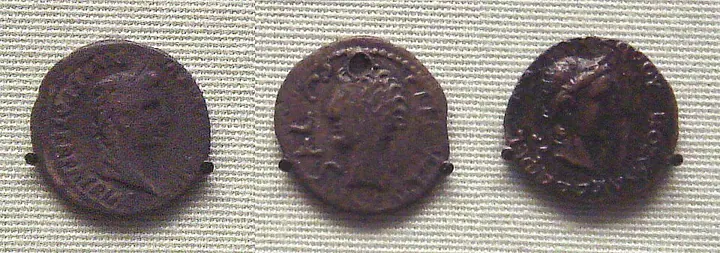
Hoards of Roman coins, especially of Augustus and Tiberius, have been found in Tamil Nadu and Kerala. South India was never part of the Roman empire, yet the two were closely tied by trade. The link worked both ways: pottery with Tamil-Brahmi writing (the early script of Tamil) has been found at Berenike, a Red Sea port in Egypt, showing Tamil traders went west too. A Greek papyrus, the “Muziris papyrus”, records a loan for a cargo shipped from Muziris.
Trade to the east
Trade also ran east to Sri Lanka and South-east Asia, where Tamil-Brahmi inscribed pottery has been found in Thailand. Ships from Puhar and Arikamedu crossed the Bay of Bengal, carrying beads, cloth and ideas. This eastern trade later helped spread Indian culture across South-east Asia.
The fall
The decline of Roman trade after the 3rd century CE weakened the Sangam kingdoms. When rich customers stopped coming, ports shrank, kings lost customs money, and the region slipped into a dark phase under the Kalabhras.
What UPSC asks
Prelims: Muziris, Korkai, Puhar, Arikamedu, and port–kingdom pairs (Muziris is Chera, Korkai is Pandya, Puhar is Chola). Mains: Indo-Roman trade and its decline. Next likely: Pattanam (Muziris) excavations.
Mains box: analysis and answer points
- Indo-Roman trade: monsoon sailing, pepper demand, gold inflow, ports and merchant guilds.
- Its decline: Roman troubles after the 3rd century CE, falling customs income, Kalabhra period.
- Likely next angle: Pattanam (Muziris) excavations.
Practice
Practice MCQs (8)
A well-known Akananuru poem speaks of a prosperous Chera port where 'the beautiful, well- made ships of the Yavanas come with gold and return with pepper'. The port is
Answer (d) & explanation
Akananuru 149 places this scene at Muchiri, the Muziris of the Greek and Roman writers, on the Periyar (Culli) river in the Chera country. Gold from Roman ships was exchanged for pepper. The same port is called the first emporium of India by Pliny and appears in the Periplus and in a second-century papyrus loan contract from Egypt.
With reference to the Chera kingdom of the Sangam age, consider the following statements:
1. Its royal emblem was the bow.
2. Muziris and Tondi were among its ports on the west coast.
3. Like the Pandyas, it used the tiger as its emblem.
Which of the statements given above is/are correct?
Answer (c) & explanation
The three crowned houses each had an emblem: the bow for the Cheras, the tiger for the Cholas and the fish for the Pandyas. The Cheras held the pepper coast of present-day Kerala, with Muziris (Muchiri) and Tondi as ports and Vanji as the inland centre. The tiger was the Chola, not the Pandya, emblem.
The Maduraikkanchi, in its portrait of Pandya Madurai, mentions the 'nalangadi' and the 'allangadi'. These terms refer to
Answer (c) & explanation
Mangudi Marudanar's Maduraikkanchi walks through a day and a night in Madurai: streets of craftsmen, temples, the palace, and two kinds of bazaar, the nalangadi (day market) and the allangadi (evening or night market). The busy markets with goods from many lands are evidence of the urban and commercial life of the Pandya capital.
Consider the following statements about Puhar (Kaveripattinam) as described in Tamil literature:
1. It was the Chola port at the mouth of the Kaveri.
2. The Pattinappalai says that goods passing its customs were stamped with the tiger emblem.
3. The Silappadikaram describes a quarter of the city where Yavana traders lived.
4. The festival of Indra (Indravizha) was celebrated there.
How many of the statements given above are correct?
Answer (d) & explanation
Puhar or Kaveripattinam was the great Chola port at the Kaveri mouth. The Pattinappalai describes warehouses and customs officers who stamped bales with the Chola tiger. The Silappadikaram's Puhar book pictures a seaside quarter with Yavana dwellings and the annual festival of Indra, and the Manimekalai later tells of the city's destruction by the sea. All four statements are correct.
With reference to Arikamedu, consider the following statements:
1. It lies on the Coromandel coast near Puducherry.
2. Mortimer Wheeler's excavations in 1945 found Roman amphorae and Arretine ware and described it as an Indo-Roman trading station.
3. Later excavations show that it was founded by Roman settlers and had no occupation before Roman trade began.
Which of the statements given above is/are correct?
Answer (a) & explanation
Arikamedu, on the Ariyankuppam river south of Puducherry, was excavated by Wheeler in 1945. Finds of Mediterranean amphorae (for wine and oil), Arretine (Italian red- gloss) ware and rouletted ware led him to call it an 'Indo-Roman trading station', often identified with the Poduke of the Periplus. The later Begley excavations (1989-92) showed that the settlement began before the Roman phase and was an Indian bead-making and trading town that Roman trade joined.
With reference to the excavated site of Pattanam, consider the following statements:
1. It lies in Ernakulam district of Kerala, near the old course of the Periyar.
2. Its excavations were begun in 2007 by the Kerala Council for Historical Research.
3. It lies at the mouth of the Kaveri on the east coast.
Which of the statements given above is/are correct?
Answer (c) & explanation
Pattanam, near North Paravur in Ernakulam district and not far from Kodungallur, was first excavated in 2007 by the Kerala Council for Historical Research, which led the work for several seasons. Its finds of amphora sherds, Mediterranean glass, beads, a wharf structure and Indian pottery have led the excavators to propose it as a likely location of ancient Muziris. The Kaveri-mouth port on the east coast is Puhar, not Pattanam.
With reference to Pliny the Elder's account of the sea route to India in his Natural History, consider the following statements:
1. He called Muziris 'the first emporium of India'.
2. He warned that Muziris was not a desirable port of call because pirates occupied a place nearby.
3. He placed the residence of king Pandion at the coastal mart of Becare itself.
Which of the statements given above is/are correct?
Answer (b) & explanation
In Book VI of the Natural History (c. 77 CE), Pliny traces the voyage from Egypt to India with the monsoon wind. He calls Muziris 'the first emporium of India', yet adds that it was not a desirable stop, since pirates held a nearby place called Nitriae and cargo had to be ferried out in boats. He prefers the harbour of Becare in the land of the Neacyndi, where king Pandion reigned; but Pandion lived far from the mart, in the inland city of Modura (Madurai). So statement 3 is wrong.
Arrange the following in chronological order, starting from the earliest:
1. The Velvikudi copper-plate grant of the Pandya king Nedunjadaiyan
2. Ashoka's Second Rock Edict naming the Cholas and the Pandyas as neighbours
3. Pliny the Elder's account of Muziris in his Natural History
4. The Pandya king Kadungon's overthrow of the Kalabhras
Select the correct answer using the code given below:
Answer (d) & explanation
Ashoka's edicts (3rd century BCE) are the earliest external notice of the Tamil kingdoms. Pliny's Natural History (completed c. 77 CE) describes Muziris during the Indo- Roman trade boom. Kadungon revived Pandya power in the late sixth century by ending the Kalabhra interlude, and the Velvikudi grant (8th century, reign of Nedunjadaiyan) later looks back on that period and on the Sangam king Mudukudumi Peruvaludi.
0 / 0 correct
Write an answer
In 150 words, explain the significance of The Sangam Age with one recent example.
Flashcards (1)
Greatest Chera pepper port?
Muziris.
Read more: related explainers
In the news
- 20 Oct 2026Sirpur in Chhattisgarh enters UNESCO’s Tentative List of World Heritage sites
- 15 Oct 2026PM inaugurates five Ladakh projects: Nimmu–Padum–Darcha road, Leh terminal, Hanu hydro
- 14 Oct 2026HAL, NCF and ASI sign MoA for Hampi, Taj Mahal and Bekal Fort
- 11 Oct 2026Birth anniversaries: Jayaprakash Narayan and Nanaji Deshmukh
 Next chapter · 11. The Gupta Empire →The Gupta Empire: The Gupta kings
Syllabus: Prelims GS-I · History of India and Indian National Movement.