
Chapter 1 · Topic 1.2 · Prelims + Mains2 of 3
Ecology: Populations, interactions, niche and ecotone
Key points
- Population growth and carrying capacity.
- Species interactions.
- Niche, ecotone and edge effect.
Prelims box: facts and traps
| Attribute | Meaning |
|---|---|
| Density | Number of individuals per unit area or volume |
| Natality and mortality | Birth rate and death rate |
| Immigration and emigration | Individuals moving in and moving out |
| Age structure | Share of pre-reproductive, reproductive and post-reproductive individuals, shown as an age pyramid |
| Sex ratio | Number of females per male, or the reverse. |
- Joseph Grinnell (1917) linked the niche to habitat, Charles Elton (1927) to an organism's role in the food web, and G. Evelyn Hutchinson (1957) defined it as an n-dimensional hypervolume of conditions and resources.
- Cnidarians (corals with algae), fungi (lichens, mycorrhiza) and protozoa (in the termite gut) all have species that form symbiotic relationships (Prelims 2021: 1, 2 and 3).
- Fig shows a unique relationship with a coevolved insect, the fig wasp, which is the only insect that can pollinate it (Prelims 2024).
- Trap (UPSC Prelims 2024): “Carabid beetles” is incorrect. “Centipedes” is incorrect. “Flies” is incorrect. “Termites” is incorrect. “Wasps Parasitoid species are found in how many of the above kind of organisms ?” is incorrect.
- Trap (UPSC Prelims 2021): all the statements are correct.
On this page (3 sections)
Populations and carrying capacity
| Attribute | Meaning |
|---|---|
| Density | Number of individuals per unit area or volume |
| Natality and mortality | Birth rate and death rate |
| Immigration and emigration | Individuals moving in and moving out |
| Age structure | Share of pre-reproductive, reproductive and post-reproductive individuals, shown as an age pyramid |
| Sex ratio | Number of females per male, or the reverse |
Population change = (births + immigration) − (deaths + emigration). With unlimited resources a population grows exponentially, giving a J-shaped curve (dN/dt = rN).
Real resources are limited. Growth slows as numbers approach the carrying capacity (K), the largest population an environment can support for a long time. This logistic growth gives an S-shaped curve (dN/dt = rN(K − N)/K).
| r-selected species | K-selected species |
|---|---|
| Many small offspring, little parental care | Few large offspring, much parental care |
| Short life, early maturity | Long life, late maturity |
| Insects, rodents, many weeds | Elephants, whales, great apes, humans |
Mains 2015: The states of Jammu and Kashmir, Himachal Pradesh, and Uttarakhand are reaching the limits of their ecological carrying capacity due to tourism. Critically evaluate. Mains 2015 Use carrying capacity, waste, water stress and fragile slopes.
The states of Jammu and Kashmir, Himachal Pradesh and Uttarakhand are reaching the limits of ecological carrying capacity due to tourism. Critically evaluate.
How species interact
A community is held together by interactions between species. Each interaction is marked by its effect on the two partners: + (benefit), − (harm) or 0 (no effect).
| Interaction | Effect | Examples |
|---|---|---|
| Mutualism | +/+ | Lichens (alga + fungus), mycorrhiza, fig and fig wasp, corals and zooxanthellae |
| Commensalism | +/0 | Orchid growing on a mango branch, cattle egret and grazing cattle |
| Parasitism | +/− | Cuscuta on hedge plants, lice; brood parasitism (koel eggs in a crow’s nest) |
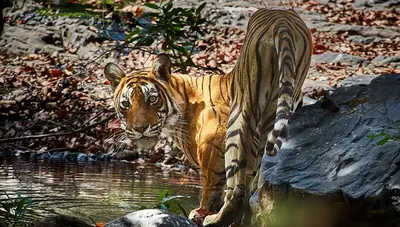
| Predation (incl. herbivory) | +/− | Tiger and deer, deer and grass |
| Competition | −/− | Species sharing a limited food or space |
| Amensalism | −/0 | Penicillium mould inhibiting bacteria |
A parasitoid is an insect whose larva lives in or on a single host and finally kills it. Many wasps and flies, and some beetles, are parasitoids, so they are used for biological pest control.
Cnidarians (corals with algae), fungi (lichens, mycorrhiza) and protozoa (in the termite gut) all have species that form symbiotic relationships (Prelims 2021: 1, 2 and 3).
Which of the following have species that can establish symbiotic relationship with other organisms? 1. Cnidarians 2. Fungi 3. Protozoa Select the correct answer using the code given below.
- 1 and 2 only
- 2 and 3 only
- 1 and 3 only
- 1, 2 and 3
Show answer
Answer: (d) · UPSC official key
Fig shows a unique relationship with a coevolved insect, the fig wasp, which is the only insect that can pollinate it (Prelims 2024).
Which one of the following shows a unique relationship with an insect that has coevolved with it and that is the only insect that can pollinate this tree ?
- Fig
- Mahua
- Sandalwood
- Silk cotton
Show answer
Answer: (a) · UPSC official key
Certain species of Ant are well known as cultivators of fungi: leaf-cutter ants grow fungus gardens on cut leaves (Prelims 2022).
Certain species of which one of the following organisms are well known as cultivators of fungi ?
- Ant
- Cockroach
- Crab
- Spider
Show answer
Answer: (a) · UPSC official key
Of carabid beetles, centipedes, flies, termites and wasps, parasitoid species are found in Only three (Prelims 2024).
Consider the following : 1. Carabid beetles 2. Centipedes 3. Flies 4. Termites 5. Wasps Parasitoid species are found in how many of the above kind of organisms ?
- Only two
- Only three
- Only four
- All five
Show answer
Answer: (b) · UPSC official key
Niche, ecotone and edge effect
| Idea | Meaning |
|---|---|
| Habitat | The physical place where an organism lives: its ‘address’ |
| Niche | Its functional role: what it eats, when it is active, how it uses resources: its ‘profession’ |
| Fundamental vs realised niche | The full range a species could use vs the part it actually uses because of competitors |
| Competitive exclusion (Gause) | Two species with exactly the same niche cannot coexist for long; one wins |
| Resource partitioning | Similar species coexist by dividing food, time or space (MacArthur’s warblers feeding at different heights) |
Joseph Grinnell (1917) linked the niche to habitat, Charles Elton (1927) to an organism’s role in the food web, and G. Evelyn Hutchinson (1957) defined it as an n-dimensional hypervolume of conditions and resources.
| Ecotone | Example |
|---|---|
| Land–sea | Mangroves and estuaries |
| Forest–grassland | Terai and forest edges, savanna margins |
| Freshwater–land | Marshes and riverbanks |
An ecotone is a transition zone where two ecosystems meet. It often holds species of both sides plus some found only there, so it can have more species and a higher density: the edge effect. Species that prefer edges are called edge species.
Mains box: analysis and answer points
- Population change = (births + immigration) − (deaths + emigration).
- With unlimited resources a population grows exponentially, giving a J-shaped curve (dN/dt = rN).
- Growth slows as numbers approach the carrying capacity (K), the largest population an environment can support for a long time.
- Likely next angle: r vs K
- Asked: Mains 2015 (GS Paper I, 12.5 marks): The states of Jammu and Kashmir, Himachal Pradesh and Uttarakhand are reaching the limits of ecological carrying capacity due to tourism. Critically evaluate.
Practice
Practice MCQs (8)
In a forest, trees occupy the top layer, shrubs the second layer, and herbs and grasses the bottom layers. This vertical distribution of species at different levels is called
Answer (d) & explanation
NCERT describes the physical structure of an ecosystem through two features. Identifying and counting the species present gives its species composition, while the vertical layering of species at different heights is called stratification. In a forest, trees form the top stratum, shrubs the middle and herbs and grasses the lowest.
Consider the following parts of a pond ecosystem:
1. Phosphates and nitrates dissolved in the water
2. Phytoplankton
3. The rich soil deposit at the bottom of the pond
4. Solar input and day length
How many of the above are biotic components?
Answer (a) & explanation
Only one, the phytoplankton, is biotic. NCERT uses the pond as its model ecosystem: the abiotic component is the water with its dissolved inorganic and organic substances and the rich soil at the bottom, while solar input, temperature and day length regulate the whole system. The autotrophs are phytoplankton, some algae and the floating, submerged and marginal plants; zooplankton and fish are consumers, and fungi, bacteria and flagellates are decomposers.
Consider the following statements:
1. An ecotone is a zone of transition where two or more different ecosystems meet, as in an estuary between a river and the sea.
2. An ecotone always has a sharp boundary and no measurable width.
3. The tendency for greater variety and density of organisms in an ecotone is called the edge effect.
Which of the statements given above are correct?
Answer (c) & explanation
Statements 1 and 3 are correct. An ecotone is the junction zone between two or more diverse ecosystems; mangroves (between land and sea), grasslands (between forest and desert) and estuaries (between fresh and salt water) are standard examples. An ecotone may be narrow or wide and usually shows a gradual change, so statement 2 is wrong. It holds species of both adjoining communities plus some that are found mostly there, called edge species; this increase in variety and density is the edge effect.
'The growth of a plant is controlled not by the total amount of resources available but by the essential factor that is in the shortest supply relative to its needs.' This idea is known as
Answer (d) & explanation
This is Liebig's law of the minimum (1840), first framed for crop nutrients: yield is limited by the scarcest essential nutrient, like a barrel that holds water only up to its shortest stave. Shelford's law of tolerance (1913) widened the idea, holding that too much of a factor can limit an organism as well as too little. Allen's rule is about the shorter limbs and ears of mammals in colder climates.
Consider the following pairs of ecosystem services and the categories to which the Millennium Ecosystem Assessment (2005) assigns them: Service — Category
1. Pollination of crops — Regulating
2. Soil formation — Provisioning
3. Spiritual and recreational value — Cultural
4. Nutrient cycling — Cultural
How many of the pairs given above are correctly matched?
Answer (b) & explanation
Pairs 1 and 3 are correct. The Millennium Ecosystem Assessment groups services into four types. Provisioning services are products such as food, fresh water, fuelwood and fibre. Regulating services are benefits from regulating processes, including climate and flood regulation, water purification and pollination. Cultural services are non- material benefits such as spiritual, aesthetic and recreational value. Supporting services, such as soil formation, nutrient cycling and primary production, underpin all the others; so pairs 2 and 4 are wrong.
In the estimate by Robert Costanza and colleagues of the value of the world's ecosystem services, cited in the NCERT Biology textbook, which one of the following services accounts for about half of the total value?
Answer (a) & explanation
Costanza and colleagues put an average price tag of about US $33 trillion a year on nature's life-support services, nearly twice the global GNP of the time (about US $18 trillion). Of this total, soil formation accounts for about 50 per cent. Recreation and nutrient cycling each contribute less than 10 per cent, and climate regulation and habitat for wildlife about 6 per cent each.
With reference to the ecological niche, consider the following statements:
1. The niche of a species covers not only the physical space it occupies but also its functional role, such as what it eats and when it is active.
2. According to Gause's competitive exclusion principle, two closely related species competing for the same limiting resources cannot coexist indefinitely.
3. Two different species living in the same habitat must always occupy an identical niche.
Which of the statements given above are correct?
Answer (b) & explanation
Statements 1 and 2 are correct. The ecological niche is the functional role of a species in its community together with the physical space and conditions it uses; the habitat is only its 'address'. NCERT states Gause's competitive exclusion principle: two closely related species competing for the same resources cannot coexist indefinitely, and the inferior competitor is eventually eliminated. That is why species sharing a habitat usually divide resources, for example by feeding at different times or heights; they do not occupy identical niches, so statement 3 is wrong.
Consider the following statements:
1. A vast majority of organisms can live only within a narrow range of temperature and are called stenothermal.
2. Organisms that can tolerate a wide range of salinity are called stenohaline.
3. Shelford's law of tolerance holds that an organism's success can be limited by too much of a factor as well as by too little of it.
Which of the statements given above are correct?
Answer (b) & explanation
Statements 1 and 3 are correct. NCERT notes that a few organisms tolerate and thrive in a wide range of temperatures (eurythermal), but a vast majority are restricted to a narrow range (stenothermal). The same prefixes apply to salinity: wide tolerance is euryhaline and narrow tolerance is stenohaline, so statement 2 has the term reversed. Shelford's law of tolerance says that each organism has an ecological minimum and maximum for every factor, with an optimum range between them.
0 / 0 correct
Write an answer
In 150 words, explain the significance of Ecology with one recent example.
Flashcards (9)
J-shaped curve means?
Exponential growth, unlimited resources.
S-shaped curve means?
Logistic growth up to carrying capacity.
Elephants: r- or K-selected?
K-selected.
Mutualism sign?
+ / +.
Amensalism example?
Penicillium inhibiting bacteria.
Only pollinator of the fig?
Its coevolved fig wasp.
Fungus-cultivating insect (2022 PYQ)?
Ant.
Gause's principle?
Competitive exclusion: identical niches cannot coexist.
Edge effect?
More species and density at an ecotone.
In the news
- 23 Oct 2026Carbon capture: how India can make its ₹20,000 crore CCUS push count, in three phases
- 22 Oct 2026Emissions Gap Report 2026 ‘The Point of Return’: 1.5°C will be crossed, but can be regained by 2100
- 22 Oct 20261% green jet fuel for international flights from 2027: India’s SAF plan and ICAO’s CORSIA
- 22 Oct 2026Agrivoltaics World Conference in Delhi: PM-KUSUM’s next phase and the small-farmer test
 Next topic · 1.3 →Ecology: Ecosystem, biome and biosphere