
Chapter 1 · Topic 1.1 · Prelims + Mains1 of 3
Ecology: Levels of organisation and species types
Key points
- Ecology: coined by Ernst Haeckel in 1866 (oikos = house, logos = study).
- Levels: individual, population, community, ecosystem, landscape, biome, biosphere.
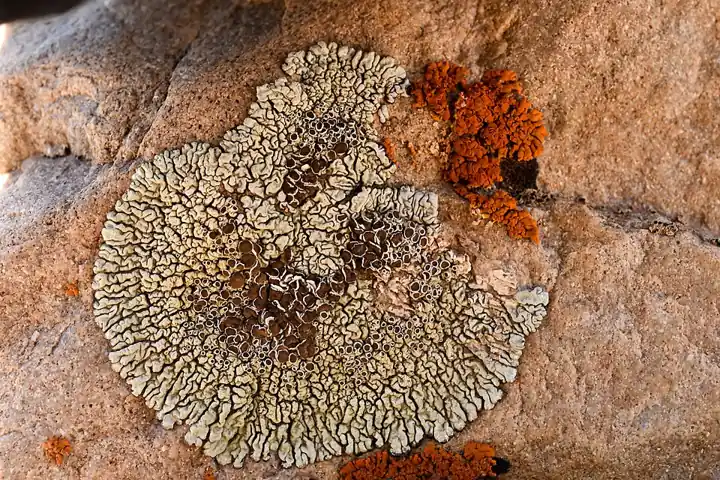
- Keystone: effect far larger than its numbers (starfish Pisaster, fig trees). Indicator: lichens for sulphur dioxide.
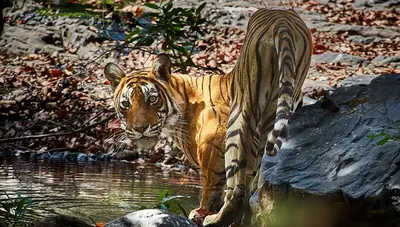
- Flagship and umbrella: the tiger (Project Tiger, 1973).
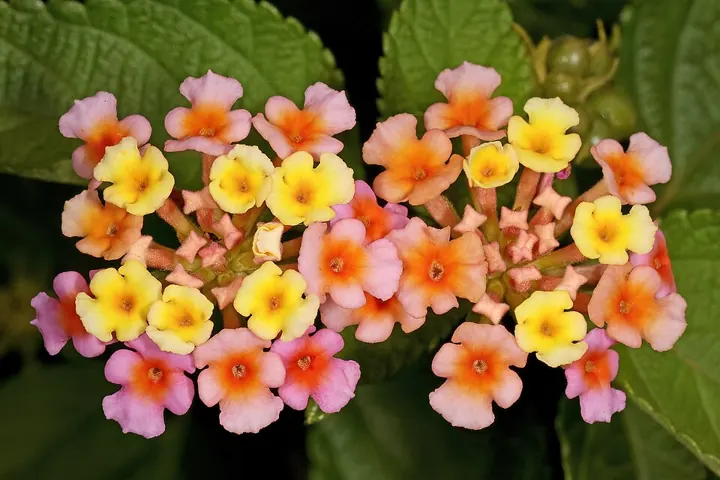
- Endemic: Nilgiri tahr, lion-tailed macaque, Sangai. Invasive: Lantana, Prosopis, water hyacinth, Parthenium.
Prelims box: facts and traps
| Type | Example |
|---|---|
| Keystone | Starfish Pisaster, fig trees, elephants |
| Indicator | Lichens (sulphur dioxide), amphibians, mayfly larvae |
| Flagship | Tiger, snow leopard, Gangetic dolphin |
| Endemic | Sangai (Keibul Lamjao, Manipur) |
| Invasive | Lantana camara, Prosopis juliflora |
- Trap: vegetarianism is not a threat to biodiversity (Prelims 2012).
On this page (3 sections)
What ecology studies
Ecology is the study of how organisms interact with each other and with their physical surroundings. Think of a neighbourhood where people, pets, trees and weather all affect each other. The German biologist Ernst Haeckel coined the term in 1866 from the Greek oikos (house) and logos (study).
| Component | Examples |
|---|---|
| Biotic (living) | Plants, animals, fungi, bacteria and other micro-organisms |
| Abiotic (non-living) | Light, temperature, water, soil, air, minerals, relief |
| Level | Meaning |
| Individual (organism) | A single living being, such as one tiger |
| Population | Individuals of one species in an area at one time |
| Community | All the populations of different species living together in an area |
| Ecosystem | A community plus its abiotic environment, linked by energy flow and nutrient cycling |
| Level Meaning | |
| Landscape A mosaic of connected ecosystems | |
| Biome A large region with a typical climate, vegetation and animals | |
| Biosphere All the parts of the Earth where life exists |
Each level adds properties that the level below does not have. A population has a birth rate and density, which a single individual does not. A community has species diversity, which one population does not.
Species and the roles they play
A species is a group of organisms that can interbreed in nature and produce fertile offspring, meaning young that can themselves have young. Conservationists group species by the role they play.
| Type | Meaning | Examples |
|---|---|---|
| Keystone | Has an effect on its community far larger than its numbers suggest; its loss changes the whole system | Starfish Pisaster (Robert Paine’s 1969 study), fig trees in tropical forests, elephants |
| Indicator | Its presence, absence or health reveals environmental conditions | Lichens (sensitive to sulphur dioxide), frogs and other amphibians, mayfly larvae in clean water |
| Flagship | A popular species used to rally public support for conservation | Tiger, Asian elephant, snow leopard, Gangetic dolphin |
| Umbrella | Needs such a large area that protecting it protects many other species | Tiger (Project Tiger, 1973), Asian elephant |
| Foundation | Creates or forms the habitat itself | Reef-building corals, mangroves |
One species can fill several roles. The tiger is a flagship, an umbrella and a top predator.
Bats, bees and birds are all pollinating agents, animals that carry pollen from flower to flower (Prelims 2012: 1, 2 and 3).
Consider the following kinds of organisms : 1. Bat 2. Bee 3. Bird Which of the above is/are pollinating agent/agents?
- 1 and 2 only
- 2 only
- 1 and 3 only
- 1, 2 and 3
Show answer
Answer: (d) · UPSC official key
If butterfly numbers fall sharply, pollination of some plants could suffer. Wasps, spiders and birds that feed on butterflies could also decline (Prelims 2017: 1 and 3 only).
Due to some reasons, if there is a huge fall in the population of species of butterflies, what could be its likely consequence/consequences ? 1. Pollination of some plants could be adversely affected. 2. There could be a drastic increase in the fungal infections of some cultivated plants. 3. It could lead to a fall in the population of some species of wasps, spiders and birds. Select the correct answer using the code given below :
- 1 only
- 2 and 3 only
- 1 and 3 only
- 1, 2 and 3
Show answer
Answer: (c) · UPSC official key
Endemic and invasive species
| Endemic species of India | Where found |
|---|---|
| Nilgiri tahr | Western Ghats (Kerala, Tamil Nadu) |
| Lion-tailed macaque | Western Ghats |
| Sangai (brow-antlered deer) | Keibul Lamjao, Manipur |
| Asiatic lion (wild) | Gir landscape, Gujarat |
An endemic species occurs naturally in only one area. Islands and isolated mountains, such as the Western Ghats, the Himalaya and the Andaman and Nicobar Islands, have many endemics because their plants and animals evolved cut off from others.
| Invasive alien species in India | Native range |
|---|---|
| Lantana camara | Tropical Americas |
| Prosopis juliflora | Central and South America |
| Water hyacinth (Eichhornia crassipes) | South America |
| Parthenium hysterophorus (congress grass) | Tropical Americas |
| African catfish (Clarias gariepinus) | Africa |
An invasive species is a non-native species that spreads quickly and harms native biodiversity, the economy or health. It succeeds because it has no natural enemies in its new home, like a weed in a garden with no one to pull it out.
Global warming, fragmentation of habitat (breaking a forest into small patches) and invasion of alien species can all threaten an area’s biodiversity. Promotion of vegetarianism does not (Prelims 2012: 1, 2 and 3 only).
Which of the following can be threats to the biodiversity of a geographical area? 1. Global warming 2. Fragmentation of habitat 3. Invasion of alien species 4. Promotion of vegetarianism Select the correct answer using the codes given below :
- 1, 2 and 3 only
- 2 and 3 only
- 1 and 4 only
- 1, 2, 3 and 4
Show answer
Answer: (a) · UPSC official key
The Himalayan Range is very rich in species diversity because it is a confluence (meeting point) of different biogeographical zones (Prelims 2011).
The Himalayan Range is very rich in species diversity. Which one among the following is the most appropriate reason for this phenomenon ?
- It has a high rainfall that supports luxuriant vegetative growth
- It is a confluence of different bio-geographical zones
- Exotic and invasive species have not been introduced in this region
- It has less human interference
Show answer
Answer: (b) · UPSC official key
What UPSC asks: Prelims: Haeckel 1866, species types. Mains: threats from alien species like Lantana and Prosopis.
Mains box: analysis and answer points
- Levels of organisation: each level adds new properties.
- Species roles: why keystone loss changes a whole system.
- Invasive species: no natural enemies, harm to natives and the economy.
Practice
Practice MCQs (8)
Consider the following statements about ecological succession:
1. In the successive seral stages there is generally an increase in the number of species and organisms as well as in the total biomass.
2. Although descriptions of succession usually focus on vegetation, the numbers and types of animals and decomposers also change as succession proceeds.
Which of the statements given above is/are correct?
Answer (c) & explanation
Both statements are correct and follow NCERT closely. NCERT says that in the successive seral stages there is a change in species diversity, 'an increase in the number of species and organisms as well as an increase in the total biomass'. It also notes that descriptions focus on vegetation, but these vegetational changes alter food and shelter, so 'the numbers and types of animals and decomposers also change'.
When a top predator reduces the number of herbivores, and as a result plant growth increases, the indirect effect passing down through several trophic levels is called a
Answer (a) & explanation
A trophic cascade is the chain of indirect effects that a change at one trophic level — usually the top predator — causes at lower levels. Predators suppress herbivores, which releases plants from grazing pressure; removing the predators reverses this. Such top-down effects have been shown in lakes, kelp forests and grasslands, and they are why loss of apex predators can change whole ecosystems.
Consider the following statements:
1. The prickly pear cactus, which spread rapidly after being introduced into Australia, was brought under control only after a cactus-feeding moth from its native range was introduced.
2. The monarch butterfly is distasteful to its predators because of chemicals it acquires by feeding on a poisonous weed during its caterpillar stage.
3. Biological control of an invasive pest relies on introducing a predator that is native to the region the pest has invaded.
Which of the statements given above is/are correct?
Answer (c) & explanation
Statements 1 and 2 are taken from NCERT. The prickly pear cactus, introduced into Australia in the early 1920s, caused havoc by spreading over millions of hectares until a cactus-feeding moth (Cactoblastis) from its natural habitat was introduced. The monarch butterfly acquires distasteful chemicals by feeding on a poisonous weed as a caterpillar, a defence against predators. Statement 3 is wrong: invasive species often spread because they have escaped the predators of their native range, so biological control usually introduces a natural enemy from the pest's native range, not from the invaded region.
Consider the following interactions:
1. A tiger killing and eating a chital
2. A grasshopper eating the leaves of a living plant
3. A koel laying its eggs in a crow's nest for the crow to incubate
4. Barnacles growing on the back of a whale NCERT notes that, in a broad ecological context, animals that eat plants are not very different from predators. Taking this broad view, how many of the above can be regarded as predation?
Answer (b) & explanation
Two — items 1 and 2. A tiger eating a chital is classic predation; NCERT points out that herbivores eating plants are, in a broad ecological sense, not very different from predators, so a grasshopper eating leaves also counts. Item 3 is brood parasitism: the koel's eggs resemble the crow's and the crow rears the koel's young. Item 4 is commensalism: barnacles gain a habitat and the whale is largely unaffected.
With reference to the starfish Pisaster on the rocky intertidal coast of the American Pacific, consider the following statements:
1. When all the starfish were removed from an enclosed intertidal area in a field experiment, more than ten species of invertebrates disappeared within a year.
2. The loss of species was caused by interspecific competition among the prey once the predator was removed.
3. Robert Paine, who carried out this work, later used the term 'keystone species' for such a predator.
Which of the statements given above are correct?
Answer (d) & explanation
All three are correct. NCERT describes how removing the predatory starfish Pisaster from an enclosed area led to the extinction of more than ten invertebrate species within a year, because of interspecific competition — mussels in particular took over the space. The predator had been keeping the dominant competitor in check and so maintaining diversity. Robert Paine, who ran the experiment on the Washington coast from the 1960s, introduced the term 'keystone species' in 1969 for a species whose effect on the community is far larger than its abundance suggests.
Consider the following features of a site:
1. Soil is already present.
2. Buried seeds, roots and rootstocks of earlier plants survive in the ground.
3. Organic matter and nutrients left by the earlier community remain in the substratum.
4. The site carries no biological legacy of any earlier community.
How many of the above help explain why secondary succession usually proceeds faster than primary succession?
Answer (c) & explanation
Features 1, 2 and 3 are correct. In secondary succession the area has lost its community but keeps its soil, its seed bank and buried propagules (called residuals), and the organic matter and nutrients of the earlier community. Colonisers can therefore start growing at once, and NCERT notes that 'since soil is already there, the rate of succession is much faster'. Feature 4 describes primary succession on a new surface such as lava or a glacial moraine, where every propagule must arrive from outside, so it slows succession down.
Consider the following statements:
1. 'Bottom-up' control means that the abundance of organisms at higher trophic levels is limited mainly by nutrient supply and primary productivity.
2. 'Top-down' control means that consumers, especially predators, regulate the abundance of organisms at lower trophic levels.
3. Stocking a eutrophic lake with fish-eating fish to reduce plankton-eating fish, so that zooplankton increase and graze down the algae, is an application of top-down control.
Which of the statements given above are correct?
Answer (d) & explanation
All three are correct. In bottom-up control, resources (nutrients, light) set productivity, which limits every level above. In top-down control, predators regulate herbivores and, through a trophic cascade, plants or algae. Biomanipulation of lakes uses top-down control: adding piscivorous fish reduces planktivorous fish, which lets large zooplankton such as Daphnia multiply and graze algae, improving water clarity — an approach studied since the 1980s as a complement to cutting nutrient inputs.
With reference to autotrophic and heterotrophic succession, consider the following statements:
1. In the early stages of autotrophic succession, gross primary production usually exceeds community respiration.
2. Heterotrophic succession typically begins in a medium rich in organic matter, such as a stream receiving sewage or a decaying log, where respiration initially exceeds production.
3. In both types, the ratio of production to respiration tends to approach one as the community matures.
Which of the statements given above is/are correct?
Answer (d) & explanation
All three statements are correct. In autotrophic succession green plants dominate from the start on a mainly inorganic substrate, so production (P) exceeds respiration (R) and organic matter piles up. In heterotrophic succession bacteria, fungi and other consumers dominate a substrate already rich in organic matter (sewage, leaf litter, a fallen log), so R exceeds P at first and stored energy declines. Odum (1969) showed that in both cases the P/R ratio moves towards 1 as the system matures, which is why it is used as an index of ecosystem maturity.
0 / 0 correct
Write an answer
In 150 words, explain the significance of Ecology with one recent example.
Flashcards (11)
Who coined the term ecology, and when?
Ernst Haeckel, 1866.
Population vs community?
One species vs all species in an area.
Ecosystem = ?
Community + abiotic environment.
Keystone species?
Effect far larger than its abundance suggests.
Who introduced the keystone idea?
Robert Paine (starfish Pisaster, 1969).
Classic air-pollution indicator?
Lichens (sensitive to SO2).
Umbrella species?
One whose protection protects many others: the tiger.
Flagship species?
A charismatic species used to rally support.
Why are the Himalaya species-rich (2011
PYQ)? Confluence of different biogeographical zones.
Native range of Lantana camara?
Tropical Americas.
Endemic deer of Keibul Lamjao?
Sangai.
Read more: related explainers
In the news
- 25 Oct 2026Bleached corals revived in the lab: two studies on algae transfer and heat-tolerant symbionts
- 25 Oct 2026₹1.04 crore of access and benefit-sharing money from crops shared with 27 States and 2 UTs
- 25 Oct 2026North India is drying: IMD–IITM study on shifting climate zones and the Pacific ‘Victoria Mode’
- 23 Oct 2026Carbon capture: how India can make its ₹20,000 crore CCUS push count, in three phases
 Next topic · 1.2 →Ecology: Populations, interactions, niche and ecotone