
Chapter 2 · Topic 2.1 · Prelims + Mains1 of 3
Ecosystem: Components, food chains and pyramids
Key points
- Ecosystem term coined by A. G. Tansley in 1935.
- Energy flows one way. Nutrients cycle.
- Fungi and bacteria are decomposers. Viruses are not.
- Lindeman's ten per cent law (1942): about 10% of energy passes to the next level.
- Pyramids (Elton, 1927): numbers inverted in a tree, biomass inverted in oceans, energy always upright.
9 PYQs 2012–2026
Prelims box: facts and traps
| Pyramid | Usually | Exception |
|---|---|---|
| Numbers | Upright (grassland) | Inverted in a tree |
| Biomass | Upright on land | Inverted in the ocean |
| Energy | Always upright | None |
- Trap: viruses are not decomposers (Prelims 2013).
On this page (3 sections)
Structure and components
An ecosystem is a community of organisms together with the environment in which they live. The British ecologist A. G. Tansley coined the term in 1935. A pond, a forest, a grassland and a crop field are all ecosystems.
| Component | What it includes |
|---|---|
| Abiotic | Sunlight, temperature, water, air, soil, minerals; organic matter such as humus |
| Producers (autotrophs) | Green plants, algae, phytoplankton and cyanobacteria that make food by photosynthesis |
| Consumers (heterotrophs) | Herbivores (primary), carnivores (secondary, tertiary) and omnivores |
| Decomposers (saprotrophs) | Bacteria and fungi that break down dead matter and return nutrients to the soil |
Two processes link the parts. Energy flows one way, from the Sun through living things, and is finally lost as heat. Nutrients cycle round and round between living and non-living parts.
With reference to food chains, fungi and bacteria are decomposers, the clean-up crew that breaks down dead matter. Viruses are not (Prelims 2013: 2 and 3 only).
With reference to the food chains in ecosystems, which of the following kinds of organism is/are known as decomposer organism/organisms? 1. Virus 2. Fungi 3. Bacteria Select the correct answer using the codes given below.
- 1 only
- 2 and 3 only
- 1 and 3 only
- 1, 2 and 3
Show answer
Answer: (b) · UPSC official key
Food chains and food webs
| Type | Starts with | Example |
|---|---|---|
| Grazing food chain | Living green plants | Grass → grasshopper → frog → snake → hawk |
| Detritus food chain | Dead organic matter | Leaf litter → earthworm → bird |
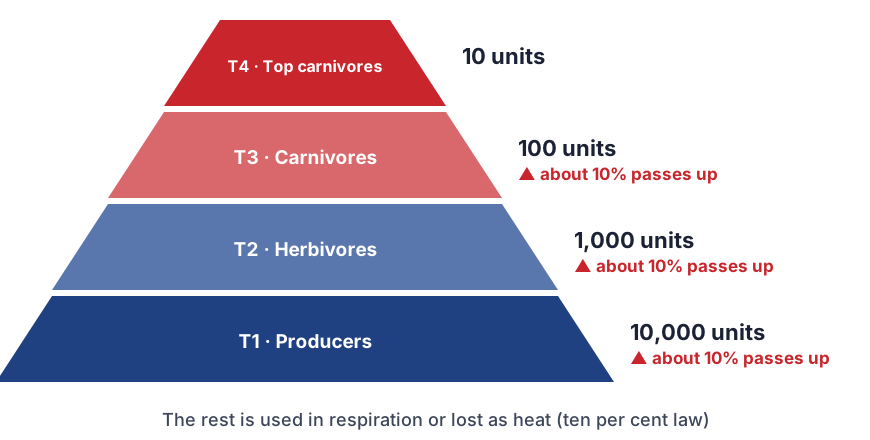
Each step in a chain is a trophic level, meaning a feeding level: producers (T1), herbivores (T2), carnivores (T3) and top carnivores (T4). Chains are short, usually four or five links, because energy is lost at every step.
Raymond Lindeman’s ten per cent law (1942): on average only about 10% of the energy at one level passes to the next. The rest is used for breathing and moving (respiration) or lost as heat. Think of passing a bucket of water down a line where each person spills most of it.
Food chains interlock to form a food web. A web is more stable than a single chain because a consumer has other food if one source declines.
A food chain shows the order in which organisms feed on each other. It is not found within one species’ population and does not show the numbers eaten (Prelims 2013: 1 only).
With reference to food chains in ecosystems, consider the following statements : 1. A food chain illustrates the order in which a chain of organisms feed upon each other. 2. Food chains are found within the populations of a species. 3. A food chain illustrates the numbers of each organism which are eaten by others. Which of the statements given above is/are correct?
- 1 only
- 1 and 2 only
- 1, 2 and 3
- None
Show answer
Answer: (a) · UPSC official key
Ecological pyramids
| Pyramid | Usually | Exception |
|---|---|---|
| Numbers | Upright (grassland) | Inverted in a tree: one tree supports many insects |
| Biomass | Upright on land | Inverted in the ocean: a small standing crop of fast-growing phytoplankton supports a larger biomass of consumers |
| Energy | Always upright | None: energy falls at every level |
Charles Elton introduced ecological pyramids (1927). They show producers at the base and the top carnivore at the apex (top). Their limits: they leave out decomposers and omnivores that feed at several levels.
Some persistent chemicals such as DDT and mercury become more concentrated at each higher level. This biomagnification is covered in the Pollution chapter.
What UPSC asks: Prelims: Tansley 1935, decomposers, grazing vs detritus chains, inverted pyramids. Mains: the 10% law and why food webs are stable.
Mains box: analysis and answer points
- Energy flow: 10% law explains short chains.
- Food webs: more stable than single chains.
- Pyramids: uses and limits.
Practice
Practice MCQs (8)
Ecologists generally regard a complex food web as more stable than a single, isolated food chain. Which one of the following best explains this?
Answer (d) & explanation
A food web is a network of interconnected food chains. Because most consumers have more than one food source, the loss or decline of one species can be buffered by alternative pathways — a predator switches to other prey instead of starving. In a single linear chain, the loss of one link breaks the whole chain. Energy is still lost as heat at every transfer in a web (the second law of thermodynamics applies), and decomposers are part of food webs.
Food chains in nature rarely have more than four or five trophic levels. The main reason is that
Answer (b) & explanation
At each transfer only about 10 per cent of the energy at one trophic level is passed on to the next; the rest is lost mainly as heat in respiration, in undigested waste and in organisms that are never eaten. After four or five steps, the energy left is too small to sustain a viable population of yet another predator. NCERT states that the number of trophic levels in a grazing food chain is restricted because energy transfer follows the 10 per cent law.
With reference to the grazing food chain (GFC) and the detritus food chain (DFC), consider the following statements:
1. In aquatic ecosystems, the GFC is the major conduit for energy flow.
2. In terrestrial ecosystems, a much larger fraction of energy flows through the DFC than through the GFC.
3. The DFC and the GFC never connect, because detritivores are not eaten by the animals of the grazing chain.
Which of the statements given above is/are correct?
Answer (b) & explanation
Statements 1 and 2 are taken directly from NCERT: in aquatic ecosystems the GFC is the major conduit for energy flow, while in terrestrial ecosystems a much larger fraction of energy flows through the DFC, because most land plant matter is never eaten alive and ends up as litter. Statement 3 is wrong: NCERT says the DFC may be connected with the GFC at some levels — for example, an earthworm (detritivore) is eaten by a bird that also eats insects from the grazing chain.
Consider the following sequences, each written in the direction in which energy flows:
1. Grass → grasshopper → frog → snake → hawk
2. Phytoplankton → zooplankton → small fish → kingfisher
3. Fallen leaves → earthworm → frog
4. Grass → tiger → deer
How many of the above are valid food chains?
Answer (c) & explanation
Three are valid. Sequence 1 is a classic grazing food chain with five trophic levels. Sequence 2 is an aquatic grazing chain from producers (phytoplankton) to a fish-eating bird. Sequence 3 is a detritus food chain that links to a predator (frog), showing how the two chains connect. Sequence 4 is wrong because energy flows from grass to the herbivore (deer) and then to the carnivore (tiger); arrows always point from food to feeder.
With reference to Antarctic krill, consider the following statements:
1. They feed largely on phytoplankton, especially diatoms.
2. Baleen whales, penguins and seals feed directly on them, so many Southern Ocean food chains are short.
3. Commercial fishing for them is regulated by the Commission for the Conservation of Antarctic Marine Living Resources (CCAMLR).
Which of the statements given above are correct?
Answer (d) & explanation
All three are correct. Antarctic krill (Euphausia superba) are shrimp-like crustaceans that graze phytoplankton, notably diatoms, and also feed on ice algae. They are the central prey of baleen whales, crabeater seals, penguins and many fish and seabirds, giving short chains such as diatoms → krill → whale. The krill fishery is managed by CCAMLR under the Antarctic Treaty System, with catch limits set on an ecosystem-based approach.
In the oceans, a large part of the organic matter released by phytoplankton is in dissolved form, which most animals cannot eat. The pathway by which bacteria take up this dissolved organic matter and are then eaten by small protists, returning part of the energy to the food web, is called the
Answer (a) & explanation
The microbial loop, described by Farooq Azam and colleagues in 1983, explains how dissolved organic matter (DOM) — leaked by phytoplankton, excreted by animals or released when cells burst — is used by heterotrophic bacteria. These bacteria are grazed by flagellates and ciliates, which are eaten by zooplankton, so energy that would otherwise be lost re-enters the classic food chain.
Consider the following statements about a parasitic food chain, such as a large tree supporting many herbivorous insects that are in turn attacked by still more numerous parasites:
1. Organisms at successive levels of such a chain are generally smaller in size and greater in number.
2. The pyramid of numbers drawn for such a chain is inverted.
3. A parasitic food chain begins with dead organic matter at its base.
Which of the statements given above is/are correct?
Answer (a) & explanation
Statements 1 and 2 are correct. In a parasitic food chain energy passes from a large host to smaller and more numerous parasites (and hyperparasites), so numbers increase as one moves up and the pyramid of numbers is inverted. Statement 3 is wrong: a chain that starts with dead organic matter is the detritus food chain; a parasitic chain starts with a living host. Even here, the pyramid of energy stays upright.
In his classic analysis 'Photosynthesis and fish production in the sea' (1969), J.H. Ryther showed that coastal upwelling zones, though a tiny fraction of the ocean's area, yield a very large share of the world's fish catch. Which one of the following is a key reason he identified?
Answer (c) & explanation
Ryther assumed about five trophic levels for the open ocean, three for coastal waters and only about 1.5 for upwelling zones, where fish such as anchovies feed close to the phytoplankton (often large diatoms). Combined with the high primary productivity created by nutrient-rich upwelled water and somewhat higher transfer efficiency, these short food chains mean that far more of the energy fixed by producers reaches harvestable fish. Upwelled water is actually cold, not warm.
0 / 0 correct
Prelims PYQs on this topic (8)
With reference to food chains in ecosystems, consider the following statements :
- 1. A food chain illustrates the order in which a chain of organisms feed upon each other.
- 2. Food chains are found within the populations of a species.
- 3. A food chain illustrates the numbers of each organism which are eaten by others.
Which of the statements given above is/are correct?
Answer (a) & explanation
Statement 1 only is correct (a). A food chain shows the order in which organisms feed on each other, who eats whom, in sequence, such as grass → grasshopper → frog → snake → eagle (1). Statement 2 is wrong: a food chain links different species at different trophic levels, not members of one population. Statement 3 is wrong: a food chain shows no numbers; counts of organisms at each level are shown by ecological pyramids of number, biomass and energy. So (b), (c) and (d) fail.
Notice the related ideas: many interlinked chains form a food web. Only about 10% of energy passes to the next level (Lindeman's rule), so chains rarely exceed four or five links. Detritus food chains start from dead matter. Trap: chains show order, pyramids show quantity.
Answer as per the official UPSC answer key.
With reference to the food chains in ecosystems, which of the following kinds of organism is/are known as decomposer organism/organisms?
- 1. Virus
- 2. Fungi
- 3. Bacteria
Select the correct answer using the codes given below.
Answer (b) & explanation
Fungi and bacteria are correct (b). Fungi and bacteria break down dead plants, animals and wastes by secreting enzymes and absorbing the products, returning nutrients such as nitrogen and phosphorus to the soil. They are the decomposers of the food chain (2, 3). Item 1 is wrong: viruses cannot feed on dead matter; they have no metabolism of their own and multiply only inside living cells. So (a), (c) and (d) fail.
Notice the related terms: detritivores such as earthworms and termites physically break down litter before decomposers finish the job. The detritus food chain starts from dead matter and is important in forests. Without decomposers, nutrients would stay locked in dead bodies. Trap: viruses are microbes but not decomposers.
Answer as per the official UPSC answer key.
Consider the following kinds of organisms :
- 1. Copepods
- 2. Cyanobacteria
- 3. Diatoms
- 4. Foraminifera
Which of the above are primary producers in the food chains of oceans?
Answer (b) & explanation
Cyanobacteria and diatoms are primary producers (b). Primary producers make their own food by photosynthesis, forming the base of the food chain. Item 2 is right: cyanobacteria (blue-green algae) photosynthesise and also fix nitrogen. Item 3 is right: diatoms are phytoplankton with glass-like silica shells, and they produce much of the world's oxygen. Item 1 is wrong: copepods are tiny crustaceans that eat phytoplankton, so they are consumers. Item 4 is wrong: foraminifera are shelled protists that mostly feed on other organisms.
Notice that marine phytoplankton produce about half of Earth's oxygen. Foraminifera shells pile up on the ocean floor and help scientists study past climates.
Answer as per the official UPSC answer key.
Which one of the following is the correct sequence of a food chain?
Answer (a) & explanation
A food chain always starts with a producer. Diatoms are phytoplankton that make food by photosynthesis. Small crustaceans such as copepods graze on them, and herrings eat the crustaceans. So the order is Diatoms–Crustaceans–Herrings (a). Options (b), (c) and (d) put a consumer before the producer or reverse the order of eating.
Diatoms have glassy silica shells and produce a large share of the oxygen made in the oceans. Notice how energy shrinks at each step (roughly the 10% rule), which is why food chains rarely have more than four or five links.
Answer as per the official UPSC answer key.
There is some concern regarding the nanoparticles of some chemical elements that are used by the industry in the manufacture of various products. Why?
- 1. They can accumulate in the environment, and contaminate water and soil.
- 2. They can enter the food chains.
- 3. They can trigger the production of free radicals.
Select the correct answer using the code given below.
Answer (d) & explanation
All three are real concerns (d). Because they are so tiny, nanoparticles of silver, titanium dioxide and zinc oxide pass easily into soil, water and living cells, so they can accumulate and contaminate the environment (1). They can move up food chains (2). They can also trigger free radicals that cause oxidative damage to cells (3).
Their small size gives them a huge surface area, which makes them useful in sunscreens, medicines and electronics but also more reactive. Notice how the same property that makes a technology useful can make it risky, the core idea of the precautionary principle.
Answer as per the official UPSC answer key.
What would happen if phytoplankton of an ocean is completely destroyed for some reason?
- 1. The ocean as a carbon sink would be adversely affected.
- 2. The food chains in the ocean would be adversely affected.
- 3. The density of ocean water would drastically decrease.
Select the correct answer using the codes given below :
Answer (a) & explanation
Statements 1 and 2 are correct (a). Phytoplankton are the ocean's microscopic plants. Through photosynthesis they absorb CO₂ and, when they die and sink, carry carbon to the deep sea: the biological pump, which makes the ocean a carbon sink (1). They form the base of marine food chains, feeding zooplankton, fish and whales (2). Statement 3 is wrong: seawater density depends on temperature and salinity, not on plankton. So (b), (c) and (d) fail.
Notice the scale: phytoplankton produce about half of the world's oxygen. Ocean warming and acidification threaten them, and blooms can turn harmful. Satellites track them through ocean colour, as India's Oceansat does to forecast fishing zones. Trap: losing plankton would not change water density.
Answer as per the official UPSC answer key.
Mains PYQs on this topic (1)
Write an answer
In 150 words, explain the significance of Ecosystem with one recent example.
Flashcards (10)
Who coined 'ecosystem'?
A. G. Tansley, 1935.
Decomposers (2013 PYQ)?
Fungi and bacteria.
Autotrophs are?
Producers that make their own food.
Detritus food chain starts with?
Dead organic matter.
Ten per cent law is by?
Raymond Lindeman (1942).
Why is a food web stabler than a chain?
Consumers have alternative foods.
Which pyramid is always upright?
Pyramid of energy.
Pyramid of numbers inverted in?
A tree ecosystem.
Pyramid of biomass inverted in?
The ocean.
Does photosynthesis add CO2?
No, it removes it.
In the news
- 25 Oct 2026Bleached corals revived in the lab: two studies on algae transfer and heat-tolerant symbionts
- 25 Oct 2026₹1.04 crore of access and benefit-sharing money from crops shared with 27 States and 2 UTs
- 25 Oct 2026North India is drying: IMD–IITM study on shifting climate zones and the Pacific ‘Victoria Mode’
- 23 Oct 2026Carbon capture: how India can make its ₹20,000 crore CCUS push count, in three phases
 Next topic · 2.2 →Ecosystem: Productivity, services and succession