
Chapter 4 · Topic 4.1 · Prelims + Mains1 of 3
Forests: Forest cover and forest types
Key points
- ISFR 2023 (18th report, released 21 December 2024): forest cover 21.76%, forest plus tree cover 25.17%.
- Forest cover: land over one hectare with canopy density above 10%.
- National Forest Policy, 1988: one-third under forest or tree cover, two-thirds in the hills.
- Champion and Seth (1968): 16 type groups. Tropical moist deciduous is the most widespread.
- Thorn forests below about 70 cm rain. Sea buckthorn suits Ladakh.
8 PYQs 2016–2026
Prelims box: facts and traps
| Item | Value |
|---|---|
| Forest cover (ISFR 2023) | 7,15,343 sq km (21.76%) |
| Forest + tree cover | 25.17% |
| Policy goal | One-third (NFP 1988) |
| Classification | Champion and Seth, 1968, 16 type groups |
- Trap: Red Sanders grows in the Eastern Ghats, not rain forests.
On this page (3 sections)
India’s forest cover
The Forest Survey of India (FSI), Dehradun, has published the India State of Forest Report (ISFR) every two years since 1987. It uses satellite pictures plus ground checks called the National Forest Inventory. ISFR 2023, released on 21 December 2024, is the 18th report and the latest on FSI’s website.
| ISFR 2023 indicator | Value (administrative survey) |
|---|---|
| Forest cover | 7,15,343 sq km (21.76% of geographical area) |
| Tree cover | 1,12,014 sq km (3.41%) |
| Forest + tree cover | 8,27,357 sq km (25.17%); up 1,445 sq km over 2021 |
| Largest forest cover (area) | Madhya Pradesh, Arunachal Pradesh, Chhattisgarh |
| Highest forest cover (% of area) | Lakshadweep (91.33%), Mizoram (85.34%), Andaman and Nicobar (81.62%) |
| Mangrove cover | 4,992 sq km |
| Carbon stock | 7,285.5 million tonnes; additional sink of 2.29 billion t CO2e over 2005 against the NDC target of 2.5–3.0 billion t by 2030 |
Forest cover and tree cover together come to 25.17% of the country. Forest cover means all land over one hectare with tree canopy density above 10%, whatever its owner or legal status. Canopy density is how much of the sky the tree tops cover when you look up. This differs from recorded forest area, which is land written down as forest in government records, even if it has few trees. The National Forest Policy, 1988 aims at one-third of the country under forest or tree cover (two-thirds in the hills).
In ascending order of forest cover as a share of State area, the 2019 paper’s answer was Maharashtra–Madhya Pradesh–Odisha–Chhattisgarh (Prelims 2019: 3-2-4-1), based on the ISFR then current.
Consider the following States : 1. Chhattisgarh 2. Madhya Pradesh 3. Maharashtra 4. Odisha With reference to the States mentioned above, in terms of percentage of forest cover to the total area of State, which one of the following is the correct ascending order?
- 2-3-1-4
- 2-3-4-1
- 3-2-4-1
- 3-2-1-4
Show answer
Answer: (c) · UPSC official key
Mains 2020 asked about the status of India’s forests and their impact on climate change. Use ISFR cover and carbon-stock data and the NDC sink target, India’s promise to soak up extra carbon in forests.
Examine the status of forest resources of India and its resultant impact on climate change.
Tropical forests
H. G. Champion and S. K. Seth (1968) classified India’s forests into 16 type groups. For exams they are grouped by rainfall and altitude. The rule is simple: more rain means taller, greener, denser forest.
| Type | Rainfall (approx.) | Features | Trees and areas |
|---|---|---|---|
| Tropical evergreen | Over 200 cm | Tall, dense, multi-layered; no single leaf-fall season | Rosewood, mahogany, ebony; Western Ghats, North-east, Andaman |
| Tropical semi-evergreen | Slightly less | Mix of evergreen and deciduous trees | Cedar, hollock, kail; fringes of evergreen belts |
| Tropical moist deciduous | 100–200 cm | Shed leaves in the dry season; commercially valuable | Teak, sal, bamboo, sandalwood; Odisha, Jharkhand, Western Ghats slopes |
| Tropical dry deciduous | 70–100 cm | Open canopy, grazing pressure | Teak, tendu, palas, red sanders; peninsular plateau |
Red Sanders is a tree found in a part of South India (the Eastern Ghats of Andhra Pradesh). It is not a rain-forest tree (Prelims 2016: 1 only).
With reference to ‘Red Sanders’, sometimes seen in the news, consider the following statements : 1. It is a tree species found in a part of South India. 2. It is one of the most important trees in the tropical rain forest areas of south India. Which of the statements given above is/are correct?
- 1 only
- 2 only
- Both 1 and 2
- Neither 1 nor 2
Show answer
Answer: (a) · UPSC official key
Tropical moist deciduous forests, whose trees shed leaves in the dry season, are the most widespread type in India. Teak and sal are their main timber trees.
Thorn and montane forests
| Type | Where | Features and species |
|---|---|---|
| Tropical thorn | Below about 70 cm rain: Rajasthan, Gujarat, Haryana, rain-shadow Deccan | Scattered thorny trees and bushes; acacia, khejri, babul, Prosopis, euphorbias |
| Montane subtropical | Lower Himalaya (about 1,000–2,000 m) | Chir pine, broad-leaved hill forests |
| Montane temperate | About 1,500–3,000 m | Oak, deodar, blue pine, fir, spruce, rhododendron; shola forests and grasslands in the Nilgiris |
| Alpine | Above about 3,000 m to the tree line | Birch, juniper, dwarf rhododendron, then alpine meadows (bugyals) |
Sea buckthorn helps control soil erosion and prevent desertification (land turning into desert). It has nutritional value and suits cold, high areas such as Ladakh (Prelims 2012: 1 and 3 only).
Government of India encourages the cultivation of ‘sea buckthorn’. What is the importance of this plant? 1. It helps in controlling soil erosion and in preventing desertification. 2. It is a rich source of biodiesel. 3. It has nutritional value and is well-adapted to live in cold areas of high altitudes. 4. Its timber is of great commercial value. Which of the statements given above is/are correct?
- 1 only
- 2, 3 and 4 only
- 1 and 3 only
- 1, 2, 3 and 4
Show answer
Answer: (c) · UPSC official key
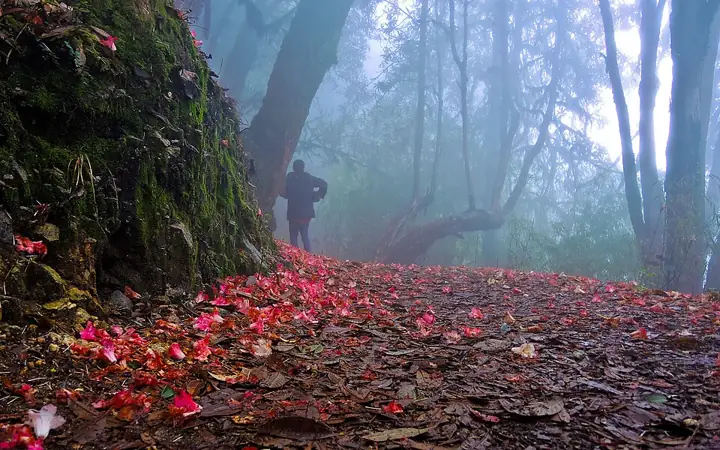
Gucchi (morel) is a fungus that grows in some Himalayan forests. It is gathered from the wild, not farmed commercially in the North-east (Prelims 2022: 1 and 2).
With reference to “Gucchi” sometimes mentioned in the news, consider the following statements : 1. It is a fungus. 2. It grows in some Himalayan forest areas. 3. It is commercially cultivated in the Himalayan foothills of north-eastern India. Which of the statements given above is/are correct ?
- 1 only
- 3 only
- 1 and 2
- 2 and 3
Show answer
Answer: (c) · UPSC official key
What UPSC asks: Prelims: ISFR 2023 figures, forest types by rainfall, species like Red Sanders and sea buckthorn. Mains: forests and climate change.
Mains box: analysis and answer points
- Status: ISFR 2023 cover and carbon stock.
- Climate link: NDC carbon sink target.
- Types: rainfall and altitude bands.
Practice
Practice MCQs (5)
The leaves of which one of the following trees are collected as minor forest produce and used for rolling bidis?
Answer (d) & explanation
Tendu or kendu (Diospyros melanoxylon), a tree of the dry deciduous forests of central and eastern India, provides the leaves used to roll bidis. Tendu leaf collection is among the largest sources of seasonal cash income for forest-dwelling and tribal families in States such as Odisha, Chhattisgarh, Madhya Pradesh and Jharkhand, and its trade is nationalised in several States. Its relative, ebony, belongs to the same genus. Sal leaves are stitched into plates, and palash leaves are also used for leaf plates.
Many members of the fungal genus Glomus are used as biofertilisers because they:
Answer (b) & explanation
NCERT notes that many members of the genus Glomus form mycorrhiza, a symbiotic association between fungi and plant roots. The fungal threads extend far into the soil and absorb phosphorus, which they pass to the plant; mycorrhizal plants also show resistance to root pathogens, tolerance to salinity and drought, and better growth. Root nodules are formed by Rhizobium bacteria, heterocysts belong to cyanobacteria such as Anabaena and Nostoc, and lichens involve fungi with algae.
Consider the following statements about wind-pollinated flowers:
1. They produce pollen grains that are light and non-sticky.
2. They usually have well-exposed stamens and a large, often feathery stigma.
3. They are usually brightly coloured, scented and rich in nectar.
Which of the statements given above is/are correct?
Answer (c) & explanation
Statements 1 and 2 are correct. NCERT lists the features of wind pollination (anemophily): pollen grains are light and non-sticky so that air currents can carry them; stamens are well exposed so pollen is easily released; and the stigma is large and often feathery to trap airborne pollen. Wind-pollinated flowers often have a single ovule per ovary and are packed into inflorescences — the tassels of maize are the familiar example. Statement 3 describes insect-pollinated flowers, which spend energy on colour, scent and nectar to attract visitors; wind-pollinated flowers do not need them.
Consider the following statements about parasitic plants:
1. Cuscuta (dodder) is a total stem parasite that lacks chlorophyll.
2. Loranthus (mistletoe) is a partial stem parasite that has green leaves and can photosynthesise.
3. Striga (witchweed) is a total stem parasite of forest trees.
Which of the statements given above is/are correct?
Answer (b) & explanation
Statements 1 and 2 are correct. Cuscuta, a leafless yellow twiner on hedges and crops, has lost its chlorophyll and depends wholly on the host, drawing nutrition through haustoria; NCERT cites it as a parasite of hedge plants. Loranthus (mistletoe) grows on tree branches and taps only water and minerals, as it has green leaves and makes its own food, so it is a partial (hemi-) parasite. Statement 3 is wrong: Striga is a root hemiparasite of cereal crops such as sorghum, maize and millets, not a stem parasite of forest trees.
The baobab trees found in and around Mandu in Madhya Pradesh, whose fruit is locally called 'khorasani imli', are best described as:
Answer (b) & explanation
The baobab (Adansonia digitata) is native to mainland Africa. Genetic studies of Indian baobabs show they were introduced from East Africa, probably several times through Indian Ocean trade and human movement over centuries; Mandu has the largest group in India. The local name 'khorasani imli' is misleading on two counts: the tree does not grow in Khorasan, and it is not a tamarind — the word 'imli' refers only to its sour fruit pulp.
0 / 0 correct
Prelims PYQs on this topic (8)
Consider the following States :
- 1. Chhattisgarh
- 2. Madhya Pradesh
- 3. Maharashtra
- 4. Odisha
With reference to the States mentioned above, in terms of percentage of forest cover to the total area of State, which one of the following is the correct ascending order?
Answer (c) & explanation
The ascending order is Maharashtra, Madhya Pradesh, Odisha, Chhattisgarh (c). By the India State of Forest Report, forest cover as a share of area is about 16–17% in Maharashtra, about 25% in Madhya Pradesh, about 33% in Odisha, and about 41% in Chhattisgarh. The trap is that Madhya Pradesh has the largest forest area in India, but because it is a big state, its share is lower. So options starting with MP (a, b) are wrong, and (d) puts Chhattisgarh before Odisha.
Notice the latest ISFR 2023 (released December 2024): India's forest and tree cover is about 25% of its area. Mizoram has the highest share, while Lakshadweep leads the UTs.
MP tops the list by area, which tempts you to put it last.
Answer as per the official UPSC answer key.
Which of the following best describes/describe the aim of ‘Green India Mission’ of the Government of India?
- 1. Incorporating environmental benefits and costs into the Union and State Budgets thereby implementing the ‘green accounting’
- 2. Launching the second green revolution to enhance agricultural output so as to ensure food security to one and all in the future
- 3. Restoring and enhancing forest cover and responding to climate change by a combination of adaptation and mitigation measures
Select the correct answer using the code given below.
Answer (c) & explanation
Only statement 3 is correct (c). The Green India Mission, one of the eight missions under the National Action Plan on Climate Change (2008), aims to protect, restore and enhance forest cover and respond to climate change through both adaptation and mitigation. Statement 1 is wrong: green accounting in budgets is not its aim. Statement 2 is wrong: a second green revolution in farm output is an agriculture goal, not this mission's.
The mission seeks to improve forest and tree cover on millions of hectares and boost ecosystem services. Notice how it links to India's NDC promise of an extra carbon sink of 2.5–3 billion tonnes of CO₂ equivalent.
Answer as per the official UPSC answer key.
Which one of the following is the first Plan Vivo certified Reducing Emissions from Deforestation and Forest Degradation (REDD+) project in India ?
Answer (c) & explanation
The Khasi Hills Community REDD+ project was India's first (c). REDD+ pays communities for keeping forests standing, through carbon credits. Plan Vivo is a standard for community-led projects. India's first such project is the Khasi Hills Community REDD+ project around Mawphlang, Meghalaya, run by a federation of Khasi village councils (hima). Options (a), (b) and (d), the Uttarakhand, ICFRE-ICIMOD and Sikkim Mamley Kamrang projects, came later or use other routes.
Notice why Mawphlang is famous: its sacred grove, a forest protected by local beliefs. REDD+ stands for Reducing Emissions from Deforestation and forest Degradation, plus conservation and sustainable management. It is recognised under Article 5 of the Paris Agreement.
Answer as per the official UPSC answer key.
Which of the following statements in relation to NIRANTAR (National Institute for Research and Application of Natural Resources to Transform, Adapt and Build Resilience), a platform of institutions under the Ministry of Environment, Forest and Climate Change, is/are correct ?
- 1. Ecosystem Survey and Analysis is a vertical under this platform, the lead institute of which is Botanical Survey of India, Kolkata.
- 2. Research and Management of Ecosystem Service is a vertical under this platform, the lead institute of which is Central Zoo Authority, New Delhi.
- 3. Capacity Development Support is a vertical under this platform, the lead institute of which is Indian Institute of Forest Management, Bhopal.
Select the answer using the code given below :
Answer (b) & explanation
Statements 1 and 3 are correct (b). NIRANTAR groups the Environment Ministry's institutes into verticals. Statement 1 is right: Ecosystem Survey and Analysis is led by the Botanical Survey of India, Kolkata, with bodies like the FSI and ZSI. Statement 3 is right: Capacity Development Support is led by the Indian Institute of Forest Management, Bhopal. Statement 2 is wrong: Research and Management of Ecosystem Service is led by ICFRE, Dehradun; the Central Zoo Authority is only a member. So options (a), (c) and (d) fail.
Notice the purpose: pooling institutes avoids duplicate work and links research to climate adaptation and resilience. Other Ministry bodies include the Wildlife Institute of India (Dehradun) and GBPNIHE for the Himalaya.
the Central Zoo Authority does sit in that vertical, but as a member, not the lead.
Answer as per the official UPSC answer key.
Regarding Peacock tarantula (Gooty tarantula), consider the following statements :
- I. It is an omnivorous crustacean.
- II. Its natural habitat in India is only limited to some forest areas.
- III. In its natural habitat, it is an arboreal species.
Which of the statements given above is/are correct?
Answer (d) & explanation
Statements II and III are correct (d). Statement II is right: the peacock tarantula (Gooty tarantula) is found only in a few forest patches of the Eastern Ghats, mainly in Andhra Pradesh. Statement III is right: it lives in tree holes, so it is arboreal. Statement I is wrong: it is a spider, an arachnid, not a crustacean, and it eats insects, not plants. So options (a), (b) and (c) fail.
Notice its status: it is Critically Endangered on the IUCN Red List, mainly due to deforestation and the pet trade, valued for its bright blue colour. It is named after Gooty town, where it was first found. Its bite is painful but rarely dangerous.
"crustacean" sounds scientific. Spiders are arachnids; crabs and prawns are crustaceans.
Answer as per the official UPSC answer key.
Consider the following statements :
Once the Central Government notifies an area as a ‘Community Reserve’
- 1. the Chief Wildlife Warden of the State becomes the governing authority of such forest
- 2. hunting is not allowed in such area
- 3. people of such area are allowed to collect non-timber forest produce
- 4. people of such area are allowed traditional agricultural practices
How many of the above statements are correct?
Answer (b) & explanation
Two statements are correct (b). Community reserves were added to the Wild Life (Protection) Act in 2003. They are notified on community or private land with the people's consent; note that under the Act it is the State Government, not the Centre, that notifies them. Statement 1 is wrong: a Community Reserve Management Committee runs them, not the Chief Wildlife Warden. Statement 2 is right: hunting is banned. Statement 3 is right: people may collect non-timber forest produce. Statement 4 is wrong: changes in land use, including traditional farming or jhum, are not allowed.
Notice the four types of protected areas: national parks, sanctuaries, conservation reserves and community reserves. Many community reserves are in Meghalaya and Nagaland, where communities own most forests.
"governing authority" tempts you because the Warden does run sanctuaries.
Answer as per the official UPSC answer key.
Write an answer
In 150 words, explain the significance of Forests with one recent example.
Flashcards (14)
Who publishes the ISFR, and how often?
Forest Survey of India, every two years.
Forest cover in ISFR 2023?
7,15,343 sq km (21.76%).
Forest + tree cover in ISFR 2023?
25.17% of geographical area.
State with the largest forest cover by area?
Madhya Pradesh.
Highest forest cover by share?
Lakshadweep (91.33%).
Forest Policy 1988 target?
One-third of area (two-thirds in hills).
Who classified India's forests into 16 type
groups? Champion and Seth (1968).
Most widespread forest type in India?
Tropical moist deciduous.
Red Sanders is found in?
Eastern Ghats of Andhra Pradesh (South India).
Rainfall for thorn forests?
Below about 70 cm.
Sea buckthorn grows where?
Cold, high-altitude areas such as Ladakh.
Gucchi is?
A morel fungus of Himalayan forests.
India's mangrove cover (ISFR 2023)?
4,992 sq km.
FRA cut-off date?
13 December 2005.
In the news
- 25 Oct 2026₹1.04 crore of access and benefit-sharing money from crops shared with 27 States and 2 UTs
- 22 Oct 2026GRAP Stage I invoked in Delhi-NCR as AQI turns ‘Poor’: the 25 actions and what comes next
- 20 Oct 2026National Red List of birds: 1,211 species under assessment, 107 done in first review
- 16 Oct 2026CAQM orders PTZ cameras at all polluting industries in NCR by 30 November 2026
 Next topic · 4.2 →Forests: Mangroves, social forestry, JFM and FRA
Syllabus: GS-III · Conservation, environmental pollution and degradation, environmental impact asse…