
Chapter 4 · Topic 4.2 · Prelims + Mains2 of 3
Forests: Mangroves, social forestry, JFM and FRA
Key points
- Mangroves.
- Social forestry and agroforestry.
- JFM and the Forest Rights Act.
8 PYQs 2017–2026
Prelims box: facts and traps
| Point | Detail |
|---|---|
| India's cover | 4,992 sq km (ISFR 2023) |
| Largest | Sundarbans in the Ganga–Brahmaputra delta (West Bengal), shared with Bangladesh |
| Other sites | Bhitarkanika (Odisha), Godavari–Krishna delta, Pichavaram (Tamil Nadu), Gulf of Kachchh, Andaman and Nicobar |
| MISHTI | Mangrove Initiative for Shoreline Habitats and Tangible Incomes: about 22,561 ha of degraded mangroves restored in 13 States/UTs (PIB, March 2025). |
- At the national level, the Ministry of Tribal Affairs Prelims 2021 is the nodal agency for implementing the Forest Rights Act, 2006 (Prelims 2021).
- The Arabari experiment in West Bengal (early 1970s) was the model; the Centre issued JFM guidelines in 1990, after the National Forest Policy of 1988 called for people's participation.
- In India, most of the tamarind is collected as minor forest produce; India exports tamarind and moringa seeds; and seeds of both can be used to produce biofuels (Prelims 2021: 3, 4 and 5).
- Trap (UPSC Prelims 2018): “Union Ministry of Environment, Forest and Climate Change officially decides and declares Habitat Rights for Primitive and Vulnerable Tribal Groups in any part of India” is incorrect.
- Trap (UPSC Prelims 2021): “Moringa (drumstick tree) is a leguminous evergreen tree” is incorrect. “Tamarind tree is endemic to South Asia” is incorrect.
On this page (3 sections)
Mangroves
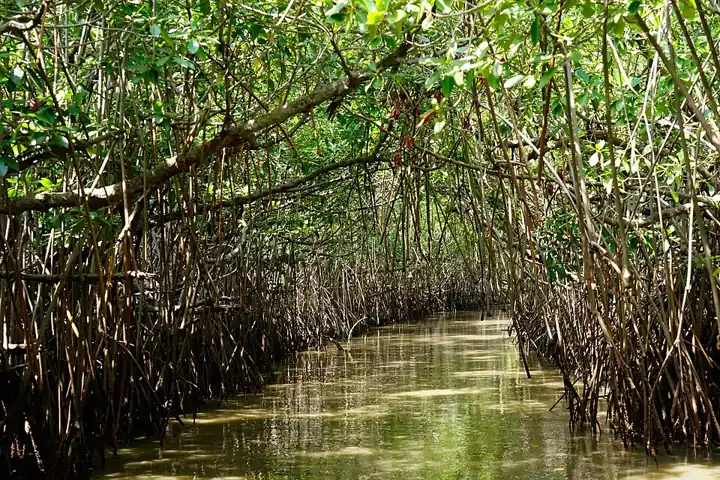
Mangroves are salt-tolerant trees and shrubs of the tropical inter-tidal zone. Adaptations include stilt and prop roots, breathing roots (pneumatophores) and viviparous seeds that sprout while still on the tree.
| Point | Detail |
|---|---|
| India’s cover | 4,992 sq km (ISFR 2023) |
| Largest | Sundarbans in the Ganga–Brahmaputra delta (West Bengal), shared with Bangladesh |
| Other sites | Bhitarkanika (Odisha), Godavari–Krishna delta, Pichavaram (Tamil Nadu), Gulf of Kachchh, Andaman and Nicobar |
| MISHTI | Mangrove Initiative for Shoreline Habitats and Tangible Incomes: about 22,561 ha of degraded mangroves restored in 13 States/UTs (PIB, March 2025) |
By withstanding tidal surges and offering biomass resources, mangroves function both as natural bio-shields and livelihood bases for rural communities (Prelims 2026: 3 only).
Which of the following best explain(s) the rationale for protecting mangrove ecosystems in the context of climate resilience ? 1. Mangroves reduce tidal energy and store freshwater, making them ideal sites for paddy cultivation in saline estuarine belts. 2. Their salt-sensitive roots filter seawater, making mangroves key to converting coastal land into freshwater aquaculture zones. 3. By withstanding tidal surges and offering biomass resources, mangroves function both as natural bio- shields and livelihood bases for rural communities. Select the answer using the code given below :
- 1 only
- 1 and 2
- 2 and 3
- 3 only
Show answer
Answer: (d) · UPSC provisional key (final key awaited)
The Kharai camel of Kachchh can swim up to three kilometres in seawater and survives by grazing on mangroves (Prelims 2016: 1 and 2 only).
What is/are unique about ‘Kharai camel’, a breed found in India? 1. It is capable of swimming up to three kilometres in seawater. 2. It survives by grazing on mangroves. 3. It lives in the wild and cannot be domesticated. Select the correct answer using the code given below.
- 1 and 2 only
- 3 only
- 1 and 3 only
- 1, 2 and 3
Show answer
Answer: (a) · UPSC official key
Social forestry and agroforestry
| Type | Meaning |
|---|---|
| Social forestry | Tree planting on non-forest land for local needs, recommended by the National Commission on Agriculture (1976) |
| Farm forestry | Farmers grow trees on their own land for fuel, fodder, timber and income |
| Community forestry | Trees on village common land, managed by the community |
| Urban forestry | Trees in parks, road sides and green belts of cities |
| Agroforestry | Trees combined with crops or livestock on the same land |
India adopted a National Agroforestry Policy in 2014. ISFR 2023 puts the potential annual timber production from trees outside forests at 91.51 million cubic metres.
In India, most of the tamarind is collected as minor forest produce; India exports tamarind and moringa seeds; and seeds of both can be used to produce biofuels (Prelims 2021: 3, 4 and 5).
Consider the following statements : 1. Moringa (drumstick tree) is a leguminous evergreen tree. 2. Tamarind tree is endemic to South Asia. 3. In India, most of the tamarind is collected as minor forest produce. 4. India exports tamarind and seeds of moringa. 5. Seeds of moringa and tamarind can be used in the production of biofuels. Which of the statements given above are correct?
- 1, 2, 4 and 5
- 3, 4 and 5
- 1, 3 and 4
- 1, 2, 3 and 5
Show answer
Answer: (b) · UPSC official key
Joint Forest Management and the Forest Rights Act
Joint Forest Management (JFM) makes villagers partners of the forest department: forest protection committees protect and regenerate degraded forests and share usufructs and part of timber revenue. The Arabari experiment in West Bengal (early 1970s) was the model; the Centre issued JFM guidelines in 1990, after the National Forest Policy of 1988 called for people’s participation.
| Forest Rights Act, 2006 | Detail |
|---|---|
| Full name | Scheduled Tribes and Other Traditional Forest Dwellers (Recognition of Forest Rights) Act, 2006 |
| Who | Forest-dwelling STs, and other traditional forest dwellers living there for three generations (75 years) before 13 December 2005 |
| Rights | Individual land rights up to 4 hectares; community rights over minor forest produce, grazing, water; community forest resource rights; habitat rights for PVTGs |
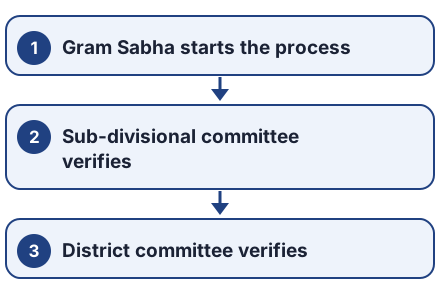
| Process | Gram Sabha starts the process; sub-divisional and district committees verify |
| Nodal ministry | Ministry of Tribal Affairs |
At the national level, the Ministry of Tribal Affairs Prelims 2021 is the nodal agency for implementing the Forest Rights Act, 2006 (Prelims 2021).
At the national level, which ministry is the nodal agency to ensure effective implementation of the Scheduled Tribes and Other Traditional Forest Dwellers (Recognition of Forest Rights) Act, 2006?
- Ministry of Environment, Forest and Climate Change
- Ministry of Panchayati Raj
- Ministry of Rural Development
- Ministry of Tribal Affairs
Show answer
Answer: (d) · UPSC official key
‘Critical Wildlife Habitat’ is defined in the Forest Rights Act, and the Baigas were the first to get habitat rights; MoEFCC does not declare habitat rights (Prelims 2018: 1 and 2 only).
Consider the following statements : 1. The definition of “Critical Wildlife Habitat” is incorporated in the Forest Rights Act, 2006. 2. For the first time in India, Baigas have been given Habitat Rights. 3. Union Ministry of Environment, Forest and Climate Change officially decides and declares Habitat Rights for Primitive and Vulnerable Tribal Groups in any part of India. Which of the statements given above is/are correct ?
- 1 and 2 only
- 2 and 3 only
- 3 only
- 1, 2 and 3
Show answer
Answer: (a) · UPSC official key
Mains box: analysis and answer points
- Mangroves are salt-tolerant trees and shrubs of the tropical inter-tidal zone.
- Adaptations include stilt and prop roots, breathing roots (pneumatophores) and viviparous seeds that sprout while still on the tree.
- By withstanding tidal surges and offering biomass resources, mangroves function both as natural bio-shields and livelihood bases for rural communities (Prelims 2026: 3 only).
- Likely next angle: MISHTI
Practice
Practice MCQs (5)
Consider the following plants:
1. Opuntia
2. Calotropis
3. Hydrilla
4. Vallisneria
How many of the above are xerophytes?
Answer (b) & explanation
Only two are xerophytes. Opuntia (prickly pear) and Calotropis (aak) thrive in dry, sandy wastelands: Opuntia has spines and a fleshy green stem, and Calotropis has a waxy coating and deep roots. Hydrilla and Vallisneria are submerged freshwater hydrophytes; NCERT also uses Vallisneria and Hydrilla as examples of water pollination.
Consider the following statements about the moss Sphagnum:
1. Peat derived from Sphagnum has long been used as fuel.
2. It is used as a packing material for sending living plant material because it can hold a lot of water.
3. Like other mosses, it has true roots and well-developed xylem.
Which of the statements given above is/are correct?
Answer (b) & explanation
Statements 1 and 2 are correct. NCERT notes that species of Sphagnum, a moss, provide peat that has long been used as fuel, and as packing material for trans-shipment of living material because of its great water-holding capacity. Statement 3 is wrong: mosses are bryophytes, which have only rhizoids and no true roots, xylem or phloem.
Which one of the following features is generally absent or very poorly developed in submerged hydrophytes such as Hydrilla?
Answer (d) & explanation
Submerged hydrophytes such as Hydrilla and Vallisneria live surrounded by water, so they have no need to prevent water loss. Their leaves and stems therefore have a thin or no cuticle, which lets them absorb water, minerals and gases over the whole surface. At the same time they show aerenchyma (large air spaces for buoyancy and gas exchange), chloroplasts even in epidermal cells to use the dim light, and thin or dissected leaves that resist tearing by currents. A thick waxy cuticle is a xerophytic feature.
With reference to lichens, consider the following statements:
1. A lichen is a symbiotic association between a fungus and an alga or a cyanobacterium.
2. The algal partner prepares food, while the fungal partner provides shelter and absorbs water and mineral nutrients.
3. Lichens anchor themselves to rocks by true roots that penetrate the rock surface.
Which of the statements given above are correct?
Answer (a) & explanation
Statements 1 and 2 are correct. A lichen is a composite organism formed by a fungus (the mycobiont) living with an alga or a cyanobacterium (the phycobiont). The photosynthetic partner makes food for both, while the fungal threads give shelter and absorb water and minerals, so the partnership is a classic case of mutualism. Statement 3 is wrong: lichens have no roots at all; they cling by fungal threads (rhizines), and acids they secrete slowly weather the rock, which is why they are pioneers on bare rock.
With reference to the Khejri tree (Prosopis cineraria), consider the following statements:
1. It is a leguminous tree that improves soil fertility by fixing atmospheric nitrogen.
2. It is the same species as the invasive 'vilayati babul' that has spread across dry regions of India.
3. The Bishnoi community's sacrifice to protect it at Khejarli in 1730 is a landmark in the history of conservation in India.
Which of the statements given above are correct?
Answer (b) & explanation
Statements 1 and 3 are correct. Khejri (Prosopis cineraria) is a deep-rooted leguminous tree of the Thar; its root nodules fix nitrogen, so crops grow well under it, and its pods (sangri) and leaves are food and fodder. Statement 2 is wrong: the invasive 'vilayati babul' is a different species, Prosopis juliflora, brought from the Americas, which UPSC asked about in 2018 for reducing local biodiversity. In 1730, at Khejarli near Jodhpur, Amrita Devi Bishnoi and over 360 Bishnois gave their lives to stop the felling of khejri trees, an episode later recalled as an inspiration for the Chipko movement.
0 / 0 correct
Prelims PYQs on this topic (8)
“Leaf litter decomposes faster than in any other biome and as a result the soil surface is often almost bare. Apart from trees, the vegetation is largely composed of plant forms that reach up into the canopy vicariously, by climbing the trees or growing as epiphytes, rooted on the upper branches of trees.” This is the most likely description of
Answer (d) & explanation
This describes the tropical rain forest (d). Leaf litter decays fastest where heat and moisture are constant all year: the tropical rain forest. Microbes, fungi and insects break down fallen leaves within weeks, so the soil surface is often almost bare. Little light reaches the floor, so many plants climb (lianas) or grow on branches (epiphytes, such as orchids and ferns) to reach the canopy. Coniferous forests (a) are cold, so litter decays slowly. Dry deciduous forests (b) have a long dry season. Mangroves (c) are coastal and waterlogged.
Notice that rain forest soils are poor, because nutrients are quickly taken up by plants and washed out by rain. India's rain forests are in the Western Ghats, the North-East and the Andamans.
Answer as per the official UPSC answer key.
Which one of the following is the first Plan Vivo certified Reducing Emissions from Deforestation and Forest Degradation (REDD+) project in India ?
Answer (c) & explanation
The Khasi Hills Community REDD+ project was India's first (c). REDD+ pays communities for keeping forests standing, through carbon credits. Plan Vivo is a standard for community-led projects. India's first such project is the Khasi Hills Community REDD+ project around Mawphlang, Meghalaya, run by a federation of Khasi village councils (hima). Options (a), (b) and (d), the Uttarakhand, ICFRE-ICIMOD and Sikkim Mamley Kamrang projects, came later or use other routes.
Notice why Mawphlang is famous: its sacred grove, a forest protected by local beliefs. REDD+ stands for Reducing Emissions from Deforestation and forest Degradation, plus conservation and sustainable management. It is recognised under Article 5 of the Paris Agreement.
Answer as per the official UPSC answer key.
Which of the following statements in relation to NIRANTAR (National Institute for Research and Application of Natural Resources to Transform, Adapt and Build Resilience), a platform of institutions under the Ministry of Environment, Forest and Climate Change, is/are correct ?
- 1. Ecosystem Survey and Analysis is a vertical under this platform, the lead institute of which is Botanical Survey of India, Kolkata.
- 2. Research and Management of Ecosystem Service is a vertical under this platform, the lead institute of which is Central Zoo Authority, New Delhi.
- 3. Capacity Development Support is a vertical under this platform, the lead institute of which is Indian Institute of Forest Management, Bhopal.
Select the answer using the code given below :
Answer (b) & explanation
Statements 1 and 3 are correct (b). NIRANTAR groups the Environment Ministry's institutes into verticals. Statement 1 is right: Ecosystem Survey and Analysis is led by the Botanical Survey of India, Kolkata, with bodies like the FSI and ZSI. Statement 3 is right: Capacity Development Support is led by the Indian Institute of Forest Management, Bhopal. Statement 2 is wrong: Research and Management of Ecosystem Service is led by ICFRE, Dehradun; the Central Zoo Authority is only a member. So options (a), (c) and (d) fail.
Notice the purpose: pooling institutes avoids duplicate work and links research to climate adaptation and resilience. Other Ministry bodies include the Wildlife Institute of India (Dehradun) and GBPNIHE for the Himalaya.
the Central Zoo Authority does sit in that vertical, but as a member, not the lead.
Answer as per the official UPSC answer key.
Regarding Peacock tarantula (Gooty tarantula), consider the following statements :
- I. It is an omnivorous crustacean.
- II. Its natural habitat in India is only limited to some forest areas.
- III. In its natural habitat, it is an arboreal species.
Which of the statements given above is/are correct?
Answer (d) & explanation
Statements II and III are correct (d). Statement II is right: the peacock tarantula (Gooty tarantula) is found only in a few forest patches of the Eastern Ghats, mainly in Andhra Pradesh. Statement III is right: it lives in tree holes, so it is arboreal. Statement I is wrong: it is a spider, an arachnid, not a crustacean, and it eats insects, not plants. So options (a), (b) and (c) fail.
Notice its status: it is Critically Endangered on the IUCN Red List, mainly due to deforestation and the pet trade, valued for its bright blue colour. It is named after Gooty town, where it was first found. Its bite is painful but rarely dangerous.
"crustacean" sounds scientific. Spiders are arachnids; crabs and prawns are crustaceans.
Answer as per the official UPSC answer key.
Consider the following statements :
Once the Central Government notifies an area as a ‘Community Reserve’
- 1. the Chief Wildlife Warden of the State becomes the governing authority of such forest
- 2. hunting is not allowed in such area
- 3. people of such area are allowed to collect non-timber forest produce
- 4. people of such area are allowed traditional agricultural practices
How many of the above statements are correct?
Answer (b) & explanation
Two statements are correct (b). Community reserves were added to the Wild Life (Protection) Act in 2003. They are notified on community or private land with the people's consent; note that under the Act it is the State Government, not the Centre, that notifies them. Statement 1 is wrong: a Community Reserve Management Committee runs them, not the Chief Wildlife Warden. Statement 2 is right: hunting is banned. Statement 3 is right: people may collect non-timber forest produce. Statement 4 is wrong: changes in land use, including traditional farming or jhum, are not allowed.
Notice the four types of protected areas: national parks, sanctuaries, conservation reserves and community reserves. Many community reserves are in Meghalaya and Nagaland, where communities own most forests.
"governing authority" tempts you because the Warden does run sanctuaries.
Answer as per the official UPSC answer key.
Consider the following statements :
- Statement-I : The soil in tropical rain forests is rich in nutrients.
- Statement-II : The high temperature and moisture of tropical rain forests cause dead organic matter in the soil to decompose quickly.
Which one of the following is correct in respect of the above statements?
Answer (d) & explanation
Statement I is wrong but Statement II is correct (d). Statement II is right: the high heat and moisture of tropical rainforests make dead leaves and organic matter decompose very fast. Statement I is wrong: the nutrients released are taken up at once by the dense plant cover, and heavy rain washes, or leaches, the rest away. Most nutrients sit in the living plants, not the soil. So rainforest soil is poor, often red laterite rich in iron and aluminium.
Notice why clearing rainforest for farming fails: once trees are cut, the thin soil is exhausted in a few years. This explains shifting cultivation (jhum) in such areas. In contrast, cold temperate forests decompose slowly and build thick, fertile soils.
lush forest suggests rich soil. In rainforests the richness is in the plants, not the soil.
Answer as per the official UPSC answer key.
Write an answer
In 150 words, explain the significance of Forests with one recent example.
Flashcards (6)
Mangrove breathing roots are called?
Pneumatophores.
Camel that grazes on mangroves?
Kharai camel (Kachchh).
Who recommended social forestry?
National Commission on Agriculture (1976).
National Agroforestry Policy year?
2014.
JFM model experiment?
Arabari, West Bengal.
FRA nodal ministry?
Ministry of Tribal Affairs.
In the news
- 22 Oct 2026GRAP Stage I invoked in Delhi-NCR as AQI turns ‘Poor’: the 25 actions and what comes next
- 20 Oct 2026National Red List of birds: 1,211 species under assessment, 107 done in first review
- 16 Oct 2026CAQM orders PTZ cameras at all polluting industries in NCR by 30 November 2026
- 15 Oct 2026Sukhna Wetland and Sauj Jheel become Ramsar sites; India’s tally reaches 103
 Next topic · 4.3 →Forests: Forest programmes and REDD+
Syllabus: GS-III · Conservation, environmental pollution and degradation, environmental impact asse…