
Chapter 8 · Topic 8.1 · Prelims + Mains1 of 3
Maratha Empire: Shivaji
Key points
- Maratha rise: Sahyadri forts and guerrilla war, service under Deccan sultans, bhakti saints (Tukaram, Ramdas).
- Shivaji: Torna (1646), Afzal Khan (1659), Surat (1664), Purandar (1665), Agra escape (1666), coronation at Raigad (1674).
- Ashtapradhan council of eight, led by the Peshwa; officers paid in cash.
- Chauth (a quarter) and sardeshmukhi (a further tenth) from neighbouring areas.
Prelims box: facts and traps
- Treaty of Purandar (1665): with Jai Singh; 23 forts given up.
- Annaji Datto: land survey.
- Navy: Sindhudurg; Kanhoji Angre.
The rise of the Marathas and Shivaji
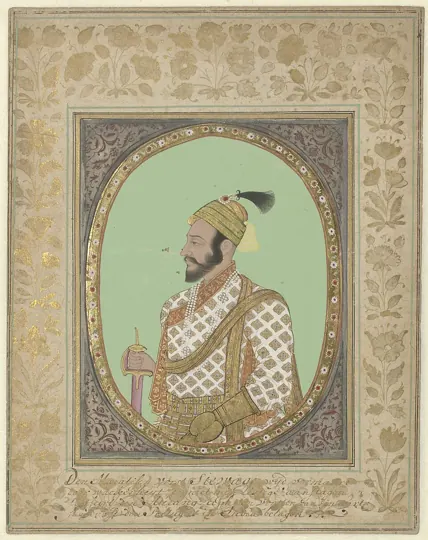
The Marathas rose in the 17th century from the hills of the western Deccan. Several things helped: the rugged Sahyadri hills, ideal for forts and guerrilla war (small, fast hit-and-run attacks); experience gained serving the Bijapur and Ahmadnagar sultans; and a shared regional identity shaped by the Marathi bhakti saints such as Tukaram and Ramdas.
| Year | Shivaji’s career |
|---|---|
| 1630 | Born at Shivneri fort, son of Shahji Bhonsle and Jijabai |
| 1646 | Takes Torna fort from Bijapur |
| 1659 | Kills the Bijapur general Afzal Khan at Pratapgarh |
| 1663 | Night raid on the Mughal governor Shaista Khan at Pune |
| 1664 | Sacks Surat, the richest Mughal port |
| 1665 | Treaty of Purandar with Raja Jai Singh: gives up 23 forts |
| 1666 | Escapes from house arrest at Agra |
| 1674 | Crowned Chhatrapati at Raigad |
| 1677–78 | Karnataka campaign: takes Jinji and Vellore |
| 1680 | Dies at Raigad |
What UPSC asks
Prelims: Purandar 1665, coronation 1674. Mains: rise of a regional power. Next likely: Maratha Military Landscapes, UNESCO World Heritage (2025).
Shivaji’s administration
Shivaji built a centralised state. He paid most officers in cash instead of jagirs, so nobles could not build local power.
| Ashtapradhan (council of eight) | Work |
|---|---|
| Peshwa | Prime minister |
| Amatya (Mazumdar) | Finance and accounts |
| Mantri (Waqia-navis) | Records and the king’s daily affairs |
| Sachiv (Shurunavis) | Royal letters |
| Sumant (Dabir) | Foreign affairs |
| Senapati (Sar-i-Naubat) | Army chief |
| Panditrao | Religious matters and charity |
| Nyayadhish | Justice |
| Revenue and defence | Detail |
|---|---|
| Land revenue | Land measured (Annaji Datto’s survey); about 40% of produce |
| Chauth | A quarter of the revenue, taken from neighbouring areas in return for not raiding them |
| Sardeshmukhi | A further tenth, claimed as the hereditary chief headman (sardeshmukh) |
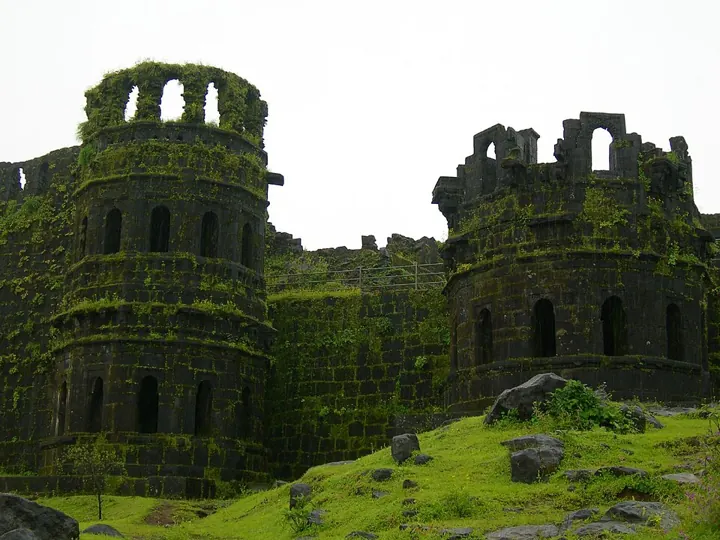
| Forts | Hundreds of forts, each with a havaldar, sabnis and karkhanis |
| Navy | Sea forts such as Sindhudurg; later admirals like Kanhoji Angre |
What UPSC asks
Prelims: Ashtapradhan, chauth, sardeshmukhi. Mains: Shivaji’s state. Next likely: naval history.
Mains box: analysis and answer points
- Rise of a regional power: geography, experience, identity.
- Shivaji's state: centralised, cash-paid, fort-based.
- Likely next angle: Maratha Military Landscapes (UNESCO 2025).
Practice
Practice MCQs (8)
With reference to Shivaji's navy, consider the following statements:
1. He began building a fleet with galivats purchased from the Portuguese shipyards at Bassein.
2. His first marine fort, Sindhudurg off the coast of Malvan, became the headquarters of the Maratha navy.
3. His fleet finally captured the island fortress of Janjira from the Siddis.
Which of the statements given above is/are correct?
Answer (d) & explanation
Shivaji saw that control of the Konkan coast required sea power. He began building a navy in 1657 or 1659 by purchasing twenty galivats from the Portuguese shipyards at Bassein, and recruited crews from coastal communities long familiar with the sea, Muslim mercenaries and some Portuguese sailors. He also fortified the coast, and his first marine fort, Sindhudurg, built from 1664 on an island off Malvan with the help of Portuguese engineers from Goa, became the headquarters of the fleet. His great maritime rivals were the Siddis of Janjira, Abyssinian-descended chiefs who allied with the Mughals. Shivaji reduced their power on the coast, but his naval actions against Janjira, including the skirmish of 1675, failed to dislodge them, and Sambhaji's siege of 1682 also failed. Janjira remained in Siddi hands.
The Mughal commander whose residence at Pune was raided at night by Shivaji in April 1663, and who lost some fingers in the attack, was
Answer (a) & explanation
In 1660 Aurangzeb, at Bijapur's request, sent his maternal uncle Shaista Khan with a large army and artillery into Maharashtra. He occupied Pune, took the nearby fort of Chakan and settled into Shivaji's home territory. On the night of 5 April 1663 Shivaji, with about 400 men, broke into the Khan's mansion and wounded him; Shaista Khan lost three fingers, and one of his sons and several attendants were killed. The emperor, embarrassed by the episode, punished his uncle with a transfer to Bengal. The raid, followed by the sack of Surat in 1664, provoked Aurangzeb into sending Jai Singh, which led to the Treaty of Purandar. The other commanders in the options belong to later phases of the Mughal-Maratha conflict.
With reference to the encounter between Shivaji and Afzal Khan in 1659, consider the following statements:
1. Afzal Khan was a veteran general sent by the Bijapur court, where the young Ali Adil Shah II's mother was then the effective ruler.
2. The two men met in a hut at the foot of the Pratapgad fort, each allowed to bring only one attendant.
3. After the Battle of Pratapgarh that followed, Shivaji had the captured Bijapuri officers and soldiers put to death.
Which of the statements given above is/are correct?
Answer (b) & explanation
By the late 1650s Shivaji's seizure of forts and of the Javali valley had made him the chief threat to Bijapur in the western Deccan. Ali Adil Shah II was a minor, and the decision to send the veteran Afzal Khan against Shivaji was most probably taken by his mother, the de facto regent (called Badi Begum or Badi Sahiba). Shivaji withdrew to the hill fort of Pratapgad; the Bijapuri cavalry could not take it without siege equipment, so a private meeting was arranged in a hut at the foot of the fort on 10 November 1659, each side allowed a sword and one follower. Afzal Khan was killed in the encounter, and in the Battle of Pratapgarh that followed the Marathas routed his army. The captured officers and soldiers were not executed: after a grand review below Pratapgarh they were set free and sent home, a detail the sources stress as part of Shivaji's treatment of defeated enemies.
During Shivaji's visit to Aurangzeb's court at Agra in 1666, he was placed under house arrest. The Rajput noble who had stood guarantee for his safe custody, and who was demoted by the emperor after Shivaji's escape, was
Answer (d) & explanation
Under the Treaty of Purandar Shivaji agreed to visit the emperor, and in 1666 he went to Agra with his nine-year-old son Sambhaji. At the darbar on 12 May he was made to stand among nobles of relatively low rank, took offence and left in anger, after which he was confined. His custody was the responsibility of Ram Singh, the son of Jai Singh, who had given guarantees for his safety. Shivaji later asked Ram Singh to withdraw these guarantees, feigned illness, sent out baskets of sweets as charity, and on 17 August 1666 escaped, by tradition hidden in one of the baskets, returning to the Deccan. Aurangzeb blamed Ram Singh and demoted him. Jai Singh himself was then in the Deccan, fighting Bijapur.
Shivaji's Karnataka expedition of 1677, in which he seized the forts of Gingee and Vellore and later defeated the army of his half-brother Venkoji, was undertaken with artillery and funds supplied by
Answer (b) & explanation
In the last years of his reign Shivaji looked south. In 1677 he marched into Karnataka with about 30,000 cavalry and 40,000 infantry, backed by Golconda artillery and funding, at a time when Bijapur was weakened by a civil war between its Deccani and Afghan factions. He seized Gingee and Vellore and gained a large territory in the Madras Carnatic and the Mysore plateau, containing about a hundred forts. Negotiations with his half-brother Venkoji (Ekoji I), Shahaji's son by Tukabai who ruled Thanjavur, failed, and on 26 November 1677 Shivaji defeated Venkoji's army and took most of his possessions on the Mysore plateau. Gingee proved important later: Rajaram made it his base when Aurangzeb overran Maharashtra after 1689.
Which one of the following statements about the early career of Shivaji is NOT correct?
Answer (a) & explanation
Shivaji was born at Shivneri near Junnar in 1630. Shahaji, serving Bijapur, held a jagir around Pune, and Dadoji Kondadeo looked after it and the young Shivaji until his death in 1647. In 1656 Shivaji killed Chandrarao More, a fellow feudatory of Bijapur, and took the Javali valley near Mahabaleshwar, which opened the way to the Konkan. The episode in option (a) is real but its attribution is wrong. After Pratapgarh, Bijapur sent Siddi Jauhar in 1660, in concert with a Mughal advance in the north, and he besieged Shivaji in Panhala. Shivaji slipped out at night towards Vishalgad, and Baji Prabhu Deshpande with about 300 men held the pursuing Bijapuri cavalry at Ghod Khind, later renamed Pavan Khind, until the guns of Vishalgad signalled that Shivaji was safe. The Panhala siege was a Bijapuri operation; Shaista Khan was at that time occupying Pune and Chakan.
The Adnyapatra (Ajnapatra), a treatise in Marathi on the principles of Maratha civil and military administration that gives great importance to the protection and repair of forts, was written by
Answer (c) & explanation
Ramchandra Pant Amatya (about 1650-1716) was the youngest of Shivaji's ministers at the coronation, holding the finance portfolio (Majumdar, renamed Amatya). After Shivaji's death he served as a regent-like figure through the crisis years: in 1689 he helped arrange Rajaram's flight to Jinji and held the Maratha territories in Maharashtra while the king was in the south. Later, at the request of Sambhaji II of Kolhapur, Shivaji's grandson, he wrote the Adnyapatra, a work of about 7,000 words in Modi Marathi. Its first part narrates the achievements of Shivaji and his sons; the second sets out principles of rule, treating among other things the king's duties, the treasury and, at length, forts and their protection, construction and reconstruction. Writers often compare it to the Arthashastra, and Shivaji's state was, in Amatya's own phrase, created from forts.
Consider the following statements about Shivaji's coronation of 1674:
1. It was conducted at Raigad by Gaga Bhatt, a Brahmin scholar from Varanasi.
2. Before the ceremony Shivaji performed penance and was invested with the sacred thread, to answer objections that he was not of Kshatriya status.
3. A second coronation according to Tantric rites was held later the same year on the advice of Nischal Puri Goswami.
4. On this occasion Shivaji adopted a Persian royal seal in place of the Sanskrit seal he had used earlier.
How many of the statements given above are correct?
Answer (c) & explanation
Shivaji had won lands and forts but was still, in law, a Mughal zamindar or the son of a Bijapuri jagirdar; a formal kingship would give him legal standing above other Maratha chiefs. Court Brahmins objected that kingship belonged to the Kshatriya varna, so the scholar Gaga Bhatt of Varanasi was brought in. On 28 May Shivaji did penance for his ancestors' lapse in Kshatriya rites and was invested with the sacred thread, and on 6 June 1674 he was crowned at Raigad as Chhatrapati. After his mother Jijabai died that month, the Tantric priest Nischal Puri Goswami declared the first ceremony inauspicious, and a second, Tantric coronation followed later in 1674. A new era (the Rajyabhishek era) was proclaimed and coins were struck. Statement 4 reverses the facts: Shahaji and Jijabai had Persian seals, but Shivaji used a Sanskrit seal from the very beginning. Three statements are correct.
0 / 0 correct
Write an answer
In 150 words, explain the significance of Maratha Empire with one recent example.
Flashcards (9)
Where was Shivaji born?
Shivneri fort, 1630.
First fort Shivaji took?
Torna (1646).
Where did Shivaji kill Afzal Khan?
Pratapgarh (1659).
Treaty of Purandar?
1665, with Raja Jai Singh.
Shivaji's coronation?
1674 at Raigad.
What was chauth?
A quarter of the revenue.
What was sardeshmukhi?
An extra tenth of the revenue.
Minister for foreign affairs in the
Ashtapradhan? Sumant.
Minister for finance?
Amatya.
Read more: related explainers
In the news
- 20 Oct 2026Sirpur in Chhattisgarh enters UNESCO’s Tentative List of World Heritage sites
- 15 Oct 2026PM inaugurates five Ladakh projects: Nimmu–Padum–Darcha road, Leh terminal, Hanu hydro
- 14 Oct 2026HAL, NCF and ASI sign MoA for Hampi, Taj Mahal and Bekal Fort
- 11 Oct 2026Birth anniversaries: Jayaprakash Narayan and Nanaji Deshmukh
 Next topic · 8.2 →Maratha Empire: Successors and Peshwas
Syllabus: Prelims GS-I · History of India and Indian National Movement.