
Chapter 8 · Topic 8.2 · Prelims + Mains2 of 3
Maratha Empire: Successors and Peshwas
Key points
- Sambhaji executed (1689); Rajaram held out at Jinji till 1698; Tarabai fought on till 1707.
- Shahu won the civil war at Khed (1707); Treaty of Warna (1731) split Satara and Kolhapur.
- Peshwas: Balaji Vishwanath (1719 rights), Baji Rao I (Palkhed 1728, Delhi raid 1737), Nana Saheb (Sangola 1750).
- Confederacy: Scindia (Gwalior), Holkar (Indore), Gaekwad (Baroda), Bhonsle (Nagpur), Peshwa (Pune).
Prelims box: facts and traps
- Vasai (1739): Chimaji Appa took it from the Portuguese.
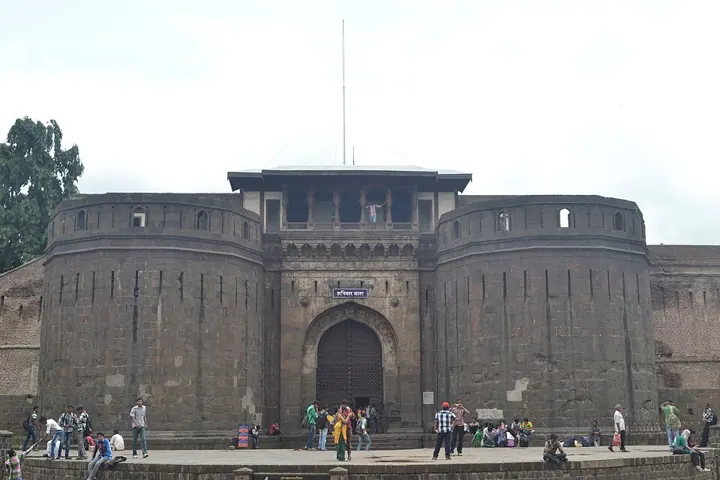
- Shaniwar Wada: the Peshwas' palace in Pune.
Sambhaji, Rajaram and Tarabai: the war of independence
After Shivaji, Aurangzeb came to the Deccan himself. The Marathas survived 27 years of war, a period sometimes called their war of independence.
| Ruler | Key facts |
|---|---|
| Sambhaji (1680–89) | Sheltered Aurangzeb’s rebel son Akbar; captured and executed by the Mughals in 1689 |
| Rajaram (1689–1700) | Escaped to Jinji in the Tamil country, which held out against a Mughal siege until 1698; died in 1700 |
| Tarabai (1700–07) | Rajaram’s widow; ruled for her young son Shivaji II and kept fighting until Aurangzeb died in 1707 |
| Shahu (1707–49) | Sambhaji’s son, released by the Mughals in 1707; won the civil war against Tarabai (battle of Khed, 1707) |
The split left two houses: Satara (Shahu) and Kolhapur (Tarabai’s line), settled by the Treaty of Warna (1731). Under Shahu, real power passed to his Peshwa (chief minister).
What UPSC asks
Prelims: Jinji, Tarabai, Khed 1707. Mains: resisting Aurangzeb. Next likely: women rulers.
The Peshwas and the Maratha confederacy
| Peshwa | Achievement |
|---|---|
| Balaji Vishwanath (1713–20) | Helped the Sayyid brothers; in 1719 won Mughal recognition of chauth and sardeshmukhi over the six Deccan provinces |
| Baji Rao I (1720–40) | Beat the Nizam at Palkhed (1728); pushed into Malwa, Gujarat and Bundelkhand; raided Delhi (1737); his brother Chimaji Appa took Vasai from the Portuguese (1739) |
| Balaji Baji Rao (Nana Saheb, 1740–61) | After Shahu died, the Sangola agreement (1750) moved real power to Pune; empire at its widest; defeat at Panipat |
| Confederacy house | Seat |
|---|---|
| Scindia (Shinde) | Gwalior |
| Holkar | Indore |
| Gaekwad | Baroda |
| Bhonsle | Nagpur |
| Peshwa | Pune (Shaniwar Wada) |
The confederacy (a loose union of chiefs) made fast expansion possible, but each chief followed his own interest. The British later used that weakness.
What UPSC asks
Prelims: Baji Rao I, Palkhed, confederacy houses. Mains: expansion and limits. Next likely: regional states.
Mains box: analysis and answer points
- Resisting Aurangzeb: 27 years of war.
- Expansion and limits: the confederacy's speed and disunity.
Practice
Practice MCQs (8)
After the capture of Sambhaji and the fall of Raigad in 1689, his younger brother Rajaram escaped to the far south and carried on the Maratha resistance for several years from the fortress of
Answer (c) & explanation
When the Mughals captured and executed Sambhaji in 1689, his younger brother Rajaram was hastily crowned at Raigad. As Zulfiqar Khan closed in on the capital, Rajaram slipped away to the extreme south in disguise, helped by the commanders Santaji Ghorpade and Dhanaji Jadhav, and found refuge in the great triple-hill fortress of Jinji (Gingee), between Arcot and Tiruchirappalli in present-day Tamil Nadu. There he set up his court, while Ramchandra Pant Amatya held the home territories. Aurangzeb sent Zulfiqar Khan to besiege the fort, and the siege of Jinji dragged on from 1690 to 1698. Shortly before the final assault, Rajaram escaped to Vellore, moved north and set up his court at Satara around 1698, where the struggle continued until his death at Sinhagad in 1700.
Which one of the following statements about Chhatrapati Shahu is NOT correct?
Answer (b) & explanation
Shahu was the son of Sambhaji and Yesubai and the grandson of Shivaji. When Raigad fell in 1689, the young prince and his mother were captured, and he spent nearly eighteen years in the Mughal camp, treated with royal courtesy and married into Maratha families in Mughal service. After Aurangzeb's death in 1707 the Mughals released him on conditions, hoping that a rival claimant would divide the Marathas, and Shahu at once challenged Tarabai, who was ruling as regent for her son Shivaji II. Many Maratha sardars joined him, Dhanaji Jadhav went over to him at Khed, and he went on to take Satara, where he was crowned on 12 January 1708. In 1713 he appointed Balaji Vishwanath as Peshwa, the beginning of the Peshwa ascendancy. The false statement is the one that makes him Rajaram's son: he was Rajaram's nephew, and it was Tarabai's son Shivaji II who was proclaimed in 1700.
With reference to Tarabai, consider the following statements:
1. On Rajaram's death in 1700 she proclaimed her infant son Shivaji II as king and led the resistance against Aurangzeb as regent.
2. After Shahu's return she set up a rival court, which in 1709 became the seat of a separate line at Kolhapur.
3. In 1714 she herself deposed Shivaji II and placed Sambhaji II on the Kolhapur throne.
Which of the statements given above is/are correct?
Answer (a) & explanation
Tarabai, née Mohite and the queen of Rajaram, took charge of the Maratha state on her husband's death in March 1700, proclaiming her infant son Shivaji II as Chhatrapati and acting as regent. She personally directed the war against Aurangzeb's forces, and Jadunath Sarkar judged that in 1700-1707 the supreme guiding force in Maharashtra was not any minister but the dowager queen. The Mughals then released Shahu, Sambhaji's son, after Aurangzeb's death in 1707, hoping to divide the Marathas. Shahu defeated her forces at Khed and was crowned at Satara, so Tarabai set up a rival court at Kolhapur in 1709. Statement 3 is false: in 1714 it was Rajaram's other widow, Rajasbai, who deposed Shivaji II and installed her own son Sambhaji II; Sambhaji II then imprisoned Tarabai and her son.
In November 1750, the dowager queen Tarabai imprisoned the Chhatrapati Rajaram II in the fort of Satara. The immediate reason was that he had refused to
Answer (c) & explanation
Shahu died without a son in 1749. In his last years Tarabai had presented to him a young man whom she claimed to be her grandson, and Shahu adopted him; he succeeded as Rajaram II. Real power, however, now lay with the Peshwa Balaji Baji Rao (Nanasaheb). In 1750, while the Peshwa was away campaigning, Tarabai urged Rajaram II to remove him from office; when the young king refused, she imprisoned him in a dungeon at Satara on 24 November 1750 and declared him an impostor. With the support of Umabai Dabhade, Damaji Gaekwad marched to her aid but was defeated by Peshwa loyalists. Finding herself isolated, Tarabai made peace with the Peshwa, and on 14 September 1752 the two swore mutual peace at the Khandoba temple in Jejuri. The episode confirmed that after Shahu the Peshwa, not the Chhatrapati, was the effective head of the Maratha state.
During the reign of Rajaram, which two Maratha commanders became famous for mobile campaigns against the Mughals, including the capture of the Mughal general Ali Mardan Khan in 1692 and attacks on the army besieging Jinji?
Answer (b) & explanation
With Rajaram far away at Jinji and Aurangzeb holding most of the old swarajya, the Maratha war became a war of moving columns. Its two most celebrated leaders were Santaji Ghorpade and Dhanaji Jadhav. In 1689 they attacked the Mughal force besieging Panhala; in 1690 they helped Ramchandra Pant Amatya defeat and capture Sarza Khan near Satara; in late 1692 they came south, took Dharwad and captured Ali Mardan Khan, and forced back Zulfiqar Khan's lines around Jinji. Santaji later killed the Mughal general Himmat Khan in 1696, but he quarrelled with Rajaram, was attacked by Dhanaji on the king's orders and was later killed in an ambush. Dhanaji went on to become Senapati, raided Gujarat in 1705 and, through the mediation of Balaji Vishwanath, went over to Shahu at the time of the Battle of Khed. The other pairs belong to earlier or later generations.
Consider the following events:
1. The Treaty of Warna between Shahu and Sambhaji II
2. The fall of Jinji to the Mughals under Zulfiqar Khan
3. The coronation of Shahu at Satara
4. The execution of Sambhaji at Tulapur
Which one of the following is the correct chronological order of these events?
Answer (d) & explanation
The four events trace the Maratha state from its darkest hour to the settlement of the royal succession. First came the execution of Sambhaji at Tulapur on 11 March 1689, after his capture at Sangameshwar; Raigad fell in the same year and Rajaram fled south. Next, the long siege of Jinji ended when Zulfiqar Khan's forces stormed the fort in January 1698, although Rajaram had already escaped and moved his court to Satara. After Aurangzeb's death in 1707 the Mughals released Shahu, who defeated Tarabai's forces and was crowned at Satara on 12 January 1708. Last came the Treaty of Warna of April 1731, by which Shahu and Sambhaji II of Kolhapur recognised each other's thrones and fixed the Warana river as their boundary. The order is therefore 4-2-3-1.
Consider the following statements about the Peshwa Bajirao I:
1. He was appointed Peshwa by Shahu in 1720 in succession to his father, Balaji Vishwanath.
2. In 1729 he answered an appeal from Chhatrasal of Bundelkhand and forced Muhammad Khan Bangash to withdraw.
3. In 1737 he made a lightning march to the outskirts of Delhi, exposing the weakness of the Mughal government.
4. He was killed in 1739 while leading the Maratha army against Nadir Shah's invasion.
How many of the statements given above are correct?
Answer (c) & explanation
On Balaji Vishwanath's death in 1720, Shahu appointed his son Bajirao I as Peshwa, and with that the office passed from father to son. Over the next twenty years Bajirao carried Maratha arms northwards. In Bundelkhand, where Chhatrasal had been besieged by the Mughal commander Muhammad Khan Bangash, he marched in March 1729 with 25,000 horse and forced Bangash to withdraw; Chhatrasal rewarded him with a share of his territory, and Mastani, Chhatrasal's daughter, became his wife. In 1737 he made a sudden dash on Delhi, and although he left the city quickly, the raid caused great dismay and showed how weak the imperial government had become; the defeat of the Nizam at Bhopal followed, and Malwa was ceded. Statement 4 is false. During Nadir Shah's invasion (1738-40) he asked Chimaji Appa to send reinforcements, but he did not fight Nadir; worn out by ceaseless campaigning, he fell ill with fever and died on 28 April 1740, and was cremated on the bank of the Narmada.
Consider the following statements about the Mughal siege of Jinji (1690-1698):
1. The siege was commanded for most of its course by Zulfiqar Khan.
2. Maratha commanders such as Santaji Ghorpade and Dhanaji Jadhav repeatedly harassed the besieging army from outside.
3. When the fort finally fell in 1698, Rajaram was captured and sent to Aurangzeb's camp.
4. Rumours of Aurangzeb's death led prince Kam Bakhsh to open peace talks with Rajaram during the siege.
How many of the statements given above are correct?
Answer (c) & explanation
The siege of Jinji was one of the longest operations of Aurangzeb's Deccan wars. Zulfiqar Khan, son of the wazir Asad Khan, arrived before the triple-hill fortress around October 1690 and directed the siege for most of its nine-year course. The fort was too large to be encircled effectively, the Raja of Thanjavur supported Rajaram, and Maratha forces kept supplies moving in. In 1692 Santaji Ghorpade and Dhanaji Jadhav came south, captured the Mughal general Ali Mardan Khan and beat back Zulfiqar's lines. The isolation of the Mughal camp bred rumours that the old emperor had died, and in 1693 Kam Bakhsh opened negotiations with Rajaram with a view to his own succession. When Aurangzeb ordered an all- out attack in 1697, Rajaram escaped to Vellore before the final assault, and the fort fell in January 1698; only some of his queens and children were captured. Statements 1, 2 and 4 are correct.
0 / 0 correct
Write an answer
In 150 words, explain the significance of Maratha Empire with one recent example.
Flashcards (8)
Fate of Sambhaji?
Executed by the Mughals, 1689.
Where did Rajaram take refuge?
Jinji.
Who led resistance from 1700 to 1707?
Tarabai.
Treaty of Warna?
1731, Satara and Kolhapur.
First Peshwa of Shahu's line?
Balaji Vishwanath.
Battle of Palkhed?
1728; Baji Rao I beat the Nizam.
Seat of the Holkars?
Indore.
Seat of the Gaekwads?
Baroda.
Read more: related explainers
In the news
- 20 Oct 2026Sirpur in Chhattisgarh enters UNESCO’s Tentative List of World Heritage sites
- 15 Oct 2026PM inaugurates five Ladakh projects: Nimmu–Padum–Darcha road, Leh terminal, Hanu hydro
- 14 Oct 2026HAL, NCF and ASI sign MoA for Hampi, Taj Mahal and Bekal Fort
- 11 Oct 2026Birth anniversaries: Jayaprakash Narayan and Nanaji Deshmukh
 Next topic · 8.3 →Maratha Empire: Panipat (1761) and the decline
Syllabus: Prelims GS-I · History of India and Indian National Movement.