
Chapter 9 · Topic 9.1 · Prelims + Mains1 of 3
Amendment of the Constitution: Procedure and majorities
Key points
- Part XX, Art 368: amend by addition, variation or repeal. Partly rigid, partly flexible.
- Bill only in Parliament, in either House; minister or private member; no prior Presidential
- Special majority in each House separately; no joint sitting; Rajya Sabha has equal power.
- Federal provisions: + half the States by simple majority (PEJ-LGRA).
- President must assent (24th Amendment, 1971).
- Outside Art 368 (simple majority): Arts 2, 3, 169, Second Schedule, quorum, citizenship,
- Majorities: simple, absolute, effective, special.
1 PYQ 2015–2024
Prelims box: facts and traps
| Rigid like the USA | Flexible like the UK |
|---|---|
| Three-fourths of the US | Parliament can change |
| States must ratify every | any law, constitutional or |
| amendment. | not, by simple majority.. |
- M FEDERAL LIST PEJ-LGRA: President's election, Executive power, Judiciary, Lists, GST Council, Representation of States, Art 368 itself.
- If the Houses disagree, there is no joint sitting. 5 If the bill changes a federal provision, it must also be ratified by the legislatures of half the States, by a simple majority. 6 The President must give assent.
- Citizenship (acquisition and termination) is left to Parliament by Article 11, delimitation of constituencies is done under laws made under Articles 82 and 327, and Legislative Councils are created or abolished under Article 169 on a resolution of the State Assembly.
- Trap (UPSC Prelims 2013): “An amendment to the Constitution of India can be initiated by an introduction of a bill in the Lok Sabha only” is incorrect. “If such an amendment seeks to make changes in the federal character of the Constitution, the amendment also requires to be ratified by the legislature of all the States of India” is incorrect.
- Trap (UPSC Prelims 2022): “A bill amending the Constitution requires a prior recommendation of the President of India” is incorrect.
On this page (3 sections)
Neither rigid nor flexible: why the Constitution can
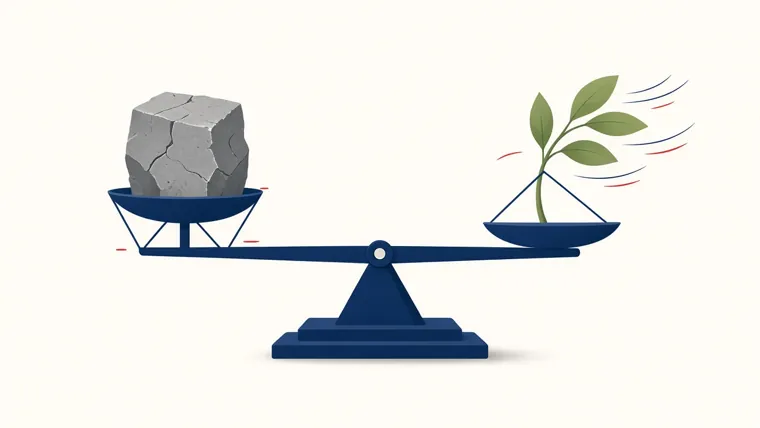
be amended A constitution that cannot change breaks; one that changes too easily is not a constitution at all. The framers took a middle path. Some parts can be changed by an ordinary law, most need a special majority of Parliament, and a few also need the consent of half the States. That mix is why the Indian Constitution is called partly rigid and partly flexible.
The power sits in Part XX, which has a single article, Art 368. It says Parliament may, in exercise of its constituent power, amend any provision of the Constitution by way of addition, variation or repeal, in line with the procedure laid down in that Article. Note the three words. ‘Amend’ covers adding new provisions, changing existing ones and deleting them.
As per Article 368 of the Constitution of India, the Parliament may amend any provision of the Constitution by way of : 1. Addition 2. Variation 3. Repeal Select the correct answer using the code given below :
- 1 and 2 only
- 2 and 3 only
- 1 and 3 only
- 1, 2 and 3
Show answer
Answer: (d) · UPSC official key
Students mix up Part numbers. Remember three: Part IXA deals with Municipalities, Part XVIII with Emergency provisions, and Part XX with amendment of the Constitution.
Which of the following statements are correct about the Constitution of India ? 1. Powers of the Municipalities are given in Part IX A of the Constitution. 2. Emergency provisions are given in Part XVIII of the Constitution. 3. Provisions related to the amendment of the Constitution are given in Part XX of the Constitution. Select the answer using the code given below :
- 1 and 2 only
- 2 and 3 only
- 1 and 3 only
- 1, 2 and 3
Show answer
Answer: (d) · UPSC official key
| Rigid like the USA | Flexible like the UK | India: in between |
|---|---|---|
| Three-fourths of the US | Parliament can change | Most changes need a |
| States must ratify every | any law, constitutional or | special majority; federal |
| amendment. | not, by simple majority. | ones need half the States too. |
The procedure in Article 368, step by step
- An amendment can be started only by a bill in Parliament, not by a State legislature.
- The bill can be introduced in either House, by a minister or a private member. No prior permission of the President is needed.
- Each House must pass it by a special majority: a majority of the total membership of the House and two-thirds of the members present and voting.
- Each House must pass it separately. If the Houses disagree, there is no joint sitting.
- If the bill changes a federal provision, it must also be ratified by the legislatures of half the States, by a simple majority.
- The President must give assent. He can neither withhold it nor return the bill (24th Amendment, 1971).
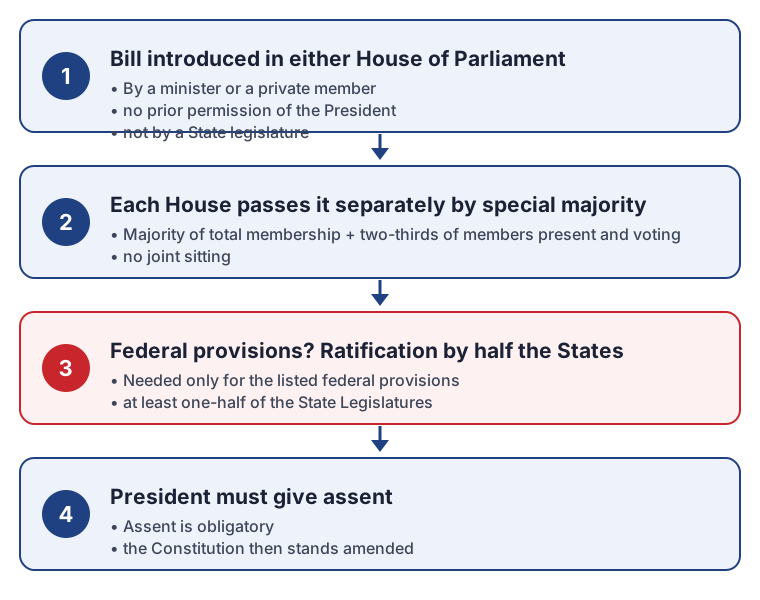
UPSC has tested each of these steps: whether the bill needs the President’s prior recommendation (no), whether his assent is obligatory (yes), and whether it must pass both Houses by a special majority, with no provision for joint sitting (yes).
Consider the following statements : 1. A bill amending the Constitution requires a prior recommendation of the President of India. 2. When a Constitution Amendment Bill is presented to the President of India, it is obligatory for the President of India to give his/her assent. 3. A Constitution Amendment Bill must be passed by both the Lok Sabha and the Rajya Sabha by a special majority and there is no provision for joint sitting. Which of the statements given above are correct?
- 1 and 2 only
- 2 and 3 only
- 1 and 3 only
- 1, 2 and 3
Show answer
Answer: (b) · UPSC official key
Two further traps. First, an amendment can be initiated by an introduction of a bill in the Lok Sabha only? No: in either House. Second, a federal change needs ratification by half the States, not all of them.
Consider the following statements : 1. An amendment to the Constitution of India can be initiated by an introduction of a bill in the Lok Sabha only. 2. If such an amendment seeks to make changes in the federal character of the Constitution, the amendment also requires to be ratified by the legislature of all the States of India. Which of the statements given above is/are correct?
- 1 only
- 2 only
- Both 1 and 2
- Neither 1 nor 2
Show answer
Answer: (d) · UPSC official key
→ Constitutional Amendment Bill (Parliament) How the bill moves through each House.
Three ways to amend, and the four kinds of majority
| Route | Examples |
|---|---|
| Simple majority of Parliament (outside Art 368) | Admission or formation of States (Arts 2, 3); creation or abolition of Legislative Councils (Art 169); Second Schedule (salaries); quorum in Parliament; citizenship; Fifth and Sixth Schedules; use of English in Parliament |
| Special majority of Parliament | Fundamental Rights, Directive Principles and all provisions not in the other two groups |
| Special majority + half the States | Election of the President and its manner (Arts 54, 55); extent of the executive power of the Union and the States (Arts 73, 162); Supreme Court and High Courts; distribution of legislative powers; any of the Lists in the Seventh Schedule; GST Council (Art 279A); representation of States in Parliament; Art 368 itself |
For the third group, the Constitution asks for ratification by the Legislatures of not less than one-half of the States before the bill goes to the President. Apply the list carefully. A change to List I-Union List, in the Seventh Schedule, needs the States. So does a change to the extent of the executive power of a State. But the conditions of the Governor’s office (Art 158) are not on the federal list, so Parliament alone can change them by a special majority.
Consider the following subjects under the Constitution of India : I. List I-Union List, in the Seventh Schedule II. Extent of the executive power of a State III. Conditions of the Governor’s office For a constitutional amendment with respect to which of the above, ratification by the Legislatures of not less than one-half of the States is required before presenting the bill to the President of India for assent?
- I and II only
- II and III only
- I and III only
- I, II and III
Show answer
Answer: (a) · UPSC official key
| Majority | Meaning | Used for (examples) |
|---|---|---|
| Simple | More than half of members present and voting | Ordinary bills, money bills, no-confidence motion |
| Absolute | More than half of the total membership | Not used alone; part of the special majority |
| Effective | More than half of the effective strength (total minus vacancies) | Removal of the Vice-President (Rajya Sabha), Speaker or Deputy Speaker |
| Special | Defined differently in different Articles | Art 368 (total membership + 2/3 present and voting); Art 249 (2/3 present and voting); impeachment (2/3 of total membership) |
M FEDERAL LIST PEJ-LGRA: President’s election, Executive power, Judiciary, Lists, GST Council, Representation of States, Art 368 itself.
Mains box: analysis and answer points
- be amended A constitution that cannot change breaks; one that changes too easily is not a constitution at all.
- Some parts can be changed by an ordinary law, most need a special majority of Parliament, and a few also need the consent of half the States.
- That mix is why the Indian Constitution is called partly rigid and partly flexible.
- Likely next angle: Comparison with the US or UK amendment process
Practice
Practice MCQs (8)
Consider the following statements:
1. A Constitution Amendment Bill can be introduced by a private member.
2. A Constitution Amendment Bill needs a special majority only in the Lok Sabha.
Which of the statements given above is/are correct?
Answer (a) & explanation
Statement 1 is correct: a Constitution Amendment Bill can be introduced either by a minister or by a private member, and it does not need the President's prior permission. Statement 2 is incorrect: Article 368(2) requires the special majority in each House, so the Rajya Sabha has exactly the same power as the Lok Sabha and can, in effect, block the bill. Because there is no joint sitting for such bills, the Lok Sabha cannot override a Rajya Sabha defeat.
Consider the following matters:
1. Acquisition and termination of citizenship
2. Delimitation of constituencies
3. Creation or abolition of Legislative Councils in States
4. Representation of States in Parliament
How many of the above can be changed by a simple majority of Parliament, outside Article 368?
Answer (c) & explanation
Only three can be changed by a simple majority outside Article 368. Citizenship (acquisition and termination) is left to Parliament by Article 11, delimitation of constituencies is done under laws made under Articles 82 and 327, and Legislative Councils are created or abolished under Article 169 on a resolution of the State Assembly. Representation of States in Parliament, however, is expressly in the proviso to Article 368(2), so it needs a special majority and ratification by half the States.
Consider the following statements: Statement-I: A Constitution Amendment Bill must be passed by each House of Parliament separately. Statement-II: If the two Houses disagree on such a bill, the President can summon a joint sitting to resolve the deadlock.
Which one of the following is correct in respect of the above statements?
Answer (c) & explanation
Statement-I is correct: under Article 368(2), an amendment bill must be passed by each House separately by the special majority. Statement-II is incorrect: the joint sitting under Article 108 is available only for ordinary bills when the Houses disagree; it does not apply to Money Bills or to Constitution Amendment Bills. If one House rejects an amendment bill, the bill simply fails. Since Statement-II is false, it cannot explain Statement-I.
Consider the following statements:
1. Parliament alone can amend every provision of the Constitution, and the States never take part.
2. Some provisions can be changed by a simple majority of Parliament, and such changes are not deemed amendments under Article 368.
Which of the statements given above is/are correct?
Answer (b) & explanation
Statement 2 is correct: several provisions, such as admission or establishment of new States (Article 2), formation of new States and alteration of boundaries (Article 3) and creation or abolition of Legislative Councils (Article 169), can be changed by a simple majority of Parliament, and Articles 4(2) and 169(3) say such laws are not deemed amendments under Article 368. Statement 1 is incorrect: the federal provisions in the proviso to Article 368(2) need ratification by half the State legislatures, so the States do take part.
The 24th Amendment Act, 1971 described Parliament's power to amend the Constitution under Article 368 as
Answer (b) & explanation
The 24th Amendment Act, 1971 added Article 368(1), which says that Parliament may amend the Constitution 'in exercise of its constituent power'. It also added Article 13(4), so that Article 13 does not apply to an amendment, and made the President's assent to an amendment bill obligatory. These changes answered Golaknath (1967), which had treated an amendment as 'law' under Article 13 and so barred the abridgement of Fundamental Rights. Kesavananda Bharati (1973) upheld the 24th Amendment.
With reference to the procedure under Article 368, consider the following statements:
1. A Constitution Amendment Bill can be introduced in a State legislature.
2. Each House of Parliament must pass the bill separately by a special majority.
Which of the statements given above is/are correct?
Answer (b) & explanation
Statement 2 is correct: under Article 368(2), the bill must be passed in each House separately by a special majority, that is, a majority of the total membership of that House and two-thirds of the members present and voting. Statement 1 is incorrect: an amendment can be initiated only by introducing a bill in either House of Parliament; a State legislature has no power to start one. The States come in only at the later stage of ratification, and only for the federal provisions listed in the proviso to Article 368(2).
With reference to Article 368, consider the following statements:
1. The Constitution does not provide for a special body, such as a convention or a referendum, for its amendment.
2. The special majority means a majority of the total membership of each House and two-thirds of the members present and voting.
Which of the statements given above is/are correct?
Answer (c) & explanation
Both statements are correct. Unlike the USA, where amendments can be proposed by a convention, or Switzerland, which uses a referendum, India has no special body such as a constituent convention and no referendum for amendment; the power rests with Parliament under Article 368. The special majority in Article 368(2) has two parts that must both be met in each House: a majority of the total membership of the House and a majority of not less than two-thirds of the members present and voting. This is stricter than the special majority used for some other matters.
With reference to the basic structure doctrine, consider the following statements:
1. It applies only to amendments of Fundamental Rights and not to other Parts of the Constitution.
2. An amendment that violates the basic structure becomes valid if it is ratified by half of the States.
Which of the statements given above is/are correct?
Answer (d) & explanation
Neither statement is correct. The basic structure doctrine applies to an amendment of any Part of the Constitution, not only Part III; for example, in Minerva Mills (1980) the Court struck down clauses (4) and (5) of Article 368 itself, and in Kihoto Hollohan (1992) it tested the Tenth Schedule. Statement 2 is also wrong: State ratification is only a procedural requirement for federal provisions. Even an amendment passed by special majority and ratified by every State is void if it destroys a basic feature, because the limit is on substance.
0 / 0 correct
Prelims PYQs on this topic (1)
Which of the following statements are correct about the Constitution of India ?
- 1. Powers of the Municipalities are given in Part IX A of the Constitution.
- 2. Emergency provisions are given in Part XVIII of the Constitution.
- 3. Provisions related to the amendment of the Constitution are given in Part XX of the Constitution.
Select the answer using the code given below :
Answer (d) & explanation
All three statements are correct (d). Statement 1 is right: Part IXA (Articles 243P to 243ZG), added by the 74th Amendment (1992), covers Municipalities. Statement 2 is right: Part XVIII (Articles 352 to 360) covers Emergency provisions. Statement 3 is right: Part XX has a single Article, 368, on amending the Constitution. So options (a), (b) and (c), which leave one out, are wrong.
Notice other key Parts: Part III for Fundamental Rights, Part IV for Directive Principles, Part IVA for Fundamental Duties, and Part IX for Panchayats (73rd Amendment). Part IXB covers cooperative societies (97th Amendment). Knowing the big Parts by number saves time in such questions.
Answer as per the official UPSC answer key.
Write an answer
In 150 words, explain the significance of Amendment of the Constitution with one recent example.
Flashcards (12)
Which Part and Article deal with
amendment? Part XX, Article 368.
Three ways in which Art 368 lets Parliament
amend a provision? Addition, variation or repeal.
Can a State legislature initiate an
amendment? No. Only a bill in either House of Parliament.
Is the President's prior permission needed
to introduce an amendment bill? No.
What is the special majority under Art 368?
Majority of total membership + two-thirds of members present and voting, in each House.
Is there a joint sitting for an amendment
bill? No.
Can the President withhold assent to an
amendment bill? No, since the 24th Amendment (1971).
How many States must ratify a federal
amendment? At least half, by simple majority.
Name four provisions that need ratification
by the States. Election of the President; executive power of Union and States; Supreme Court and High Courts; Seventh Schedule Lists; GST Council; representation in Parliament; Art 368.
Do conditions of the Governor's office need
States' ratification to amend? No. Special majority of Parliament alone.
Give two provisions changed by simple
majority outside Art 368. Formation of new States (Art 3); creation or abolition of Legislative Councils (Art 169); Second Schedule; quorum.
Where does the Rajya Sabha have equal
power with the Lok Sabha? In amending the Constitution (and some other matters).
Read more: related explainers
- Constitution (130th Amendment) Bill, 2025: Removal of the Prime Minister, Chief Ministers and Ministers Detained for 30 Days, Articles 75, 164 and 239AA, Arguments For and Against
- Decriminalisation of Business Laws: Jan Vishwas (Amendment of Provisions) Act, 2023, the Jan Vishwas Act, 2026 (2.0), Ease of Doing Business and Ease of Living
- Waqf in India: Meaning, the Waqf Act 1995, the Waqf (Amendment) Act 2025, What Changed, the Constitutional Challenge and the Way Forward
In the news
 Next topic · 9.2 →Amendment of the Constitution: Rajya Sabha’s role and key amendments
Syllabus: GS-II · Indian Constitution—historical underpinnings, evolution, features, amendments, s…