
Chapter 4 · Topic 4.1 · Prelims + Mains1 of 3
Union and its Territory: Articles 1 to 4
Key points
- Art 1: "India, that is Bharat, shall be a Union of States." Territory of India = States + UTs + acquired territories.
- "Union", not "federation": not an agreement among States; no State can secede (Ambedkar).
- Art 2: admit or establish new States (Sikkim, 1975). Art 3: reshape existing States (Telangana, 2014).
- Art 3 conditions: President's recommendation; State's views sought but not binding; simple majority.
- Art 4: such laws are not Art 368 amendments, though they change the First and Fourth Schedules.
Prelims box: facts and traps
- Territory of India is wider than the Union of India. For a union territory, no reference is needed.
Article 1: ‘India, that is Bharat, shall be a Union of States’
Like a family house with movable walls: rooms can be split or joined, but the house itself cannot be broken up.
The opening sentence. The Constitution opens its body, Part I, with one plain sentence: “India, that is Bharat, shall be a Union of States.” Two names, one country. The words that follow do two jobs: they name the units that make up India, and they mark out the territory of India.
| States | Union territories | Acquired territories |
|---|---|---|
| The units of the federal system. They share power with the Centre under the Seventh Schedule. | Governed directly by the Centre through an administrator appointed by the President. | Any territory India may acquire later, by treaty, purchase or conquest, becomes part of India automatically. |
Territory vs Union. The territory of India (Art 1(3)) is wider than the Union of India.
- The Union means only the States, which share power with the Centre.
- The territory takes in the States, the union territories and any territory India may acquire.
- The names of the States and union territories, and their extent, are listed in the First Schedule.
Why “Union” and not “Federation”? Dr B.R. Ambedkar explained this in the Constituent Assembly.
- The Indian federation is not the result of an agreement among the States, as the American federation was. So no State has the right to break away (secede).
- The federation is a Union because it is indestructible.
- The country can be divided into States for convenient administration, but the country as a whole cannot be broken up.
What UPSC asks: Prelims: “Union of States” versus federation; territory of India versus Union of India. Mains: why Ambedkar chose “Union”. Next likely angle: Art 1 wording, with the Schedule 1 change after J&K’s reorganisation.
→ Features of the federal system Why India is called ‘an indestructible Union of destructible States’.
Articles 2, 3 and 4: Parliament’s power over the map
Art 2 deals with territory not yet part of India. Parliament may admit new States into the Union, or establish new States, on terms it thinks fit.
Art 3 deals with existing States. Parliament may by law:
- form a new State by separating territory from a State, by uniting two or more States or parts of States, or by uniting any territory to a part of a State;
- increase or diminish the area of any State;
- alter the boundaries or the name of any State.
Two conditions.
- A bill under Art 3 can be introduced only on the recommendation of the President.
- Before recommending it, the President must refer it to the legislature of the State concerned for its views within a set time.
- Parliament is not bound by those views, and need not refer the bill again if it is amended. For a union territory, no reference is needed at all.
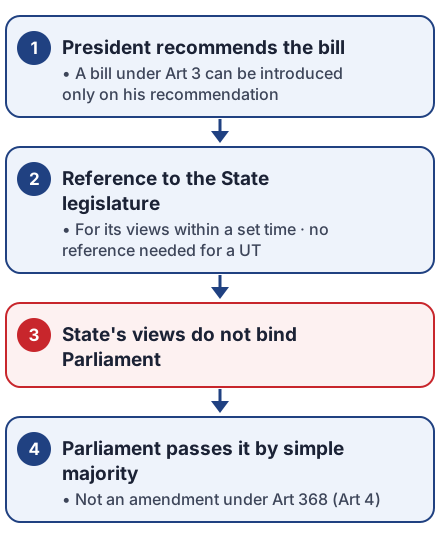
Art 4 adds that such laws are not amendments of the Constitution under Article 368, even though they change the First and Fourth Schedules. They are passed by a simple majority (more than half of those present and voting), like any ordinary law.
Read the difference. Art 2: new territory coming in from outside (Sikkim, 1975). Art 3: reshaping the States already inside (Telangana, 2014).
What UPSC asks: Prelims: Art 3 procedure: President’s recommendation, State’s views not binding, simple majority, Art 4 not an Art 368 amendment. Mains: Parliament’s power to redraw States and its effect on federalism (“indestructible Union of destructible States”). Next likely angle: whether a State can be turned into a Union Territory under Art 3 (J&K, 2019).
→ Procedure for amending the Constitution Why Art 3 laws escape the special majority of Art 368.
Mains box: analysis and answer points
- Parliament's power to redraw States and federalism: "an indestructible Union of destructible States".
Practice
Practice MCQs (8)
Under Article 241 of the Constitution of India, Parliament may by law
Answer (c) & explanation
Article 241 lets Parliament by law constitute a High Court for a Union Territory, or declare any court in a UT to be a High Court for all or any of the Constitution's purposes. Using this power, Parliament set up the Delhi High Court in 1966. Other UTs come under the High Court of a neighbouring State, for example Chandigarh under the Punjab and Haryana High Court. Appointment of judges is by the President under Article 217, and transfers are under Article 222; Article 241 does neither.
Consider the following statements about the administrator of a Union Territory:
1. The administrator is appointed by the President.
2. The President decides the designation of the administrator.
3. Parliament can make laws on State List subjects for Union Territories.
4. Like a Governor, the administrator has a fixed five-year term.
How many of the statements given above are correct?
Answer (c) & explanation
Only three statements are correct. Under Article 239, the President administers every UT through an administrator whom he appoints, with the designation he chooses: Lieutenant Governor in Delhi, Puducherry and the Andamans, and Administrator elsewhere. Under Article 246(4), Parliament can make laws for UTs on any subject, including those in the State List. Statement 4 is incorrect: unlike a Governor, who has a five-year term under Article 156, the administrator has no fixed tenure and holds office as the President decides.
Consider the following statements:
1. The administrator of a Union Territory must be a resident of that territory.
2. Parliament loses its power to legislate for a Union Territory once that territory is given a legislature.
Which of the statements given above is/are correct?
Answer (d) & explanation
Both statements are incorrect. The Constitution sets no residence or other qualification for a UT administrator; the President may appoint any person, often a retired civil servant or military officer. Statement 2 is also wrong: under Article 246(4), Parliament can legislate for UTs on any subject, and creating a legislature does not take this away. For Delhi, Article 239AA(3)(b) expressly keeps Parliament's power on any matter, and for Puducherry the Government of Union Territories Act, 1963 makes the local legislature's power subject to Parliament's laws.
Match List-I (Article) with List-II (Subject): List-I A. Article 239 B. Article 239A C. Article 239B D. Article 240 List-II
1. Administration of Union Territories through an administrator
2. Creation of local legislatures or Councils of Ministers for certain Union Territories
3. Power of the administrator to promulgate ordinances during recess of the legislature
4. Power of the President to make regulations for certain Union Territories
Select the correct answer using the code given below:
Answer (a) & explanation
Part VIII of the Constitution deals with the Union Territories. Article 239 provides for their administration by the President through an administrator. Article 239A, added in 1962, lets Parliament create local legislatures or Councils of Ministers for certain UTs, now Puducherry. Article 239B gives the administrator power to promulgate ordinances during a recess of the legislature. Article 240 gives the President power to make regulations for certain UTs. So the code is A-1, B-2, C-3, D-4.
Consider the following statements about Article 239AA:
1. Parliament keeps its power to make laws for Delhi on any matter.
2. A Delhi law that is repugnant to a law of Parliament is void to the extent of the repugnancy, unless reserved for and assented to by the President.
3. The Delhi Assembly can make laws on matters in the Union List.
4. Members of the Delhi Assembly are nominated by the President.
How many of the statements given above are correct?
Answer (b) & explanation
Only two statements are correct. Under Article 239AA(3)(b), Parliament keeps its power to make laws for Delhi on any matter. Under Article 239AA(3)(c), a Delhi law that is repugnant to a law of Parliament is void to that extent, unless it was reserved for the President and received his assent. Statement 3 is incorrect: the Assembly's power covers only the State and Concurrent Lists, minus the excluded subjects, not the Union List. Statement 4 is incorrect: Assembly members are chosen by direct election.
With reference to Article 239 of the Constitution of India, consider the following statements:
1. The President may appoint the Governor of a State as the administrator of an adjoining Union Territory.
2. A Governor so appointed exercises his functions as administrator independently of his Council of Ministers.
Which of the statements given above is/are correct?
Answer (c) & explanation
Both statements are correct. Article 239(1) says every UT is administered by the President through an administrator with such designation as he specifies. Article 239(2) adds that the President may appoint the Governor of a State as the administrator of an adjoining UT, and that a Governor so appointed shall act independently of his Council of Ministers. The reason is that the UT is the Centre's responsibility, not the State's. The standing example is the Governor of Punjab, who has also been the Administrator of Chandigarh since 1984.
Consider the following statements:
1. The administrator of a Union Territory with a legislature can promulgate ordinances even while its legislature is dissolved.
2. Such an administrator can promulgate an ordinance only after obtaining instructions from the President.
Which of the statements given above is/are correct?
Answer (b) & explanation
Statement 2 is correct: under Article 239B(1), the administrator of Puducherry may promulgate an ordinance when its legislature is not in session, but only after obtaining instructions from the President. Statement 1 is incorrect: the proviso to Article 239B(1) bars any ordinance while the legislature is dissolved or its functioning is suspended. In that situation the President can act directly through Article 240 regulations. An ordinance under 239B must be laid before the legislature and lapses six weeks after it reassembles.
A regulation made by the President under Article 240 for a Union Territory such as the Andaman and Nicobar Islands
Answer (d) & explanation
Article 240 lets the President make regulations for the peace, progress and good government of the UTs listed in it, such as the Andaman and Nicobar Islands, Lakshadweep, Dadra and Nagar Haveli and Daman and Diu, and Puducherry (only while its legislature is suspended or dissolved). Article 240(2) says such a regulation may repeal or amend any Act of Parliament or other law applying to that UT, and has the same force and effect as an Act of Parliament. No parliamentary approval or emergency is required; it is a standing legislative power of the President.
0 / 0 correct
Write an answer
In 150 words, explain the significance of Union and its Territory with one recent example.
Flashcards (7)
What does Article 1 call India?
'India, that is Bharat, shall be a Union of States.'
Which Schedule lists the States and union
territories? The First Schedule.
Why 'Union' and not 'Federation'?
Indian federation is not the result of an agreement among States, and no State can secede (Ambedkar).
Which Article lets Parliament admit or
establish new States? Article 2.
Name the five things Parliament can do
under Article 3. Form a new State, increase or diminish area, alter boundaries, alter name.
Whose recommendation does an Art 3 bill
need? The President's.
Are the State legislature's views on an Art 3
bill binding? No. Parliament may accept or reject them.
Read more: related explainers
- Constitution (130th Amendment) Bill, 2025: Removal of the Prime Minister, Chief Ministers and Ministers Detained for 30 Days, Articles 75, 164 and 239AA, Arguments For and Against
- Supreme Court of India (Articles 124-147): Composition, Appointment, Removal, Jurisdiction and Independence
- President of India (Articles 52-78): Election, Impeachment, Veto, Pardon, Ordinance and Discretion
In the news
 Next topic · 4.2 →Union and its Territory: Reorganisation and new States
Syllabus: GS-II · Indian Constitution—historical underpinnings, evolution, features, amendments, s…