
Chapter 11 · Topic 11.3 · Prelims + Mains3 of 3
Cold War: Chapter test
Key points
- The USA lost in Vietnam (Saigon fell 1975) despite over 500,000 troops by 1968.
- Détente in the 1970s (SALT I, Helsinki) gave way to a 'Second Cold War' after Afghanistan (1979).
- Gorbachev's reforms led to 1989 in eastern Europe and the end of the USSR on 25 December 1991.
2 PYQs 2002–2011
Prelims box: facts and traps
- Dien Bien Phu and Geneva Accords: 1954; India chaired the International Control Commission.
- Tet Offensive: 1968. Paris Peace Accords: 1973.
- SALT I: 1972. INF Treaty: 1987.
- Glasnost = openness; perestroika = restructuring.
The Vietnam War
| Stage | Detail |
|---|---|
| French defeat | Dien Bien Phu (1954); Geneva Accords divided Vietnam at the 17th parallel |
| Domino theory | US backed South Vietnam against Ho Chi Minh’s North |
| Escalation | Gulf of Tonkin Resolution (1964); over 500,000 US troops by 1968 |
| Tet Offensive (1968) | Turned US opinion against the war |
| Exit | Paris Peace Accords (1973); Saigon fell (1975); Vietnam reunified (1976) |
- Domino theory: the US belief that if one country fell to communism, its neighbours would fall one after another, like a row of dominoes.
- Why the USA lost: the North fought a guerrilla war on home ground, with Soviet and Chinese help; many South Vietnamese saw the US-backed government as corrupt; and TV images of the war turned Americans against it.
- Tet Offensive: a surprise attack during the Vietnamese New Year. The North lost militarily but won the propaganda battle.
Vietnam showed that even a superpower could not win a war against a determined national movement. India chaired the International Control Commission set up under the Geneva Accords (1954), with Canada and Poland, to watch the ceasefire.
Détente and the end of the Cold War
| Stage | Detail |
|---|---|
| Détente (1970s) | SALT I (1972); Helsinki Accords (1975); Nixon’s visit to China (1972) |
| Second Cold War | Soviet invasion of Afghanistan (1979); Reagan’s arms build-up |
| Gorbachev (1985) | Glasnost and perestroika; INF Treaty (1987) |
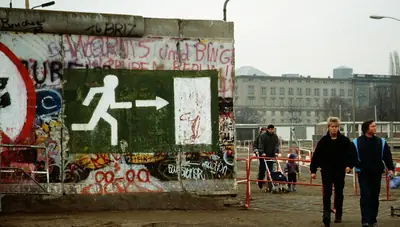
| 1989 | Revolutions in eastern Europe; Berlin Wall fell |
| 1991 | Warsaw Pact dissolved; USSR dissolved (25 December 1991) |
| Result | Unipolar US moment; NATO expansion; India’s economic reforms and Look East policy |
- Détente: French for “relaxing”. The two sides talked, traded and signed arms limits.
- SALT I: the first Strategic Arms Limitation Talks deal, capping nuclear missiles.
- Glasnost: “openness”, more freedom to speak and publish. Perestroika: “restructuring” the economy.
- Unipolar: a world with only one superpower, the USA.
Why did the USSR collapse?
Its planned economy had stagnated, the arms race and the Afghan war drained it, and Gorbachev’s openness let people criticise the system freely for the first time. Once Moscow stopped using force in eastern Europe, those governments fell one by one in 1989. The 15 Soviet republics then broke away, and the USSR ended in December 1991. It was like a tired old building: opening the windows let in fresh air, but the weak walls could not take the wind.
What it meant for India
India lost its closest strategic partner and a big trading partner at the same time as its 1991 balance-of-payments crisis. It responded with economic reforms, closer ties with the USA and the Look East policy towards South-East Asia, later upgraded to Act East.
Common doubts
Who won the Cold War? The USA and its allies, in the sense that the Soviet system collapsed. But the cost was huge on both sides: arms races, proxy wars and millions of deaths in places like Korea, Vietnam and Afghanistan.
Did the Cold War really end? The bloc rivalry ended in 1991. But tension between the USA and Russia returned later, and many experts now describe US–China rivalry as a “new Cold War”.
What UPSC asks
Prelims: Geneva 1954, SALT I 1972, Helsinki 1975, INF 1987, 25 December 1991. Mains: why the Cold War ended and its effect on India’s foreign policy.
Mains box: analysis and answer points
- Why the USSR collapsed: stagnant economy, arms race, Afghan war, glasnost, nationalism in the republics.
- Impact on India: loss of a partner during the 1991 crisis; reforms, closer US ties, Look East.
Practice
Prelims PYQs on this topic (2)
Southeast Asia has captivated the attention of global community over space and time as a geostrategically significant region. Which among the following is the most convincing explanation for this global perspective ?
Answer (d) & explanation
Option (d) is the most convincing (d). Southeast Asia lies between the Pacific and Indian Oceans, and sea lanes such as the Strait of Malacca, Sunda and Lombok carry a large share of world trade and energy. This lasting maritime character explains its importance 'over space and time'. (a) and (c) are wrong because they describe single periods, the Second World War and the Cold War. (b) is wrong because its position between China and India is only one, narrower angle, not the deepest reason.
Notice the present: the South China Sea disputes, ASEAN centrality and India's Act East and Indo-Pacific policies all flow from this maritime geography. Trap: options tied to one era cannot explain 'over space and time'.
(a) and (c) are true but belong to one period each; the question asks for a reason that holds "over space and time".
Answer as per the official UPSC answer key.
With reference to “Look East Policy” of India, consider the following statements :
- 1. India wants to establish itself as an important regional player in the East Asian affairs.
- 2. India wants to plug the vacuum created by the termination of Cold War.
- 3. India wants to restore the historical and cultural ties with its neighbours in Southeast and East Asia.
Which of the statements given above is/are correct ?
Answer (b) & explanation
Statements 1 and 3 are correct (b). The Look East Policy (1991, under P.V. Narasimha Rao) aimed to make India an important regional player in East and Southeast Asia through trade, investment and ties with ASEAN (1), and to revive old historical and cultural links of Buddhism, trade and Indian kingdoms (3). Statement 2 is wrong: the policy was driven by economic reform and the loss of the Soviet partner, not by a wish to 'fill a Cold War vacuum'. So (a), (c) and (d) fail.
Notice the upgrade: it became the Act East Policy in 2014, adding security, connectivity (Kaladan, India–Myanmar–Thailand highway) and the Indo-Pacific. India became an ASEAN dialogue partner in 1995 and a Comprehensive Strategic Partner in 2022.
Statement 2 sounds right because the policy began in 1991, just as the Cold War ended, but filling a "vacuum" was never its aim.
Answer as per the official UPSC answer key.
Write an answer
In 150 words, explain the significance of Cold War with one recent example.
Flashcards (4)
French defeat in Vietnam?
Dien Bien Phu (1954).
Tet Offensive?
1968.
Gorbachev's reforms?
Glasnost and perestroika.
USSR dissolved?
25 December 1991.
Read more: related explainers
 Next chapter · 12. Chinese Revolution →Chinese Revolution: Qing decline and 1911
Syllabus: GS-I · History of the world will include events from 18th century such as industrial re…