
CSAT 2014: every question, solved
80 questions from the official UPSC Prelims 2014 paper, in paper order. Tap an option; the answer and the reason appear instantly.
Read the passage
In recent times, India has grown fast not only compared to its own past but also in comparison with other nations. But there cannot be any room for complacency because it is possible for the Indian economy to develop even faster and also to spread the benefits of this growth more widely than has been done thus far. Before going into details of the kinds of micro-structural changes that we need to conceptualize and then proceed to implement, it is worthwhile elaborating on the idea of inclusive growth that constitutes the defining concept behind this Government’s various economic policies and decisions. A nation interested in inclusive growth views the same growth differently depending on whether the gains of the growth are heaped primarily on a small segment or shared widely by the population. The latter is cause for celebration but not the former. In other words, growth must not be treated as an end in itself but as an instrument for spreading prosperity to all. India’s own past experience and the experience of other nations suggests that growth is necessary for eradicating poverty but it is not a sufficient condition. In other words, policies for promoting growth need to be complemented with policies to ensure that more and more people join in the growth process and, further, that there are mechanisms in place to redistribute some of the gains to those who are unable to partake in the market process and, hence, get left behind.
A simple way of giving this idea of inclusive growth a sharper form is to measure a nation’s progress in terms of the progress of its poorest segment, for instance the bottom 20 per cent of the population. One could measure the per capita income of the bottom quintile of the population and also calculate the growth rate of income; and evaluate our economic success in terms of these measures that pertain to the poorest segment. This approach is attractive because it does not ignore growth like some of the older heterodox criteria did. It simply looks at the growth of income of the poorest sections of the population. It also ensures that those who are outside of the bottom quintile do not get ignored. If that were done, then those people would in all likelihood drop down into the bottom quintile and so would automatically become a direct target of our policies. Hence the criterion being suggested here is a statistical summing up of the idea of inclusive growth, which, in turn, leads to two corollaries : to wish that India must strive to achieve high growth and that we must work to ensure that the weakest segments benefit from the growth.
The author’s central focus is on
Answer (c) & explanation
The central focus is inclusive growth (c). Step 1: find the key phrase. The author calls inclusive growth "the defining concept" behind policy, and says growth should be judged by whether its gains are "shared widely by the population". Step 2: test the other options. Option (a) is wrong: India's fast growth is mentioned only in the opening line, and the author then says there is "no room for complacency". Option (b) is wrong: the passage says growth is "not a sufficient condition", so it cannot be the "sole determinant". Option (d) is wrong: high growth is only half the idea; the other half is spreading its benefits.
Tip: the central focus is usually the idea the author defines and keeps returning to, not the first fact mentioned.
Answer as per the official UPSC answer key.
Read the passage
In recent times, India has grown fast not only compared to its own past but also in comparison with other nations. But there cannot be any room for complacency because it is possible for the Indian economy to develop even faster and also to spread the benefits of this growth more widely than has been done thus far. Before going into details of the kinds of micro-structural changes that we need to conceptualize and then proceed to implement, it is worthwhile elaborating on the idea of inclusive growth that constitutes the defining concept behind this Government’s various economic policies and decisions. A nation interested in inclusive growth views the same growth differently depending on whether the gains of the growth are heaped primarily on a small segment or shared widely by the population. The latter is cause for celebration but not the former. In other words, growth must not be treated as an end in itself but as an instrument for spreading prosperity to all. India’s own past experience and the experience of other nations suggests that growth is necessary for eradicating poverty but it is not a sufficient condition. In other words, policies for promoting growth need to be complemented with policies to ensure that more and more people join in the growth process and, further, that there are mechanisms in place to redistribute some of the gains to those who are unable to partake in the market process and, hence, get left behind.
A simple way of giving this idea of inclusive growth a sharper form is to measure a nation’s progress in terms of the progress of its poorest segment, for instance the bottom 20 per cent of the population. One could measure the per capita income of the bottom quintile of the population and also calculate the growth rate of income; and evaluate our economic success in terms of these measures that pertain to the poorest segment. This approach is attractive because it does not ignore growth like some of the older heterodox criteria did. It simply looks at the growth of income of the poorest sections of the population. It also ensures that those who are outside of the bottom quintile do not get ignored. If that were done, then those people would in all likelihood drop down into the bottom quintile and so would automatically become a direct target of our policies. Hence the criterion being suggested here is a statistical summing up of the idea of inclusive growth, which, in turn, leads to two corollaries : to wish that India must strive to achieve high growth and that we must work to ensure that the weakest segments benefit from the growth.
The author supports policies which will help
Answer (c) & explanation
The author wants growth plus redistribution (c). Step 1: find the policy line. Growth policies "need to be complemented" with policies that bring more people into growth and mechanisms "to redistribute some of the gains" to those "left behind". Step 2: test the others. Option (a) is wrong: it keeps only growth and drops redistribution. Option (b) is wrong: the author's method "does not ignore growth", so "irrespective of rate of growth" contradicts him. Option (d) is wrong: the poorest matter, but the author also wants high growth and does not ignore those outside the bottom 20%.
Tip: when one option combines both halves of the author's argument, and the others hold only one half, the combined option is usually right.
Answer as per the official UPSC answer key.
Read the passage
In recent times, India has grown fast not only compared to its own past but also in comparison with other nations. But there cannot be any room for complacency because it is possible for the Indian economy to develop even faster and also to spread the benefits of this growth more widely than has been done thus far. Before going into details of the kinds of micro-structural changes that we need to conceptualize and then proceed to implement, it is worthwhile elaborating on the idea of inclusive growth that constitutes the defining concept behind this Government’s various economic policies and decisions. A nation interested in inclusive growth views the same growth differently depending on whether the gains of the growth are heaped primarily on a small segment or shared widely by the population. The latter is cause for celebration but not the former. In other words, growth must not be treated as an end in itself but as an instrument for spreading prosperity to all. India’s own past experience and the experience of other nations suggests that growth is necessary for eradicating poverty but it is not a sufficient condition. In other words, policies for promoting growth need to be complemented with policies to ensure that more and more people join in the growth process and, further, that there are mechanisms in place to redistribute some of the gains to those who are unable to partake in the market process and, hence, get left behind.
A simple way of giving this idea of inclusive growth a sharper form is to measure a nation’s progress in terms of the progress of its poorest segment, for instance the bottom 20 per cent of the population. One could measure the per capita income of the bottom quintile of the population and also calculate the growth rate of income; and evaluate our economic success in terms of these measures that pertain to the poorest segment. This approach is attractive because it does not ignore growth like some of the older heterodox criteria did. It simply looks at the growth of income of the poorest sections of the population. It also ensures that those who are outside of the bottom quintile do not get ignored. If that were done, then those people would in all likelihood drop down into the bottom quintile and so would automatically become a direct target of our policies. Hence the criterion being suggested here is a statistical summing up of the idea of inclusive growth, which, in turn, leads to two corollaries : to wish that India must strive to achieve high growth and that we must work to ensure that the weakest segments benefit from the growth.
Consider the following statements :
According to the author, India’s economy has grown but there is no room for complacency as
- 1. growth eradicates poverty.
- 2. growth has resulted in prosperity for all.
Which of the statements given above is/are correct ?
Answer (d) & explanation
Neither statement is correct (d). Step 1: find why there is "no room for complacency". The passage says India can grow faster and spread the benefits more widely than so far. Step 2: test statement 1. It says growth eradicates poverty, but the author says growth is "necessary" but "not a sufficient condition" for ending poverty. So 1 fails. Step 3: test statement 2. It says growth has brought prosperity for all. If that were true, there would be no need to spread benefits "more widely". So 2 fails. Options (a), (b) and (c) all include a wrong statement.
Tip: watch for statements that turn the author's worry into a success. If the author calls for more action, the statement saying the job is done is wrong.
Answer as per the official UPSC answer key.
Read the passage
It is easy for the government to control State-owned companies through nods and winks. So what really needs to be done as a first step is to put petrol pricing on a transparent formula — if the price of crude is x and the exchange rate y, then every month or fortnight, the government announces a maximum price of petrol, which anybody can work out from the x and the y. The rule has to be worked out to make sure that the oil-marketing companies can, in general, cover their costs. This will mean that if one company can innovate and cut costs, it will make greater profits. Hence, firms will be more prone to innovate and be efficient under this system. Once the rule is announced, there should be no interference by the government. If this is done for a while, private companies will re-enter this market. And once a sufficient number of them are in the fray, we can remove the rule-based pricing and leave it truly to the market (subject to, of course, the usual regulations of anti-trust and other competition laws).
Consider the following statements :
According to the passage, an oil company can make greater profits, if a transparent formula for petrol pricing is announced every fortnight or month, by
- 1. promoting its sales.
- 2. undertaking innovation.
- 3. cutting costs.
- 4. selling its equity shares at higher prices.
Which of the statements given above is/are correct ?
Answer (b) & explanation
Innovation and cost-cutting raise profits (b). Step 1: find the sentence. "If one company can innovate and cut costs, it will make greater profits." That gives items 2 and 3. Step 2: test the others. Item 1 is wrong: promoting sales is never mentioned; the formula fixes a maximum price, so profit comes from efficiency, not selling more. Item 4 is wrong: share prices are not mentioned at all. So options (a), (c) and (d) fail.
Tip: in "according to the passage" questions, tick only what the text actually says. An item that sounds sensible in real business, like sales promotion, is still wrong if the passage does not mention it.
Answer as per the official UPSC answer key.
Read the passage
It is easy for the government to control State-owned companies through nods and winks. So what really needs to be done as a first step is to put petrol pricing on a transparent formula — if the price of crude is x and the exchange rate y, then every month or fortnight, the government announces a maximum price of petrol, which anybody can work out from the x and the y. The rule has to be worked out to make sure that the oil-marketing companies can, in general, cover their costs. This will mean that if one company can innovate and cut costs, it will make greater profits. Hence, firms will be more prone to innovate and be efficient under this system. Once the rule is announced, there should be no interference by the government. If this is done for a while, private companies will re-enter this market. And once a sufficient number of them are in the fray, we can remove the rule-based pricing and leave it truly to the market (subject to, of course, the usual regulations of anti-trust and other competition laws).
Consider the following statements :
According to the passage, private oil companies re-enter the oil producing market if
- 1. a transparent rule-based petrol pricing exists.
- 2. there is no government interference in the oil producing market.
- 3. subsidies are given by the government.
- 4. regulations of anti-trust are removed.
Which of the statements given above are correct ?
Answer (a) & explanation
Transparent pricing and no interference bring private firms back (a). Step 1: find the sequence. The government sets a transparent formula; "once the rule is announced, there should be no interference by the government"; then "private companies will re-enter". That gives items 1 and 2. Step 2: test the others. Item 3 is wrong: subsidies are not mentioned. Item 4 is wrong: the passage says anti-trust and competition rules stay even after the market is freed. So options (b), (c) and (d) fail.
Tip: words like "subject to, of course, the usual regulations" mean those rules remain. An option saying they are removed reverses the text.
Answer as per the official UPSC answer key.
Five persons fire bullets at a target at an interval of 6, 7, 8, 9 and 12 seconds respectively. The number of times they would fire the bullets together at the target in an hour is
Answer (b) & explanation
UPSC's final key accepts both 7 (b) and 8 (c). Step 1: find when all five fire together again. That is the smallest number that 6, 7, 8, 9 and 12 all divide into, the LCM. 8 covers 2 and 4; 9 covers 3; 7 is separate; 6 and 12 are already covered by 8 × 9. So LCM = 7 × 8 × 9 = 504 seconds. Step 2: one hour is 3,600 seconds. 3,600 ÷ 504 = 7 and a bit. So after the first shot they fire together 7 more times, option (b). If you also count the starting shot, it is 8, option (c). The question does not say which, so both were accepted. Options (a) and (d) fit neither count.
Tip: for "together again" questions, always use the LCM, and check whether the start is counted.
The question does not say whether to count the first shot, so UPSC's final key accepts both (b) 7 and (c) 8.
Answer as per the official UPSC answer key.
A group of 630 children is seated in rows for a group photo session. Each row contains three less children than the row in front of it. Which one of the following number of rows is not possible ?
Answer (d) & explanation
1. Try each option by writing the rows out (each row has 3 fewer than the one in front).
2. 3 rows: 213 + 210 + 207 = 630. Works.
3. 4 rows: 162 + 159 + 156 + 153 = 630. Works.
4. 5 rows: 132 + 129 + 126 + 123 + 120 = 630. Works.
5. 6 rows: the average row would be 630 ÷ 6 = 105, so the two middle rows would be 106·5 and 103·5. Half a child is impossible, so 6 rows cannot be done.
Answer as per the official UPSC answer key.
There are seven persons up on a ladder, A, B, C, D, E, F and G (not in that order). A is further up than E but is lower than C. B is in the middle. G is between A and B. E is between B and F. If F is between E and D, the person on the bottom step of the ladder will be
Answer (c) & explanation
D is on the bottom step (c). Step 1: there are seven people, so the middle step is 4th. B is there. Step 2: E is between B and F, and F is between E and D. So below B the order runs B, E, F, D. That fills steps 4 to 7. Step 3: A is above E but below C, and G is between A and B. So above B the order runs C, A, G, B. Step 4: full order from top: C, A, G, B, E, F, D. The bottom step is D. Options (a), (b) and (d) are on steps 4, 6 and 5.
Tip: in ladder or row puzzles, start with the fixed position (here B in the middle), then attach the chains of "between" clues to it.
Answer as per the official UPSC answer key.
Consider that :
- 1. A is taller than B.
- 2. C is taller than A.
- 3. D is taller than C.
- 4. E is the tallest of all.
If they are made to sit in the above order of their height, who will occupy the mid position ?
Answer (c) & explanation
C sits in the middle (c). Step 1: write the order from the clues. A is taller than B, so A > B. C is taller than A, so C > A. D is taller than C, so D > C. E is the tallest of all. Step 2: full order from tallest to shortest: E, D, C, A, B. Step 3: five people means the middle seat is the 3rd. Counting from either end, the 3rd is C. Options (a), (b) and (d) are 4th, 5th and 2nd.
Tip: chain the comparisons into one line first. With an odd number of people, the middle is (n + 1) ÷ 2, here (5 + 1) ÷ 2 = 3.
Answer as per the official UPSC answer key.
Consider the following statements :
There are six villages A, B, C, D, E and F.
F is 1 km to the west of D.
B is 1 km to the east of E.
A is 2 km to the north of E.
C is 1 km to the east of A.
D is 1 km to the south of A.
Which three villages are in a line ?
Answer (b) & explanation
A, D and E are in a line (b). Step 1: place the villages on a simple grid. Put E at (0, 0). B is 1 km east of E, so B is at (1, 0). A is 2 km north of E, so A is at (0, 2). C is 1 km east of A, so C is at (1, 2). D is 1 km south of A, so D is at (0, 1). F is 1 km west of D, so F is at (−1, 1). Step 2: A, D and E all have the same first number, 0, so they lie on one north–south line. Step 3: check the others. A, C, B form an L shape. C, B, F and E, B, D do not line up.
Tip: draw a quick sketch with one village at the centre. Direction puzzles become easy on paper.
Answer as per the official UPSC answer key.
Four children are sitting in a row. A is occupying the seat next to B but not next to C. If C is not sitting next to D, who is/are occupying seat/seats adjacent to D ?
Answer (b) & explanation
Only A sits next to D (b). Step 1: four children sit in a row. C is next to neither A nor D, so C can only sit next to B. That means C must be at an end, with B beside it. Step 2: A sits next to B but not C, so A comes next: C, B, A, D (or the reverse, D, A, B, C). Step 3: in both cases D is at the other end, and its only neighbour is A. Option (a) is wrong: B is two seats away from D. Option (c) is wrong: D has only one neighbour. Option (d) is wrong: the answer is fixed.
Tip: find the person with the most restrictions first. Here C can sit beside only one person, which forces the whole row.
Answer as per the official UPSC answer key.
Assume that
- 1. the hour and minute hands of a clock move without jerking.
- 2. the clock shows a time between 8 o'clock and 9 o'clock.
- 3. the two hands of the clock are one above the other.
After how many minutes (nearest integer) will the two hands be again lying one above the other ?
Answer (c) & explanation
The hands meet again after about 65 minutes (c). Step 1: the minute hand moves 6° a minute and the hour hand 0.5° a minute. So the minute hand gains 5.5° every minute. Step 2: once the hands are together, the minute hand must gain a full 360° to catch the hour hand again. Step 3: 360 ÷ 5.5 = 65 5/11 minutes, which is about 65 minutes. Options (a), (b) and (d) do not match. Option (a), 60 minutes, is the trap: after one hour the hour hand has also moved ahead.
Tip: the hands of a clock overlap 11 times in 12 hours, not 12 times, because each overlap comes about 65 5/11 minutes after the last one.
Answer as per the official UPSC answer key.
Read the passage
Climate change poses potentially devastating effects on India’s agriculture. While the overall parameters of climate change are increasingly accepted — a 1°C average temperature increase over the next 30 years, sea level rise of less than 10 cm in the same period, and regional monsoon variations and corresponding droughts — the impacts in India are likely to be quite site and crop specific. Some crops may respond favourably to the changing conditions, others may not. This emphasizes the need to promote agricultural research and create maximum flexibility in the system to permit adaptations.
The key ingredient for “drought proofing” is the managed recharge of aquifers. To ensure continued yields of important staple crops (e.g. wheat), it may also be necessary to shift the locations where these crops are grown, in response to temperature changes as well as to water availability. The latter will be a key factor in making long term investment decisions.
For example, water runoff from the Himalayas is predicted to increase over the next 30 years as glaciers melt, but then decline substantially thereafter. It will be critical to provide incentives to plan for these large-scale shifts in agro-ecological conditions.
India needs to make long term investment in research and development in agriculture. India is likely to experience changed weather patterns in future.
Consider the following statements :
Climate change may force the shifting of locations of the existing crops due to
- 1. melting of glaciers.
- 2. water availability and temperature suitability at other locations.
- 3. poor productivity of crops.
- 4. wider adaptability of crop plants.
Select the correct answer using the code given below :
Answer (b) & explanation
Water, temperature and yields drive the shift (b). Step 1: find the sentence. To keep "continued yields" of staple crops, it may be necessary to shift where crops are grown "in response to temperature changes as well as to water availability". That gives item 2 (water and temperature) and item 3 (poor productivity, the reason yields would fall). Step 2: test the others. Item 1 is not taken by UPSC's key: glacier melt is mentioned only as an example of changing runoff, not as the direct reason for shifting crops. Item 4 is wrong: wider adaptability would let crops stay where they are. So options (a), (c) and (d) fail.
Tip: separate the reason the author gives from examples used to illustrate it.
Answer as per the official UPSC answer key.
Read the passage
Climate change poses potentially devastating effects on India’s agriculture. While the overall parameters of climate change are increasingly accepted — a 1°C average temperature increase over the next 30 years, sea level rise of less than 10 cm in the same period, and regional monsoon variations and corresponding droughts — the impacts in India are likely to be quite site and crop specific. Some crops may respond favourably to the changing conditions, others may not. This emphasizes the need to promote agricultural research and create maximum flexibility in the system to permit adaptations.
The key ingredient for “drought proofing” is the managed recharge of aquifers. To ensure continued yields of important staple crops (e.g. wheat), it may also be necessary to shift the locations where these crops are grown, in response to temperature changes as well as to water availability. The latter will be a key factor in making long term investment decisions.
For example, water runoff from the Himalayas is predicted to increase over the next 30 years as glaciers melt, but then decline substantially thereafter. It will be critical to provide incentives to plan for these large-scale shifts in agro-ecological conditions.
India needs to make long term investment in research and development in agriculture. India is likely to experience changed weather patterns in future.
According to the passage, why is it important to promote agricultural research in India ?
Answer (c) & explanation
Research is needed for wider adaptability of crops (c). Step 1: find the reason. Climate impacts are "site and crop specific"; some crops may do well and others not. "This emphasizes the need to promote agricultural research and create maximum flexibility in the system to permit adaptations." Step 2: test the others. Option (a) is wrong: the passage does not link research to predicting monsoons. Option (b) is wrong: long-term investment is linked to water availability, not to research's purpose. Option (d) is wrong: aquifer recharge is for drought-proofing, a separate point.
Tip: the answer usually sits in the same sentence as the key word of the question, here "research". Do not borrow ideas from other paragraphs.
Answer as per the official UPSC answer key.
Read the passage
It is essential that we mitigate the emissions of greenhouse gases and thus avoid some of the worst impacts of climate change that would take place in coming years and decades. Mitigation would require a major shift in the way we produce and consume energy. A shift away from overwhelming dependence on fossil fuels is now long overdue, but unfortunately, technological development has been slow and inadequate largely because government policies have not promoted investments in research and development, myopically as a result of relatively low prices of oil. It is now, therefore, imperative for a country like India treating the opportunity of harnessing renewable energy on a large scale as a national imperative. This country is extremely well endowed with solar, wind and biomass sources of energy. Where we have lagged, unfortunately, is in our ability to develop and to create technological solutions for harnessing these resources.
One particular trajectory for carrying out stringent mitigation of greenhouse gas emissions assessed by the Intergovernmental Panel on Climate Change (IPCC) clearly shows the need for ensuring that global emissions of greenhouse gases peak no later than 2015 and reduce rapidly thereafter. The cost associated with such a trajectory is truly modest and would amount, in the estimation of IPCC, to not more than 3 percent of the global GDP in 2030. In other words, the level of prosperity that the world would have reached without mitigation would at worst be postponed by a few months or a year at the most. This is clearly not a very high price to pay for protecting hundreds of millions of people from the worst risks associated with climate change. Any such effort, however, would require lifestyles to change appropriately also. Mitigation of greenhouse gas emissions is not a mere technological fix, and clearly requires changes in lifestyles and transformation of a country’s economic structure, whereby effective reduction in emissions is brought about, such as through the consumption of much lower quantities of animal protein. The Food and Agriculture Organization (FAO) has determined that the emissions from the livestock sector amount to 18 percent of the total. The reduction of emissions from this source is entirely in the hands of human beings, who have never questioned the impacts that their dietary habits of consuming more and more animal protein are bringing about. Mitigation overall has huge co-benefits, such as lower air pollution and health benefits, higher energy security and greater employment.
According to the passage, which of the following would help in the mitigation of greenhouse gases ?
- 1. Reducing the consumption of meat
- 2. Rapid economic liberalization
- 3. Reducing the consumerism
- 4. Modern management practices of livestock
Select the correct answer using the code given below :
Answer (c) & explanation
Eating less meat and cutting consumerism help mitigation (c). Step 1: find what the passage asks people to do. Mitigation needs "changes in lifestyles", such as "consumption of much lower quantities of animal protein" (item 1). It also requires a change in the way we "consume" energy and goods (item 3). Step 2: test the others. Item 2 is wrong: economic liberalization is never mentioned. Item 4 is wrong: the passage wants fewer livestock emissions through diet change, not modern livestock management. So options (a), (b) and (d) fail.
Tip: when an option sounds like a reasonable real-world solution but the passage never names it, it is outside the passage and wrong.
Answer as per the official UPSC answer key.
Read the passage
It is essential that we mitigate the emissions of greenhouse gases and thus avoid some of the worst impacts of climate change that would take place in coming years and decades. Mitigation would require a major shift in the way we produce and consume energy. A shift away from overwhelming dependence on fossil fuels is now long overdue, but unfortunately, technological development has been slow and inadequate largely because government policies have not promoted investments in research and development, myopically as a result of relatively low prices of oil. It is now, therefore, imperative for a country like India treating the opportunity of harnessing renewable energy on a large scale as a national imperative. This country is extremely well endowed with solar, wind and biomass sources of energy. Where we have lagged, unfortunately, is in our ability to develop and to create technological solutions for harnessing these resources.
One particular trajectory for carrying out stringent mitigation of greenhouse gas emissions assessed by the Intergovernmental Panel on Climate Change (IPCC) clearly shows the need for ensuring that global emissions of greenhouse gases peak no later than 2015 and reduce rapidly thereafter. The cost associated with such a trajectory is truly modest and would amount, in the estimation of IPCC, to not more than 3 percent of the global GDP in 2030. In other words, the level of prosperity that the world would have reached without mitigation would at worst be postponed by a few months or a year at the most. This is clearly not a very high price to pay for protecting hundreds of millions of people from the worst risks associated with climate change. Any such effort, however, would require lifestyles to change appropriately also. Mitigation of greenhouse gas emissions is not a mere technological fix, and clearly requires changes in lifestyles and transformation of a country’s economic structure, whereby effective reduction in emissions is brought about, such as through the consumption of much lower quantities of animal protein. The Food and Agriculture Organization (FAO) has determined that the emissions from the livestock sector amount to 18 percent of the total. The reduction of emissions from this source is entirely in the hands of human beings, who have never questioned the impacts that their dietary habits of consuming more and more animal protein are bringing about. Mitigation overall has huge co-benefits, such as lower air pollution and health benefits, higher energy security and greater employment.
Why do we continue to depend on the fossil fuels heavily ?
- 1. Inadequate technological development
- 2. Inadequate funds for research and development
- 3. Inadequate availability of alternative sources of energy
Select the correct answer using the code given below :
Answer (d) & explanation
All three reasons are accepted (d). Step 1: find the line. A shift from fossil fuels is "long overdue", but "technological development has been slow and inadequate" (item 1), "largely because government policies have not promoted investments in research and development" (item 2). Step 2: item 3, the lack of usable alternative sources, follows because India has "lagged" in creating ways of "harnessing" its solar, wind and biomass resources, so in practice they are not available. Step 3: UPSC's key accepts all three, so options (a), (b) and (c) fall short.
Tip: India is "well endowed" with renewables, so the sources exist in nature. The point is that they are not yet available for use, because the technology is missing.
Answer as per the official UPSC answer key.
Read the passage
It is essential that we mitigate the emissions of greenhouse gases and thus avoid some of the worst impacts of climate change that would take place in coming years and decades. Mitigation would require a major shift in the way we produce and consume energy. A shift away from overwhelming dependence on fossil fuels is now long overdue, but unfortunately, technological development has been slow and inadequate largely because government policies have not promoted investments in research and development, myopically as a result of relatively low prices of oil. It is now, therefore, imperative for a country like India treating the opportunity of harnessing renewable energy on a large scale as a national imperative. This country is extremely well endowed with solar, wind and biomass sources of energy. Where we have lagged, unfortunately, is in our ability to develop and to create technological solutions for harnessing these resources.
One particular trajectory for carrying out stringent mitigation of greenhouse gas emissions assessed by the Intergovernmental Panel on Climate Change (IPCC) clearly shows the need for ensuring that global emissions of greenhouse gases peak no later than 2015 and reduce rapidly thereafter. The cost associated with such a trajectory is truly modest and would amount, in the estimation of IPCC, to not more than 3 percent of the global GDP in 2030. In other words, the level of prosperity that the world would have reached without mitigation would at worst be postponed by a few months or a year at the most. This is clearly not a very high price to pay for protecting hundreds of millions of people from the worst risks associated with climate change. Any such effort, however, would require lifestyles to change appropriately also. Mitigation of greenhouse gas emissions is not a mere technological fix, and clearly requires changes in lifestyles and transformation of a country’s economic structure, whereby effective reduction in emissions is brought about, such as through the consumption of much lower quantities of animal protein. The Food and Agriculture Organization (FAO) has determined that the emissions from the livestock sector amount to 18 percent of the total. The reduction of emissions from this source is entirely in the hands of human beings, who have never questioned the impacts that their dietary habits of consuming more and more animal protein are bringing about. Mitigation overall has huge co-benefits, such as lower air pollution and health benefits, higher energy security and greater employment.
According to the passage, how does the mitigation of greenhouse gases help us ?
- 1. Reduces expenditure on public health
- 2. Reduces dependence on livestock
- 3. Reduces energy requirements
- 4. Reduces rate of global climate change
Select the correct answer using the code given below :
Answer (b) & explanation
Mitigation helps public health, energy needs and climate change (b). Step 1: find the benefits. Mitigation has "co-benefits, such as lower air pollution and health benefits" (item 1, lower health spending), "higher energy security" (item 3, read by UPSC as reduced energy needs), and it helps "avoid some of the worst impacts of climate change" (item 4). Step 2: test item 2. It is wrong: livestock is a source of emissions to cut by eating less animal protein, not a dependence that mitigation reduces. So options (a), (c) and (d) fail.
Tip: match each option to a phrase in the passage. Item 2 uses a passage word, "livestock", but twists its role.
Answer as per the official UPSC answer key.
Read the passage
It is essential that we mitigate the emissions of greenhouse gases and thus avoid some of the worst impacts of climate change that would take place in coming years and decades. Mitigation would require a major shift in the way we produce and consume energy. A shift away from overwhelming dependence on fossil fuels is now long overdue, but unfortunately, technological development has been slow and inadequate largely because government policies have not promoted investments in research and development, myopically as a result of relatively low prices of oil. It is now, therefore, imperative for a country like India treating the opportunity of harnessing renewable energy on a large scale as a national imperative. This country is extremely well endowed with solar, wind and biomass sources of energy. Where we have lagged, unfortunately, is in our ability to develop and to create technological solutions for harnessing these resources.
One particular trajectory for carrying out stringent mitigation of greenhouse gas emissions assessed by the Intergovernmental Panel on Climate Change (IPCC) clearly shows the need for ensuring that global emissions of greenhouse gases peak no later than 2015 and reduce rapidly thereafter. The cost associated with such a trajectory is truly modest and would amount, in the estimation of IPCC, to not more than 3 percent of the global GDP in 2030. In other words, the level of prosperity that the world would have reached without mitigation would at worst be postponed by a few months or a year at the most. This is clearly not a very high price to pay for protecting hundreds of millions of people from the worst risks associated with climate change. Any such effort, however, would require lifestyles to change appropriately also. Mitigation of greenhouse gas emissions is not a mere technological fix, and clearly requires changes in lifestyles and transformation of a country’s economic structure, whereby effective reduction in emissions is brought about, such as through the consumption of much lower quantities of animal protein. The Food and Agriculture Organization (FAO) has determined that the emissions from the livestock sector amount to 18 percent of the total. The reduction of emissions from this source is entirely in the hands of human beings, who have never questioned the impacts that their dietary habits of consuming more and more animal protein are bringing about. Mitigation overall has huge co-benefits, such as lower air pollution and health benefits, higher energy security and greater employment.
What is the essential message of the passage ?
Answer (b) & explanation
The essential message is that mitigation is imperative (b). Step 1: look at the opening and the flow. The passage begins, "It is essential that we mitigate the emissions of greenhouse gases", then shows the cost is modest (under 3% of global GDP in 2030) and lists the co-benefits. Step 2: test the others. Option (a) is wrong: dependence on fossil fuels is the problem described, not the message. Option (c) is wrong: R&D is one means to the goal. Option (d) is wrong: lifestyle change is also a means.
Tip: the "essential message" is the goal that every other point supports. Means and problems are supporting details.
Answer as per the official UPSC answer key.
There are 50 students admitted to a nursery class. Some students can speak only English and some can speak only Hindi. 10 students can speak both English and Hindi. If the number of students who can speak English is 21, then how many students can speak Hindi, how many can speak only Hindi and how many can speak only English ?
Answer (d) & explanation
The answer is 39, 29 and 11 (d). Step 1: 21 students speak English, and 10 of them also speak Hindi. So only English = 21 − 10 = 11. Step 2: everyone speaks at least one language. So all students except the "only English" ones speak Hindi: 50 − 11 = 39 Hindi speakers. Step 3: only Hindi = 39 − 10 = 29. Check: 11 + 10 + 29 = 50. Options (a), (b) and (c) fail this check.
Tip: draw two overlapping circles. Put the "both" number in the middle first, then fill the rest. The parts must add up to the total.
Answer as per the official UPSC answer key.
A gardener increased the area of his rectangular garden by increasing its length by 40% and decreasing its width by 20%. The area of the new garden
Answer (b) & explanation
The area increases by 12% (b). Step 1: take the old garden as length 10 and width 10, so area = 100. Step 2: the length goes up 40%, to 14. The width goes down 20%, to 8. Step 3: new area = 14 × 8 = 112. That is 12 more than 100, a 12% increase. Option (a) is the trap: simply doing 40 − 20 = 20% ignores how the two changes multiply. Options (c) and (d) are also wrong.
Tip: quick formula for two percentage changes: a + b + (a × b ÷ 100). Here 40 + (−20) + (40 × −20 ÷ 100) = 40 − 20 − 8 = 12%.
40 – 20 = 20% adds percentages that should be multiplied.
Answer as per the official UPSC answer key.
Six books are labelled A, B, C, D, E and F and are placed side by side. Books B, C, E and F have green covers while others have yellow covers. Books A, B and D are new while the rest are old volumes. Books A, B and C are law reports while the rest are medical extracts. Which two books are old medical extracts and have green covers ?
Answer (b) & explanation
E and F are old, medical and green (b). Step 1: make three lists. Green covers: B, C, E, F. Old books (not new): C, E, F. Medical extracts (not law reports): D, E, F. Step 2: find the books in all three lists. C is green and old but a law report. D is medical but yellow and new. Only E and F are in all three. Options (a), (c) and (d) include B or C, which are law reports.
Tip: when items have several features, write one short list per feature and look for the common members. This avoids mixing up "the rest" in each clue.
Answer as per the official UPSC answer key.
A straight line segment is 36 cm long. Points are to be marked on the line from both the end points. From each end, the first point is at a distance of 1 cm from the end, the second point is at a distance of 2 cm from the first point and the third point is at a distance of 3 cm from the second point and so on. If the points on the ends are not counted and the common points are counted as one, what is the number of points?
Answer (b) & explanation
There are 12 points (b). Step 1: from the left end, gaps are 1, 2, 3, 4 and so on. Points fall at running totals: 1, 3, 6, 10, 15, 21, 28. The next total would be 36, the far end, which is not counted. That is 7 points. Step 2: from the right end, measured from the left, points fall at 36 − 1 = 35, then 33, 30, 26, 21, 15, 8. Another 7 points. Step 3: the points at 15 and 21 appear in both lists, so count them once. Total = 7 + 7 − 2 = 12. Options (a), (c) and (d) do not match.
Tip: convert both sets into distances from one end so that shared points are easy to spot.
Answer as per the official UPSC answer key.
If Sohan, while selling two goats at the same price, makes a profit of 10% on one goat and suffers a loss of 10% on the other
Answer (c) & explanation
He loses 1% (c). Step 1: take an easy selling price that works for both goats, say ₹99 each. Step 2: 10% profit means cost × 1.1 = 99, so cost = ₹90. 10% loss means cost × 0.9 = 99, so cost = ₹110. Step 3: total cost = 90 + 110 = ₹200. Total sale = 99 + 99 = ₹198. Loss = ₹2 on ₹200 = 1%. Option (a) is the trap: the profit and loss are on different costs, so they do not cancel. Options (b) and (d) are wrong.
Tip: whenever two things sell at the same price, one at x% profit and one at x% loss, there is always a loss of (x × x ÷ 100)%. Here 10 × 10 ÷ 100 = 1%.
"+10 and –10 cancel" is wrong. The cost prices differ.
Answer as per the official UPSC answer key.
Out of a total of 120 musicians in a club, 5% can play all the three instruments, guitar, violin and flute. It so happens that the number of musicians who can play any two and only two of the above instruments is 30. The number of musicians who can play the guitar alone is 40. What is the total number of those who can play violin alone or flute alone ?
Answer (b) & explanation
44 play only the violin or only the flute (b). Step 1: work out each group. All three instruments: 5% of 120 = 6. Exactly two instruments: 30. Guitar alone: 40. Step 2: everyone else plays only one of the other two, violin alone or flute alone. So 120 − 6 − 30 − 40 = 44. This assumes every musician plays at least one of the three. Options (a), (c) and (d) do not match.
Tip: in such questions, split the total into non-overlapping groups: all three, exactly two, and each one alone. They must add up to the total, so the missing group is the total minus the rest.
Answer as per the official UPSC answer key.
Six identical cards are placed on a table. Each card has number '1' marked on one side and number '2' marked on its other side. All the six cards are placed in such a manner that the number '1' is on the upper side. In one try, exactly four (neither more nor less) cards are turned upside down. In how many least number of tries can the cards be turned upside down such that all the six cards show number '2' on the upper side ?
Answer (a) & explanation
Three tries are enough (a). Step 1: each card starts on 1 and must end on 2, so each card must be turned an odd number of times. Step 2: can two tries work? In two tries a card is turned 0, 1 or 2 times. The only odd choice is exactly once, so all six cards would be turned once: 6 turns in total. But two tries always make exactly 4 + 4 = 8 turns. That is impossible. Step 3: three tries work. Turn cards 1, 4, 5, 6; then 2, 4, 5, 6; then 3, 4, 5, 6. Cards 1, 2, 3 turn once and cards 4, 5, 6 turn three times. All now show 2. Options (b), (c) and (d) are not the least number.
Tip: in flipping puzzles, think about odd and even counts; it rules out small answers quickly.
Answer as per the official UPSC answer key.
Read the passage
The Himalayan ecosystem is highly vulnerable to damage, both due to geological reasons and on account of the stress caused by increased pressure of population, exploitation of natural resources and other related challenges. These aspects may be exacerbated due to the impact of climate change. It is possible that climate change may adversely impact the Himalayan ecosystem through increased temperature, altered precipitation patterns, episodes of drought and biotic influences. This would not only impact the very sustenance of the indigenous communities in uplands but also the life of downstream dwellers across the country and beyond. Therefore, there is an urgent need for giving special attention to sustain the Himalayan ecosystem. This would require conscious efforts for conserving all the representative systems.
Further, it needs to be emphasized that the endemics with restricted distribution, and most often with specialized habitat requirements, are among the most vulnerable elements. In this respect the Himalayan biodiversity hotspot, with rich endemic diversity, is vulnerable to climate change. The threats include possible loss of genetic resources and species, habitats and concomitantly a decrease in ecosystem services. Therefore, conservation of endemic elements in representative ecosystems/habitats assumes a great significance while drawing conservation plans for the region.
Towards achieving the above, we will have to shift toward contemporary conservation approaches, which include a paradigm of landscape level interconnectivity between protected area systems. The concept advocates a shift from the species-habitat focus to an inclusive focus on expanding the biogeographic range so that natural adjustments to climate change can proceed without being restrictive.
Consider the following statements :
According to the passage, the adverse impact of climate change on an ecosystem can be a
- 1. permanent disappearance of some of its flora and fauna.
- 2. permanent disappearance of ecosystem itself.
Which of the statements given above is/are correct ?
Answer (a) & explanation
Only statement 1 is correct (a). Step 1: find the threats. The passage lists "possible loss of genetic resources and species, habitats and concomitantly a decrease in ecosystem services". Losing species means some flora and fauna can disappear permanently, so statement 1 holds. Step 2: test statement 2. The passage speaks of a decrease in what the ecosystem provides, not of the ecosystem itself vanishing. So 2 goes beyond the text. Options (b), (c) and (d) fail.
Tip: watch the size of the claim. "Some species may be lost" is much smaller than "the whole ecosystem disappears". UPSC often adds an extreme version of a true point as the wrong statement.
Answer as per the official UPSC answer key.
Read the passage
The Himalayan ecosystem is highly vulnerable to damage, both due to geological reasons and on account of the stress caused by increased pressure of population, exploitation of natural resources and other related challenges. These aspects may be exacerbated due to the impact of climate change. It is possible that climate change may adversely impact the Himalayan ecosystem through increased temperature, altered precipitation patterns, episodes of drought and biotic influences. This would not only impact the very sustenance of the indigenous communities in uplands but also the life of downstream dwellers across the country and beyond. Therefore, there is an urgent need for giving special attention to sustain the Himalayan ecosystem. This would require conscious efforts for conserving all the representative systems.
Further, it needs to be emphasized that the endemics with restricted distribution, and most often with specialized habitat requirements, are among the most vulnerable elements. In this respect the Himalayan biodiversity hotspot, with rich endemic diversity, is vulnerable to climate change. The threats include possible loss of genetic resources and species, habitats and concomitantly a decrease in ecosystem services. Therefore, conservation of endemic elements in representative ecosystems/habitats assumes a great significance while drawing conservation plans for the region.
Towards achieving the above, we will have to shift toward contemporary conservation approaches, which include a paradigm of landscape level interconnectivity between protected area systems. The concept advocates a shift from the species-habitat focus to an inclusive focus on expanding the biogeographic range so that natural adjustments to climate change can proceed without being restrictive.
Which one of the following statements best implies the need to shift toward contemporary conservation approach ?
Answer (d) & explanation
The need is to let the Himalaya adapt smoothly (d). Step 1: find why the new approach is wanted. The shift to landscape-level conservation is made "so that natural adjustments to climate change can proceed without being restrictive". Option (d) says exactly this. Step 2: test the others. Option (a) is wrong: resource exploitation is a cause of stress, the problem, not the reason for the new method. Option (b) is wrong: it lists climate impacts, also part of the problem. Option (c) is wrong: rich endemic diversity explains why the region matters, not why the method must change.
Tip: "justify the shift" asks for the purpose of the change. Look for the "so that" clause in the passage.
Answer as per the official UPSC answer key.
Read the passage
The Himalayan ecosystem is highly vulnerable to damage, both due to geological reasons and on account of the stress caused by increased pressure of population, exploitation of natural resources and other related challenges. These aspects may be exacerbated due to the impact of climate change. It is possible that climate change may adversely impact the Himalayan ecosystem through increased temperature, altered precipitation patterns, episodes of drought and biotic influences. This would not only impact the very sustenance of the indigenous communities in uplands but also the life of downstream dwellers across the country and beyond. Therefore, there is an urgent need for giving special attention to sustain the Himalayan ecosystem. This would require conscious efforts for conserving all the representative systems.
Further, it needs to be emphasized that the endemics with restricted distribution, and most often with specialized habitat requirements, are among the most vulnerable elements. In this respect the Himalayan biodiversity hotspot, with rich endemic diversity, is vulnerable to climate change. The threats include possible loss of genetic resources and species, habitats and concomitantly a decrease in ecosystem services. Therefore, conservation of endemic elements in representative ecosystems/habitats assumes a great significance while drawing conservation plans for the region.
Towards achieving the above, we will have to shift toward contemporary conservation approaches, which include a paradigm of landscape level interconnectivity between protected area systems. The concept advocates a shift from the species-habitat focus to an inclusive focus on expanding the biogeographic range so that natural adjustments to climate change can proceed without being restrictive.
What is the most important message conveyed by the passage ?
Answer (b) & explanation
The main message is to conserve biogeographic ranges, not just species or habitats (b). Step 1: see where the passage ends. It builds to "a shift from the species-habitat focus to an inclusive focus on expanding the biogeographic range". That is its conclusion. Step 2: test the others. Option (a) is wrong: endemism is a supporting detail. Option (c) is wrong: climate change harming the Himalaya is the starting point, not the message. Option (d) is wrong: it overstates the text; the passage says communities' sustenance will be impacted, not that they will have none.
Tip: in long passages, the last paragraph often holds the main message, especially when it begins "Towards achieving the above".
Answer as per the official UPSC answer key.
Read the passage
The Himalayan ecosystem is highly vulnerable to damage, both due to geological reasons and on account of the stress caused by increased pressure of population, exploitation of natural resources and other related challenges. These aspects may be exacerbated due to the impact of climate change. It is possible that climate change may adversely impact the Himalayan ecosystem through increased temperature, altered precipitation patterns, episodes of drought and biotic influences. This would not only impact the very sustenance of the indigenous communities in uplands but also the life of downstream dwellers across the country and beyond. Therefore, there is an urgent need for giving special attention to sustain the Himalayan ecosystem. This would require conscious efforts for conserving all the representative systems.
Further, it needs to be emphasized that the endemics with restricted distribution, and most often with specialized habitat requirements, are among the most vulnerable elements. In this respect the Himalayan biodiversity hotspot, with rich endemic diversity, is vulnerable to climate change. The threats include possible loss of genetic resources and species, habitats and concomitantly a decrease in ecosystem services. Therefore, conservation of endemic elements in representative ecosystems/habitats assumes a great significance while drawing conservation plans for the region.
Towards achieving the above, we will have to shift toward contemporary conservation approaches, which include a paradigm of landscape level interconnectivity between protected area systems. The concept advocates a shift from the species-habitat focus to an inclusive focus on expanding the biogeographic range so that natural adjustments to climate change can proceed without being restrictive.
With reference to the passage, the following assumptions have been made :
- 1. To maintain natural ecosystems, exploitation of natural resources should be completely avoided.
- 2. Not only anthropogenic but also natural reasons can adversely affect ecosystems.
- 3. Loss of endemic diversity leads to the extinction of ecosystems.
Which of the above assumptions is/are correct ?
Answer (b) & explanation
Only assumption 2 is valid (b). Step 1: test assumption 2. The passage says the Himalaya is vulnerable "both due to geological reasons and on account of the stress" from people. So both natural and human causes can harm ecosystems. 2 holds. Step 2: test assumption 1. The passage never says exploitation must be "completely avoided". That extreme word makes 1 wrong. Step 3: test assumption 3. Losing endemic species reduces ecosystem services; the passage never says ecosystems go extinct. So 3 is wrong. Options (a), (c) and (d) fail.
Tip: words like "completely", "always" and "never" make an assumption too strong unless the passage itself uses them.
Answer as per the official UPSC answer key.
Read the passage
It is often forgotten that globalization is not only about policies on international economic relationships and transactions, but has equally to do with domestic policies of a nation. Policy changes necessitated by meeting the internationally set conditions (by WTO etc.) of free trade and investment flows obviously affect domestic producers and investors. But the basic philosophy underlying globalization emphasizes absolute freedom to markets to determine prices and production and distribution patterns, and view government interventions as processes that create distortions and bring in inefficiency. Thus, public enterprises have to be privatized through disinvestments and sales; sectors and activities hitherto reserved for the public sector have to be opened to the private sector. This logic extends to the social services like education and health. Any restrictions on the adjustments in workforce by way of retrenchment of workers should also be removed and exit should be made easier by removing any restrictions on closures. Employment and wages should be governed by free play of market forces, as any measure to regulate them can discourage investment and also create inefficiency in production. Above all, in line with the overall philosophy of reduction in the role of the State, fiscal reforms should be undertaken to have generally low levels of taxation and government expenditure should be kept to the minimum to abide by the principle of fiscal prudence. All these are policy actions on the domestic front and are not directly related to the core items of the globalization agenda, namely free international flow of goods and finance.
According to the passage, under the globalization, government interventions are viewed as processes leading to
Answer (a) & explanation
Interventions are seen as causing distortions and inefficiency (a). Step 1: find the line. Globalization's philosophy views "government interventions as processes that create distortions and bring in inefficiency". Option (a) repeats it. Step 2: test the others. Option (b) is wrong: optimum use of resources is what free markets are said to achieve, not interventions. Option (c) is wrong: profitability of industries is not mentioned. Option (d) is wrong: free play of market forces is the alternative to intervention, the opposite.
Tip: when a question asks how something is "viewed" in a passage, look for the exact verb, here "view", and copy the phrase that follows.
Answer as per the official UPSC answer key.
Read the passage
It is often forgotten that globalization is not only about policies on international economic relationships and transactions, but has equally to do with domestic policies of a nation. Policy changes necessitated by meeting the internationally set conditions (by WTO etc.) of free trade and investment flows obviously affect domestic producers and investors. But the basic philosophy underlying globalization emphasizes absolute freedom to markets to determine prices and production and distribution patterns, and view government interventions as processes that create distortions and bring in inefficiency. Thus, public enterprises have to be privatized through disinvestments and sales; sectors and activities hitherto reserved for the public sector have to be opened to the private sector. This logic extends to the social services like education and health. Any restrictions on the adjustments in workforce by way of retrenchment of workers should also be removed and exit should be made easier by removing any restrictions on closures. Employment and wages should be governed by free play of market forces, as any measure to regulate them can discourage investment and also create inefficiency in production. Above all, in line with the overall philosophy of reduction in the role of the State, fiscal reforms should be undertaken to have generally low levels of taxation and government expenditure should be kept to the minimum to abide by the principle of fiscal prudence. All these are policy actions on the domestic front and are not directly related to the core items of the globalization agenda, namely free international flow of goods and finance.
According to the passage, the basic philosophy of globalization is to
Answer (c) & explanation
The basic philosophy is absolute freedom for markets (c). Step 1: find the sentence. The philosophy "emphasizes absolute freedom to markets to determine prices and production and distribution patterns". Later, employment and wages are also left to "free play of market forces". So (c) fits. Step 2: test the others. Options (a) and (b) are wrong: they give freedom to producers, not markets; a producer is one player, a market is the whole system. Option (d) is wrong: import and export freedom is the international part, and the passage stresses that globalization is equally about domestic policy.
Tip: one changed word, here "producers" in place of "markets", is a classic UPSC trap. Compare the subject of each option with the passage.
Answer as per the official UPSC answer key.
Read the passage
It is often forgotten that globalization is not only about policies on international economic relationships and transactions, but has equally to do with domestic policies of a nation. Policy changes necessitated by meeting the internationally set conditions (by WTO etc.) of free trade and investment flows obviously affect domestic producers and investors. But the basic philosophy underlying globalization emphasizes absolute freedom to markets to determine prices and production and distribution patterns, and view government interventions as processes that create distortions and bring in inefficiency. Thus, public enterprises have to be privatized through disinvestments and sales; sectors and activities hitherto reserved for the public sector have to be opened to the private sector. This logic extends to the social services like education and health. Any restrictions on the adjustments in workforce by way of retrenchment of workers should also be removed and exit should be made easier by removing any restrictions on closures. Employment and wages should be governed by free play of market forces, as any measure to regulate them can discourage investment and also create inefficiency in production. Above all, in line with the overall philosophy of reduction in the role of the State, fiscal reforms should be undertaken to have generally low levels of taxation and government expenditure should be kept to the minimum to abide by the principle of fiscal prudence. All these are policy actions on the domestic front and are not directly related to the core items of the globalization agenda, namely free international flow of goods and finance.
According to the passage, which of the following is/are necessary for ensuring globalization ?
- 1. Privatization of public enterprises
- 2. Expansionary policy of public expenditure
- 3. Free play of market forces to determine wages and employment
- 4. Privatization of social services like education and health
Select the correct answer using the code given below :
Answer (c) & explanation
Privatization, market-set wages and private social services are needed (c). Step 1: list what the passage requires. Public enterprises "have to be privatized" (item 1). "Employment and wages should be governed by free play of market forces" (item 3). The same logic "extends to the social services like education and health" (item 4). Step 2: test item 2. It is wrong: the passage says government expenditure "should be kept to the minimum", so an expansionary spending policy is the opposite. Options (a), (b) and (d) fail.
Tip: tick items one by one against the text. One item that reverses the passage, like "expansionary" against "minimum", knocks out every option containing it.
Answer as per the official UPSC answer key.
Read the passage
It is often forgotten that globalization is not only about policies on international economic relationships and transactions, but has equally to do with domestic policies of a nation. Policy changes necessitated by meeting the internationally set conditions (by WTO etc.) of free trade and investment flows obviously affect domestic producers and investors. But the basic philosophy underlying globalization emphasizes absolute freedom to markets to determine prices and production and distribution patterns, and view government interventions as processes that create distortions and bring in inefficiency. Thus, public enterprises have to be privatized through disinvestments and sales; sectors and activities hitherto reserved for the public sector have to be opened to the private sector. This logic extends to the social services like education and health. Any restrictions on the adjustments in workforce by way of retrenchment of workers should also be removed and exit should be made easier by removing any restrictions on closures. Employment and wages should be governed by free play of market forces, as any measure to regulate them can discourage investment and also create inefficiency in production. Above all, in line with the overall philosophy of reduction in the role of the State, fiscal reforms should be undertaken to have generally low levels of taxation and government expenditure should be kept to the minimum to abide by the principle of fiscal prudence. All these are policy actions on the domestic front and are not directly related to the core items of the globalization agenda, namely free international flow of goods and finance.
According to the passage, in the process of globalization the State should have
Answer (b) & explanation
The State should have a reducing role (b). Step 1: find the phrase. The passage speaks of "the overall philosophy of reduction in the role of the State", with low taxes, minimum spending and privatization. Step 2: test the others. Option (a) is wrong: an expanding role is the opposite. Option (c) is wrong: a statutory role is not discussed; the passage is about how much the State does, not its legal form. Option (d) is wrong: the passage clearly states a role, a smaller one.
Tip: short questions like this often lift a phrase straight from the passage. Scan for the key noun, here "role of the State", and read the word next to it.
Answer as per the official UPSC answer key.
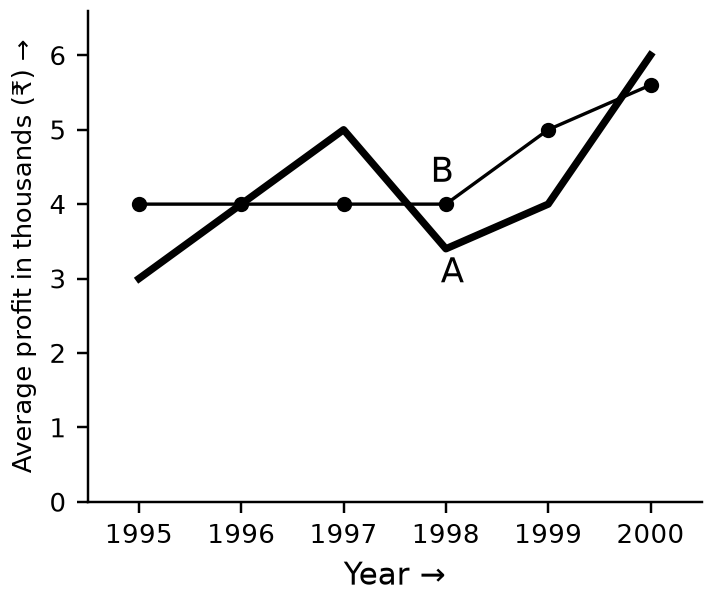
Directions for the following 4 (four) items : The following graph shows the average profit of two fruit-sellers A and B in thousands (₹) per year from the year 1995 to 2000. Consider the graph and answer the 4 (four) items that follow :
In which year is the average profit of A and B same ?
Answer (b) & explanation
Their profits are equal in 1996 (b). Step 1: read B's line on the graph. B's dotted line stays flat at ₹4,000 from 1995 to 1998. Step 2: read A's thick line. It crosses the 4 thousand level exactly at 1996. So in that year both sellers earn ₹4,000. Step 3: check the other years. In 1995, 1997 and 1998, A's line is above or below 4, so options (a), (c) and (d) fail.
Tip: on a two-line graph, "same value" means the point where the two lines cross or touch. Look for the meeting point first, then read the year below it.
Answer as per the official UPSC answer key.
(Same graph as the question above.)
What is the difference between the average profit of B and A in the year 1998 ?
Answer (c) & explanation
B minus A in 1998 is +₹600 (c). Step 1: read the graph for 1998. B is at 4 thousand, that is ₹4,000. A is at about 3.4 thousand, that is ₹3,400. Step 2: the question asks for B − A: 4,000 − 3,400 = +₹600. The answer is positive because B is higher. Options (a), (b) and (d) are wrong: they are negative values, which would mean A earned more than B.
Tip: notice the order of subtraction in the question, "B and A". A minus sign in the options tells you the examiner is testing whether you subtract the right way round.
Answer as per the official UPSC answer key.
(Same graph as the question above.)
How much more average profit did A make in the year 2000 than in the year 1999 ?
Answer (d) & explanation
A made ₹2,000 more in 2000 (d). Step 1: read A's line on the graph. In 1999, A is at 4 thousand, that is ₹4,000. In 2000, A is at 6 thousand, that is ₹6,000. Step 2: difference = 6,000 − 4,000 = ₹2,000. Options (a), (b) and (c) are too small.
Tip: the graph is in thousands of rupees. A common slip is to read 6 − 4 = 2 and pick ₹200 (option a). Always multiply by the unit on the axis before answering. Also check you are reading the right line: A's line is the thick one, B's has dots.
Answer as per the official UPSC answer key.
(Same graph as the question above.)
What is the trend of the average profit of B from the year 1997 to the year 2000 ?
Answer (b) & explanation
B's profit trend is non-decreasing (b). Step 1: read B's values. 1997: 4. 1998: 4. 1999: 5. 2000: about 5.6 (thousand rupees). Step 2: describe the pattern. The profit stays the same for a year, then rises, and never falls. That is "non-decreasing". Option (a) is wrong: non-increasing means it never rises. Option (c) is wrong: steady means no change at all. Option (d) is wrong: fluctuating means going up and down.
Tip: "non-decreasing" allows flat stretches and rises, but no falls. "Increasing" would need a rise every year, which B does not show from 1997 to 1998.
Answer as per the official UPSC answer key.
The following table shows the marks obtained by two students in different subjects :
| Student A | Maximum Marks | Student B | Maximum Marks | |
|---|---|---|---|---|
| English | 60 | 100 | 80 | 150 |
| Psychology | 70 | 100 | 70 | 100 |
| History | 50 | 100 | 60 | 100 |
| Sanskrit | 30 | 50 | 15 | 25 |
The difference in the mean aggregate percentage marks of the students is
Answer (d) & explanation
The difference is zero (d). Step 1: Student A's marks are 60 + 70 + 50 + 30 = 210 out of a maximum of 350. 210 ÷ 350 = 0.6, that is 60%. Step 2: Student B's marks are 80 + 70 + 60 + 15 = 225 out of a maximum of 375. 225 ÷ 375 = 0.6, that is 60%. Step 3: both aggregate percentages are 60%, so the difference is zero. Options (a), (b) and (c) come from adding subject percentages or using the wrong maximum.
Tip: aggregate percentage = total marks obtained ÷ total maximum marks × 100. Do not average the subject-wise percentages when the maximum marks differ.
Add up the marks first, then find one percentage. Do not average the subject percentages.
Answer as per the official UPSC answer key.
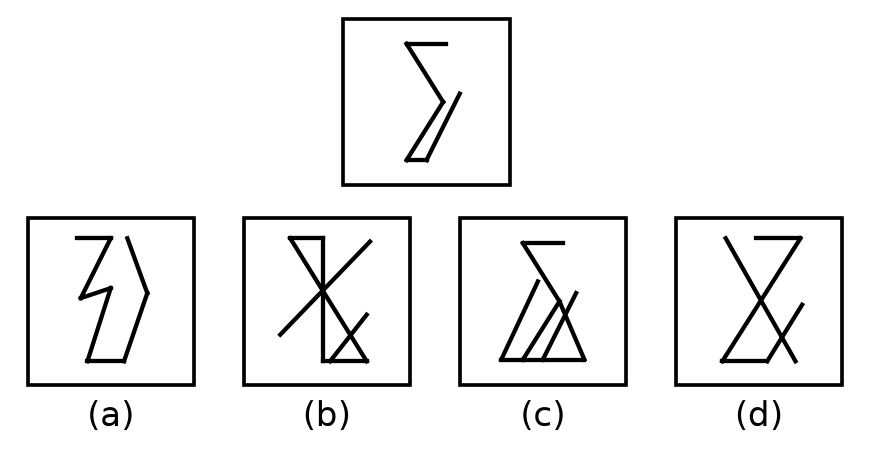
Examine the following figure :
Which one of the following figures has the above figure embedded in it ?
Answer (c) & explanation
The figure is hidden inside (c) (c). Step 1: note the parts of the given shape: a short top line, a bend pointing right, a short bottom line, and a slanting line going up from the bottom. Step 2: look for all four parts, in the same size and same direction, inside each option. In figure (c) they all appear together; the extra lines only add small triangles at the bottom. Step 3: in (a), (b) and (d), the bend or the top line is missing or turned, so the shape is not there.
Tip: for embedded-figure questions, pick the most unusual part of the shape, here the bend, and hunt for it first. The figure must not be rotated or resized.
Answer as per the official UPSC answer key.
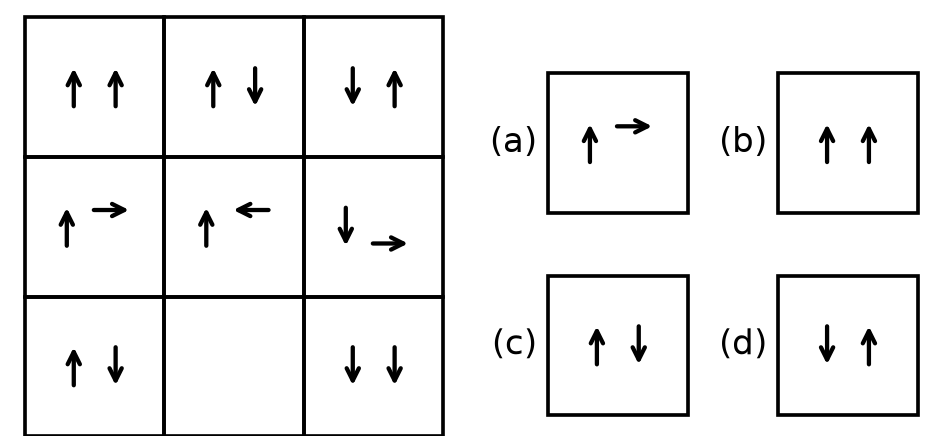
Consider the following matrix :
Which one of the following figures fits into the blank part of the above matrix ?
Answer (b) & explanation
1. Look down each column at the first (left) arrow: column 1 is always ↑, column 2 is always ↑, column 3 is always ↓. So the blank starts with ↑.
2. Look along each row at the second arrow: the middle box is the opposite of the two outer boxes (row 1: ↑ ↓ ↑; row 2: → ← →). Row 3 is ↓ ? ↓, so the middle one is ↑.
3. The blank is ↑ ↑, which is (b).
Answer as per the official UPSC answer key.
The following table gives population and total income of a city for four years :
| Year | 1992 | 1993 | 1994 | 1995 |
|---|---|---|---|---|
| Population in lakhs | 20 | 21 | 22 | 23 |
| Income in crores (₹) | 1010 | 1111 | 1225 | 1345 |
Which one of the following statements is correct in respect of the above data ?
Answer (c) & explanation
Per capita income was always above ₹5,000 (c). Step 1: income is in crores and population in lakhs. ₹1 crore ÷ 1 lakh people = ₹100 per person. So per capita income = (income ÷ population) × 100. Step 2: 1992: 1,010 ÷ 20 × 100 = ₹5,050. 1993: about ₹5,290. 1994: about ₹5,570. 1995: about ₹5,850. All are above ₹5,000, so (c) is right. Step 3: option (d) is wrong: the highest is 1995. Option (a) is wrong: population rising from 22 to 23 is under 5%. Option (b) is wrong: income rising from 1,225 to 1,345 is under 10%.
Tip: sort out units (crore, lakh) first. Then test the quickest option to check.
Answer as per the official UPSC answer key.
Consider the table given below in which the numbers bear certain relationship among themselves along the rows :
| 29 | 13 | 18 |
|---|---|---|
| 33 | X | 19 |
| 30 | 27 | 3 |
Which one of the following numbers is the missing number indicated above by X ?
Answer (b) & explanation
UPSC's final key accepts both 15 (b) and 8 (d). Step 1: look for a rule in the complete rows. Row 1: 29 + 13 + 18 = 60. Row 3: 30 + 27 + 3 = 60. So each row adds up to 60. Step 2: apply it to row 2: 33 + X + 19 = 60. So X = 60 − 52 = 8, option (d). Step 3: the table can also be read with a different rule that gives 15, option (b). Because the pattern is not unique, UPSC accepted both answers. Options (a) and (c) fit no rule.
Tip: in number tables, try the simplest rules first: sum of the row, then difference, then product. Check the rule on two full rows before using it.
The rule is not unique, so UPSC's final key accepts both (b) 15 and (d) 8.
Answer as per the official UPSC answer key.
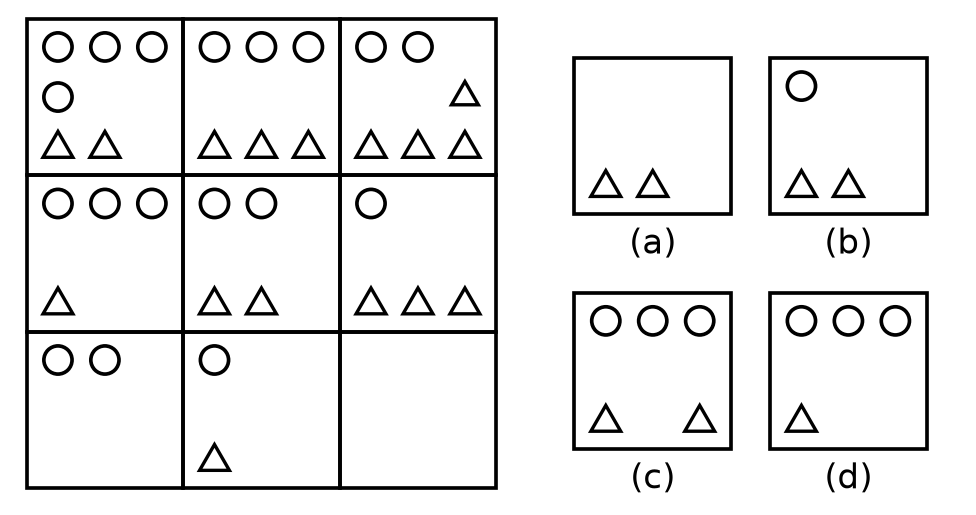
Consider the following matrix with one empty block in the lower extreme corner :
Which of the following figures could fit in the empty block and thus complete the matrix ?
Answer (a) & explanation
Figure (a) completes the matrix (a). Step 1: count the shapes in each box, left to right. Row 1: circles 4, 3, 2; triangles 2, 3, 4. Row 2: circles 3, 2, 1; triangles 1, 2, 3. Step 2: find the rule. Each step to the right, one circle goes and one triangle comes. Step 3: apply it to row 3. Circles go 2, 1, so next is 0. Triangles go 0, 1, so next is 2. The empty box needs two triangles and no circle, which is figure (a). Options (b), (c) and (d) have the wrong counts.
Tip: in figure matrices, count each kind of shape separately; a simple plus-one, minus-one rule is very common.
Answer as per the official UPSC answer key.
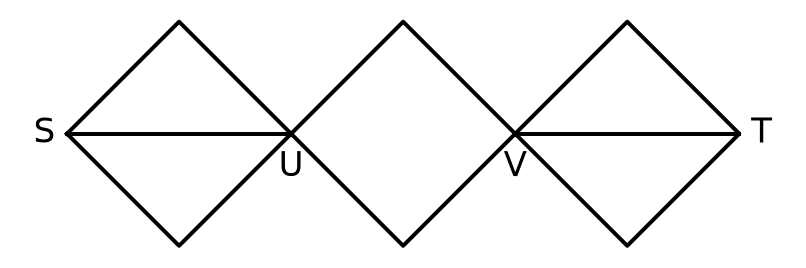
With reference to the figure given below, the number of different routes from S to T without retracing from U and/or V, is
Answer (d) & explanation
There are 18 routes (d). Step 1: break the journey into three parts. From S to U there are three paths: the top, the middle line and the bottom, so 3 ways. Step 2: from U to V there are two paths, top or bottom, so 2 ways. Step 3: from V to T there are again three paths, so 3 ways. Step 4: each choice can be combined with every other choice, so multiply: 3 × 2 × 3 = 18. Options (a), (b) and (c) add instead of multiplying or skip a part.
Tip: when a route passes through fixed points one after another, multiply the number of ways for each part. Add only when the routes are alternatives that do not combine.
Answer as per the official UPSC answer key.
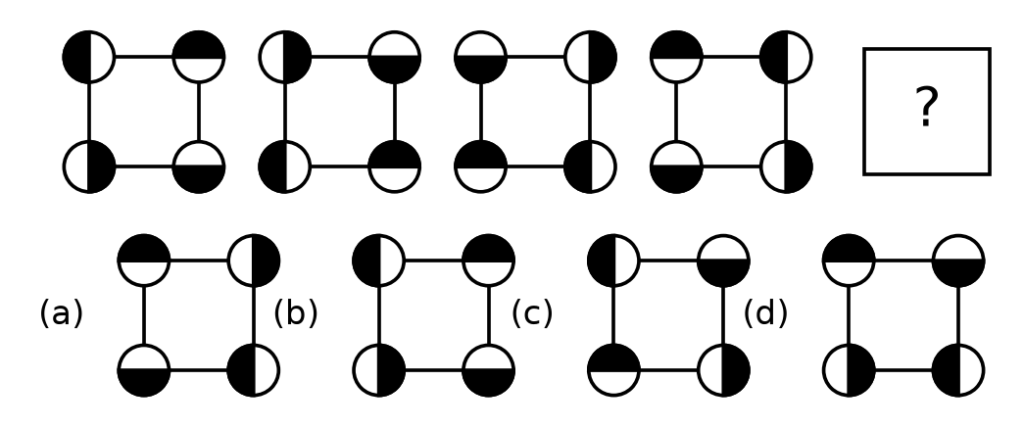
Consider the following figures :
Change in positions of beads in the four figures above follows a sequence. Following the same sequence, which of the figures below should appear as the fifth figure above ?
Answer (b) & explanation
Figure (b) comes fifth (b). Step 1: follow one bead at a time. The top-left bead's dark half moves left, then right, then bottom, then top across the four figures. Step 2: check another bead, the top-right one: top, bottom, right, left. Each bead runs through a 4-step cycle. Step 3: after four steps the cycle starts again, so the fifth figure must look like the first: dark halves left, top, right, bottom. That is figure (b). Options (a), (c) and (d) do not repeat the first figure.
Tip: in sequence questions, if a pattern seems to have four distinct positions, the fifth figure is often a repeat of the first. Check one element at a time.
Answer as per the official UPSC answer key.
A bell rings every 18 minutes. A second bell rings every 24 minutes. A third bell rings every 32 minutes. If all the three bells ring at the same time at 8 o'clock in the morning, at what other time will they all ring together?
Answer (b) & explanation
They ring together again at 12:48 (b). Step 1: find the LCM of 18, 24 and 32. Break them into factors: 18 = 2 × 3 × 3; 24 = 2 × 2 × 2 × 3; 32 = 2 × 2 × 2 × 2 × 2. Step 2: take the highest power of each: five 2s (32) and two 3s (9). LCM = 32 × 9 = 288 minutes. Step 3: 288 minutes = 4 hours 48 minutes. 8:00 + 4:48 = 12:48. Options (a), (c) and (d) are a few minutes off.
Tip: "ring together again" always means LCM. Turn the minutes into hours and minutes before adding to the start time.
Answer as per the official UPSC answer key.
"Price is not the same thing as value. Suppose that on a day the price of everything viz., coal, bread, postage stamps, a day's labour, the rent of houses, etc. were to double. Prices then would certainly rise, but values of all things except one would not."
The writer wants to say that if prices of all things were doubled
Answer (d) & explanation
Only the value of money is halved (d). Step 1: understand the claim. If every price doubles, things still trade for the same amounts against each other: a loaf still costs as many hours of labour as before. So their real values do not change. Step 2: the "one" thing whose value changes is money: one rupee now buys only half as much. Step 3: test the others. Option (a) is wrong: it misses the exception the writer mentions. Options (b) and (c) are wrong: values of goods neither double nor halve.
Tip: price is value measured in money. If all prices rise together, it is money that has lost value; this is what inflation means.
Answer as per the official UPSC answer key.
A and B decide to travel from place X to place Y by bus. A has ₹ 10 with him and he finds that it is 80% of the bus fare for two persons. B finds that he has ₹ 3 with him and hands it over to A. In this context, which one of the following statements is correct?
Answer (c) & explanation
A is left with 50 paise (c). Step 1: A's ₹10 is 80% of the fare for two people. So full fare = 10 ÷ 0.8 = ₹12.50. Step 2: B gives ₹3, so A now has 10 + 3 = ₹13. Step 3: after buying two tickets: 13 − 12.50 = ₹0.50 left. Option (a) is wrong: ₹13 is more than "just enough". Option (b) is wrong: A needs nothing extra. Option (d) is wrong: the money is enough.
Tip: to find the whole from a percentage, divide by the percentage as a decimal: whole = part ÷ 0.8. Quick check: 80% of 12.50 = 10.
Answer as per the official UPSC answer key.
As per agreement with a bank, a businessman had to refund a loan in some equal instalments without interest. After paying 18 instalments he found that 60 percent of his loan was refunded. How many instalments were there in the agreement?
Answer (c) & explanation
There were 30 instalments (c). Step 1: 18 instalments cleared 60% of the loan. The instalments are equal and there is no interest, so every instalment clears the same share. Step 2: each instalment clears 60 ÷ 18 = 3⅓%. Step 3: to clear 100%, he needs 100 ÷ 3⅓ = 30 instalments. A faster way: 18 is 60%, so 100% is 18 ÷ 0.6 = 30. Options (a), (b) and (d) do not give 100%.
Tip: this is simple proportion. If 60% takes 18, then 10% takes 3, and 100% takes 30. Breaking it into 10% chunks makes the maths easy without a calculator.
Answer as per the official UPSC answer key.
A worker reaches his factory 3 minutes late if his speed from his house to the factory is 5 km/hr. If he walks at a speed of 6 km/hr, then he reaches the factory 7 minutes early. The distance of the factory from his house is
Answer (c) & explanation
The factory is 5 km away (c). Step 1: at 5 km/hr he is 3 minutes late; at 6 km/hr he is 7 minutes early. So the two journey times differ by 3 + 7 = 10 minutes, which is 1/6 hour. Step 2: time = distance ÷ speed. Distance ÷ 5 − distance ÷ 6 = 1/6. Step 3: distance ÷ 5 − distance ÷ 6 = distance ÷ 30. So distance ÷ 30 = 1/6, and distance = 5 km. Check: 5 km takes 60 minutes at 5 km/hr and 50 minutes at 6 km/hr, a 10-minute gap. Options (a), (b) and (d) fail the check.
Tip: "late" and "early" times add to give the gap between the two journeys.
the gap is 3 + 7, not 7 – 3. One trip is late and the other early.
Answer as per the official UPSC answer key.
Read the passage
“Liberty, therefore, is never real unless the Government can be called to account when it invades rights.”
Which one of the following is the best justification of the above statement ?
Answer (d) & explanation
Liberty and restraint go together (d). Step 1: read the statement. "Liberty is never real unless the Government can be called to account when it invades rights." So freedom is real only when the power that could crush it is checked. Step 2: that means liberty needs restraints on power; the two are complementary, which is option (d) in UPSC's key. Step 3: test the others. Option (a) is close but names only one mechanism, a court case, not the underlying idea. Option (b) is wrong: singling a person out from other citizens is unrelated. Option (c) is wrong: decentralization and basic needs are not mentioned.
Tip: "best justification" asks for the principle behind a statement, not one example of it.
Answer as per the official UPSC answer key.
Read the passage
Many nations now place their faith in capitalism and governments choose it as the strategy to create wealth for their people. The spectacular economic growth seen in Brazil, China and India after the liberalisation of their economies is proof of its enormous potential and success. However, the global banking crisis and the economic recession have left many bewildered. The debates tend to focus on free market operations and forces, their efficiency and their ability for self correction. Issues of justice, integrity and honesty are rarely elaborated to highlight the failure of the global banking system. The apologists of the system continue to justify the success of capitalism and argue that the recent crisis was a blip. Their arguments betray an ideological bias with the assumptions that an unregulated market is fair and competent, and that the exercise of private greed will be in the larger public interest.
Few recognize the bidirectional relationship between capitalism and greed; that each reinforces the other. Surely, a more honest conceptualisation of the conflicts of interest among the rich and powerful players who have benefited from the system, their biases and ideology is needed; the focus on the wealth creation should also highlight the resultant gross inequity.
The apologists of the “Free Market System”, according to the passage, believe in
Answer (c) & explanation
They believe in the market's ability to self-correct (c). Step 1: find the apologists. They "continue to justify the success of capitalism and argue that the recent crisis was a blip". The debates focus on the market's "ability for self correction". Calling the crisis a blip means they trust the market to fix itself. Step 2: test the others. Option (a) is close, but the passage stresses self-correction, not just the absence of control. Option (b) is wrong: protection by government is not discussed. Option (d) is wrong: free goods means goods that cost nothing, which is unrelated.
Tip: a "blip" is a short, temporary problem. Words like this reveal what a group believes.
Answer as per the official UPSC answer key.
Read the passage
Many nations now place their faith in capitalism and governments choose it as the strategy to create wealth for their people. The spectacular economic growth seen in Brazil, China and India after the liberalisation of their economies is proof of its enormous potential and success. However, the global banking crisis and the economic recession have left many bewildered. The debates tend to focus on free market operations and forces, their efficiency and their ability for self correction. Issues of justice, integrity and honesty are rarely elaborated to highlight the failure of the global banking system. The apologists of the system continue to justify the success of capitalism and argue that the recent crisis was a blip. Their arguments betray an ideological bias with the assumptions that an unregulated market is fair and competent, and that the exercise of private greed will be in the larger public interest.
Few recognize the bidirectional relationship between capitalism and greed; that each reinforces the other. Surely, a more honest conceptualisation of the conflicts of interest among the rich and powerful players who have benefited from the system, their biases and ideology is needed; the focus on the wealth creation should also highlight the resultant gross inequity.
With reference to “ideological bias”, the passage implies that
Answer (c) & explanation
The bias assumes the free market is fair and competent (c). Step 1: find the phrase. The apologists' arguments "betray an ideological bias with the assumptions that an unregulated market is fair and competent". Option (c) repeats this. Step 2: test the others. Options (a) and (b) are wrong: each keeps only one of the two qualities. Option (d) is wrong: "neither fair nor biased" is not what the passage says at all.
Tip: when a question quotes a phrase in inverted commas, like "ideological bias", go straight to that phrase in the passage. The answer is usually in the same sentence. Look for options that keep all the parts, here both "fair" and "competent".
Answer as per the official UPSC answer key.
Read the passage
Many nations now place their faith in capitalism and governments choose it as the strategy to create wealth for their people. The spectacular economic growth seen in Brazil, China and India after the liberalisation of their economies is proof of its enormous potential and success. However, the global banking crisis and the economic recession have left many bewildered. The debates tend to focus on free market operations and forces, their efficiency and their ability for self correction. Issues of justice, integrity and honesty are rarely elaborated to highlight the failure of the global banking system. The apologists of the system continue to justify the success of capitalism and argue that the recent crisis was a blip. Their arguments betray an ideological bias with the assumptions that an unregulated market is fair and competent, and that the exercise of private greed will be in the larger public interest.
Few recognize the bidirectional relationship between capitalism and greed; that each reinforces the other. Surely, a more honest conceptualisation of the conflicts of interest among the rich and powerful players who have benefited from the system, their biases and ideology is needed; the focus on the wealth creation should also highlight the resultant gross inequity.
“The exercise of private greed will be in the larger public interest” from the passage
- 1. refers to the false ideology of capitalism.
- 2. underlies the righteous claims of the free market.
- 3. shows the benevolent face of capitalism.
- 4. ignores resultant gross inequity.
Which of the statements given above is/are correct ?
Answer (c) & explanation
Statements 1 and 4 are correct (c). Step 1: the line "private greed will be in the larger public interest" is one of the assumptions the author calls an "ideological bias". So he sees it as a false ideology (statement 1). Step 2: he also wants the focus on wealth creation to "highlight the resultant gross inequity", which the claim ignores (statement 4). Step 3: test the others. Statement 2 is wrong: the author does not see the free market's claims as righteous. Statement 3 is wrong: he does not see greed as capitalism's benevolent face. Options (a), (b) and (d) fail.
Tip: first decide whether the author agrees or disagrees with the quoted line. Here he disagrees, so positive words like "righteous" and "benevolent" are wrong.
Answer as per the official UPSC answer key.
Read the passage
Net profits are only 2·2% of their total assets for central public sector undertakings, lower than for the private corporate sector. While the public sector or the State-led entrepreneurship played an important role in triggering India’s industrialization, our evolving development needs, comparatively less-than-satisfactory performance of the public sector enterprises, the maturing of our private sector, a much larger social base now available for expanding entrepreneurship and the growing institutional capabilities to enforce competition policies would suggest that the time has come to review the role of public sector.
What should the portfolio composition of the government be ? It should not remain static all times. The airline industry works well as a purely private affair. At the opposite end, rural roads, whose sparse traffic makes tolling unviable, have to be on the balance-sheet of the State. If the government did not own rural roads, they would not exist. Similarly, public health capital in our towns and cities will need to come from the public sector. Equally, preservation and improvement of forest cover will have to be a new priority for the public sector assets.
Take the example of steel. With near-zero tariffs, India is a globally competitive market for the metal. Indian firms export steel into the global market, which demonstrates there is no gap in technology. Indian companies are buying up global steel companies, which shows there is no gap in capital availability. Under these conditions, private ownership works best.
Private ownership is clearly desirable in regulated industries, ranging from finance to infrastructure, where a government agency performs the function of regulation and multiple competing firms are located in the private sector. Here, the simple and clean solution — government as the umpire and the private sector as the players is what works best. In many of these industries, we have a legacy of government ownership, where productivity tends to be lower, fear of bankruptcy is absent, and the risk of asking for money from the tax payer is ever present. There is also the conflict of interest between government as an owner and as the regulator. The formulation and implementation of competition policy will be more vigorous and fair if government companies are out of action.
According to the passage, what is/are the reason/reasons for saying that the time has come to review the role of public sector ?
- 1. Now public sector has lost its relevance in the industrialization process.
- 2. Public sector does not perform satisfactorily.
- 3. Entrepreneurship in private sector is expanding.
- 4. Effective competition policies are available now.
Which of the statements given above is/are correct in the given context ?
Answer (c) & explanation
Reasons 2, 3 and 4 are given (c). Step 1: list the reasons in the passage. It cites "comparatively less-than-satisfactory performance" of public enterprises (item 2), "a much larger social base now available for expanding entrepreneurship" (item 3), and "growing institutional capabilities to enforce competition policies" (item 4). Step 2: test item 1. It is wrong: the passage says the public sector "played an important role" in India's industrialization. It never says it has lost all relevance. Options (a), (b) and (d) fail.
Tip: "time to review" a role is much milder than "it has lost relevance". Do not let a strong option replace a moderate idea in the text.
Answer as per the official UPSC answer key.
Read the passage
Net profits are only 2·2% of their total assets for central public sector undertakings, lower than for the private corporate sector. While the public sector or the State-led entrepreneurship played an important role in triggering India’s industrialization, our evolving development needs, comparatively less-than-satisfactory performance of the public sector enterprises, the maturing of our private sector, a much larger social base now available for expanding entrepreneurship and the growing institutional capabilities to enforce competition policies would suggest that the time has come to review the role of public sector.
What should the portfolio composition of the government be ? It should not remain static all times. The airline industry works well as a purely private affair. At the opposite end, rural roads, whose sparse traffic makes tolling unviable, have to be on the balance-sheet of the State. If the government did not own rural roads, they would not exist. Similarly, public health capital in our towns and cities will need to come from the public sector. Equally, preservation and improvement of forest cover will have to be a new priority for the public sector assets.
Take the example of steel. With near-zero tariffs, India is a globally competitive market for the metal. Indian firms export steel into the global market, which demonstrates there is no gap in technology. Indian companies are buying up global steel companies, which shows there is no gap in capital availability. Under these conditions, private ownership works best.
Private ownership is clearly desirable in regulated industries, ranging from finance to infrastructure, where a government agency performs the function of regulation and multiple competing firms are located in the private sector. Here, the simple and clean solution — government as the umpire and the private sector as the players is what works best. In many of these industries, we have a legacy of government ownership, where productivity tends to be lower, fear of bankruptcy is absent, and the risk of asking for money from the tax payer is ever present. There is also the conflict of interest between government as an owner and as the regulator. The formulation and implementation of competition policy will be more vigorous and fair if government companies are out of action.
According to the passage, rural roads should be in the domain of public sector only. Why ?
Answer (b) & explanation
The private sector cannot profit from rural roads (b). Step 1: find the reason. Rural roads have "sparse traffic" that "makes tolling unviable". With little traffic, a private builder cannot collect enough tolls to earn money. So "if the government did not own rural roads, they would not exist". Step 2: test the others. Option (a) is wrong: the passage does not say all rural development is only the government's job. Option (c) is wrong: taxpayers' money is not the reason given. Option (d) is wrong: social responsibility of firms is not discussed.
Tip: a "Why?" question needs the cause the passage gives. Look for linking words like "whose" and "makes" that show cause and effect.
Answer as per the official UPSC answer key.
Read the passage
Net profits are only 2·2% of their total assets for central public sector undertakings, lower than for the private corporate sector. While the public sector or the State-led entrepreneurship played an important role in triggering India’s industrialization, our evolving development needs, comparatively less-than-satisfactory performance of the public sector enterprises, the maturing of our private sector, a much larger social base now available for expanding entrepreneurship and the growing institutional capabilities to enforce competition policies would suggest that the time has come to review the role of public sector.
What should the portfolio composition of the government be ? It should not remain static all times. The airline industry works well as a purely private affair. At the opposite end, rural roads, whose sparse traffic makes tolling unviable, have to be on the balance-sheet of the State. If the government did not own rural roads, they would not exist. Similarly, public health capital in our towns and cities will need to come from the public sector. Equally, preservation and improvement of forest cover will have to be a new priority for the public sector assets.
Take the example of steel. With near-zero tariffs, India is a globally competitive market for the metal. Indian firms export steel into the global market, which demonstrates there is no gap in technology. Indian companies are buying up global steel companies, which shows there is no gap in capital availability. Under these conditions, private ownership works best.
Private ownership is clearly desirable in regulated industries, ranging from finance to infrastructure, where a government agency performs the function of regulation and multiple competing firms are located in the private sector. Here, the simple and clean solution — government as the umpire and the private sector as the players is what works best. In many of these industries, we have a legacy of government ownership, where productivity tends to be lower, fear of bankruptcy is absent, and the risk of asking for money from the tax payer is ever present. There is also the conflict of interest between government as an owner and as the regulator. The formulation and implementation of competition policy will be more vigorous and fair if government companies are out of action.
The portfolio composition of the government refers to
Answer (c) & explanation
Portfolio composition means the mix of government investment across sectors (c). Step 1: see how the passage uses the term. Right after asking "What should the portfolio composition of the government be?", it discusses which sectors the State should own: airlines private, rural roads public, public health public, forests public, steel private. So the term means the mix of sectors in which government invests. Step 2: test the others. Option (a) is wrong: asset quality is not discussed. Option (b) is wrong: liquid assets are not mentioned. Option (d) is wrong: return on investment is not the point.
Tip: for a word-meaning question, read the examples that follow the term; they reveal its meaning in context.
Answer as per the official UPSC answer key.
Read the passage
Net profits are only 2·2% of their total assets for central public sector undertakings, lower than for the private corporate sector. While the public sector or the State-led entrepreneurship played an important role in triggering India’s industrialization, our evolving development needs, comparatively less-than-satisfactory performance of the public sector enterprises, the maturing of our private sector, a much larger social base now available for expanding entrepreneurship and the growing institutional capabilities to enforce competition policies would suggest that the time has come to review the role of public sector.
What should the portfolio composition of the government be ? It should not remain static all times. The airline industry works well as a purely private affair. At the opposite end, rural roads, whose sparse traffic makes tolling unviable, have to be on the balance-sheet of the State. If the government did not own rural roads, they would not exist. Similarly, public health capital in our towns and cities will need to come from the public sector. Equally, preservation and improvement of forest cover will have to be a new priority for the public sector assets.
Take the example of steel. With near-zero tariffs, India is a globally competitive market for the metal. Indian firms export steel into the global market, which demonstrates there is no gap in technology. Indian companies are buying up global steel companies, which shows there is no gap in capital availability. Under these conditions, private ownership works best.
Private ownership is clearly desirable in regulated industries, ranging from finance to infrastructure, where a government agency performs the function of regulation and multiple competing firms are located in the private sector. Here, the simple and clean solution — government as the umpire and the private sector as the players is what works best. In many of these industries, we have a legacy of government ownership, where productivity tends to be lower, fear of bankruptcy is absent, and the risk of asking for money from the tax payer is ever present. There is also the conflict of interest between government as an owner and as the regulator. The formulation and implementation of competition policy will be more vigorous and fair if government companies are out of action.
The author prefers government as the umpire and private sector as players because
Answer (a) & explanation
Government sets norms for fair play (a). Step 1: understand the image. An umpire sets and enforces rules; players compete. In regulated industries "a government agency performs the function of regulation" and many private firms compete. Competition policy will be "more vigorous and fair" if government firms are out. So the umpire's job is to set norms for fair play. Step 2: test the others. Option (b) is wrong: being "ultimate in policy formulation" is not the point of the analogy. Option (c) is wrong: an umpire does control the players. Option (d) is wrong because (a) fits.
Tip: for an analogy question, ask what the two roles do in real life, then match that to the passage.
Answer as per the official UPSC answer key.
A question paper must have a question on one of the eight poets : A, B, C, D, E, F, G or H. The first four belong to the medieval period while the rest are considered modern poets. Generally, modern poets figure in the question paper in alternate years. Generally those who like H like G also; and those who like F like E also. The paper-setter does not like to ask about F as he has written a book on F, but he likes F. Last year, the paper contained a question on A. On the basis of the information given, this year's paper is most likely to contain a question on
Answer (b) & explanation
E is the most likely poet (b). Step 1: last year's paper had A, a medieval poet. Modern poets "generally" come in alternate years, so this year a modern poet is likely: E, F, G or H. Options (a) C is ruled out, as C is medieval. Step 2: the setter likes F but will not ask about F, as he wrote a book on F. So (c) is ruled out. Step 3: "those who like F like E also". The setter likes F, so he likely likes E too, and will choose E. Option (d) H is wrong: nothing says he likes H or G.
Tip: in "most likely" puzzles, use every "generally" rule to narrow choices, then pick the option the clues point to, not one that is merely possible.
Answer as per the official UPSC answer key.
In a group of six women there are four dancers, four vocal musicians, one actress and three violinists. Girija and Vanaja are among the violinists while Jalaja and Shailaja do not know how to play on the violin. Shailaja and Tanuja are among the dancers. Jalaja, Vanaja, Shailaja and Tanuja are all vocal musicians and two of them are also violinists. If Pooja is an actress, who among the following is certainly a dancer and a violinist ?
Answer (d) & explanation
Tanuja is certainly a dancer and a violinist (d). Step 1: the four vocal musicians are Jalaja, Vanaja, Shailaja and Tanuja, and two of them play the violin. Step 2: Jalaja and Shailaja do not play the violin. So the two violinists among them must be Vanaja and Tanuja. Step 3: Tanuja is also among the dancers. So she is certainly both. Option (a) is wrong: Jalaja does not play the violin. Option (b) is wrong: Pooja is the actress, with no sure link to violin. Option (c) is wrong: Shailaja is a dancer but not a violinist.
Tip: use the "two of them" clue with the "do not" clue. Removing who cannot be in a group often leaves exactly who must be.
Answer as per the official UPSC answer key.
The letters L, M, N, O, P, Q, R, S and T in their order are substituted by nine integers 1 to 9 but not in that order. 4 is assigned to P. The difference between P and T is 5. The difference between N and T is 3. What is the integer assigned to N ?
Answer (d) & explanation
N is 6 (d). Step 1: P is 4. The difference between P and T is 5, so T is 4 + 5 = 9 or 4 − 5 = −1. Only numbers 1 to 9 are allowed, so T = 9. Step 2: the difference between N and T is 3, so N is 9 + 3 = 12 or 9 − 3 = 6. 12 is too big, so N = 6. Options (a), (b) and (c) do not satisfy both differences.
Tip: a "difference" can go either way, plus or minus. Try both, then throw out any value outside the allowed range. Here the range 1 to 9 settles each step at once. The letter order L to T is just a distraction.
Answer as per the official UPSC answer key.
Read the passage
The number of deaths among the army personnel is 8 in 1000, but among the civilian population it is 20 per 1000.
Which one of the following inferences can be drawn from this statement ?
Answer (d) & explanation
The two groups cannot be compared (d). Step 1: the data show 8 deaths per 1,000 in the army and 20 per 1,000 among civilians. Step 2: think about who is in each group. Soldiers are young, fit and medically screened. Civilians include babies, old people and the sick, who die at higher rates anyway. The groups are heterogeneous (very different), so the lower army death rate does not prove anything about army life. Step 3: test the others. Option (a) is wrong: it treats unlike groups as comparable. Option (b) is too vague. Option (c) is wrong: a Quality of Life index is not shown by death rates alone.
Tip: before comparing two rates, check whether the groups are alike in age and health.
Answer as per the official UPSC answer key.
Read the passage
Given the statement : “Buses are the cause of more accidents than cars, and trucks cause fewer accidents than buses”
Which of the following conclusions can we draw ?
Answer (d) & explanation
No conclusion can be drawn (d). Step 1: the statement only says buses cause more accidents than cars, and trucks fewer than buses. Step 2: test option (a). Accident counts tell us nothing about how many buses and trucks there are on the road, so it fails. Step 3: test (b) and (c). More accidents could be due to more vehicles, longer hours or busier routes, not driver care or skill. Both fail. So none of the conclusions follows.
Tip: raw counts without the base number (how many vehicles, how many kilometres driven) cannot show which group is safer. This idea, comparing rates and not totals, appears often in CSAT logic questions.
Answer as per the official UPSC answer key.
Read the passage
“If political leadership fails to emerge, there is likelihood of military taking over power in developing countries. Radical student groups or labour may try to raise revolution but they are not likely to compete with the military. Military intervention, rule, and withdrawal from politics is closely related to a society’s level of political development.”
In the context of political development, the assumption in the above passage is that
Answer (b) & explanation
The assumption is that the military fills a political vacuum (b). Step 1: read the first line. "If political leadership fails to emerge, there is likelihood of military taking over power." So when there is a vacuum of leadership, the military steps in. Step 2: test the others. Option (a) is wrong: the passage does not say political leadership is ineffective; it talks about it failing to emerge. Option (c) is wrong: the passage says "likelihood", not that military rule is inevitable or needed for development. Option (d) is wrong because (b) fits.
Tip: "likelihood" is not "inevitable". UPSC often offers an option that turns a possibility into a certainty.
Answer as per the official UPSC answer key.
Four persons, Alok, Bhupesh, Chander and Dinesh have a total of ₹ 100 among themselves. Alok and Bhupesh between them have as much money as Chander and Dinesh between them, but Alok has more money than Bhupesh; and Chander has only half the money that Dinesh has. Alok has in fact ₹ 5 more than Dinesh has. Who has the maximum amount of money?
Answer (a) & explanation
Alok has the most money (a). Step 1: Alok + Bhupesh = Chander + Dinesh, and all four total ₹100, so each pair has ₹50. Step 2: Chander has half of Dinesh's money. So Chander + Dinesh = 50 with Dinesh = 2 × Chander. That gives Chander = ₹16⅔ and Dinesh = ₹33⅓. Step 3: Alok has ₹5 more than Dinesh: 33⅓ + 5 = ₹38⅓. Then Bhupesh = 50 − 38⅓ = ₹11⅔. Step 4: the largest is Alok. Options (b), (c) and (d) have less.
Tip: split the total into the pairs first. "Half as much" means three equal parts: one for Chander and two for Dinesh, so 50 ÷ 3 per part.
Answer as per the official UPSC answer key.
Examine the following statements :
- 1. George attends Music classes on Monday.
- 2. He attends Mathematics classes on Wednesday.
- 3. His Literature classes are not on Friday.
- 4. He attends History classes on the day following the day of his Mathematics classes.
- 5. On Tuesday, he attends his Sports classes.
If he attends just one subject in a day and his Sunday is free, then he is also free on
Answer (d) & explanation
He is free on Friday (d). Step 1: fill in the week. Monday: Music. Tuesday: Sports. Wednesday: Mathematics. Thursday: History, the day after Mathematics. Sunday: free. Step 2: only Friday and Saturday are left for Literature. Literature is not on Friday, so it is on Saturday. Step 3: that leaves Friday free. Options (a), (b) and (c) are all filled days.
Tip: in scheduling puzzles, place the fixed clues first (named days), then the relative clues ("the day after"), and use the negative clue ("not on Friday") last to settle what is left.
Answer as per the official UPSC answer key.
In a row 'A' is in the 11th position from the left and 'B' is in the 10th position from the right. If 'A' and 'B' interchange, then 'A' becomes 18th from the left. How many persons are there in the row other than 'A' and 'B' ?
Answer (c) & explanation
There are 25 other people (c). Step 1: A is 11th from the left and B is 10th from the right. When they swap, A moves into B's old seat and becomes 18th from the left. Step 2: so B's old seat is 18th from the left and 10th from the right. Step 3: total people = 18 + 10 − 1 = 27. We subtract 1 because that seat was counted twice. Step 4: people other than A and B = 27 − 2 = 25. Options (a), (b) and (d) miss one of these steps.
Tip: total in a row = position from left + position from right − 1, for the same person or seat. Read the last line carefully: "other than A and B".
the question asks for people other than A and B.
Answer as per the official UPSC answer key.
Location of B is north of A and location of C is east of A. The distances AB and AC are 5 km and 12 km respectively. The shortest distance (in km) between the locations B and C is
Answer (b) & explanation
B and C are 13 km apart (b). Step 1: B is north of A and C is east of A. North and east are at a right angle, so A, B and C form a right-angled triangle with the corner at A. Step 2: use the right-angle rule (Pythagoras): square the two short sides and add. 5 × 5 + 12 × 12 = 25 + 144 = 169. Step 3: 13 × 13 = 169, so the straight distance BC = 13 km. Option (a) multiplies the sides. Option (c) adds them, which is the road distance through A. Option (d) subtracts them.
Tip: remember common triples: 3-4-5, 5-12-13, 8-15-17. They save time in CSAT direction questions.
Answer as per the official UPSC answer key.
Two cars start towards each other, from two places A and B which are at a distance of 160 km. They start at the same time 08 : 10 AM. If the speeds of the cars are 50 km and 30 km per hour respectively, they will meet each other at
Answer (a) & explanation
They meet at 10:10 AM (a). Step 1: the cars move towards each other, so their speeds add: 50 + 30 = 80 km/hr. This is how fast the gap between them closes. Step 2: time to close the 160 km gap = 160 ÷ 80 = 2 hours. Step 3: they start at 8:10 AM, so they meet at 8:10 + 2 hours = 10:10 AM. Options (b), (c) and (d) use the wrong speed or wrong start time.
Tip: moving towards each other: add speeds. Moving in the same direction: subtract speeds. Then time = distance ÷ that combined speed.
Answer as per the official UPSC answer key.
Read the passage
Directions : The following six items are based on two passages in English to test the comprehension of English language and therefore these items do not have Hindi version. Read each passage and answer the items that follow.
Passage - 1
In front of us was walking a bare-headed old man in tattered clothes. He was driving his beasts. They were all laden with heavy loads of clay from the hills and looked tired. The man carried a long whip which perhaps he himself had made. As he walked down the road he stopped now and then to eat the wild berries that grew on bushes along the uneven road. When he threw away the seeds, the bold birds would fly to peck at them. Sometimes a stray dog watched the procession philosophically and then began to bark. When this happened, my two little sons would stand still holding my hands firmly. A dog can sometimes be dangerous indeed.
The author's children held his hands firmly because
No official answer (question dropped) & notes
The answer is (a), they were scared of the barking dog. UPSC did not evaluate the six English-only items of 2014 (Q70 to Q75), so this answer is for practice. Step 1: find the line. "Sometimes a stray dog watched the procession philosophically and then began to bark. When this happened, my two little sons would stand still holding my hands firmly." So they held his hands when the dog barked, out of fear. The last line, "A dog can sometimes be dangerous indeed," confirms it. Step 2: test the others. Option (b) is wrong: the berries were eaten by the old man. Option (c) is wrong: the whip is mentioned but did not scare the boys. Option (d) is wrong: the road was uneven, but that is not when they held on.
Tip: "When this happened" points back to the sentence just before it.
UPSC did not evaluate the six English-only items of 2014 (Q70 to Q75), so there is no official key. The answer given in the explanation is for practice.
UPSC dropped this question from evaluation; there is no official answer.
Read the passage
Directions : The following six items are based on two passages in English to test the comprehension of English language and therefore these items do not have Hindi version. Read each passage and answer the items that follow.
Passage - 1
In front of us was walking a bare-headed old man in tattered clothes. He was driving his beasts. They were all laden with heavy loads of clay from the hills and looked tired. The man carried a long whip which perhaps he himself had made. As he walked down the road he stopped now and then to eat the wild berries that grew on bushes along the uneven road. When he threw away the seeds, the bold birds would fly to peck at them. Sometimes a stray dog watched the procession philosophically and then began to bark. When this happened, my two little sons would stand still holding my hands firmly. A dog can sometimes be dangerous indeed.
The expression "a stray dog watched the procession philosophically" means that
No official answer (question dropped) & notes
The answer is (b), the dog stood aloof, watching seriously. UPSC did not evaluate the six English-only items of 2014 (Q70 to Q75), so this answer is for practice. Step 1: understand the word. "Philosophically" here means calmly, thoughtfully, as if from a distance, the way a philosopher might watch the world. Step 2: test the others. Option (a) is wrong: the dog was not restless while watching; it barked only afterwards ("and then began to bark"). Option (c) is wrong: "big, wondering eyes" suggests surprise, not calm thought. Option (d) is wrong: a dog with its eyes closed cannot watch.
Tip: for word-in-context questions, think of the everyday meaning of the word and check that it fits the sentence before and after. The order of events, watching and then barking, matters here.
UPSC did not evaluate the six English-only items of 2014 (Q70 to Q75), so there is no official key. The answer given in the explanation is for practice.
UPSC dropped this question from evaluation; there is no official answer.
Read the passage
Passage - 2
Cynthia was a shy girl. She believed that she was plain and untalented. One day her teacher ordered the entire class to show up for audition for the school play. Cynthia nearly died of fright when she was told that she would have to stand on stage in front of the entire class and deliver dialogues. The mere thought of it made her feel sick. But a remarkable transformation occurred during the audition. A thin, shy girl, her knees quaking, her stomach churning in terror, began to stun everyone with her excellent performance. Her bored classmates suddenly stopped their noisy chat to stare at her slender figure on the stage. At the end of her audition, the entire room erupted in thunderous applause.
Cynthia was afraid to stand on stage because
No official answer (question dropped) & notes
The answer is (c), she lacked self-confidence. UPSC did not evaluate the six English-only items of 2014 (Q70 to Q75), so this answer is for practice. Step 1: find the cause. "Cynthia was a shy girl. She believed that she was plain and untalented." Believing you have no talent is a lack of self-confidence, and that is why she feared the stage. Step 2: test the others. Option (a) is wrong: the passage never says she feared her classmates would laugh. Option (b) is wrong: her churning stomach was a result of her fear, not its cause. Option (d) is wrong: the passage does not say she disliked school plays.
Tip: separate the cause of a feeling from its symptoms. A churning stomach and shaking knees are symptoms; the cause is in what she believed about herself.
UPSC did not evaluate the six English-only items of 2014 (Q70 to Q75), so there is no official key. The answer given in the explanation is for practice.
UPSC dropped this question from evaluation; there is no official answer.
Read the passage
Passage - 2
Cynthia was a shy girl. She believed that she was plain and untalented. One day her teacher ordered the entire class to show up for audition for the school play. Cynthia nearly died of fright when she was told that she would have to stand on stage in front of the entire class and deliver dialogues. The mere thought of it made her feel sick. But a remarkable transformation occurred during the audition. A thin, shy girl, her knees quaking, her stomach churning in terror, began to stun everyone with her excellent performance. Her bored classmates suddenly stopped their noisy chat to stare at her slender figure on the stage. At the end of her audition, the entire room erupted in thunderous applause.
Cynthia's classmates were chatting because
No official answer (question dropped) & notes
The answer is (b), they were bored. UPSC did not evaluate the six English-only items of 2014 (Q70 to Q75), so this answer is for practice. Step 1: find the phrase. The passage calls them "her bored classmates", who "suddenly stopped their noisy chat" when Cynthia performed. So they were chatting because they were bored of the auditions. Step 2: test the others. Option (a) is wrong: nothing says it was their turn next. Option (c) is the opposite: Cynthia acted so well that they stopped chatting. Option (d) is wrong: the teacher's control is not mentioned.
Tip: an adjective placed right before a noun, like "bored classmates", often answers a "why" question directly. Watch for options that reverse what happened.
UPSC did not evaluate the six English-only items of 2014 (Q70 to Q75), so there is no official key. The answer given in the explanation is for practice.
UPSC dropped this question from evaluation; there is no official answer.
Read the passage
Passage - 2
Cynthia was a shy girl. She believed that she was plain and untalented. One day her teacher ordered the entire class to show up for audition for the school play. Cynthia nearly died of fright when she was told that she would have to stand on stage in front of the entire class and deliver dialogues. The mere thought of it made her feel sick. But a remarkable transformation occurred during the audition. A thin, shy girl, her knees quaking, her stomach churning in terror, began to stun everyone with her excellent performance. Her bored classmates suddenly stopped their noisy chat to stare at her slender figure on the stage. At the end of her audition, the entire room erupted in thunderous applause.
Cynthia's knees were quaking because
No official answer (question dropped) & notes
The answer is (a), she was nervous and shy. UPSC did not evaluate the six English-only items of 2014 (Q70 to Q75), so this answer is for practice. Step 1: find the line. "A thin, shy girl, her knees quaking, her stomach churning in terror." Her knees shook because she was frightened and shy, that is, nervous. Step 2: test the others. Option (b) is wrong: no scolding by the teacher is mentioned. Option (c) is wrong: she was thin, but being thin does not make knees shake; fear does. Option (d) is wrong: she feared the stage, not her classmates.
Tip: the passage gives many details in one sentence. Pick the detail that actually explains the action asked about. Here "terror" and "shy" explain the quaking knees, while "thin" just describes her.
UPSC did not evaluate the six English-only items of 2014 (Q70 to Q75), so there is no official key. The answer given in the explanation is for practice.
UPSC dropped this question from evaluation; there is no official answer.
Read the passage
Passage - 2
Cynthia was a shy girl. She believed that she was plain and untalented. One day her teacher ordered the entire class to show up for audition for the school play. Cynthia nearly died of fright when she was told that she would have to stand on stage in front of the entire class and deliver dialogues. The mere thought of it made her feel sick. But a remarkable transformation occurred during the audition. A thin, shy girl, her knees quaking, her stomach churning in terror, began to stun everyone with her excellent performance. Her bored classmates suddenly stopped their noisy chat to stare at her slender figure on the stage. At the end of her audition, the entire room erupted in thunderous applause.
The transformation that occurred during the audition refers to
No official answer (question dropped) & notes
The answer is (d), her stunning performance. UPSC did not evaluate the six English-only items of 2014 (Q70 to Q75), so this answer is for practice. Step 1: find the transformation. "But a remarkable transformation occurred during the audition. A thin, shy girl... began to stun everyone with her excellent performance." The change is from a frightened, shy girl to a confident performer. Step 2: test the others. Option (a) is wrong: her nervousness is what she started with, not the change. Options (b) and (c) are wrong: the applause and the classmates' surprise were reactions to the change, not the change itself.
Tip: a "transformation" is a change in the main character. Look for the sentence that comes right after the word, which usually describes it.
UPSC did not evaluate the six English-only items of 2014 (Q70 to Q75), so there is no official key. The answer given in the explanation is for practice.
UPSC dropped this question from evaluation; there is no official answer.
If the 3rd day of a month is Monday, which one of the following will be the fifth day from 21st of this month?
Answer (c) & explanation
The fifth day from the 21st is a Wednesday (c). Step 1: the 3rd is a Monday. Add 7 at a time to find more Mondays: 3, 10, 17, 24. Step 2: "the fifth day from the 21st" means count five days after the 21st: 21 + 5 = the 26th. Step 3: the 24th is a Monday, so the 25th is Tuesday and the 26th is Wednesday. Options (a), (b) and (d) fall on the wrong day.
Tip: in calendar questions, jump in steps of 7 from a known day, because the weekday repeats every 7 days. Then count only the small gap that is left.
counting the 21st itself as day 1 gives the 25th (Tuesday). Fifth day from the 21st is the 26th.
Answer as per the official UPSC answer key.
For a charity show, the total tickets sold were 420. Half of these tickets were sold at the rate of ₹ 5 each, one-third at the rate of ₹ 3 each and the rest for ₹ 2 each. What was the total amount received?
Answer (c) & explanation
The total collected is ₹1,610 (c). Step 1: split the 420 tickets. Half = 210 tickets at ₹5 = ₹1,050. One-third = 140 tickets at ₹3 = ₹420. Step 2: the rest = 420 − 210 − 140 = 70 tickets at ₹2 = ₹140. Step 3: total = 1,050 + 420 + 140 = ₹1,610. Options (a), (b) and (d) come from miscounting "the rest".
Tip: always work out "the rest" by subtracting from the total, not by guessing a fraction. Here half plus one-third is five-sixths, so the rest is one-sixth: 420 ÷ 6 = 70.
Answer as per the official UPSC answer key.
A, B, C, D, E, F are members of a family. They are engineer, stenographer, doctor, draughtsman, lawyer and judge (not in order). A, the engineer is married to the lady stenographer. The judge is married to the lawyer. F, the draughtsman is the son of B and brother of E. C, the lawyer is the daughter-in-law of D. E is the unmarried doctor. D is the grandmother of F. There are two married couples in the family.
What is the profession of B ?
Answer (a) & explanation
B is the judge (a). Step 1: list known jobs. A is the engineer, C the lawyer, E the doctor and F the draughtsman. That leaves stenographer and judge for B and D. Step 2: the judge is married to the lawyer, C. C is the daughter-in-law of D, so D cannot be C's husband. So D is not the judge, and B is the judge. Step 3: D is then the lady stenographer, married to A. This fits: D is F's grandmother, and B, F's father, is D's son. Options (b), (c) and (d) fail.
Tip: in family puzzles, first fill in the direct clues, then use relationships like "daughter-in-law" to rule out who can be married to whom.
Answer as per the official UPSC answer key.
(Same information as the question above.)
Which of the following is/are a couple/couples ?
Answer (c) & explanation
Both AD and BC are couples (c). Step 1: from the earlier working, A, the engineer, is married to the lady stenographer, who is D. Step 2: the judge, B, is married to the lawyer, C. Step 3: so the two couples are A–D and B–C. This also matches the clue that there are exactly two married couples. Option (a) and (b) give only one couple. Option (d) is wrong: C is married to B, not A, and D is B's mother, not wife.
Tip: once the main puzzle is solved, related questions only need you to read off the answer. Check it against every clue, here "two married couples", to be sure.
Answer as per the official UPSC answer key.
(Same information as the question above.)
What is the profession of D ?
Answer (b) & explanation
D is the stenographer (b). Step 1: from the earlier working, B is the judge. The only jobs left for B and D were judge and stenographer. Step 2: so D is the stenographer. Step 3: check: A, the engineer, is married to the lady stenographer, and D is a lady, the grandmother of F. This fits. Option (a) is wrong: B is the judge. Option (c) is wrong: E is the doctor. Option (d) is wrong: the answer can be fixed.
Tip: in a set of linked questions, solve the puzzle once in a small table of names and jobs. Each question then takes seconds.
Answer as per the official UPSC answer key.
All years by topic
Every question from 2011 to 2026, grouped by syllabus topic, with year-wise trends.