
UPSC Prelims 2023 · GS Paper I: Consider the following statements :Statement-I : India’s public sector health care system largely focuses…
Consider the following statements :
Statement-I : India’s public sector health care system largely focuses on curative care with limited preventive, promotive and rehabilitative care.
Statement-II : Under India’s decentralized approach to health care delivery, the States are primarily responsible for organizing health services.
Which one of the following is correct in respect of the above statements?
Answer (b) & explanation
Both statements are correct but II does not explain I (b). Statement I is right: the National Health Policy 2017 itself notes that public health care is mostly curative, treating illness after it strikes, with limited preventive, promotive and rehabilitative care. Statement II is right: public health and hospitals are on the State List, so States are mainly responsible for running health services. But II does not explain I: the curative focus comes from priorities and funding, not from decentralisation.
Notice the shift under Ayushman Bharat (2018): its Ayushman Arogya Mandirs, the former Health and Wellness Centres, push primary and preventive care, while PM-JAY pays for hospital treatment. Public health spending is still below the target of 2.5% of GDP.
Answer as per the official UPSC answer key.
Same theme in UPSC Mains
- MAINS UPSC Mains 2026 · GS Paper IV · Q10Vikas is a government officer with over a decade of service in public administration. He has recently moved as the District Collector (DC) of Nainipura, a…
- MAINS UPSC Mains 2026 · GS Paper II · Q7Malnutrition in India is not merely a public health concern; it is also a challenge of social equity, human development and effective welfare governance. Discuss.
- MAINS UPSC Mains 2025 · GS Paper III · Q11Explain how the Fiscal Health Index (FHI) can be used as a tool for assessing the fiscal performance of states in India. In what way would…
Related questions from other years
Which of the following countries are members of the European Union ?
- 1. Belarus
- 2. Poland
- 3. Germany
- 4. Switzerland
Select the answer using the code given below :
Answer (c) & explanation
Poland and Germany are EU members (c). Item 2 is right: Poland joined in the big 2004 enlargement. Item 3 is right: Germany is a founder member from the 1957 Treaty of Rome. Item 1 is wrong: Belarus is close to Russia and not in the EU. Item 4 is wrong: Switzerland stays outside, linked through bilateral deals and the Schengen area. So options (a), (b) and (d) fail.
Notice the numbers: the EU has 27 members since the UK left (Brexit, 2020). Norway, Iceland and Liechtenstein are in the European Economic Area but not the EU. India and the EU concluded talks on their Free Trade Agreement in January 2026.
Answer as per the official UPSC answer key.
Match List I with List II and select the answer using the code given below the Lists :
| List I (INTERPOL Notice) | List II (Description)
| A. Silver Notice | 1. To seek information on unidentified bodies
| B. Blue Notice | 2. To collect additional information about a person’s identity, location, or activities in relation to a criminal investigation
| C. Black Notice | 3. To provide warning about a person’s criminal activities, where the person is considered to be a possible threat to public safety
| D. Green Notice | 4. To identify and trace criminal assets
Code :
Answer (c) & explanation
The correct match is A-4, B-2, C-1, D-3 (c). The Silver Notice, first issued in January 2025 as a pilot, helps trace criminal assets (A-4). A Blue Notice collects more information about a person's identity, location or activities (B-2). A Black Notice seeks information on unidentified bodies (C-1). A Green Notice warns about a person's criminal activities when they may threaten public safety (D-3). Options (a), (b) and (d) mix these up.
Notice the best-known one: a Red Notice asks police worldwide to locate and provisionally arrest a person pending extradition. A Yellow Notice helps find missing persons, and an Orange Notice warns of an imminent threat. In India, the CBI is the National Central Bureau for INTERPOL, which is headquartered in Lyon.
Answer as per the official UPSC answer key.
The Chancellor of the Federal Republic of Germany visited India in January, 2026. Which of the following is/are not correct in terms of outcomes of this visit ?
- 1. Signing of a Memorandum of Understanding between the All India Institute of Ayurveda and the University of Hamburg
- 2. Signing of a Memorandum of Understanding on Youth Hockey Development between Hockey India and the German Hockey Federation
- 3. Establishment of a bilateral dialogue mechanism on the Indo-Pacific
- 4. Opening of an Honorary Consul of Germany in Lucknow
Select the answer using the code given below :
Answer (b) & explanation
Outcomes 1 and 4 are not correct (b). Chancellor Friedrich Merz visited India on 12–13 January 2026. Item 1 is wrong: the Ayurveda MoU was between the All India Institute of Ayurveda and Charité University, Berlin, not Hamburg. Item 4 is wrong: Germany's new Honorary Consul was opened in Ahmedabad, not Lucknow. Item 2 is a real outcome: an MoU on youth hockey development between Hockey India and the German Hockey Federation. Item 3 is a real outcome: a new bilateral dialogue on the Indo-Pacific. So options (a), (c) and (d) fail.
Notice the method: for visit questions, UPSC copies the MEA's "List of Outcomes" and changes one word, here a city name. India and Germany have been strategic partners since 2000.
Answer as per the official UPSC answer key.
Which of the following is/are the most significant implication(s) of obtaining Oeko-Tex certification for Eri Silk in the global textile industry ?
- 1. It allows Indian exporters to compete in high-end markets that prioritise chemical-free products.
- 2. It confirms that Eri Silk meets international safety, environmental, and quality standards, enabling its entry into premium eco-conscious markets.
Select the answer using the code given below :
Answer (c) & explanation
Both statements describe the significance (c). Oeko-Tex Standard 100 is an international label showing that a textile has been tested for harmful substances. Statement 1 is right: it lets Indian exporters compete in high-end markets that want chemical-free products. Statement 2 is right: it confirms Eri silk meets international safety, environmental and quality standards, opening premium, eco-conscious markets in Europe and elsewhere. So options (a), (b) and (d) fail.
Notice Eri silk's story: called "peace silk" or ahimsa silk, because the moth is allowed to leave the cocoon before the silk is spun. It is made mainly in Assam and the North-East. India's other silks are mulberry, tasar and muga, the golden silk found only in Assam.
Answer as per the official UPSC answer key.
In the news since
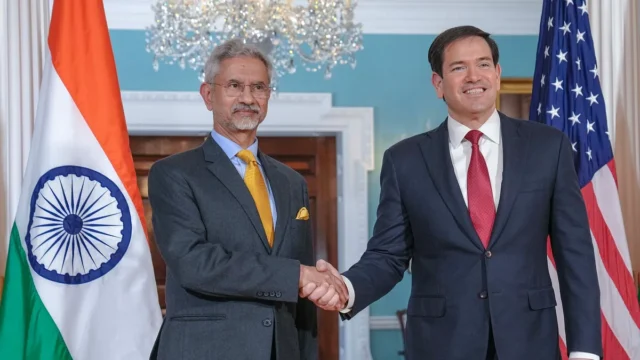
Rubio in Mumbai: India–US trade deal ‘very, very close’; energy and defence on the table
US Secretary of State Marco Rubio began his second India visit of the year in Mumbai on 20 October 2026 and met External Affairs Minister S. Jaishankar on trade, energy, technology and defence. Rubio said the two sides are ‘very, very close’ to a trade deal with ‘a small number of items left’, and praised India’s progress in diversifying energy supplies.
20 Oct 2026
AUSTRAHIND 2026: fifth India–Australia Army exercise begins in Thiruvananthapuram
The fifth edition of the India–Australia joint military exercise AUSTRAHIND began on 19 October 2026 at the Foreign Training Node, Thiruvananthapuram, and runs till 1 November. About 120 soldiers from each army will train for sub-conventional operations in island and coastal terrain under a UN Chapter VII mandate. For the first time, New Zealand has sent observers.
20 Oct 2026
India–New Zealand FTA enters into force: zero duty on all Indian exports from day one
The India–New Zealand Free Trade Agreement came into force on 20 October 2026. From day one, New Zealand charges no customs duty on any Indian export, the first time India has got full duty-free access on all tariff lines at entry into force. New Zealand has also committed to facilitate USD 20 billion of investment into India, while dairy, sugar and edible oils stay protected.
20 Oct 2026