
UPSC Prelims PYQs with explanations
Real questions from official papers, mapped to syllabus topics. Attempt each one; the answer and the reason appear instantly.
Consider the following pairs :
| Wetlands | Confluence of rivers
| 1. Harike Wetlands | Confluence of Beas and Satluj/Sutlej
| 2. Keoladeo Ghana National Park | Confluence of Banas and Chambal
| 3. Kolleru Lake | Confluence of Musi and Krishna
Which of the above pairs is/are correctly matched?
Answer (a) & explanation
Only pair 1 is correct (a). Harike wetland in Punjab formed behind a barrage at the confluence of the Beas and Sutlej. Keoladeo in Bharatpur lies at the confluence of the Gambhir and Banganga rivers, not the Banas and Chambal. Kolleru Lake in Andhra Pradesh lies between the Godavari and Krishna deltas, not at a Musi–Krishna meeting point.
All three are Ramsar sites. Keoladeo is also a UNESCO World Heritage Site and was once the winter home of the Siberian crane. Notice how many Indian wetlands owe their existence to rivers and even to human-made barrages.
Answer as per the official UPSC answer key.
Which one of the following is the correct sequence of a food chain?
Answer (a) & explanation
A food chain always starts with a producer. Diatoms are phytoplankton that make food by photosynthesis. Small crustaceans such as copepods graze on them, and herrings eat the crustaceans. So the order is Diatoms–Crustaceans–Herrings (a). Options (b), (c) and (d) put a consumer before the producer or reverse the order of eating.
Diatoms have glassy silica shells and produce a large share of the oxygen made in the oceans. Notice how energy shrinks at each step (roughly the 10% rule), which is why food chains rarely have more than four or five links.
Answer as per the official UPSC answer key.
There are seven persons up on a ladder, A, B, C, D, E, F and G (not in that order). A is further up than E but is lower than C. B is in the middle. G is between A and B. E is between B and F. If F is between E and D, the person on the bottom step of the ladder will be
Answer (c) & explanation
D is on the bottom step (c). Step 1: there are seven people, so the middle step is 4th. B is there. Step 2: E is between B and F, and F is between E and D. So below B the order runs B, E, F, D. That fills steps 4 to 7. Step 3: A is above E but below C, and G is between A and B. So above B the order runs C, A, G, B. Step 4: full order from top: C, A, G, B, E, F, D. The bottom step is D. Options (a), (b) and (d) are on steps 4, 6 and 5.
Tip: in ladder or row puzzles, start with the fixed position (here B in the middle), then attach the chains of "between" clues to it.
Answer as per the official UPSC answer key.
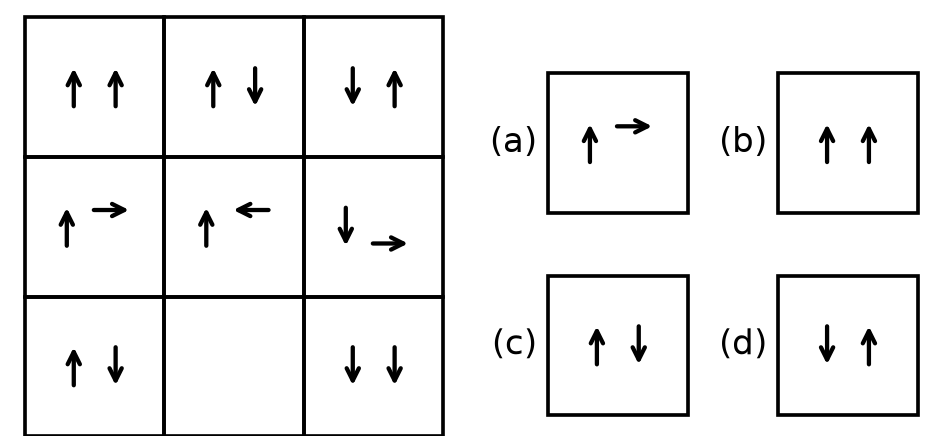
Consider the following matrix :
Which one of the following figures fits into the blank part of the above matrix ?
Answer (b) & explanation
1. Look down each column at the first (left) arrow: column 1 is always ↑, column 2 is always ↑, column 3 is always ↓. So the blank starts with ↑.
2. Look along each row at the second arrow: the middle box is the opposite of the two outer boxes (row 1: ↑ ↓ ↑; row 2: → ← →). Row 3 is ↓ ? ↓, so the middle one is ↑.
3. The blank is ↑ ↑, which is (b).
Answer as per the official UPSC answer key.
Read the passage
Passage - 2
Cynthia was a shy girl. She believed that she was plain and untalented. One day her teacher ordered the entire class to show up for audition for the school play. Cynthia nearly died of fright when she was told that she would have to stand on stage in front of the entire class and deliver dialogues. The mere thought of it made her feel sick. But a remarkable transformation occurred during the audition. A thin, shy girl, her knees quaking, her stomach churning in terror, began to stun everyone with her excellent performance. Her bored classmates suddenly stopped their noisy chat to stare at her slender figure on the stage. At the end of her audition, the entire room erupted in thunderous applause.
Cynthia was afraid to stand on stage because
No official answer (question dropped) & notes
The answer is (c), she lacked self-confidence. UPSC did not evaluate the six English-only items of 2014 (Q70 to Q75), so this answer is for practice. Step 1: find the cause. "Cynthia was a shy girl. She believed that she was plain and untalented." Believing you have no talent is a lack of self-confidence, and that is why she feared the stage. Step 2: test the others. Option (a) is wrong: the passage never says she feared her classmates would laugh. Option (b) is wrong: her churning stomach was a result of her fear, not its cause. Option (d) is wrong: the passage does not say she disliked school plays.
Tip: separate the cause of a feeling from its symptoms. A churning stomach and shaking knees are symptoms; the cause is in what she believed about herself.
UPSC did not evaluate the six English-only items of 2014 (Q70 to Q75), so there is no official key. The answer given in the explanation is for practice.
UPSC dropped this question from evaluation; there is no official answer.
Which of the following are some important pollutants released by steel industry in India?
- 1. Oxides of sulphur
- 2. Oxides of nitrogen
- 3. Carbon monoxide
- 4. Carbon dioxide
Select the correct answer using the code given below.
Answer (d) & explanation
All four are released (d). Coke ovens and blast furnaces burn coal at high heat. Sulphur in the coal gives sulphur oxides; high temperatures produce nitrogen oxides; incomplete burning in the blast furnace yields carbon monoxide; and the whole process emits large amounts of carbon dioxide. Options that leave any of these out are incomplete.
Steel is one of India's largest industrial emitters. Cleaner routes include green hydrogen-based direct reduction, scrap-based electric arc furnaces and the Green Steel taxonomy released in 2024. Notice how industry, chemistry and climate policy meet in this one sector.
Answer as per the official UPSC answer key.
Which of the following is/are the function/functions of the Cabinet Secretariat?
- 1. Preparation of agenda for Cabinet Meetings
- 2. Secretarial assistance to Cabinet Committees
- 3. Allocation of financial resources to the Ministries
Select the correct answer using the code given below.
Answer (c) & explanation
The Cabinet Secretariat, under the Prime Minister and headed by the Cabinet Secretary, prepares the agenda for Cabinet meetings (1 correct) and provides secretarial assistance to Cabinet committees (2 correct). It also records and follows up decisions and coordinates between ministries. Allocation of financial resources (3) is done through the Budget by the Finance Ministry and Parliament, so the answer is (c).
The Cabinet Secretariat also administers the Government of India (Transaction of Business) Rules. Notice how it differs from the Prime Minister's Office, which advises the PM directly on policy.
Answer as per the official UPSC answer key.
What was/were the object/objects of Queen Victoria’s Proclamation (1858)?
- 1. To disclaim any intention to annex Indian States
- 2. To place the Indian administration under the British Crown
- 3. To regulate East India Company’s trade with India
Select the correct answer using the code given below.
Answer (a) & explanation
Queen Victoria's Proclamation, read at Allahabad on 1 November 1858, announced that the Crown had taken over India's government from the East India Company (2 correct). It promised to respect the princes' rights and give up annexation (1 correct), and not to interfere in religion. Statement 3 is wrong: the Company's trading role had already ended by the Charter Act of 1833. So the answer is (a).
The Government of India Act, 1858 created the post of Secretary of State for India. Notice how the 1857 revolt pushed Britain to end Doctrine of Lapse annexations and court the princes as allies.
Answer as per the official UPSC answer key.
There are 50 students admitted to a nursery class. Some students can speak only English and some can speak only Hindi. 10 students can speak both English and Hindi. If the number of students who can speak English is 21, then how many students can speak Hindi, how many can speak only Hindi and how many can speak only English ?
Answer (d) & explanation
The answer is 39, 29 and 11 (d). Step 1: 21 students speak English, and 10 of them also speak Hindi. So only English = 21 − 10 = 11. Step 2: everyone speaks at least one language. So all students except the "only English" ones speak Hindi: 50 − 11 = 39 Hindi speakers. Step 3: only Hindi = 39 − 10 = 29. Check: 11 + 10 + 29 = 50. Options (a), (b) and (c) fail this check.
Tip: draw two overlapping circles. Put the "both" number in the middle first, then fill the rest. The parts must add up to the total.
Answer as per the official UPSC answer key.
Read the passage
“Liberty, therefore, is never real unless the Government can be called to account when it invades rights.”
Which one of the following is the best justification of the above statement ?
Answer (d) & explanation
Liberty and restraint go together (d). Step 1: read the statement. "Liberty is never real unless the Government can be called to account when it invades rights." So freedom is real only when the power that could crush it is checked. Step 2: that means liberty needs restraints on power; the two are complementary, which is option (d) in UPSC's key. Step 3: test the others. Option (a) is close but names only one mechanism, a court case, not the underlying idea. Option (b) is wrong: singling a person out from other citizens is unrelated. Option (c) is wrong: decentralization and basic needs are not mentioned.
Tip: "best justification" asks for the principle behind a statement, not one example of it.
Answer as per the official UPSC answer key.
Which one of the following pairs of islands is separated from each other by the ‘Ten Degree Channel’?
Answer (a) & explanation
The Ten Degree Channel runs along about 10° N and separates Little Andaman from Car Nicobar, so it divides the Andaman group from the Nicobar group (a). The other pairs have their own channels: the Great Channel lies between Great Nicobar and Sumatra (b); the Eight Degree Channel separates Minicoy from the Maldives (c); and the Sunda Strait separates Sumatra from Java (d).
The Nine Degree Channel separates Minicoy from the main Lakshadweep islands. Notice how these channels sit on busy sea lanes towards the Malacca Strait, which is why they matter for India's maritime security and trade.
Answer as per the official UPSC answer key.
Consider the following pairs :
| Region often in news | Country
| 1. Chechnya | Russian Federation
| 2. Darfur | Mali
| 3. Swat Valley | Iraq
Which of the above pairs is/are correctly matched?
Answer (a) & explanation
Only pair 1 is correct (a). Chechnya is a republic of the Russian Federation in the North Caucasus, where two separatist wars were fought in the 1990s and 2000s. Darfur, scene of mass atrocities since 2003, is in western Sudan, not Mali. The Swat Valley, where the Pakistani Taliban were active and Malala Yousafzai was shot in 2012, is in Pakistan's Khyber Pakhtunkhwa, not Iraq.
Swat was also an old centre of Gandhara Buddhist culture. Notice how "places in news" questions reward a mental world map built steadily from current affairs.
Answer as per the official UPSC answer key.
Which of the following is/are the example/examples of chemical change?
- 1. Crystallization of sodium chloride
- 2. Melting of ice
- 3. Souring of milk
Select the correct answer using the code given below.
Answer (b) & explanation
Only the souring of milk is a chemical change (b): bacteria turn lactose into lactic acid, which curdles the milk protein casein, and the change cannot be reversed. Crystallisation of sodium chloride (1) and melting of ice (2) change only the physical state; the substance stays the same and the change can be undone.
Signs of a chemical change include a new substance, a change in colour or smell, gas given off, or heat released or absorbed. Rusting, burning and digestion are other examples. Notice how curd-making is everyday microbiology.
Answer as per the official UPSC answer key.
Which of the following are the discretionary powers given to the Governor of a State?
- 1. Sending a report to the President of India for imposing the President's rule
- 2. Appointing the Ministers
- 3. Reserving certain bills passed by the State Legislature for consideration of the President of India
- 4. Making the rules to conduct the business of the State Government
Select the correct answer using the code given below.
Answer (b) & explanation
The Governor uses personal discretion when sending a report to the President under Article 356 for President's rule (1 correct) and when reserving a Bill for the President's consideration under Article 200 (3 correct). So the answer is (b). Ministers are appointed on the Chief Minister's advice under Article 164, not at discretion. Rules of business are made under Article 166(3) on the advice of the Council of Ministers, not as a discretionary power.
Article 163 allows discretion only where the Constitution provides it. Notice how the Supreme Court in S.R. Bommai (1994) restricted misuse of Article 356.
Answer as per the official UPSC answer key.
Read the passage
It is often forgotten that globalization is not only about policies on international economic relationships and transactions, but has equally to do with domestic policies of a nation. Policy changes necessitated by meeting the internationally set conditions (by WTO etc.) of free trade and investment flows obviously affect domestic producers and investors. But the basic philosophy underlying globalization emphasizes absolute freedom to markets to determine prices and production and distribution patterns, and view government interventions as processes that create distortions and bring in inefficiency. Thus, public enterprises have to be privatized through disinvestments and sales; sectors and activities hitherto reserved for the public sector have to be opened to the private sector. This logic extends to the social services like education and health. Any restrictions on the adjustments in workforce by way of retrenchment of workers should also be removed and exit should be made easier by removing any restrictions on closures. Employment and wages should be governed by free play of market forces, as any measure to regulate them can discourage investment and also create inefficiency in production. Above all, in line with the overall philosophy of reduction in the role of the State, fiscal reforms should be undertaken to have generally low levels of taxation and government expenditure should be kept to the minimum to abide by the principle of fiscal prudence. All these are policy actions on the domestic front and are not directly related to the core items of the globalization agenda, namely free international flow of goods and finance.
According to the passage, under the globalization, government interventions are viewed as processes leading to
Answer (a) & explanation
Interventions are seen as causing distortions and inefficiency (a). Step 1: find the line. Globalization's philosophy views "government interventions as processes that create distortions and bring in inefficiency". Option (a) repeats it. Step 2: test the others. Option (b) is wrong: optimum use of resources is what free markets are said to achieve, not interventions. Option (c) is wrong: profitability of industries is not mentioned. Option (d) is wrong: free play of market forces is the alternative to intervention, the opposite.
Tip: when a question asks how something is "viewed" in a passage, look for the exact verb, here "view", and copy the phrase that follows.
Answer as per the official UPSC answer key.
Read the passage
The number of deaths among the army personnel is 8 in 1000, but among the civilian population it is 20 per 1000.
Which one of the following inferences can be drawn from this statement ?
Answer (d) & explanation
The two groups cannot be compared (d). Step 1: the data show 8 deaths per 1,000 in the army and 20 per 1,000 among civilians. Step 2: think about who is in each group. Soldiers are young, fit and medically screened. Civilians include babies, old people and the sick, who die at higher rates anyway. The groups are heterogeneous (very different), so the lower army death rate does not prove anything about army life. Step 3: test the others. Option (a) is wrong: it treats unlike groups as comparable. Option (b) is too vague. Option (c) is wrong: a Quality of Life index is not shown by death rates alone.
Tip: before comparing two rates, check whether the groups are alike in age and health.
Answer as per the official UPSC answer key.
Other than poaching, what are the possible reasons for the decline in the population of Ganges River Dolphins?
- 1. Construction of dams and barrages on rivers
- 2. Increase in the population of crocodiles in rivers
- 3. Getting trapped in fishing nets accidentally
- 4. Use of synthetic fertilizers and other agricultural chemicals in crop-fields in the vicinity of rivers.
Select the correct answer using the code given below.
Answer (c) & explanation
Dams and barrages fragment dolphin populations and reduce flow (1 correct). Dolphins drown as bycatch in fishing nets (3 correct), and farm chemicals washing into rivers poison their habitat (4 correct). Statement 2 is wrong: crocodile numbers are themselves low and crocodiles are not a cause of decline, so options (a), (b) and (d) fail.
The Ganges River Dolphin is India's national aquatic animal (2009) and is listed as Endangered. It is nearly blind and finds prey by echolocation. Project Dolphin (2020) and the Vikramshila Gangetic Dolphin Sanctuary in Bihar work for its protection. Notice how its health is a sign of the river's health.
Answer as per the official UPSC answer key.
Which one of the following pairs does not form part of the six systems of Indian Philosophy?
Answer (c) & explanation
The six astika darshanas, which accept the authority of the Vedas, are Sankhya, Yoga, Nyaya, Vaisheshika, Mimamsa and Vedanta. So options (a), (b) and (d) are all genuine pairs. Lokayata (Charvaka) was a materialist school that rejected the Vedas, and the Kapalikas were a Tantric Shaiva sect, not a system of philosophy, so (c) is the answer.
The darshanas are usually studied in pairs. The nastika schools that rejected Vedic authority include Charvaka, Buddhism, Jainism and Ajivika. Notice how this debate on authority and reason shaped Indian thought for centuries.
Answer as per the official UPSC answer key.
The 1929 Session of Indian National Congress is of significance in the history of the Freedom Movement because the
Answer (b) & explanation
At the Lahore session of December 1929, under Jawaharlal Nehru's presidency, the Congress adopted Purna Swaraj (complete independence) as its goal (b). It hoisted the tricolour on the banks of the Ravi on 31 December and fixed 26 January 1930 as Independence Day. Option (a) is wrong: self-government had been the goal much earlier. Non-Cooperation (c) began in 1920, and the Congress boycotted, not joined, the first Round Table Conference (d).
The session also authorised civil disobedience, launched with the Dandi March in 1930. Notice how 26 January later became Republic Day in honour of this pledge.
Answer as per the official UPSC answer key.
Consider that :
- 1. A is taller than B.
- 2. C is taller than A.
- 3. D is taller than C.
- 4. E is the tallest of all.
If they are made to sit in the above order of their height, who will occupy the mid position ?
Answer (c) & explanation
C sits in the middle (c). Step 1: write the order from the clues. A is taller than B, so A > B. C is taller than A, so C > A. D is taller than C, so D > C. E is the tallest of all. Step 2: full order from tallest to shortest: E, D, C, A, B. Step 3: five people means the middle seat is the 3rd. Counting from either end, the 3rd is C. Options (a), (b) and (d) are 4th, 5th and 2nd.
Tip: chain the comparisons into one line first. With an odd number of people, the middle is (n + 1) ÷ 2, here (5 + 1) ÷ 2 = 3.
Answer as per the official UPSC answer key.