
UPSC Prelims PYQs with explanations
Real questions from official papers, mapped to syllabus topics. Attempt each one; the answer and the reason appear instantly.
Read the passage
A country under foreign domination seeks escape from the present in dreams of a vanished age, and finds consolation in visions of past greatness. That is a foolish and dangerous pastime in which many of us indulge. An equally questionable practice for us in India is to imagine that we are still spiritually great though we have come down in the world in other respects. Spiritual or any other greatness cannot be founded on lack of freedom and opportunity, or on starvation and misery. Many western writers have encouraged that notion that Indians are other-worldly. I suppose the poor and unfortunate in every country become to some extent other-worldly, unless they become revolutionaries, for this world is evidently not meant for them. So also subject peoples.
As a man grows to maturity he is not entirely engrossed in, or satisfied with, the external objective world. He seeks also some inner meaning, some psychological and physical satisfactions. So also with peoples and civilizations as they mature and grow adult. Every civilization and every people exhibit these parallel streams of an external life and an internal life. Where they meet or keep close to each other, there is an equilibrium and stability. When they diverge conflict arises and the crises that torture the mind and spirit.
The passage mentions that “this world is evidently not meant for them”. It refers to people who
- 1. seek freedom from foreign domination.
- 2. live in starvation and misery.
- 3. become revolutionaries.
Which of the statements given above is/are correct ?
Answer (b) & explanation
Statement 2 only is correct (b). Step 1: find the sentence: 'the poor and unfortunate in every country become to some extent other-worldly, unless they become revolutionaries, for this world is evidently not meant for them'. So 'them' means the poor and unfortunate, people living in starvation and misery: statement 2. Step 2: statement 3 is wrong: revolutionaries are the exception ('unless'), not the people meant. Step 3: statement 1 is wrong: subject peoples are added only afterwards with 'So also'; they are compared, not referred to by 'them'. So (a), (c) and (d) fail.
Tip: for 'it refers to' questions, find the pronoun and trace it back to the nearest matching noun in the same sentence.
Answer as per the official UPSC answer key.
(Same information as the question above.)
Whose wife is the teacher?
Answer (d) & explanation
B's wife is correct (d). Step 1: the clue says 'The teacher was the wife of a lawyer who was the son of a doctor'. Step 2: from the earlier solution, D is the eldest and the doctor, and B, a male, is his son and the lawyer. Step 3: so the teacher is the wife of B. (a) C is the youngest, a child, not the lawyer. (b) D is the doctor, not the lawyer. (c) A is a female. So (a), (b) and (c) fail.
Tip: in family puzzles, chain the relationship words: teacher → wife of lawyer → lawyer is son of doctor. Each link narrows the field.
Answer as per the official UPSC answer key.
The Constitution (Seventy-Third Amendment) Act, 1992, which aims at promoting the Panchayati Raj Institutions in the country, provides for which of the following ?
- 1. Constitution of District Planning Committees.
- 2. State Election Commissions to conduct all panchayat elections.
- 3. Establishment of State Finance Commissions.
Select the correct answer using the codes given below :
Answer (d) & explanation
UPSC's official key is (d), all three, but this key is doubtful. The 73rd Amendment (1992) clearly created State Election Commissions to conduct all panchayat elections (Article 243K, statement 2) and State Finance Commissions, set up every five years to review panchayat finances (Article 243I, statement 3). Statement 1 is the problem: District Planning Committees sit in Article 243ZD, in Part IXA on municipalities, inserted by the 74th Amendment. The official key counts them because DPCs consolidate the plans of panchayats too, so many books argue (c). For the exam, follow the official key, but know the article numbers.
Notice the related items: the 73rd Amendment added the Eleventh Schedule (29 subjects), a five-year term (243E) and one-third reservation for women (243D). National Panchayati Raj Day is 24 April.
Official UPSC key: (d). Some sources print (c); we follow the official key.
Answer as per the official UPSC answer key.
When the annual Union Budget is *not* passed by the Lok Sabha,
Answer (d) & explanation
The Prime Minister resigns is correct (d). Defeat of the Budget in the Lok Sabha means the government has lost the House's confidence, since money bills are central to governing. Under Article 75(3) the Council of Ministers is collectively responsible to the Lok Sabha, so the Prime Minister must resign with the whole ministry. (a) is wrong: there is no simple re-presentation. (b) is wrong: the Rajya Sabha has only a 14-day recommending role on money bills and cannot rescue a defeated budget. (c) is wrong: responsibility is collective, not of one minister.
Notice the related devices: a cut motion (policy cut, economy cut, token cut) that passes is also treated as a defeat of the government.
Answer as per the official UPSC answer key.
The “Red Data Books” published by the International Union for Conservation of Nature and Natural Resources (IUCN) contain lists of
- 1. Endemic plant and animal species present in the biodiversity hotspots.
- 2. Threatened plant and animal species.
- 3. Protected sites for conservation of nature and natural resources in various countries.
Select the correct answer using the codes given below :
Answer (b) & explanation
Statement 2 only is correct (b). The Red Data Book, now the IUCN Red List, records species at risk of extinction, sorted into categories: Critically Endangered, Endangered and Vulnerable (together 'threatened'), plus Near Threatened, Least Concern, Extinct in the Wild and Extinct. Statement 1 is wrong: it does not list endemic species of hotspots as such; endemics appear only if they are assessed for risk. Statement 3 is wrong: protected sites are listed in the World Database on Protected Areas, not the Red List. So (a), (c) and (d) fail.
Notice the colour code: the old books used pink pages for critically endangered species and green pages for those once endangered but now safe. Trap: hotspots and protected areas are different conservation lists.
Answer as per the official UPSC answer key.
Read the passage
The concept of ‘creative society’ refers to a phase of development of a society in which a large number of potential contradictions become articulate and active. This is most evident when oppressed social groups get politically mobilised and demand their rights. The upsurge of the peasants and tribals, the movements for regional autonomy and self-determination, the environmental movements, and the women’s movements in the developing countries are signs of emergence of creative society in contemporary times. The forms of social movements and their intensity may vary from country to country and place to place within a country. But the very presence of movements for social transformation in various spheres of a society indicates the emergence of a creative society in a country.
What does the author imply by “creative society” ?
- 1. A society where diverse art forms and literary writings seek incentive.
- 2. A society where social inequalities are accepted as the norm.
- 3. A society where a large number of contradictions are recognised.
- 4. A society where the exploited and the oppressed groups grow conscious of their human rights and upliftment.
Select the correct answer using the codes given below :
Answer (c) & explanation
Items 3 and 4 are correct (c). Step 1: the passage defines a creative society as one where 'a large number of potential contradictions become articulate and active'. That matches item 3. Step 2: it says this is most evident 'when oppressed social groups get politically mobilised and demand their rights'. That matches item 4. Step 3: check the traps. Item 1 picks up the word 'creative' and talks about art and literature, which the passage never mentions. Item 2 says inequalities are accepted, but the passage says they are challenged. So (a), (b) and (d) fail.
Tip: watch for options that play on the everyday meaning of a word. Here 'creative' does not mean artistic; the passage gives its own meaning.
Answer as per the official UPSC answer key.
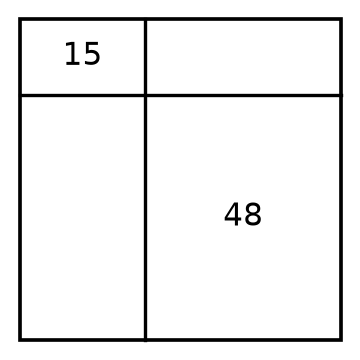
Consider the following figure and answer the item that follows:
A square is divided into four rectangles as shown above. The lengths of the sides of rectangles are natural numbers. The areas of two rectangles are indicated in the figure. What is the length of each side of the square?
Answer (b) & explanation
1. Call the side of the square s. The '15' box is a wide by b tall; the '48' box is then (s − a) wide by (s − b) tall.
2. Whole-number sides for 15: 1 × 15 or 3 × 5.
3. Try 3 and 5 with s = 11: the other box is (11 − 5) × (11 − 3) = 6 × 8 = 48. It fits.
4. Check the other options: s = 10 gives 5 × 7 = 35, not 48; s = 15 gives 10 × 12 = 120 (or 0 if 1 × 15 is used). Neither fits.
5. So each side is 11.
Answer as per the official UPSC answer key.
Read the passage
In spring, polar bear mothers emerge from dens with three month old cubs. The mother bear has fasted for as long as eight months but that does not stop the young from demanding full access to her remaining reserves. If there are triplets, the most persistent stands to gain an extra meal and it may have the meal at the expense of others. The smallest of the litter forfeits many meals to stronger siblings. Females are protective of their cubs but tend to ignore family rivalry over food. In 21 years of photographing polar bears, I’ve only once seen the smallest of triplets survive till autumn.
Female polar bears give birth during
Answer (d) & explanation
Winter is correct (d). Step 1: the passage says 'In spring, polar bear mothers emerge from dens with three month old cubs'. Step 2: if the cubs are three months old in spring, they were born about three months earlier, which is winter: (d). Step 3: (a) spring is when they come out of the den, not when they are born. (b) and (c), summer and autumn, do not fit the timeline. So (a), (b) and (c) fail.
Tip: when a passage gives an age at a certain time, count backwards. The emergence date is not the birth date.
Answer as per the official UPSC answer key.
In the context of ecosystem productivity, marine upwelling zones are important as they increase the marine productivity by bringing the
- 1. decomposer microorganisms to the surface.
- 2. nutrients to the surface.
- 3. bottom-dwelling organisms to the surface.
Which of the statements given above is/are correct ?
Answer (b) & explanation
Only statement 2 is correct (b). In upwelling zones, winds push surface water away from the coast, and cold, deep water rises to replace it. This deep water is rich in nutrients such as nitrates and phosphates (2). In the sunlit surface, these nutrients cause phytoplankton blooms, which feed zooplankton and fish, making upwelling zones among the most productive fisheries. Statements 1 and 3 are wrong: upwelling does not specially bring up decomposers or bottom-dwelling organisms. So options (a), (c) and (d) fail.
Notice the famous examples: the coasts of Peru (Humboldt current, anchovy fishery), Namibia (Benguela), California and northwest Africa, and in India the Kerala coast during the monsoon, which supports oil sardine catches. During El Niño, upwelling off Peru weakens, and fish catches collapse. Upwelling zones cover about 1% of the ocean but give a large share of the world's fish. Trap: nutrients, not organisms, are lifted.
Answer as per the official UPSC answer key.
India maintained its early cultural contacts and trade links with Southeast Asia across the Bay of Bengal. For this pre-eminence of early maritime history of Bay of Bengal, which of the following could be the most convincing explanation/explanations ?
Answer (c) & explanation
Monsoon winds is correct (c). The monsoon winds reverse with the seasons: the south-west monsoon carries ships east towards Southeast Asia, and the north-east monsoon brings them back. Sailors timed voyages to these winds, which made the Bay of Bengal a regular, busy sea route from Tamralipti and the Coromandel coast to Suvarnabhumi. (a) is wrong: there is no proof that India's ship-building was better than others'. (b) is wrong: patronage helped, but 'always' overstates it, and it explains less than geography. (d) fails because (a) and (b) are weak.
Notice the legacy: Indian scripts, Hindu-Buddhist temples such as Angkor Wat and Borobudur, and the Chola expedition to Srivijaya (1025). Trap: human factors sound weighty, but the wind made it possible.
Answer as per the official UPSC answer key.
Between India and East Asia, the navigation-time and distance can be greatly reduced by which of the following ?
- 1. Deepening the Malacca straits between Malaysia and Indonesia.
- 2. Opening a new canal across the Kra isthmus between the Gulf of Siam and Andaman Sea.
Which of the statements given above is/are correct ?
Answer (b) & explanation
Statement 2 only is correct (b). A canal across the Kra Isthmus in southern Thailand would link the Andaman Sea with the Gulf of Thailand (Siam), letting ships skip the long loop around the Malay Peninsula through Singapore and save about 1,000 km and two to three days (2). Statement 1 is wrong: deepening the Strait of Malacca would let bigger ships pass but would not shorten the route. So (a), (c) and (d) fail.
Notice the current plan: Thailand has discussed a 'Land Bridge' of ports, road and rail across Ranong and Chumphon instead of a canal. The Malacca Strait carries about a quarter of world trade, and China calls its dependence on it the 'Malacca dilemma'. Trap: deeper is not shorter.
Answer as per the official UPSC answer key.
Read the passage
Ecosystems provide people with a variety of goods and services; food, clean water, clean air, flood control, soil stabilization, pollination, climate regulation, spiritual fulfilment and aesthetic enjoyment, to name just a few. Most of these benefits either are irreplaceable or the technology necessary to replace them is prohibitively expensive. For example, potable fresh water can be provided by desalinating sea-water, but only at great cost.
The rapidly expanding human population has greatly modified the Earth’s ecosystems to meet their increased requirements of some of the goods and services, particularly food, fresh water, timber, fibre and fuel. These modifications have contributed substantially to human well being and economic development. The benefits have not been equally distributed. Some people have actually been harmed by these changes. Moreover, short-term increases in some ecosystem goods and services have come at the cost of the long-term degradation of others. For example, efforts to increase the production of food and fibre have decreased the ability of some ecosystems to provide clean water, regulate flooding and support biodiversity.
With reference to the passage, consider the following statements.
Expanding human population has an adverse effect on :
- 1. Spiritual fulfilment
- 2. Aesthetic enjoyment
- 3. Potable fresh water
- 4. Production of food and fibre
- 5. Biodiversity
Which of the statements given above are correct ?
Answer (c) & explanation
Items 3 and 5 are correct (c). Step 1: the passage says efforts to increase food and fibre 'have decreased the ability of some ecosystems to provide clean water, regulate flooding and support biodiversity'. That gives items 3 and 5. Step 2: check item 4. Production of food and fibre actually rose; it was the cause, not the victim. Step 3: check items 1 and 2. Spiritual fulfilment and aesthetic enjoyment appear only in the opening list of services; the passage never says population growth harmed them. So (a), (b) and (d) fail.
Tip: a word appearing in the passage is not enough. Check whether the passage says what the option claims about it.
Answer as per the official UPSC answer key.
A student on her first 3 tests received an average score of N points. If she exceeds her previous average score by 20 points on her fourth test, then what is the average score for the first 4 tests?
Answer (d) & explanation
N + 5 is correct (d). Step 1: the first three tests total 3N. Step 2: the fourth score is N + 20. The new total is 3N + N + 20 = 4N + 20. Step 3: the new average = (4N + 20) ÷ 4 = N + 5. In simple words, the extra 20 points are shared over four tests, adding 5 to the average. So (a), (b) and (c) fail.
Tip: when one new value is above the old average, the average rises by (excess ÷ new count). Here 20 ÷ 4 = 5.
Answer as per the official UPSC answer key.
In the Union Budget 2011-12, a full exemption from the basic customs duty was extended to the bio-based asphalt (bioasphalt). What is the importance of this material ?
- 1. Unlike traditional asphalt, bioasphalt is not based on fossil fuels.
- 2. Bioasphalt can be made from non-renewable resources.
- 3. Bioasphalt can be made from organic waste materials.
- 4. It is eco-friendly to use bioasphalt for surfacing of the roads.
Which of the statements given above are correct ?
Answer (b) & explanation
Statements 1, 3 and 4 are correct (b). Bioasphalt is a road binder made from renewable plant matter such as sugar, molasses, vegetable oils, starch and lignin, or from organic waste, instead of petroleum bitumen. So it is not based on fossil fuels (1), can come from waste (3), and is eco-friendly for surfacing roads because it cuts fossil fuel use and emissions (4). Statement 2 is the trap: bioasphalt is made from renewable, not non-renewable, resources. So options (a), (c) and (d) fail.
Notice the wider idea: India pushes waste-to-road technology too, such as plastic waste roads (pioneered by R. Vasudevan) and lignin-based bio-bitumen developed by CSIR. Trap: one word, 'non-renewable', flips statement 2.
Answer as per the official UPSC answer key.
In India, if a religious sect/community is given the status of a national minority, what special advantages it is entitled to ?
- 1. It can establish and administer exclusive educational institutions.
- 2. The President of India automatically nominates a representative of the community to Lok Sabha.
- 3. It can derive benefits from the Prime Minister’s 15-Point Programme.
Which of the statements given above is/are correct ?
Answer (c) & explanation
Statements 1 and 3 are correct (c). Article 30 lets religious and linguistic minorities establish and administer their own educational institutions (1). Notified minorities also benefit from the Prime Minister's New 15-Point Programme (2006) for scholarships, credit and jobs (3). Statement 2 is wrong: the President never nominates a member of a religious minority to the Lok Sabha. The only nomination was for Anglo-Indians (Article 331), and it ended in January 2020 under the 104th Amendment. So (a), (b) and (d) fail.
Notice the list: six communities are notified under the NCM Act, 1992: Muslims, Christians, Sikhs, Buddhists, Parsis and Jains (added 2014). Trap: 'automatically nominates' sounds plausible but has no basis.
Answer as per the official UPSC answer key.
Mahatma Gandhi said that some of his deepest convictions were reflected in a book titled, “Unto this Last” and the book transformed his life. What was the message from the book that transformed Mahatma Gandhi ?
Answer (b) & explanation
The good of the individual is contained in the good of all is correct (b). Gandhi read John Ruskin's 'Unto This Last' on a train journey in 1904 and drew three lessons: the good of the individual is in the good of all; a lawyer's work has the same value as a barber's; and a life of labour is the life worth living. He set up the Phoenix Settlement near Durban and later paraphrased the book in Gujarati as 'Sarvodaya'. (a) and (c) are not the book's message, so (d) fails too.
Notice the other influences: Tolstoy's 'The Kingdom of God Is Within You' (Tolstoy Farm, 1910) and Thoreau's 'Civil Disobedience'. Trap: celibacy and service sound Gandhian but come from other sources.
Answer as per the official UPSC answer key.
Under the Constitution of India, which one of the following is *not* a fundamental duty ?
Answer (a) & explanation
To vote in public elections is correct (a), as it is not a fundamental duty. The Fundamental Duties in Article 51A (Part IVA, added by the 42nd Amendment, 1976, on the Swaran Singh Committee's advice) include abiding by the Constitution and respecting its ideals (d), developing scientific temper (b) and safeguarding public property (c). Voting is a constitutional and statutory right under Article 326 and the RP Act, not a listed duty. So (b), (c) and (d) are duties.
Notice the count: there are 11 duties; the 11th, parents providing education to children aged 6 to 14, came by the 86th Amendment (2002). The duties are not enforceable by courts. Trap: voting feels like a civic duty, but it is not in 51A.
Answer as per the official UPSC answer key.
Read the passage
A country under foreign domination seeks escape from the present in dreams of a vanished age, and finds consolation in visions of past greatness. That is a foolish and dangerous pastime in which many of us indulge. An equally questionable practice for us in India is to imagine that we are still spiritually great though we have come down in the world in other respects. Spiritual or any other greatness cannot be founded on lack of freedom and opportunity, or on starvation and misery. Many western writers have encouraged that notion that Indians are other-worldly. I suppose the poor and unfortunate in every country become to some extent other-worldly, unless they become revolutionaries, for this world is evidently not meant for them. So also subject peoples.
As a man grows to maturity he is not entirely engrossed in, or satisfied with, the external objective world. He seeks also some inner meaning, some psychological and physical satisfactions. So also with peoples and civilizations as they mature and grow adult. Every civilization and every people exhibit these parallel streams of an external life and an internal life. Where they meet or keep close to each other, there is an equilibrium and stability. When they diverge conflict arises and the crises that torture the mind and spirit.
Consider the following assumptions :
- 1. A country under foreign domination cannot indulge in spiritual pursuit.
- 2. Poverty is an impediment in the spiritual pursuit.
- 3. Subject peoples may become other-worldly.
With reference to the passage, which of the above assumptions is/are valid ?
Answer (c) & explanation
Assumptions 2 and 3 are valid (c). Step 1: the passage says 'spiritual or any other greatness cannot be founded on ... starvation and misery'. So poverty blocks spiritual pursuit: assumption 2. Step 2: after describing how the poor turn other-worldly, it adds 'So also subject peoples'. So subject peoples may become other-worldly: assumption 3. Step 3: assumption 1 is wrong: the passage says a dominated country does seek consolation in visions of past spiritual greatness, so it does indulge in such pursuits; 'cannot' is too strong. So (a), (b) and (d) fail.
Tip: 'cannot' is an absolute. If the passage shows people doing something, even foolishly, 'cannot' fails.
Answer as per the official UPSC answer key.
In a survey regarding a proposed measure to be introduced, 2878 persons took part of which 1652 were males. 1226 persons voted against the proposal of which 796 were males. 1425 persons voted for the proposal. 196 females were undecided.
How many females voted for the proposal?
Answer (b) & explanation
600 is correct (b). Step 1: females in the survey = 2,878 − 1,652 = 1,226. Step 2: females who voted against = total against − males against = 1,226 − 796 = 430. Step 3: 196 females were undecided. So females who voted for = 1,226 − 430 − 196 = 600. So (a), (c) and (d) fail.
Tip: build a small table with rows Male/Female and columns For/Against/Undecided. Fill in what is given, and every missing cell comes from simple subtraction.
Answer as per the official UPSC answer key.
Two important rivers -- one with its source in Jharkhand (and known by a different name in Odisha), and another, with its source in Odisha - merge at a place only a short distance from the coast of Bay of Bengal before flowing into the sea. This is an important site of wildlife and biodiversity and a protected area. Which one of the following could be this ?
Answer (a) & explanation
The answer is (a), Bhitarkanika. The Brahmani river rises in Jharkhand as the South Koel and Sankh, which join at Vedvyas near Rourkela, and is called the Brahmani in Odisha. The Baitarani rises in the Keonjhar hills of Odisha. The two meet near the coast in the Dhamra estuary region, forming the delta where Bhitarkanika lies. Bhitarkanika is a national park and Ramsar site with India's second-largest mangrove forest, famous for saltwater crocodiles, including some of the largest recorded. Chandipur-on-sea (b) is a beach and missile-test site, Gopalpur-on-sea (c) is a southern beach, and Simlipal (d) is an inland tiger reserve in Mayurbhanj.
Notice the nearby feature: Gahirmatha beach, next to Bhitarkanika, is among the world's largest nesting sites for Olive Ridley turtles. Trap: Simlipal is a protected area in Odisha but lies far from the coast.
Answer as per the official UPSC answer key.