
UPSC Prelims PYQs with explanations
Real questions from official papers, mapped to syllabus topics. Attempt each one; the answer and the reason appear instantly.
Read the passage
The Himalayan ecosystem is highly vulnerable to damage, both due to geological reasons and on account of the stress caused by increased pressure of population, exploitation of natural resources and other related challenges. These aspects may be exacerbated due to the impact of climate change. It is possible that climate change may adversely impact the Himalayan ecosystem through increased temperature, altered precipitation patterns, episodes of drought and biotic influences. This would not only impact the very sustenance of the indigenous communities in uplands but also the life of downstream dwellers across the country and beyond. Therefore, there is an urgent need for giving special attention to sustain the Himalayan ecosystem. This would require conscious efforts for conserving all the representative systems.
Further, it needs to be emphasized that the endemics with restricted distribution, and most often with specialized habitat requirements, are among the most vulnerable elements. In this respect the Himalayan biodiversity hotspot, with rich endemic diversity, is vulnerable to climate change. The threats include possible loss of genetic resources and species, habitats and concomitantly a decrease in ecosystem services. Therefore, conservation of endemic elements in representative ecosystems/habitats assumes a great significance while drawing conservation plans for the region.
Towards achieving the above, we will have to shift toward contemporary conservation approaches, which include a paradigm of landscape level interconnectivity between protected area systems. The concept advocates a shift from the species-habitat focus to an inclusive focus on expanding the biogeographic range so that natural adjustments to climate change can proceed without being restrictive.
What is the most important message conveyed by the passage ?
Answer (b) & explanation
The main message is to conserve biogeographic ranges, not just species or habitats (b). Step 1: see where the passage ends. It builds to "a shift from the species-habitat focus to an inclusive focus on expanding the biogeographic range". That is its conclusion. Step 2: test the others. Option (a) is wrong: endemism is a supporting detail. Option (c) is wrong: climate change harming the Himalaya is the starting point, not the message. Option (d) is wrong: it overstates the text; the passage says communities' sustenance will be impacted, not that they will have none.
Tip: in long passages, the last paragraph often holds the main message, especially when it begins "Towards achieving the above".
Answer as per the official UPSC answer key.
In a group of six women there are four dancers, four vocal musicians, one actress and three violinists. Girija and Vanaja are among the violinists while Jalaja and Shailaja do not know how to play on the violin. Shailaja and Tanuja are among the dancers. Jalaja, Vanaja, Shailaja and Tanuja are all vocal musicians and two of them are also violinists. If Pooja is an actress, who among the following is certainly a dancer and a violinist ?
Answer (d) & explanation
Tanuja is certainly a dancer and a violinist (d). Step 1: the four vocal musicians are Jalaja, Vanaja, Shailaja and Tanuja, and two of them play the violin. Step 2: Jalaja and Shailaja do not play the violin. So the two violinists among them must be Vanaja and Tanuja. Step 3: Tanuja is also among the dancers. So she is certainly both. Option (a) is wrong: Jalaja does not play the violin. Option (b) is wrong: Pooja is the actress, with no sure link to violin. Option (c) is wrong: Shailaja is a dancer but not a violinist.
Tip: use the "two of them" clue with the "do not" clue. Removing who cannot be in a group often leaves exactly who must be.
Answer as per the official UPSC answer key.
Consider the following diseases :
- 1. Diphtheria
- 2. Chickenpox
- 3. Smallpox
Which of the above diseases has/have been eradicated in India?
Answer (b) & explanation
Only smallpox has been eradicated (b). India's last case was in 1975, and WHO certified global eradication in 1980, the first disease ever wiped out. Diphtheria still breaks out where vaccine coverage is low, and chickenpox remains common, so options with 1 or 2 fail.
India was declared polio-free in 2014; that is regional elimination, since wild polio still exists in a few countries. Among animal diseases, rinderpest was eradicated in 2011. Notice the language: eradication is worldwide and permanent, elimination is national or regional. The DPT vaccine in the Universal Immunisation Programme protects against diphtheria.
Answer as per the official UPSC answer key.
Consider the following rivers :
- 1. Barak
- 2. Lohit
- 3. Subansiri
Which of the above flows/flow through Arunachal Pradesh?
Answer (b) & explanation
The Lohit and Subansiri flow through Arunachal Pradesh to join the Brahmaputra, so the answer is (b). The Barak rises in the Manipur hills, flows through Manipur, Mizoram and Assam's Cachar region, and enters Bangladesh as the Surma–Meghna, so options with 1 fail.
The Subansiri is the largest tributary of the Brahmaputra and hosts the Subansiri Lower hydroelectric project. The Lohit carries the Dhola–Sadiya (Bhupen Hazarika) bridge across it. Notice how hydropower in Arunachal links river geography to energy security and relations with China upstream.
Answer as per the official UPSC answer key.
Consider the following statements regarding ‘Earth Hour’ :
- 1. It is an initiative of UNEP and UNESCO.
- 2. It is a movement in which the participants switch off the lights for one hour on a certain day every year.
- 3. It is a movement to raise the awareness about the climate change and the need to save the planet.
Which of the statements given above is/are correct?
Answer (c) & explanation
Earth Hour was started by WWF in Sydney in 2007, not by UNEP or UNESCO, so statement 1 is wrong. People switch off non-essential lights for one hour on a set day each year, usually the last Saturday of March (2 correct), to raise awareness about climate change and protecting the planet (3 correct). So the answer is (c).
It has grown into one of the world's largest grassroots environmental events, with landmarks such as the Eiffel Tower and India Gate going dark. Notice how symbolic actions build public will, the same idea behind India's Mission LiFE (Lifestyle for Environment).
Answer as per the official UPSC answer key.
A group of 630 children is seated in rows for a group photo session. Each row contains three less children than the row in front of it. Which one of the following number of rows is not possible ?
Answer (d) & explanation
1. Try each option by writing the rows out (each row has 3 fewer than the one in front).
2. 3 rows: 213 + 210 + 207 = 630. Works.
3. 4 rows: 162 + 159 + 156 + 153 = 630. Works.
4. 5 rows: 132 + 129 + 126 + 123 + 120 = 630. Works.
5. 6 rows: the average row would be 630 ÷ 6 = 105, so the two middle rows would be 106·5 and 103·5. Half a child is impossible, so 6 rows cannot be done.
Answer as per the official UPSC answer key.
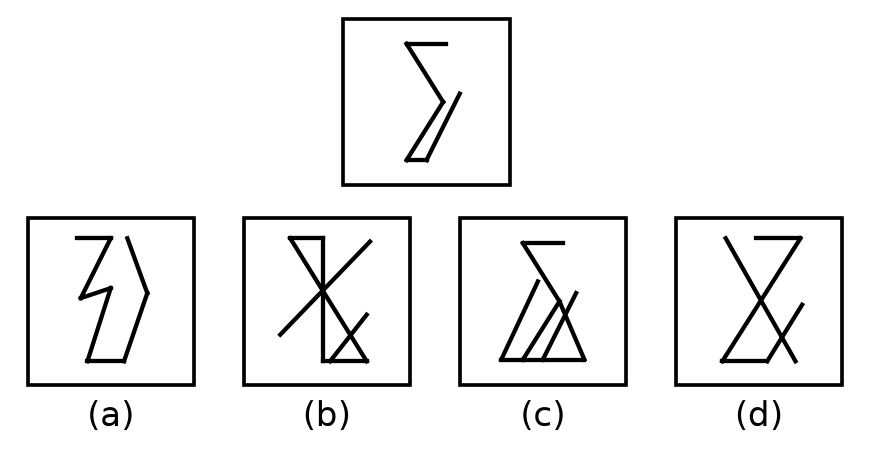
Examine the following figure :
Which one of the following figures has the above figure embedded in it ?
Answer (c) & explanation
The figure is hidden inside (c) (c). Step 1: note the parts of the given shape: a short top line, a bend pointing right, a short bottom line, and a slanting line going up from the bottom. Step 2: look for all four parts, in the same size and same direction, inside each option. In figure (c) they all appear together; the extra lines only add small triangles at the bottom. Step 3: in (a), (b) and (d), the bend or the top line is missing or turned, so the shape is not there.
Tip: for embedded-figure questions, pick the most unusual part of the shape, here the bend, and hunt for it first. The figure must not be rotated or resized.
Answer as per the official UPSC answer key.
Read the passage
Directions : The following six items are based on two passages in English to test the comprehension of English language and therefore these items do not have Hindi version. Read each passage and answer the items that follow.
Passage - 1
In front of us was walking a bare-headed old man in tattered clothes. He was driving his beasts. They were all laden with heavy loads of clay from the hills and looked tired. The man carried a long whip which perhaps he himself had made. As he walked down the road he stopped now and then to eat the wild berries that grew on bushes along the uneven road. When he threw away the seeds, the bold birds would fly to peck at them. Sometimes a stray dog watched the procession philosophically and then began to bark. When this happened, my two little sons would stand still holding my hands firmly. A dog can sometimes be dangerous indeed.
The expression "a stray dog watched the procession philosophically" means that
No official answer (question dropped) & notes
The answer is (b), the dog stood aloof, watching seriously. UPSC did not evaluate the six English-only items of 2014 (Q70 to Q75), so this answer is for practice. Step 1: understand the word. "Philosophically" here means calmly, thoughtfully, as if from a distance, the way a philosopher might watch the world. Step 2: test the others. Option (a) is wrong: the dog was not restless while watching; it barked only afterwards ("and then began to bark"). Option (c) is wrong: "big, wondering eyes" suggests surprise, not calm thought. Option (d) is wrong: a dog with its eyes closed cannot watch.
Tip: for word-in-context questions, think of the everyday meaning of the word and check that it fits the sentence before and after. The order of events, watching and then barking, matters here.
UPSC did not evaluate the six English-only items of 2014 (Q70 to Q75), so there is no official key. The answer given in the explanation is for practice.
UPSC dropped this question from evaluation; there is no official answer.
If you travel through the Himalayas, you are likely to see which of the following plants naturally growing there?
- 1. Oak
- 2. Rhododendron
- 3. Sandalwood
Select the correct answer using the code given below.
Answer (a) & explanation
Oak (banj) and rhododendron (burans, the state tree of Uttarakhand) are typical of the Himalayan montane temperate forests, roughly 1,500–3,000 m (a). Sandalwood grows naturally in the dry deciduous forests of the Deccan, mainly Karnataka and Tamil Nadu, so options with 3 fail.
Himalayan vegetation changes with height: tropical forests in the foothills, then oak, chir and deodar, then fir and birch, then alpine meadows. Notice how altitude acts like latitude here: climbing a mountain is like travelling towards the poles. Oak forests also protect springs that hill villages depend on.
Answer as per the official UPSC answer key.
Which of the following are associated with 'Planning' in India?
- 1. The Finance Commission
- 2. The National Development Council
- 3. The Union Ministry of Rural Development
- 4. The Union Ministry of Urban Development
- 5. The Parliament
Select the correct answer using the code given below.
Answer (c) & explanation
Under the planning system of 2014, the Planning Commission drafted each Five-Year Plan, the National Development Council approved it, and Parliament discussed and adopted it. So 2 and 5 are correct (c). The Finance Commission shares taxes between the Centre and States and is not a planning body. UPSC did not count the Ministries of Rural and Urban Development, which carry plans out, as part of the planning machinery.
The NDC included the Prime Minister, Union Cabinet ministers and all Chief Ministers. Notice how NITI Aayog's Governing Council now plays a similar role of bringing the Centre and States together.
the Finance Commission handles money, so it looks like a planning body. Its job is tax devolution under Article 280.
Answer as per the official UPSC answer key.
A community of people called Manganiyars is well-known for their
Answer (b) & explanation
The Manganiyars of the Thar desert (Barmer and Jaisalmer) in Rajasthan are hereditary Muslim folk musicians of North-West India (b). They sing for their Hindu patron families at births and weddings, playing the bowed kamaicha and the khartal. The other options are wrong: they are not a martial tradition of the North-East (a), South Indian classical singers (c) or pietra dura craftsmen (d).
The Langas are a related musician community. Notice how the patron–musician bond shows the shared, syncretic culture of Rajasthan, which has carried folk music across generations.
Answer as per the official UPSC answer key.
Read the passage
It is essential that we mitigate the emissions of greenhouse gases and thus avoid some of the worst impacts of climate change that would take place in coming years and decades. Mitigation would require a major shift in the way we produce and consume energy. A shift away from overwhelming dependence on fossil fuels is now long overdue, but unfortunately, technological development has been slow and inadequate largely because government policies have not promoted investments in research and development, myopically as a result of relatively low prices of oil. It is now, therefore, imperative for a country like India treating the opportunity of harnessing renewable energy on a large scale as a national imperative. This country is extremely well endowed with solar, wind and biomass sources of energy. Where we have lagged, unfortunately, is in our ability to develop and to create technological solutions for harnessing these resources.
One particular trajectory for carrying out stringent mitigation of greenhouse gas emissions assessed by the Intergovernmental Panel on Climate Change (IPCC) clearly shows the need for ensuring that global emissions of greenhouse gases peak no later than 2015 and reduce rapidly thereafter. The cost associated with such a trajectory is truly modest and would amount, in the estimation of IPCC, to not more than 3 percent of the global GDP in 2030. In other words, the level of prosperity that the world would have reached without mitigation would at worst be postponed by a few months or a year at the most. This is clearly not a very high price to pay for protecting hundreds of millions of people from the worst risks associated with climate change. Any such effort, however, would require lifestyles to change appropriately also. Mitigation of greenhouse gas emissions is not a mere technological fix, and clearly requires changes in lifestyles and transformation of a country’s economic structure, whereby effective reduction in emissions is brought about, such as through the consumption of much lower quantities of animal protein. The Food and Agriculture Organization (FAO) has determined that the emissions from the livestock sector amount to 18 percent of the total. The reduction of emissions from this source is entirely in the hands of human beings, who have never questioned the impacts that their dietary habits of consuming more and more animal protein are bringing about. Mitigation overall has huge co-benefits, such as lower air pollution and health benefits, higher energy security and greater employment.
What is the essential message of the passage ?
Answer (b) & explanation
The essential message is that mitigation is imperative (b). Step 1: look at the opening and the flow. The passage begins, "It is essential that we mitigate the emissions of greenhouse gases", then shows the cost is modest (under 3% of global GDP in 2030) and lists the co-benefits. Step 2: test the others. Option (a) is wrong: dependence on fossil fuels is the problem described, not the message. Option (c) is wrong: R&D is one means to the goal. Option (d) is wrong: lifestyle change is also a means.
Tip: the "essential message" is the goal that every other point supports. Means and problems are supporting details.
Answer as per the official UPSC answer key.
A worker reaches his factory 3 minutes late if his speed from his house to the factory is 5 km/hr. If he walks at a speed of 6 km/hr, then he reaches the factory 7 minutes early. The distance of the factory from his house is
Answer (c) & explanation
The factory is 5 km away (c). Step 1: at 5 km/hr he is 3 minutes late; at 6 km/hr he is 7 minutes early. So the two journey times differ by 3 + 7 = 10 minutes, which is 1/6 hour. Step 2: time = distance ÷ speed. Distance ÷ 5 − distance ÷ 6 = 1/6. Step 3: distance ÷ 5 − distance ÷ 6 = distance ÷ 30. So distance ÷ 30 = 1/6, and distance = 5 km. Check: 5 km takes 60 minutes at 5 km/hr and 50 minutes at 6 km/hr, a 10-minute gap. Options (a), (b) and (d) fail the check.
Tip: "late" and "early" times add to give the gap between the two journeys.
the gap is 3 + 7, not 7 – 3. One trip is late and the other early.
Answer as per the official UPSC answer key.
If a wetland of international importance is brought under the ‘Montreux Record’, what does it imply?
Answer (a) & explanation
The Montreux Record (1990) is a register of Ramsar sites whose ecological character has changed, is changing or is likely to change because of human interference (a). Listed sites get priority conservation attention. Option (b) invents a 5-km legal ban; Ramsar sets no such rule. Option (c) describes a cultural angle that is not the purpose of the Record. Option (d) confuses Ramsar with UNESCO's World Heritage list.
In India, Keoladeo (Rajasthan) and Loktak (Manipur) are on the Record. Chilika was removed in 2002 after it recovered: a hopeful reminder that damaged wetlands can be healed.
Answer as per the official UPSC answer key.
Consider the following countries :
- 1. Denmark
- 2. Japan
- 3. Russian Federation
- 4. United Kingdom
- 5. United States of America
Which of the above are the members of the ‘Arctic Council’?
Answer (d) & explanation
The Arctic Council (1996, Ottawa Declaration) has eight members: Canada, Denmark (through Greenland), Finland, Iceland, Norway, Russia, Sweden and the USA. So 1, 3 and 5 are correct (d). Japan and the UK are only observers, so options with 2 or 4 fail.
India became an observer in 2013, along with China, Japan and others. India runs the Himadri research station in Svalbard and released an Arctic Policy in 2022. Notice how melting ice opens new shipping routes and resources, linking climate change to geopolitics and trade.
Answer as per the official UPSC answer key.
Consider the following pairs :
| Region | Well-known for the production of
| 1. Kinnaur | Areca nut
| 2. Mewat | Mango
| 3. Coromandel | Soya bean
Which of the above pairs is/are correctly matched?
Answer (d) & explanation
None of the pairs is correct (d). Kinnaur in Himachal Pradesh is known for apples, chilgoza pine nuts and grapes, not areca nut, which grows mainly in Karnataka, Kerala and Assam. Mewat, in Haryana and Rajasthan, is a dry region growing millets and mustard, not famous for mangoes. Soya bean is mainly a crop of Madhya Pradesh and Maharashtra, not the Coromandel coast, which is known for rice.
Madhya Pradesh is often called the "Soya State". Notice how crop geography follows climate and soil: temperate fruit in high valleys, oilseeds on the black soils of the Deccan.
Answer as per the official UPSC answer key.
Which of the following Kingdoms were associated with the life of the Buddha?
- 1. Avanti
- 2. Gandhara
- 3. Kosala
- 4. Magadha
Select the correct answer using the code given below.
Answer (c) & explanation
The Buddha's life centred on the middle Ganga plain. In Magadha he attained enlightenment at Bodh Gaya and was patronised by Bimbisara at Rajagriha. In Kosala he often stayed at Jetavana in Shravasti under King Prasenajit. So 3 and 4 are correct (c). There is no record of him travelling to Avanti (Ujjain) or Gandhara in the north-west, though Buddhism later spread to both.
Gandhara became a great centre of Buddhist art under the Kushanas. Notice how the sixteen mahajanapadas give the political backdrop to the rise of Buddhism and Jainism.
Answer as per the official UPSC answer key.
Read the passage
The Himalayan ecosystem is highly vulnerable to damage, both due to geological reasons and on account of the stress caused by increased pressure of population, exploitation of natural resources and other related challenges. These aspects may be exacerbated due to the impact of climate change. It is possible that climate change may adversely impact the Himalayan ecosystem through increased temperature, altered precipitation patterns, episodes of drought and biotic influences. This would not only impact the very sustenance of the indigenous communities in uplands but also the life of downstream dwellers across the country and beyond. Therefore, there is an urgent need for giving special attention to sustain the Himalayan ecosystem. This would require conscious efforts for conserving all the representative systems.
Further, it needs to be emphasized that the endemics with restricted distribution, and most often with specialized habitat requirements, are among the most vulnerable elements. In this respect the Himalayan biodiversity hotspot, with rich endemic diversity, is vulnerable to climate change. The threats include possible loss of genetic resources and species, habitats and concomitantly a decrease in ecosystem services. Therefore, conservation of endemic elements in representative ecosystems/habitats assumes a great significance while drawing conservation plans for the region.
Towards achieving the above, we will have to shift toward contemporary conservation approaches, which include a paradigm of landscape level interconnectivity between protected area systems. The concept advocates a shift from the species-habitat focus to an inclusive focus on expanding the biogeographic range so that natural adjustments to climate change can proceed without being restrictive.
With reference to the passage, the following assumptions have been made :
- 1. To maintain natural ecosystems, exploitation of natural resources should be completely avoided.
- 2. Not only anthropogenic but also natural reasons can adversely affect ecosystems.
- 3. Loss of endemic diversity leads to the extinction of ecosystems.
Which of the above assumptions is/are correct ?
Answer (b) & explanation
Only assumption 2 is valid (b). Step 1: test assumption 2. The passage says the Himalaya is vulnerable "both due to geological reasons and on account of the stress" from people. So both natural and human causes can harm ecosystems. 2 holds. Step 2: test assumption 1. The passage never says exploitation must be "completely avoided". That extreme word makes 1 wrong. Step 3: test assumption 3. Losing endemic species reduces ecosystem services; the passage never says ecosystems go extinct. So 3 is wrong. Options (a), (c) and (d) fail.
Tip: words like "completely", "always" and "never" make an assumption too strong unless the passage itself uses them.
Answer as per the official UPSC answer key.
The letters L, M, N, O, P, Q, R, S and T in their order are substituted by nine integers 1 to 9 but not in that order. 4 is assigned to P. The difference between P and T is 5. The difference between N and T is 3. What is the integer assigned to N ?
Answer (d) & explanation
N is 6 (d). Step 1: P is 4. The difference between P and T is 5, so T is 4 + 5 = 9 or 4 − 5 = −1. Only numbers 1 to 9 are allowed, so T = 9. Step 2: the difference between N and T is 3, so N is 9 + 3 = 12 or 9 − 3 = 6. 12 is too big, so N = 6. Options (a), (b) and (c) do not satisfy both differences.
Tip: a "difference" can go either way, plus or minus. Try both, then throw out any value outside the allowed range. Here the range 1 to 9 settles each step at once. The letter order L to T is just a distraction.
Answer as per the official UPSC answer key.
Which of the following phenomena might have influenced the evolution of organisms?
- 1. Continental drift
- 2. Glacial cycles
Select the correct answer using the code given below.
Answer (c) & explanation
Both shaped evolution (c). Continental drift split and joined landmasses, isolating populations and changing climates; Australia's marsupials evolved in isolation after it separated from Gondwana. Glacial cycles shifted habitats, cut off species in refuges and drove extinctions as well as new species. Options (a), (b) and (d) each leave out one real factor.
Isolation is a key driver of speciation, as Darwin's finches on the Galápagos show. Notice how a geography topic (plate tectonics and ice ages) becomes a biology answer: earth history and the history of life are told together.
Answer as per the official UPSC answer key.